If you want to know how long is a high school basketball court, the answer is exactly 84 feet long. Coupled with a standard width of 50 feet, this creates a total playing surface of 4,200 square feet. Whether you are a coach planning drills, a facility manager mapping out a new gymnasium, or a player looking to improve your game, knowing these dimensions helps you understand the space you have to work with.
Understanding court sizes is essential for fair play, proper athlete development, and accurate facility planning. At Elitecourt, we manufacture the materials that bring these spaces to life. While we do not install the courts, our synthetic acrylic sports court flooring provides the foundation for thousands of high school games. In this comprehensive guide, we will explore everything you need to know about high school basketball court dimensions, how they compare to other levels of play, and what makes the perfect playing surface.
The Exact Dimensions: How Long is a High School Basketball Court?
When asking how long is a high school basketball court, it helps to look at the governing bodies that set the rules. In the United States, the National Federation of State High School Associations (NFHS) outlines the specific regulations for high school athletics. According to their guidelines, a regulation high school court measures 84 feet in length and 50 feet in width.
This specific length creates a balanced environment for teenage athletes. It is long enough to encourage strategic transition plays and fast breaks, yet short enough to prevent excessive fatigue during a standard 32-minute game.
Why 84 Feet?
The 84-foot length is a stepping stone. Younger players in junior high often play on courts measuring 74 feet long, while college and professional athletes step up to 94-foot courts. The high school dimension bridges this gap. It allows developing players to build endurance and adapt to a larger playing surface without becoming overwhelmed by the massive scale of an NBA-sized arena.
Total Square Footage and Safety Zones
While the painted boundaries cover 4,200 square feet, the actual flooring area must be larger. Player safety is paramount, and athletes need room to decelerate when running out of bounds.
- Endlines (Baselines): Facilities should provide a minimum of 3 to 10 feet of unobstructed space behind the baskets.
- Sidelines: At least 3 to 10 feet of clearance is recommended along the sides for scorer’s tables, team benches, and referees.
- Total Recommended Area: When factoring in these safety zones, a standard high school gymnasium floor often requires upwards of 5,500 to 6,000 square feet of flooring material.
Transform Your Sports Facility Today!
Contact us for high-quality synthetic sports flooring material and elevate your space!
Breaking Down the Court Lines and Measurements
Knowing how long is a high school basketball court is just the beginning. The internal markings dictate how the game is played. High school courts feature specific lines that differ slightly from collegiate or professional setups.
The Three-Point Line
The three-point line is a crucial element of modern basketball. On a high school court, the three-point arc radiates 19 feet and 9 inches from the center of the basketball hoop. This distance challenges players to develop their shooting mechanics without forcing them to shoot from the deeper ranges seen in college (22 feet, 1.75 inches) or the NBA (23 feet, 9 inches).
The Free Throw Line
The free throw line distance remains consistent across nearly all levels of basketball. It sits exactly 15 feet from the backboard. However, its placement relative to the baseline is an interesting technical point. The free throw line is 19 feet from the baseline, ensuring that the spacing within the paint remains standardized.
The Key (The Paint)
The rectangular area under the basket is known as the key, the paint, or the free throw lane. On a high school court, the key is 12 feet wide. This width matches the college level but is narrower than the 16-foot width used in professional leagues. A narrower key allows for more post-play action and reduces the distance defenders need to cover near the basket.
The Center Circle and Half-Court Line
The half-court line divides the 84-foot court perfectly in half, resting at the 42-foot mark. In the middle of this line sits the center circle, which has a 6-foot radius (12-foot diameter). This is where every game begins with the opening tip-off.
Transform Your Sports Facility Today!
Contact us for high-quality synthetic sports flooring material and elevate your space!
High School vs. College vs. NBA: Sizing it Up
To truly appreciate the design of a high school facility, you must compare it to the courts used at higher levels of competition.
| Court Element | High School | College (NCAA) | Professional (NBA) |
|---|---|---|---|
| Court Length | 84 feet | 94 feet | 94 feet |
| Court Width | 50 feet | 50 feet | 50 feet |
| Three-Point Line | 19 ft, 9 in | 22 ft, 1.75 in | 23 ft, 9 in |
| Free Throw Line | 15 feet | 15 feet | 15 feet |
| Key Width | 12 feet | 12 feet | 16 feet |
As the table shows, the primary difference lies in the length of the court and the distance of the three-point arc. When high school players transition to college, they must adjust to running an extra 10 feet on every single possession.
The Role of Premium Flooring in High School Basketball
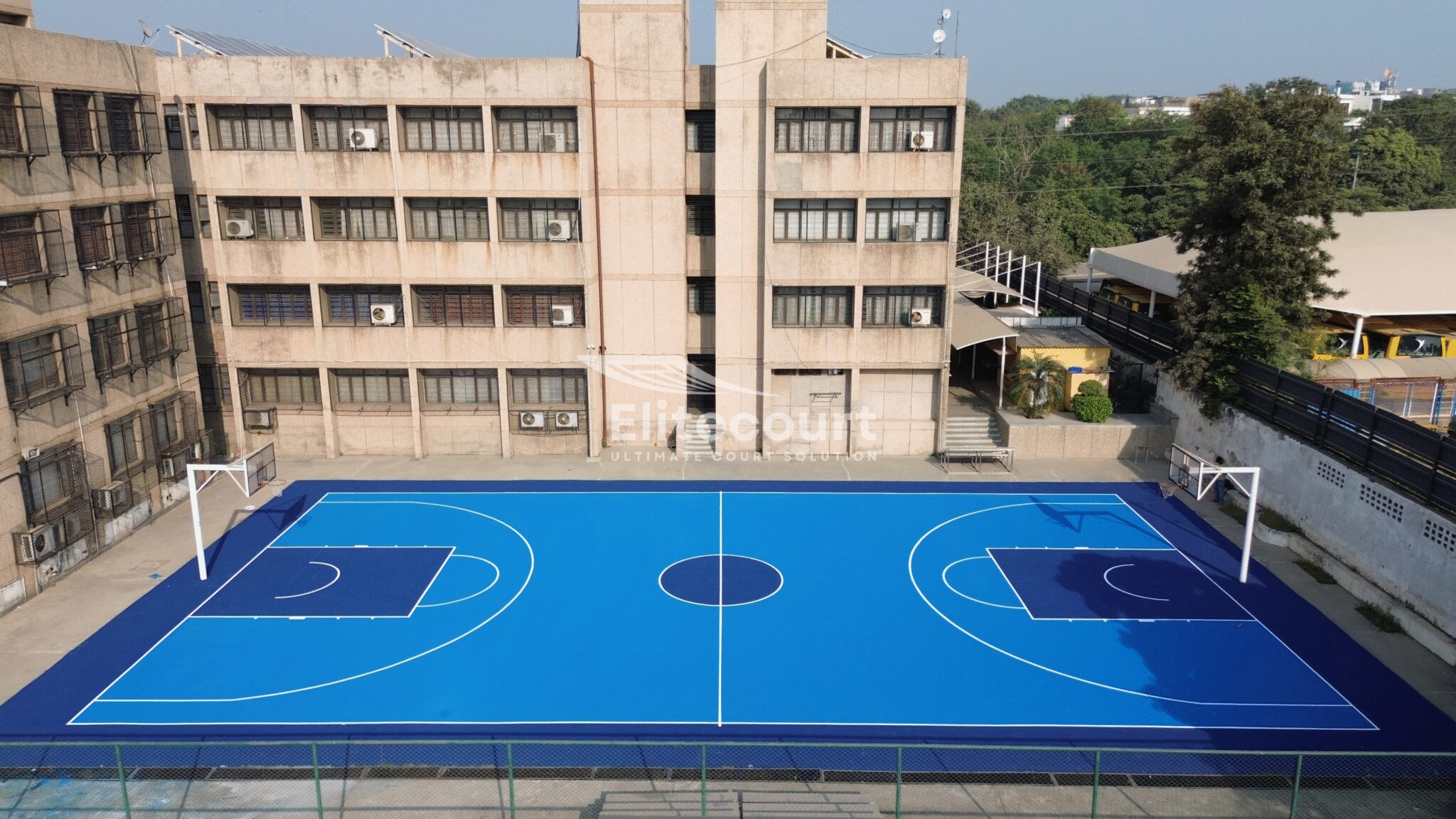
The surface beneath the players’ feet matters just as much as the dimensions drawn on it. Elitecourt specializes in manufacturing synthetic acrylic sports court flooring. Our materials provide the ideal balance of grip, slide, and shock absorption.
Why Choose Synthetic Acrylic Flooring?
While traditional hardwood has a long history in basketball, synthetic acrylic surfaces offer incredible versatility and durability. These materials are heavily favored for outdoor courts, multi-use school facilities, and community centers.
- Weather Resistance: Acrylic flooring materials withstand temperature fluctuations and moisture, making them perfect for outdoor and semi-enclosed facilities.
- Vibrant Customization: Schools take immense pride in their colors. Acrylic materials allow for deep, vibrant pigmentation that resists fading over time.
- Consistent Playing Characteristics: Our manufacturing process ensures a uniform surface texture, meaning the ball bounces predictably no matter where it hits the court.
Performance and Safety Features
Basketball requires sudden stops, rapid acceleration, and high-impact jumping. The flooring material must accommodate these biomechanical demands. Elitecourt’s synthetic acrylic formulations are engineered with years of experience to provide optimal coefficient of friction. This technical term simply means the floor offers enough grip to prevent slipping, but allows enough give to prevent joint injuries when players pivot.
How Court Length Impacts Gameplay Strategies
Understanding how long is a high school basketball court helps coaches tailor their game plans. An 84-foot court creates a uniquely fast-paced environment.
Full-Court Pressing
Because the court is 10 feet shorter than a college court, high school teams frequently employ full-court press defenses. The defense has less ground to cover to trap the opposing team, making aggressive defensive strategies highly effective.
Transition Offense
A shorter court means that a single outlet pass can bypass the entire defense. Fast breaks happen quicker on an 84-foot court. Players must react instantly during turnovers, as it only takes a few dribbles to get from one end to the other.
Transform Your Sports Facility Today!
Contact us for high-quality synthetic sports flooring material and elevate your space!
Can You Use a High School Court for Junior High Games?
Yes, you can use a high school basketball court (84 feet) for junior high games, and many schools do this to manage space and budget constraints. While junior high regulations often suggest a 74-foot court, playing on a larger surface offers several benefits.
One major advantage is enhanced athletic development. Younger athletes build better endurance, stamina, and court awareness when they train on a larger court. This prepares them physically and mentally for the transition to high school basketball, making them more confident and adaptable players.
For facility efficiency, multi-purpose gyms can use different colored boundary lines to distinguish between high school and junior high court sizes. This maximizes the use of the space and allows players and officials to switch between layouts easily.
However, there are challenges. Younger players may fatigue more quickly and struggle with the longer distances. Coaches should focus on conditioning and gradual adaptation to prevent fatigue-related injuries. Proper warm-ups and rest periods are essential.
Overall, using a high school court for junior high games promotes athletic growth and efficient facility use. When combined with consistent, high-quality flooring like Elitecourt synthetic acrylic, it provides a safe, high-performance environment for all age groups.
Does Court Size Affect Player Stamina?
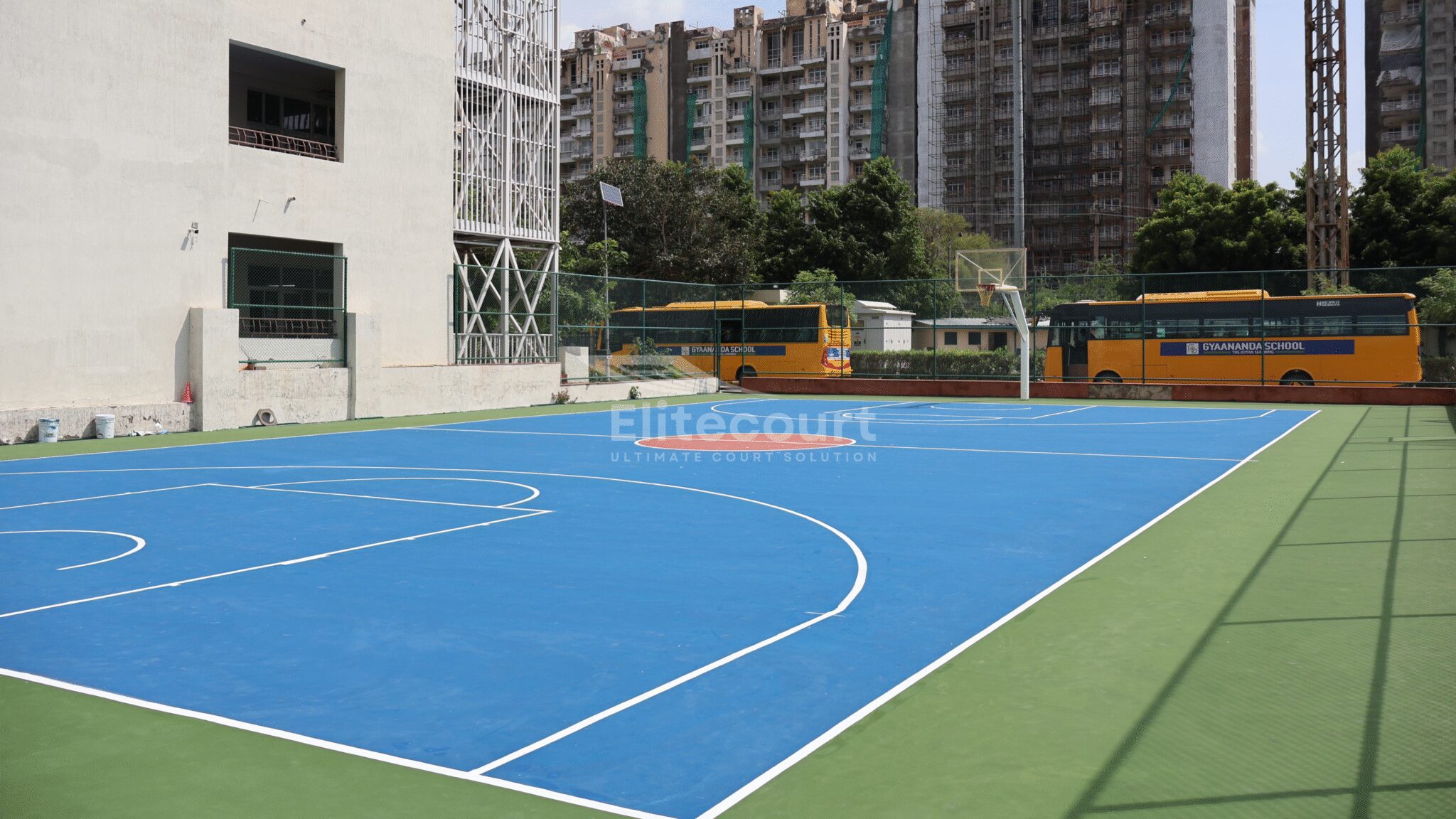
Yes, court size significantly impacts player stamina and performance. A standard high school basketball court is 84 feet long, 10 feet shorter than a college or NBA court. While this might seem to ease physical demands, a shorter court often creates a more intense, fast-paced game.
On an 84-foot court, rapid transitions between offense and defense leave little room for rest. Shorter sprints are required, but the constant action and frequent full-court presses mean athletes have fewer opportunities to catch their breath. This continuous movement demands high levels of cardiovascular and muscular endurance.
For players transitioning from a smaller junior high court (typically 74 feet), the adjustment can be challenging. They may initially struggle with fatigue as they adapt to the larger playing area and faster pace. Therefore, conditioning is essential. Coaches use high-intensity interval drills and shuttle runs to build both aerobic and anaerobic endurance.
Ultimately, playing on an 84-foot court helps develop resilient athletes with strong cardiovascular health and the physical and mental fortitude for sustained, high-level play. They learn to manage their energy, adapt to a quick tempo, and build a solid foundation for future athletic success.
Frequently Asked Questions (FAQs)
A regulation high school basketball court is exactly 84 feet long. The width is 50 feet. This creates a total painted playing area of 4,200 square feet.
No. An NBA court is 94 feet long, making it 10 feet longer than a high school court. The three-point line is also significantly further back in the NBA, and the key is wider.
Synthetic acrylic sports court flooring is widely considered the best material for outdoor courts. Elitecourt manufactures premium acrylic surfacing that provides excellent weather resistance, UV stability, and consistent ball bounce, making it ideal for high school facilities.
Because the total length of the court is 84 feet, the half-court line sits exactly at the 42-foot mark.
Safety regulations strongly recommend at least 3 to 10 feet of unobstructed space around the entire perimeter of the court. This buffer zone protects players who run out of bounds and provides space for officials and seating.
Conclusion
Whether you are mapping out a new athletic facility or just settling a debate with a fellow fan, knowing how long is a high school basketball court is fundamental basketball knowledge. The 84-foot length provides the perfect arena for young athletes to hone their skills, build their stamina, and compete safely.
At Elitecourt, our passion lies in the foundation of the game. We leverage years of experience to manufacture premium synthetic acrylic sports court flooring that meets the exact needs of athletic programs. By prioritizing durable, high-performance materials, we help ensure that every 84-foot court we supply materials for stands the test of time, game after game.
Transform Your Sports Facility Today!
Contact us for high-quality synthetic sports flooring material and elevate your space!