Introduction: Why the Different Types of Tennis Flooring Matter More Than You Think
When most people think about tennis, they picture the rally, the serve, or the athlete. Rarely does anyone think about what lies beneath their feet. But here’s the truth: the type of tennis flooring you choose determines everything — how the ball bounces, how fast the game plays, how safe players are, and how long the court lasts. Whether you’re planning a new sports facility, upgrading an existing tennis complex, or simply trying to understand the world of tennis surfaces, knowing the different types of tennis flooring is your starting point. Each surface type has its own personality — its own physics, its own performance character, and its own set of demands on the players who compete on it.
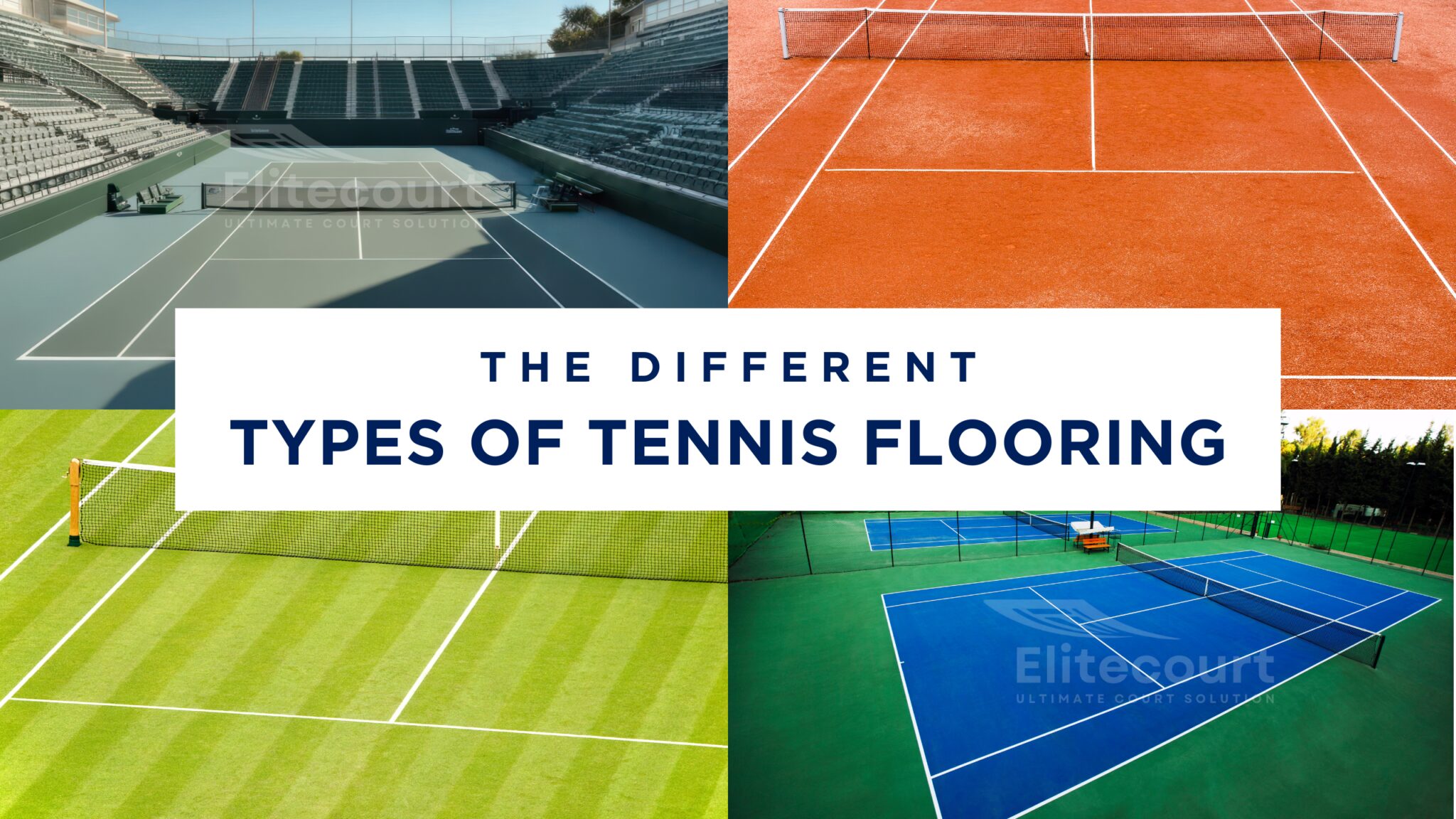
The four primary categories of tennis flooring recognized globally are hard courts (acrylic), clay courts, grass courts, and carpet/indoor courts. Within each category are further variations in materials, construction methods, and surface textures that meaningfully affect gameplay. And while all of these surface types have their place in the world of tennis, synthetic acrylic hard court flooring has emerged as the most popular, most practical, and most versatile choice for modern facilities — and for very good reason.
This comprehensive guide will walk you through every major type of tennis flooring, their technical characteristics, their gameplay implications, their maintenance demands, and how they compare to one another. By the end, you’ll have a thorough and nuanced understanding of what makes each surface tick — and what makes synthetic acrylic flooring the gold standard for facilities that demand performance, durability, and value.
The Four Primary Categories of Tennis Flooring
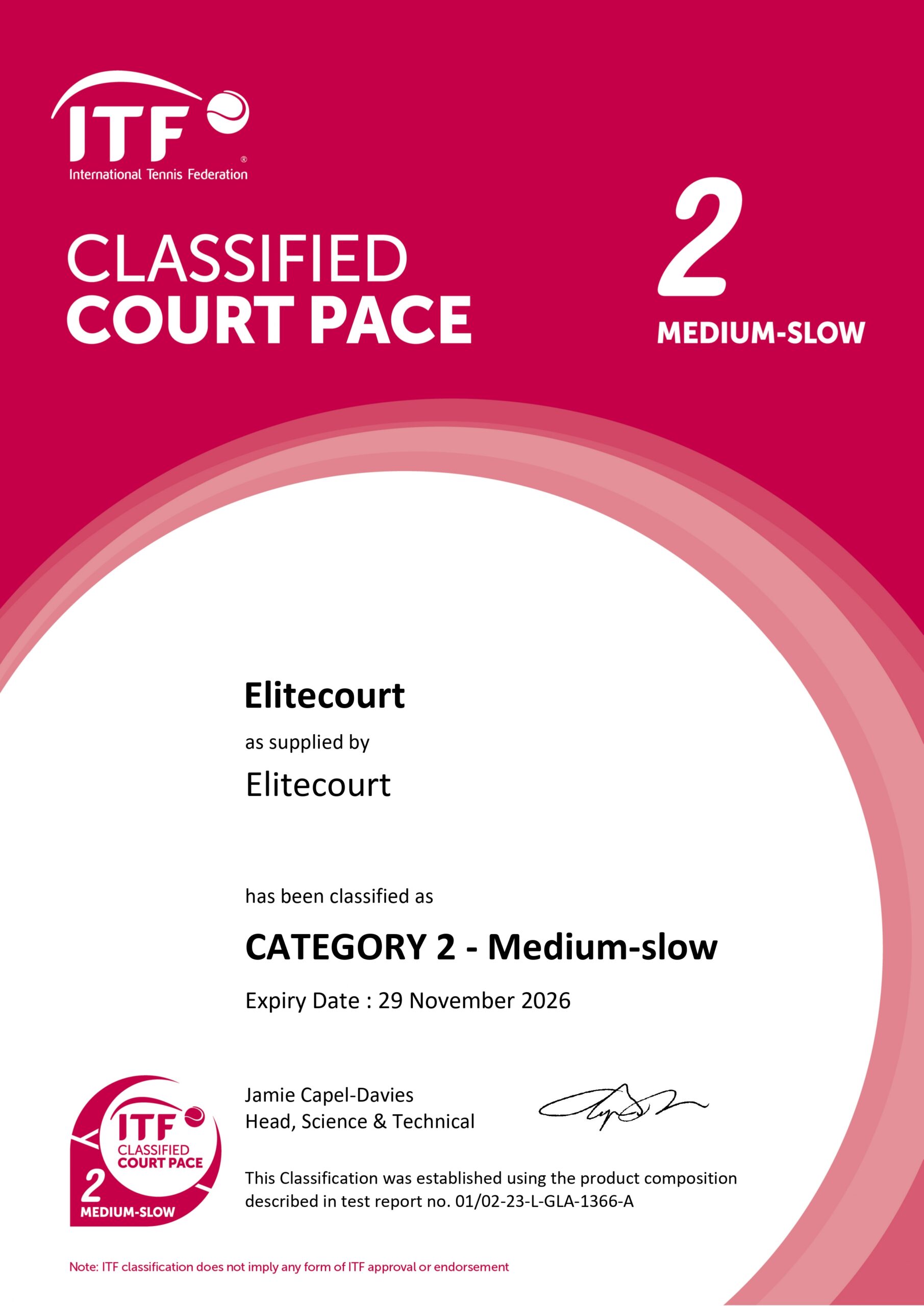
Before diving deep into each surface, it helps to understand the landscape. The International Tennis Federation (ITF), the global governing body for the sport, classifies tennis court surfaces into five pace categories — from Category 1 (slow) to Category 5 (fast) — based on how much they slow or accelerate the ball. The type of flooring you choose places your court within one of these categories and shapes the entire experience of the game played on it.
According to the ITF’s Court Pace Classification Programme, surface testing is essential to ensuring fair and consistent play across competitions worldwide. This is why surface type is not just an aesthetic or logistical choice — it is a technical and regulatory decision.
The main surface categories are:
- Hard courts (acrylic, asphalt-based, or concrete-based)
- Clay courts (red clay, green clay/Har-Tru)
- Grass courts (natural turf or artificial grass)
- Carpet and indoor courts (removable, modular, or installed)
Let’s explore each one in depth.
Hard Courts: The Dominant Force in Modern Tennis Flooring
What Is a Hard Court?
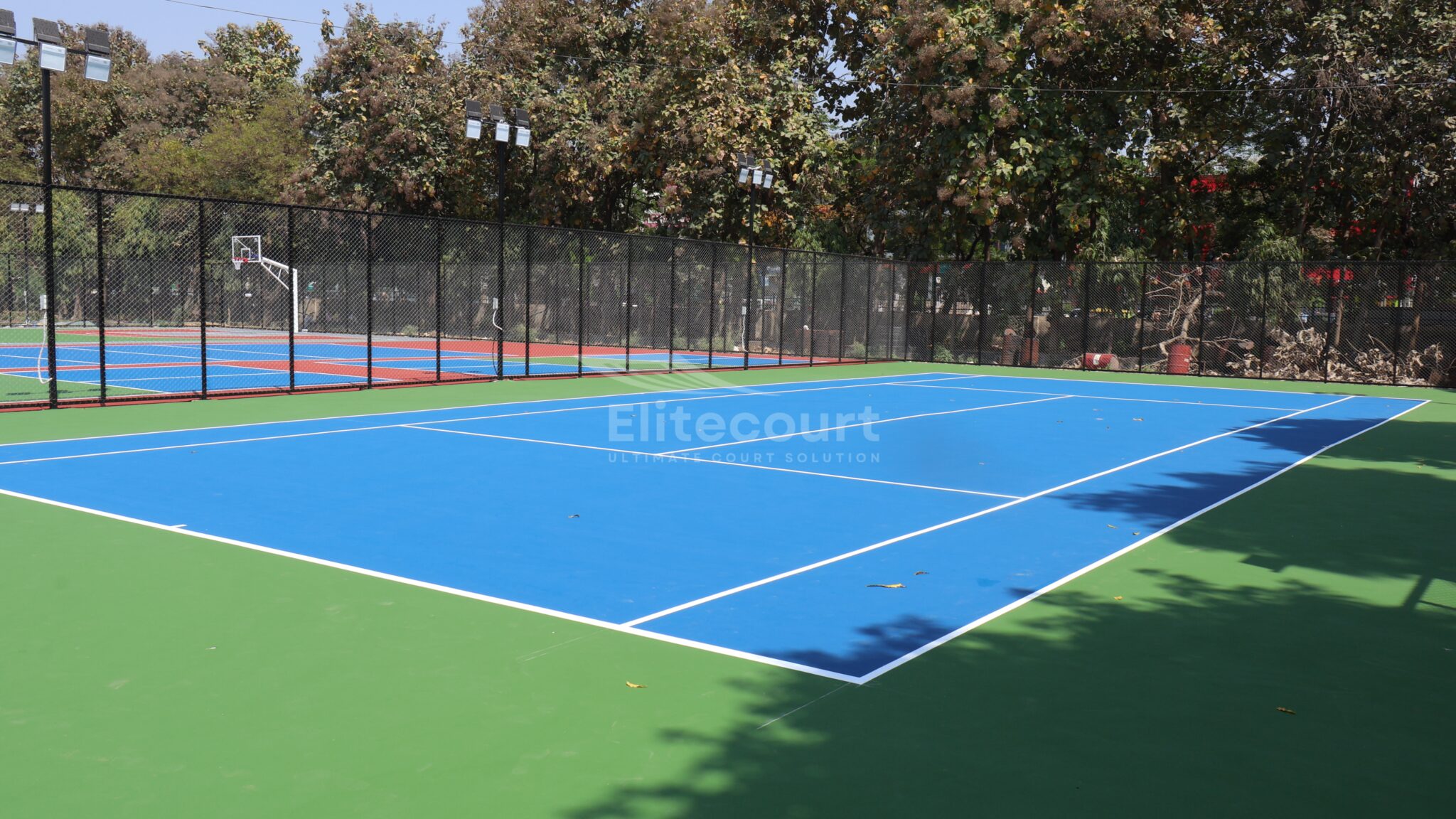
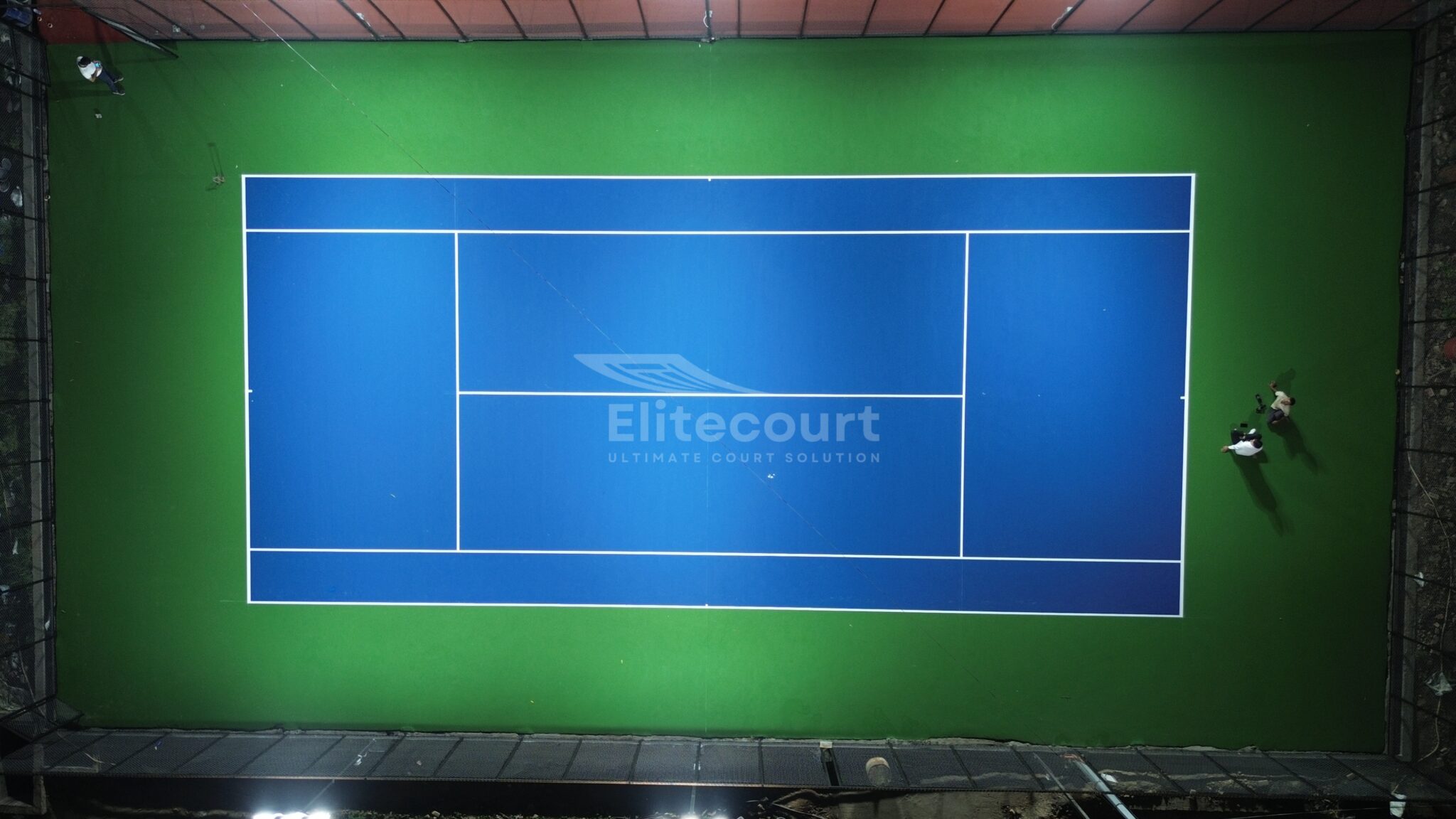
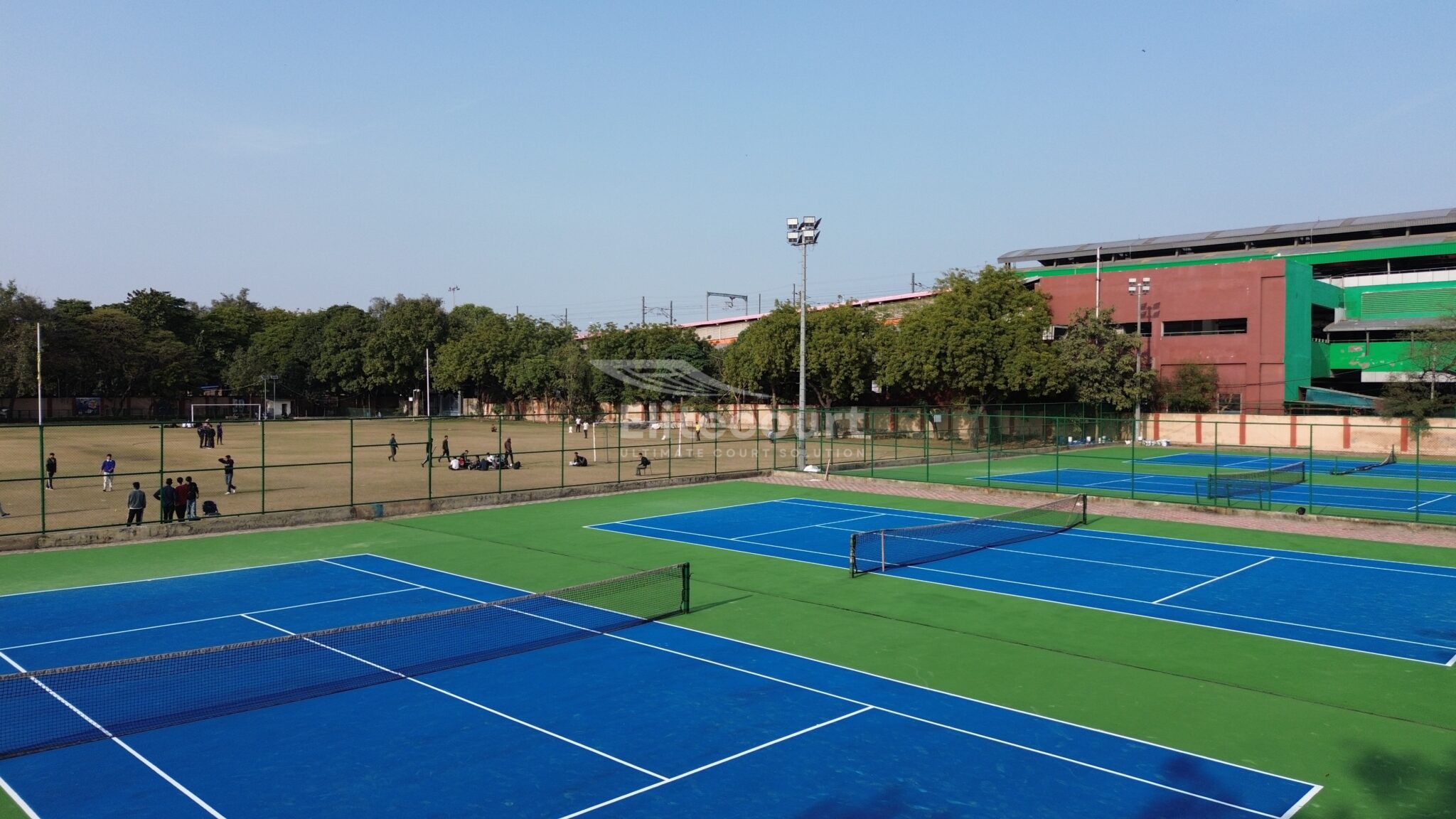
Hard courts dominate as the most widely used surface among all the different types of tennis flooring in the world today. Builders construct them on a rigid base — typically asphalt or concrete — and finish them with a synthetic acrylic surface layer that delivers the playing characteristics, texture, and color. Contractors apply the acrylic coating in multiple layers, often incorporating rubber particles, silica sand, or other aggregates to control traction and pace.
Hard courts fall in the middle of the pace spectrum. They are faster than clay but slower than grass, placing them in the ITF Category 3 (medium) range, though surface texture and sand content can push them toward faster or slower gameplay.
The US Open (on DecoTurf, an acrylic surface) and the Australian Open (on GreenSet Plexicushion) stand as the two most famous Grand Slam tournaments that use hard courts — a fact that speaks directly to the surface’s elite-level credibility and global acceptance.
The Role of Acrylic in Hard Court Tennis Flooring
Synthetic acrylic is the defining material of hard court tennis flooring. Manufacturers apply this water-based coating system over a prepared base, and formulators can adjust its composition to deliver very different performance outcomes. The key variables include:
- Grit or sand content: More silica sand = more friction = slower ball speed and more spin potential
- Number of coats: More acrylic layers = smoother surface = faster play
- Cushioning underlayer: Rubber-modified systems provide shock absorption and reduce player fatigue
- Color pigmentation: Typically green, blue, or red, with contrasting colors for the service box and baseline zones
At Elitecourt, our acrylic flooring systems deliver precise, repeatable surface characteristics — giving facility managers, court builders, and athletes a surface they can depend on season after season. Our products meet international standards for texture uniformity, slip resistance, and UV stability.
Types of Acrylic Hard Court Finishes
Hard courts are not one-size-fits-all. Within the acrylic hard court category, there are several important sub-types based on the base and cushioning system:
Non-Cushioned Hard Courts
These are the most basic form of synthetic acrylic tennis flooring. The acrylic coating is applied directly over a concrete or asphalt base with no additional shock-absorbing layer. The result is a firm, fast surface that provides maximum energy return to the ball and consistent bounce.
Non-cushioned courts are common in recreational facilities, schools, and community parks where budget efficiency is a priority. They are durable and low-maintenance, but can be harder on players’ joints over extended periods of play.
Cushioned Hard Courts
Cushioned hard courts introduce a rubber-modified or foam-based underlayer between the rigid base and the acrylic surface. This layer compresses slightly underfoot, reducing the shock transmitted to ankles, knees, and hips. The result is a significantly more player-friendly surface that reduces fatigue and lowers the risk of overuse injuries.
Cushioned systems are particularly popular for professional and semi-professional facilities where athlete welfare is a priority. They are also the preferred choice for training academies and clubs where players spend long hours on court. The ball bounce remains predictable, but the surface gives just enough to make a meaningful difference in player comfort.
Expert Tip from Elitecourt: The level of cushioning can be customized by adjusting the thickness and density of the rubber underlayer. Facilities working with high-volume daily use should seriously consider cushioned systems — the long-term benefit to player health is well worth it.
Textured vs. Smooth Acrylic Surfaces
Even without cushioning, the texture of the acrylic surface itself plays a major role in gameplay. Highly textured surfaces — achieved by incorporating more sand aggregate into the top coats — slow the ball down and produce higher bounces, giving baseline players more time to react. Smoother surfaces with less texture accelerate the ball and reduce bounce height, favoring serve-and-volley play and power hitters.
Elitecourt’s range includes both textured and smooth acrylic systems, allowing facility operators to choose a surface character that aligns with their players’ preferences and competitive requirements.
Why Hard Courts Are the Most Popular Type of Tennis Flooring
The dominance of hard courts globally comes down to a combination of factors that no other surface type can fully replicate:
| Advantage | Explanation |
|---|---|
| Consistency | Uniform bounce and pace regardless of weather or season |
| Durability | Acrylic surfaces can last many years with proper maintenance |
| Low Maintenance | No watering, rolling, or replanting required |
| Versatility | Suitable for indoor and outdoor use |
| All-weather Performance | Drains quickly after rain; not affected by frost or heat |
| Customizability | Pace, texture, color, and cushioning can all be adjusted |
| Player Safety | Slip-resistant textures and cushioned options reduce injury risk |
Hard courts are simply the most practical, adaptable, and performance-consistent of all the different types of tennis flooring — which is why they make up the majority of courts installed worldwide.
Transform Your Sports Facility Today!
Contact us for high-quality synthetic sports flooring material and elevate your space!
Clay Courts: The Original Slow Surface
What Is a Clay Court?
Clay courts are among the oldest types of tennis flooring and remain beloved by purists and professionals alike. Manufacturers produce clay courts from crushed shale, stone, or brick — most famously in the form of the distinctive red or green granular material that defines European clay courts and American green clay respectively.
Clay courts are the slowest of all tennis surfaces, sitting firmly in the ITF’s Category 1 (slow) classification. The ball grips the surface and loses considerable speed on bouncing, producing high-arcing, slower-paced rallies that reward endurance, heavy topspin, and strategic play over power. Roland Garros, the French Open, is clay’s most prestigious stage and the benchmark for clay-court excellence.
Red Clay vs. Green Clay (Har-Tru)
There are two primary forms of clay court tennis flooring used in competitive and recreational settings:
Red Clay is the traditional European clay surface, made from crushed brick. It is widely used across Europe, South America, and parts of Asia. Red clay is extremely slow, produces very high bounces, and is particularly susceptible to moisture — it becomes slippery when wet and can harden and crack when too dry. Maintaining a red clay court is a time-intensive and skill-dependent task.
Green Clay (Har-Tru) is the American equivalent, made from crushed stone (metabasalt). It plays slightly faster than red clay and is more common in the United States. It is also more porous than red clay, draining more efficiently after rain and drying more quickly, which reduces playability downtime.
Maintenance Demands of Clay Courts
Clay courts are among the most maintenance-intensive of all the different types of tennis flooring. They require:
- Daily watering to maintain the correct moisture balance
- Regular brushing to redistribute the loose top layer evenly
- Rolling to firm the surface after play
- Line tape replacement as the lines become worn
- Seasonal repairs to address cracking, uneven settling, and material erosion
This level of ongoing maintenance demands dedicated staff, specific equipment, and a reliable water supply — factors that make clay courts significantly more demanding to operate than acrylic hard courts.
Who Should Choose Clay?
Clay is a compelling choice for facilities that want to develop technically well-rounded players. The slower pace forces players to build consistency, footwork, and defensive skills that transfer well to all surfaces. Many elite academies incorporate clay courts specifically for this reason. However, for facilities with limited maintenance capacity, high player volume, or unpredictable climates, clay courts present significant operational challenges.
Grass Courts: Tradition, Speed, and Prestige
What Is a Grass Court?
Natural grass courts are the original tennis surface — the surface on which the sport was born in 19th-century England. They remain associated with prestige, tradition, and the fastest style of play in tennis. Wimbledon, the oldest and most prestigious Grand Slam tournament, still hosts play on perennial ryegrass, making grass courts synonymous with the pinnacle of the sport.
Grass courts fall into the ITF Category 4 or 5 (fast to very fast) classification. The ball skids through the surface on landing, staying low and accelerating, which dramatically compresses reaction time and rewards big servers, net-rushers, and flat ball strikers.
Natural Grass Court Construction
Building a proper natural grass tennis court is a complex horticultural and engineering undertaking. Builders begin the surface with a carefully graded drainage base, typically laying down compacted aggregate, sand, and topsoil in sequence, before seeding the grass or laying the turf on top. The precise grass mix, irrigation system, mowing frequency, and soil composition all affect how the court plays.
Natural grass requires:
- Daily mowing during the playing season
- Irrigation management to keep the surface firm but not dry
- Fertilization and aeration programs throughout the year
- Overseeding to repair worn areas, particularly around the baseline and service box
- Extended rest periods between seasons for the turf to recover
The result is a beautiful, fast, and prestigious surface — but one that is extraordinarily expensive to build and maintain, and completely unavailable to most facilities outside of specific climatic zones.
Artificial Grass as a Tennis Surface
Artificial grass offers an alternative to natural turf for facilities that want a grass-like aesthetic with far lower maintenance demands. Synthetic turf systems for tennis use short-pile polyethylene or polypropylene fibers infilled with sand or rubber granules to produce a surface that mimics some characteristics of natural grass.
Artificial grass courts are faster than clay but can be made to play at medium pace depending on pile height and infill density. They are more durable than natural grass, all-weather capable, and significantly less expensive to maintain. However, they are also more expensive to install than acrylic hard courts and do not produce the same consistent, predictable bounce.
Artificial grass is a niche choice in the broader landscape of the different types of tennis flooring — popular in some regions and contexts, but not widely adopted at the elite or community level compared to hard courts.
Transform Your Sports Facility Today!
Contact us for high-quality synthetic sports flooring material and elevate your space!
Indoor and Carpet Courts: Controlled Environment Tennis
What Are Carpet Courts?
Carpet courts are soft, textile-based surfaces used primarily in indoor tennis facilities. Carpet courts once featured prominently on the ATP and WTA tours and held a strong presence on the European indoor circuit, but the professional game has largely moved away from them in favor of hard courts. They remain in use at recreational and club-level facilities, particularly in regions with cold climates where indoor play is essential.
Carpet courts fall into the ITF’s Category 4 (fast) classification. The ball skids quickly through the pile, producing a low, fast bounce similar to grass. Rallies are typically short, and the premium is on quick reactions, flat ball striking, and aggressive net approaches.
Types of Carpet and Indoor Tennis Flooring
Indoor facilities use several types of flooring depending on the use case:
Woven carpet is a textile surface with a low, dense pile. Suppliers offer woven carpet in rolls, and installers can lay it directly over a smooth sub-floor. The surface plays fast and feels consistent and comfortable underfoot, but it carries a relatively short lifespan and requires periodic replacement.
Needle-punch carpet is a non-woven textile surface with a coarser texture. It is slower than woven carpet due to its rougher surface, placing it closer to the medium pace range. It is commonly used in recreational and school facilities.
Modular court tiles are interlocking polypropylene or acrylic-coated tiles designed for indoor installation. They are portable, easy to install and remove, and offer excellent durability. Modular tiles can be used for multi-purpose sports halls where the tennis court must be set up and dismantled for other events.
Acrylic on indoor concrete is increasingly popular for indoor tennis halls. Installers apply a standard acrylic hard court system — the same technology used outdoors — over an indoor concrete base, producing an indoor surface that delivers the same consistent, medium-paced characteristics as an outdoor hard court. Facilities that want uniformity of play across their indoor and outdoor courts tend to favor this approach.
Expert Insight: For indoor facilities seeking long-term surface consistency and minimal ongoing maintenance, indoor acrylic hard court systems are an excellent choice. They eliminate the variability and replacement cycles associated with carpet surfaces while delivering a surface performance that translates directly to and from outdoor hard court play.
Comparing the Different Types of Tennis Flooring: A Technical Overview
Understanding how these surfaces compare across key performance and operational dimensions is essential for making an informed decision. The following table provides a structured comparison:
| Surface Type | Pace (ITF) | Bounce Height | Player Stress | Maintenance | Weather Sensitivity | Durability |
|---|---|---|---|---|---|---|
| Acrylic Hard Court (non-cushioned) | Medium (Cat. 3) | Medium | Moderate | Low | Low | Very High |
| Acrylic Hard Court (cushioned) | Medium (Cat. 3) | Medium | Low | Low | Low | Very High |
| Red Clay | Slow (Cat. 1) | High | Low-Moderate | Very High | High | Moderate |
| Green Clay (Har-Tru) | Slow-Medium (Cat. 2) | Medium-High | Low-Moderate | High | Moderate | Moderate |
| Natural Grass | Fast (Cat. 4-5) | Low | Low-Moderate | Extremely High | Very High | Low |
| Artificial Grass | Medium-Fast (Cat. 3-4) | Low-Medium | Low-Moderate | Moderate | Low | Moderate-High |
| Woven Carpet (Indoor) | Fast (Cat. 4) | Low | Moderate | Low-Moderate | None | Low-Moderate |
| Modular Tiles (Indoor) | Medium (Cat. 3) | Medium | Moderate | Low | None | High |
| Indoor Acrylic (Hard Court) | Medium (Cat. 3) | Medium | Low (with cushion) | Low | None | Very High |
Transform Your Sports Facility Today!
Contact us for high-quality synthetic sports flooring material and elevate your space!
How Flooring Type Affects Playing Style and Player Development
One of the most important — and often underappreciated — aspects of the different types of tennis flooring is their effect on player development. The surface a player trains on shapes the technical and physical habits they develop, often in deep and lasting ways.
Clay Develops Patience and Consistency
Clay’s slow pace and high bounce force players to develop reliable groundstrokes, strong footwork, and the ability to construct points strategically over multiple shots. Players trained primarily on clay tend to have exceptional defensive skills, high topspin production, and strong physical endurance. Rafael Nadal is the most celebrated example of a clay-court specialist, though his clay training also built the physical and technical foundations that made him competitive on all surfaces.
Grass Develops Aggression and Net Skills
Grass rewards players who can generate pace, vary their serve, and transition quickly to the net. The compressed rally time on fast grass means there is less opportunity for sustained baseline exchanges — attack-minded players with strong serve-and-volley games thrive. Pete Sampras and Roger Federer are iconic examples of players whose grass-court skills elevated their overall game.
Hard Courts Develop All-Around Skills
Because hard courts fall in the middle of the pace spectrum and produce a predictable, consistent bounce, they reward balanced, all-around game development. Players on hard courts learn to handle pace and spin, develop reliable groundstrokes, and adapt to a variety of opponents’ styles. This is one reason why hard courts have become the default training surface for academies and clubs worldwide — the skills developed on hard courts transfer well to all other surfaces.
Acrylic Hard Courts as the Foundation for Multi-Surface Athletes
For facilities with a single surface type, synthetic acrylic hard courts represent the most effective developmental surface because they expose players to a neutral, medium-paced environment that does not overly privilege any one style of play. The consistency of the bounce also makes technical coaching more effective — when the ball does what you expect it to, it’s easier to isolate and correct specific technical errors.
The Science Behind Synthetic Acrylic Tennis Flooring
At the heart of modern hard court tennis flooring is a sophisticated chemistry. Acrylic paint systems used in sports court applications are water-based polymer coatings that, when applied in multiple layers over a prepared base, create a tightly bonded, abrasion-resistant film with precisely controlled surface properties.
Key Components of an Acrylic Tennis Surface
Acrylic polymer binders form the backbone of the coating. These polymers create a flexible, water-resistant film that adheres strongly to asphalt or concrete bases and resists cracking under thermal cycling. The elasticity of the acrylic binder is critical — a surface that cracks or de-bonds undermines ball bounce consistency and creates safety hazards.
Silica sand aggregates are mixed into the top coating layers to create surface texture. The size and concentration of silica sand particles directly determines the friction coefficient of the surface — more sand means more friction, which slows the ball and provides better shoe grip. Different courts can be specified with different sand contents to achieve different pace ratings within the medium-speed range.
UV-stabilized pigments give the surface its color and protect the polymer binder from degradation by ultraviolet radiation. High-quality UV stabilizers allow acrylic tennis surfaces to retain their color and performance properties for many years of outdoor exposure without significant fading or chalking.
Rubber particles (in cushioned systems) are incorporated into an intermediate layer to provide shock absorption. The particle size, hardness, and concentration of the rubber component determine the degree of cushioning effect — a carefully engineered balance between player comfort and ball response.
At Elitecourt, every batch of acrylic flooring material is formulated and quality-tested to meet the specific performance requirements of our clients, ensuring that the surface that leaves our facility performs precisely as specified on-court.
Sustainability and Environmental Considerations in Tennis Flooring
As sustainability becomes an increasingly important consideration in sports facility design, the environmental profile of different types of tennis flooring is receiving more attention.
Clay Courts and Environmental Impact
Clay courts require continuous watering — a significant water consumption that can be problematic in water-stressed regions. The loose material is also gradually displaced by play and weather, requiring periodic replenishment, which involves transportation of materials and associated carbon emissions.
Grass Courts and Resource Use
Natural grass courts are water-intensive and require a substantial input of fertilizers, pesticides, and energy for mowing and irrigation. In regions with low rainfall, maintaining natural grass tennis courts can place significant demands on local water resources.
Synthetic Acrylic Hard Courts and Sustainability
Synthetic acrylic hard courts compare favorably on several environmental dimensions:
- No ongoing water requirement for the surface itself
- Long lifespan reduces the frequency of surface replacement and material waste
- Low chemical inputs — no fertilizers, herbicides, or pesticides required
- Water drainage can be managed with permeable sub-base systems in some applications
- Heat island effect: A recognized concern with dark asphalt bases; lighter-colored acrylic coatings and reflective pigments can help mitigate this
The development of low-VOC (volatile organic compound) acrylic formulations has also improved the environmental profile of synthetic court surfaces. Modern water-based acrylic systems release significantly fewer volatile compounds during application than solvent-based alternatives.
Choosing the Right Tennis Flooring for Your Facility
With a thorough understanding of the different types of tennis flooring in hand, how do you make the right choice for your specific facility? The decision depends on a combination of factors:
Climate and Geography
Climate is often the most determinative factor in surface selection. Red clay is impractical in very hot, dry climates where maintaining correct moisture levels is difficult. Natural grass is limited to temperate, humid regions with skilled horticultural staff. Acrylic hard courts are genuinely all-climate surfaces — they perform reliably in heat, cold, and rain, making them the default choice for facilities in unpredictable or extreme climates.
Player Volume and Intensity of Use
High-traffic courts require surfaces that can withstand continuous play without rapid deterioration. Acrylic hard courts excel here — they are engineered for durability and can withstand years of intensive use with minimal surface degradation when properly maintained. Clay courts at high-traffic facilities face significant challenges in maintaining a consistent, even surface.
Player Demographics
The age and physical condition of the primary player base is an important consideration. Cushioned acrylic hard courts significantly reduce the impact forces on players’ joints, making them the preferred surface for facilities with older recreational players, junior development programs, or high-intensity training environments where player longevity is a priority.
Competitive Standards and Certification
Facilities hosting sanctioned competitions may need to comply with surface specifications set by national or international tennis federations. The ITF’s Court Pace Classification system provides a framework for certifying surfaces, and many national federations have specific requirements. Synthetic acrylic hard court systems from quality manufacturers like Elitecourt are designed to be certifiable under these frameworks, giving competition organizers confidence in the surface’s compliance.
Multi-Sport Use
Many sports facilities need their courts to serve multiple sports — a reality that strongly favors synthetic acrylic hard courts or modular tile systems. Acrylic-coated hard courts can be lined for badminton, basketball, volleyball, and other sports, making them inherently multi-purpose. Clay and natural grass courts, by contrast, are single-purpose surfaces that cannot realistically accommodate other sports.
Transform Your Sports Facility Today!
Contact us for high-quality synthetic sports flooring material and elevate your space!
Maintaining Different Types of Tennis Flooring
Maintenance is not a secondary consideration — it is integral to the lifespan, safety, and performance of any tennis surface. Each surface type has specific maintenance requirements.
Acrylic Hard Court Maintenance
The relatively low maintenance demands of acrylic hard courts are one of their most significant operational advantages. Key maintenance tasks include:
- Regular cleaning: Sweeping or blowing to remove debris; power washing periodically to remove algae, moss, or embedded dirt
- Crack monitoring and repair: Inspect for hairline cracks in the base or acrylic layer; small cracks should be repaired promptly before water infiltration causes larger damage
- Surface recoating: After several years of use, the top acrylic coat may show wear; resurfacing with fresh acrylic extends the life of the surface significantly
- Line repainting: Court lines fade with UV exposure and wear; repainting maintains visual clarity and regulatory compliance
Clay Court Maintenance
Clay court maintenance is a daily commitment:
- Watering before and after play to maintain optimal moisture
- Brushing and rolling to redistribute material and restore a level playing surface
- Repairing and leveling after heavy rain or intensive play
- Replacing line tapes regularly as they become worn
- Seasonal deep maintenance including scarifying, top-dressing, and rolling
Natural Grass Court Maintenance
Grass courts require an ongoing horticultural program:
- Daily mowing to maintain consistent pile height
- Irrigation management throughout the growing season
- Fertilization and aeration programs
- Overseeding worn areas, particularly near the baseline and service box
- Extended winter rest and recovery periods
The contrast in maintenance demands is stark. For most facility operators, acrylic hard courts offer the most favorable balance of performance, durability, and operational simplicity.
What Type of Tennis Court Is Best for Beginners?
Q: Which of the different types of tennis flooring is most suitable for beginners?
For beginners, clay courts and cushioned acrylic hard courts are generally considered the most suitable surfaces. Clay’s slow pace and high bounce give new players more time to react and make contact with the ball, easing the early learning curve. However, the uneven and slidey nature of clay can also make it challenging for players who haven’t yet developed confident footwork.
Cushioned acrylic hard courts offer a compelling alternative for beginners — the predictable, consistent bounce makes it easier to develop reliable stroke mechanics, the cushioned surface reduces fatigue and injury risk, and the all-weather availability means training schedules are not disrupted by rain or surface maintenance.
For junior academies and beginner-focused clubs, cushioned acrylic hard courts are the most practical all-around choice — easy to maintain, forgiving on young bodies, and consistent enough to support genuine skill development.
How Long Do Different Types of Tennis Flooring Last?
Q: What is the lifespan of the different types of tennis flooring?
Lifespan varies significantly across surface types and is heavily influenced by usage volume, climate, and quality of maintenance.
Acrylic hard courts are among the longest-lasting tennis surfaces available. A well-constructed acrylic court on a sound base can provide many years of reliable service with periodic resurfacing. The acrylic top layer itself may need recoating every several years depending on usage intensity and UV exposure, but the underlying base and cushioning system can last much longer.
Clay courts have no fixed lifespan in the same sense — the material is gradually displaced and must be periodically replenished. The underlying base construction can last for decades, but the surface layer is in a state of continuous renewal.
Natural grass courts are the most fragile of the main surface types. Without constant and expert maintenance, a grass court can deteriorate to an unplayable state in a single season. The surface layer has no fixed lifespan in isolation — it is either maintained or it fails.
For facilities planning long-term investments, synthetic acrylic hard courts represent the best return in terms of surface longevity, low lifetime maintenance demands, and consistent performance.
Can You Play Tennis Indoors on the Same Surface as Outdoors?
Q: Are the different types of tennis flooring the same for indoor and outdoor courts?
Yes and no. The fundamental surface categories are the same — hard courts, clay, grass, and carpet — but the specific products and construction systems differ between indoor and outdoor applications.
Outdoor hard courts must withstand UV radiation, rain, frost, and temperature cycling. Outdoor acrylic systems use UV-stabilized pigments and flexible polymer binders designed for these conditions. Indoor acrylic systems do not need to handle UV or rain but must be suited to the specific sub-floor and ventilation conditions of an enclosed building.
Many elite facilities deliberately match their indoor and outdoor court surfaces so that players experience the same surface feel and bounce regardless of where they train. For a club or academy that plays outdoors in summer and moves indoors in winter, using the same acrylic hard court system on both surfaces eliminates surface-change disruption and keeps player development consistent throughout the year.
FAQs
Professional tennis at the Grand Slam level is played on clay (Roland Garros), grass (Wimbledon), and acrylic hard courts (US Open and Australian Open). Of these, acrylic hard courts are the most widely used surface across both professional tours and recreational facilities worldwide.
Clay slows the ball and produces high bounces, favoring long baseline rallies. Grass accelerates the ball and keeps it low, rewarding aggressive, fast play. Acrylic hard courts sit in the middle — a medium-paced, consistent surface that suits a wide range of playing styles and can be adjusted further through surface texture and sand content.
Yes. Synthetic acrylic flooring, especially cushioned systems, is engineered for controlled traction and joint-friendly play. The cushioning underlayer absorbs impact forces, and the surface drains quickly after rain to prevent slippery conditions. Elitecourt’s systems are formulated to meet international standards for slip resistance and surface consistency.
Acrylic hard courts are by far the lowest-maintenance option. Unlike clay (which needs daily watering, brushing, and rolling) or natural grass (which demands a full horticultural program), acrylic courts require only periodic cleaning, occasional crack repairs, and surface recoating over time — no specialized daily upkeep.
Choose cushioned acrylic for facilities serving older players, juniors in intensive training, or high-volume use environments where joint protection matters most. Non-cushioned acrylic suits competitive players on tighter budgets who prioritize a firmer, faster surface feel. Elitecourt supplies both systems to match the full range of facility needs.
Elitecourt’s Approach to Tennis Flooring Excellence
As a manufacturer of synthetic acrylic sports court flooring with years of experience, Elitecourt occupies a unique position at the intersection of materials science and sports performance. Our products are developed through rigorous research and formulation work, with a constant focus on three core outcomes: performance, durability, and safety.
Every acrylic system we produce is engineered to deliver consistent, reproducible surface characteristics — the hallmark of a surface that players and facility operators can trust. We work with the understanding that tennis flooring is not just a product; it is the foundation on which every game, every practice session, and every competitive moment takes place. Getting it right matters deeply.
Our range covers non-cushioned and cushioned acrylic systems, textured and smooth surface finishes, and formulations suited to the full spectrum of climate conditions and use intensities. We supply our materials to facility builders, court contractors, and sports organizations who share our commitment to surface quality.
For any facility — from a neighborhood tennis club to a national training center — choosing Elitecourt synthetic acrylic tennis flooring means choosing a surface backed by technical expertise, manufacturing precision, and an unwavering commitment to the game.
Transform Your Sports Facility Today!
Contact us for high-quality synthetic sports flooring material and elevate your space!
Conclusion: Making the Right Choice Among the Different Types of Tennis Flooring
The world of tennis flooring is richer and more varied than it might initially appear. Each of the major surface types — clay, grass, carpet, and acrylic hard courts — has its own distinctive character, its own strengths, and its own operational demands. Understanding the full landscape of the different types of tennis flooring is essential to making a decision that serves your facility, your players, and your long-term operational goals.
For most facilities, the choice will come down to synthetic acrylic hard courts — and with good reason. They offer unmatched consistency, durability, low maintenance, all-weather performance, and the ability to customize surface character to meet specific gameplay and player welfare requirements. They are the standard for a reason, embraced from the schoolyard to the Grand Slam stage.
Clay and grass courts have their place — they serve specific competitive traditions, develop particular technical skills, and have an aesthetic and cultural resonance that is undeniably compelling. But as practical foundations for modern tennis facilities, they cannot match the reliability and versatility of synthetic acrylic flooring.
Whatever surface type you are considering, start with a clear understanding of your players’ needs, your climate, your operational capacity, and your long-term ambitions for the facility. The right flooring choice is not the most expensive or the most traditional — it is the one that best serves the game being played on it, day after day, year after year.
Elitecourt is here to support that choice — with materials engineered for performance, formulated for durability, and built for the love of the game.
Transform Your Sports Facility Today!
Contact us for high-quality synthetic sports flooring material and elevate your space!