Introduction: What Is the Correct Badminton Net Height in Feet?
If you have ever set up a badminton court and wondered whether your net is at the right height, you are not alone. The official badminton net height is 5 feet 1 inch (approximately 1.55 meters) at the poles and 5 feet (1.524 meters) at the center of the court. This one-inch difference is mandated by the Badminton World Federation (BWF). Additionally, it has a significant effect on how players compete at every level — from casual backyard rallies to elite international tournaments.
Understanding the correct badminton net height in feet goes beyond following the rules. It directly influences shuttle trajectory, shot strategy, service mechanics, and court safety. Whether you are a recreational player, a competitive athlete, a coach, or a facility manager, getting the net height exactly right is foundational to a fair and enjoyable game.
In this guide, Elitecourt walks you through everything you need to know about badminton net height in feet. Specifically, we cover the official standards, why they matter, how the net interacts with court surface quality, and the best practices for maintaining a regulation-compliant court.
Understanding the Official Badminton Net Height in Feet
The BWF Standard: Numbers Every Player Must Know
The Badminton World Federation (BWF) defines the exact dimensions of a regulation badminton court in its Laws of Badminton. According to these laws:
| Measurement Point | Height in Feet & Inches | Height in Meters |
|---|---|---|
| At the posts (sidelines) | 5 feet 1 inch | 1.55 m |
| At the center of the court | 5 feet (exactly) | 1.524 m |
| Net depth (top to bottom) | 2 feet 6 inches | 0.76 m |
This subtle slope — where the net sits slightly higher at the edges than at the center — is by design. The posts hold the net taut at either end, and natural tension creates a slight dip at the midpoint. Therefore, the BWF mandates that the center height must stay at exactly 5 feet (1.524 meters). This is the figure most players and coaches reference when discussing badminton net height in feet.
What the Net Itself Must Look Like
Beyond height, the BWF also specifies the physical characteristics of the net:
- Material: Fine cord of dark color with a mesh between 15 mm and 20 mm.
- Width: 760 mm (approximately 2.5 feet) over its full length.
- Top edge: A 75 mm white tape doubled over a cord or cable running through it.
- Length: Spanning the full court width of 20 feet (6.1 meters) for doubles. Singles uses the same net, but narrower boundary lines.
These specifications ensure the net functions as a consistent and fair obstacle across all courts worldwide — from community sports halls to Olympic arenas.
Why One Inch Matters: The Physics of the Net
You might wonder why one extra inch at the posts is worth specifying at all. The answer lies in the geometry of the game.
At the center, the net sits at its lowest point: 5 feet exactly. As a result, cross-court shots aimed at the center have a marginally lower bar to clear. Shots aimed toward the sidelines, however, must contend with the extra inch. This creates a subtle but real strategic dimension — particularly in doubles play where players target the wider tramline areas.
For professional players, this one-inch difference is not trivial. Furthermore, it means facility managers must take the measurement at the center of the net, not at the post, when verifying compliance.
Badminton Net Height in Feet vs. Other Racket Sports
How Badminton Compares to Tennis, Pickleball, and Volleyball
Many players assume net heights are interchangeable across racket sports. They are not — and the differences are significant.
| Sport | Net Height at Center | Net Height at Post |
|---|---|---|
| Badminton | 5 feet (1.524 m) | 5 feet 1 inch (1.55 m) |
| Tennis (Singles) | 3 feet 6 inches (1.07 m) | 3 feet (0.914 m) |
| Tennis (Doubles) | 3 feet 6 inches (1.07 m) | 3 feet (0.914 m) |
| Pickleball | 3 feet 4 inches (1.02 m) | 3 feet (0.914 m) |
| Volleyball | 7 feet 11.69 inches (men) | Same height across |
The badminton net is notably higher than tennis and pickleball nets. This is because the shuttlecock travels in a very different arc than a tennis ball. Consequently, the high net forces players to think carefully about trajectory — especially during net play and service, where the shuttle must clear 5 feet while landing just 6.5 feet away.
Singles vs. Doubles: Does the Net Height Change?
Many newer players ask whether net height differs between singles and doubles badminton. The answer is no. The net height stays the same — 5 feet at the center and 5 feet 1 inch at the posts — for both formats.
What changes between singles and doubles is the court’s active boundary lines. In singles, the narrower inner tramlines apply. However, the posts must still sit on the outer doubles sidelines, even during singles matches. The height, therefore, remains constant regardless of format.
Setting Up the Correct Badminton Net Height in Feet
Step-by-Step Guide to Measuring and Adjusting Your Net
Setting up a badminton net to the correct height seems straightforward. However, common mistakes often lead to incorrect measurements. Follow these steps for a reliable setup:
Step 1: Position Your Posts Correctly Place the posts on the doubles sidelines — the outermost boundary lines of the court. Fix them firmly so they do not lean inward or outward, as any tilt affects the height measurement.
Step 2: Attach the Net to the Posts Most regulation nets include hooks or loops that attach to the post tops. Attach the net symmetrically on both sides.
Step 3: Check the Post Height Confirm the net top at the post sits at 5 feet 1 inch (1.55 meters) above the court surface. Always measure from the actual playing surface — not from any underlying base or subfloor.
Step 4: Measure the Center Height Move to the court center and measure from the surface to the top of the net tape. This must read exactly 5 feet (1.524 meters). If the center sags below 5 feet, tighten the adjustable cord or cable running through the top tape.
Step 5: Check for Even Tension Run your hand along the top tape. It should feel uniformly taut without loose sections or bulges. Uneven tension causes shuttle deflections that distort play.
Step 6: Verify the Net Depth The net bottom should not bunch on the court surface. Instead, it should hang with enough weight — many nets include a weighted bottom cord — to keep the lower edge close to the floor.
Common Mistakes When Setting Net Height
Even experienced facility managers make these errors. Therefore, keep them in mind during every setup:
- Measuring from a subfloor: Always measure from the final court surface — the playing layer.
- Measuring only at the post: BWF mandates the 5-foot height at the center. Always verify both points.
- Using an under-taut net: A sagging net can drop well below 5 feet during play as it loosens further.
- Posts leaning inward: Inward-leaning posts compress the net, pushing the center above 5 feet.
- Ignoring surface thickness: After installing a new playing surface, always remeasure — surface thickness shifts the baseline.
Expert Tip from Elitecourt: After installing a new synthetic acrylic court surface, always re-verify net height measurements. The flooring layer adds to the measurement baseline, and even a few millimeters matter at the professional level.
Why Court Surface Quality Directly Affects Net Height Performance
The Elitecourt Perspective: Surface and Net Are Inseparable
Court surface quality is often overlooked in discussions about badminton net height in feet. However, an uneven or warped surface creates inconsistent height baselines across the court.
For example, if one side sits slightly higher than the other due to subfloor irregularities or surface delamination, the effective net height differs from one side to the other. This creates an uneven playing field — literally.
At Elitecourt, our synthetic acrylic sports court flooring delivers a perfectly flat, consistent playing surface that provides a reliable baseline for all court measurements. Our flooring systems include:
- Dimensional stability: Resistance to warping, swelling, and shrinkage caused by temperature and humidity changes.
- Level surface tolerances: Strict flatness requirements that prevent the surface from deviating across its length or width.
- Measurement compatibility: Surfaces designed for accurate measurement using standard BWF-compliant methods.
Surface Hardness and Shuttle Behavior at the Net
How Hardness Influences Play
Surface hardness also affects gameplay at net height. When a shuttle clips the top of the net and drops, its landing behavior depends heavily on the court material. On a properly manufactured synthetic acrylic surface, the shuttle lands predictably and consistently — a critical factor in professional play.
The Risk of Incorrect Surface Hardness
A surface that is too hard causes shuttle skipping. One that is too soft absorbs the shuttle’s velocity unpredictably. As a result, Elitecourt calibrates its acrylic court surfaces for optimal shock absorption and rebound consistency, ensuring net-cord shots and drop shots behave exactly as players and coaches expect.
Badminton Net Height in Feet for Different Skill Levels and Age Groups
Is the Standard Net Height the Same for All Players?
The BWF specifies a single net height — 5 feet at the center — as the universal standard. Nevertheless, many recreational programs, school-based PE programs, and junior academies adapt net heights for younger or smaller players.
Recommended Net Height Guidelines by Player Category
| Player Category | Recommended Net Height (Center) | Notes |
|---|---|---|
| Elite / Professional | Exactly 5 feet (1.524 m) | Strictly BWF-mandated |
| Senior Club Players | 5 feet (1.524 m) | Full BWF standard |
| Junior (Under 15) | 5 feet (1.524 m) | Full standard usually applied |
| Junior (Under 11) | Often lowered | Check national federation guidelines |
| Recreational / School | 5 feet or slightly lower | Depends on program goals |
Adjustable Posts for Multi-Age Facilities
For courts that serve multiple age groups, adjustable-height net posts are a practical solution. Consequently, facility managers can set the correct height for each session without replacing any equipment.
Transform Your Sports Facility Today!
Contact us for high-quality synthetic sports flooring material and elevate your space!
The Badminton Court — Full Dimensions and How Net Height Fits In
Understanding the Full Court Layout
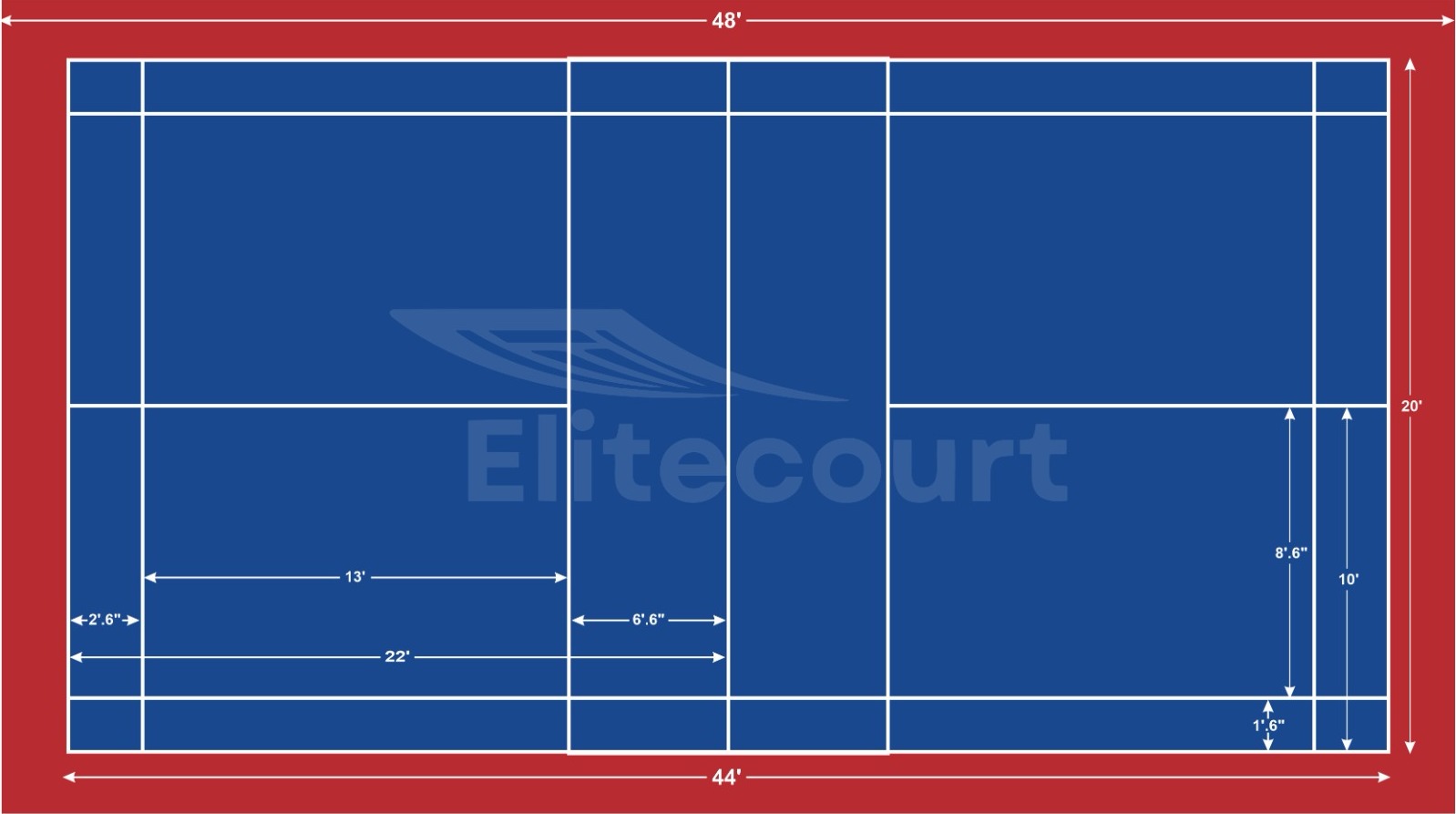
Net height does not exist in isolation. Instead, it is one specification within a comprehensive set of court dimensions defined by the BWF. Understanding the full picture helps players and facility managers see how every measurement relates to the others.
Standard Badminton Court Dimensions:
| Dimension | Measurement (Feet) | Measurement (Meters) |
|---|---|---|
| Court Length (both sides) | 44 feet | 13.4 m |
| Court Width (Doubles) | 20 feet | 6.1 m |
| Court Width (Singles) | 17 feet | 5.18 m |
| Short Service Line from Net | 6.5 feet | 1.98 m |
| Long Service Line (Doubles) | 2.5 feet from back | 0.76 m |
| Back Boundary Line to Net | 22 feet | 6.7 m |
| Net Height at Center | 5 feet | 1.524 m |
| Net Height at Posts | 5 feet 1 inch | 1.55 m |
The Relationship Between Net Height and Service Rules
Badminton service rules connect directly to net height. Under BWF regulations:
- In singles, the server serves from the right service court when their score is even, and from the left when it is odd.
- The shuttle must cross the net and land within the receiver’s service court.
- Since 2018, the service contact point must sit no higher than 1.15 meters above the court surface — a rule introduced to limit excessively high service actions.
Why the 5-Foot Net Makes Serving Challenging
The net at 5 feet creates a specific geometric challenge. The server must project the shuttle high enough to clear the net while landing it within the service court — just 6.5 feet beyond the net at the short service line. Consequently, the low serve — skimming just over the net top — becomes one of the most tactically important shots in the game.
Materials and Equipment — Choosing the Right Net for Your Court
What to Look for in a BWF-Compliant Badminton Net
Choosing the right net is just as important as measuring the correct badminton net height in feet. Here are the key characteristics to verify:
Mesh Size: The mesh must fall between 15 mm and 20 mm per BWF regulations. Too large, and shuttles pass through on edge. Too small, and the net feels solid to a catching shuttle.
Material: Use dark-colored fine cord — most regulation nets use black or dark green polyester or nylon. Cotton nets absorb moisture and sag too easily for serious play.
Top Tape: A 75 mm white tape must fold over the top edge, with a cable running through it to maintain tension and support accurate height measurement.
Net Cable: The cable through the top tape should be non-stretch or very low-stretch. This prevents the center height from dropping during play.
Post Compatibility: Ensure the net’s attachment hooks match your post system. Posts must be rigid and capable of holding the net at exactly 5 feet 1 inch.
Calculate Your Court Material Requirements
Calculate your synthetic sports flooring material and elevate your space!
Indoor vs. Outdoor Net Considerations
Choosing a Net for Outdoor Use
Outdoor play introduces additional challenges. Specifically, outdoor nets must be heavier or include a weighted bottom cord to resist wind. They should also be UV-stabilized to prevent sunlight degradation and moisture-resistant to avoid water absorption and sagging.
Why Indoor Courts Remain the Standard
For competitive play at any level, indoor facilities with controlled environments are the standard. Moreover, an indoor court with a premium synthetic acrylic surface — like those manufactured by Elitecourt — provides the stable, climate-adapted base needed for consistent net height and performance.
Maintaining Correct Net Height Over Time
Why Net Height Drifts — and How to Prevent It
Even after correctly setting the badminton net height in feet, the measurement can drift over time. Common causes include:
- Net stretching: Some cord materials stretch with use, causing the center to sag below 5 feet.
- Post movement: Poorly anchored posts shift inward or outward, altering effective net height.
- Temperature changes: Significant temperature swings change net cord tension — tightening in cold conditions and relaxing in heat.
- Top tape wear: Repeated shuttle impact compresses the tape and marginally reduces effective height.
Preventive Maintenance Practices
Regular Checks and Tensioning
Before every training session or match, verify center height with a measuring tape. Additionally, use the post’s winding mechanism or tensioning device to correct any sag. Catching drift early prevents larger adjustments later.
Inspections and Net Replacement
Check that posts remain perpendicular to the court surface and that floor sockets or base plates stay secure. Furthermore, replace nets that have stretched beyond adjustment range, show visible mesh degradation, or have compromised top tape.
Expert Tip from Elitecourt: For high-use training facilities, invest in nets with stainless steel or galvanized cable through the top tape. These maintain tension far better than ordinary cord or rope, so measurement adjustments are needed less frequently.
Badminton Net Height in Feet — Impact on Game Strategy and Training
How Net Height Shapes Shot Selection
The 5-foot center height is not arbitrary. Rather, it is the product of decades of play development and rule refinement that shaped badminton into one of the fastest racket sports in the world. Here is how net height influences strategy:
The Net Kill: The net kill involves striking the shuttle at or above net height and angling it sharply downward. Because the 5-foot standard demands quick reactions, players must reach the net before the shuttle drops below the tape. A lower net would make net kills easier; a higher net would make them nearly impossible.
The Drop Shot: A well-executed drop shot clears the net by just centimeters and lands steeply on the opponent’s side. Consequently, the precision required to clear 5 feet while staying close to the net makes the drop shot one of the most skill-testing strokes in badminton.
The Low Serve: The geometry between the service contact height rule (1.15 m) and the net height (1.524 m) creates a specific challenge. Servers must project the shuttle upward approximately 14 inches from contact point to net top, while keeping the trajectory flat enough to land in the service box.
The Smash Return: A defensive smash return must clear the net while staying controlled enough to land in the court. Therefore, players must lift the return slightly — which is why smash returns often float higher than attackers prefer.
Training Drill Recommendations Based on Net Height
Understanding the net as a 5-foot barrier leads to more effective drill design. For example:
- Net accuracy drills: Practice drop shots and net shots aiming to clear the net by just 5–10 cm.
- Service trajectory drills: Use a second horizontal cord above the net to practice keeping serves within a specific trajectory window.
- Transition drills: Practice moving from the back court to the net after a clear, covering a full 22-foot distance to reach the 5-foot net.
Transform Your Sports Facility Today!
Contact us for high-quality synthetic sports flooring material and elevate your space!
Elitecourt’s Role in Creating Perfect Badminton Environments
Flooring That Meets the Standard Every Time
At Elitecourt, we understand that a badminton court is a system — not just a collection of individual elements. The net height, court lines, boundary dimensions, and playing surface all work together to create a regulation-compliant, high-performance environment. Therefore, our synthetic acrylic sports court flooring is designed from the ground up to be part of that system.
Why Flooring Matters for Net Height Compliance
Every millimeter of the court surface contributes to the baseline from which all vertical measurements — including net height — are taken. As a result, our surfaces carry strict thickness consistency standards. When the net sits at 5 feet above the surface, it measures 5 feet everywhere on the court — not just at the measurement point.
Our surface technologies include:
- Multi-layer acrylic systems: Multiple precisely calibrated layers over a prepared base, delivering a dimensionally consistent and performance-optimized surface.
- Cushioning layers: Optional cushioning provides the shock absorption and energy return needed for high-intensity badminton play.
- Surface texture calibration: The texture provides appropriate grip for badminton footwork — enabling players to stop, change direction, and push off confidently.
- Line marking integration: Court lines are applied with precision methods, ensuring sharp, durable boundaries accurately positioned relative to net posts.
Suitable for All Badminton Court Types
Elitecourt’s synthetic acrylic flooring solutions work across a wide range of court environments:
- Indoor sports halls: Our primary domain, where controlled environments allow our surfaces to reach their full performance potential.
- Multi-sport courts: Our surfaces accommodate badminton, basketball, volleyball, and other sports on the same floor with clearly marked lines.
- Training academies: High-use environments demand durable, easily maintained surfaces — qualities built into every Elitecourt product.
- Institutional facilities: Schools, universities, and government sports complexes benefit from our surfaces’ longevity and compliance with international standards.
Frequently Asked Questions
The BWF mandates 5 feet (1.524 meters) at the center and 5 feet 1 inch (1.55 meters) at the posts, measured from the playing surface to the top of the net tape. This applies to both singles and doubles formats.
Yes. The net height is universal across all adult competitive formats — men’s singles, women’s singles, doubles, and mixed doubles — at 5 feet at the center and 5 feet 1 inch at the posts.
Use a rigid measuring tape or net height gauge. Measure vertically from the court surface to the top of the net tape at the center — it must read exactly 60 inches (5 feet). Confirm both posts measure 61 inches (5 feet 1 inch). Adjust the net cable as needed.
All recognized competitive play follows the BWF’s 5-foot standard. Junior programs for children under 10 or 11 may lower the net to aid development, per initiatives like BWF’s Shuttle Time. Recreational settings can adjust freely, though aspiring competitive players should train on a regulation-height net early on.
Yes. Net height is measured from the playing surface, so surface thickness directly shifts the baseline. A new flooring layer raises that baseline, making a previously correct net setting read lower. Always re-measure net height after any new surface installation.
The Future of Badminton Courts — Standards, Technology, and Innovation
How International Standards Continue to Evolve
The BWF regularly reviews its Laws of Badminton and technical court specifications. While the 5-foot net height has stayed stable for decades, other standards continue to evolve. Key developments include:
Surface Performance Requirements
Sports governing bodies now specify not just physical court dimensions but also surface performance characteristics — including shock absorption, energy restitution, friction, and shuttle response. Consequently, these standards push manufacturers like Elitecourt to develop surfaces that meet both dimensional and functional specifications.
Sustainability in Court Materials
There is growing interest in the sustainability profiles of sports flooring — including recyclability of synthetic surfaces, VOC content in acrylic coatings, and overall surface durability. Elitecourt, therefore, actively develops surface systems that align with these evolving sustainability expectations.
Multi-Sport Adaptability
Modern sports facilities increasingly require courts that serve multiple sports. As a result, surface design must accommodate different line configurations, texture requirements, and equipment anchor points — all while maintaining the dimensional precision each sport demands.
Elitecourt’s Commitment to Future-Ready Courts
At Elitecourt, our product development philosophy centers on one principle: great courts start with great surfaces. As badminton grows globally — with expanding professional circuits, grassroots investment, and growing recreational participation — the demand for courts that meet and exceed international standards will only rise.
Our synthetic acrylic flooring systems are built not just for today’s standards but with the adaptability to meet evolving requirements. Whether a new BWF performance specification, an updated international building standard, or the specific needs of a national federation’s new training center, Elitecourt delivers surfaces that provide the ideal foundation for badminton at every level.
Transform Your Sports Facility Today!
Contact us for high-quality synthetic sports flooring material and elevate your space!
Conclusion
The badminton net height in feet — 5 feet at the center, 5 feet 1 inch at the posts — is one of the sport’s most fundamental specifications. It shapes service rules, calibrates shot trajectories, and drives game strategy. Understanding this measurement, verifying it accurately, and keeping it consistent over time are responsibilities every player, coach, and facility manager shares.
Throughout this guide, we have covered the full context of net height: complete court dimensions, compliant net characteristics, court surface influence, age-group adaptations, and strategic shot implications. Each element connects to the others. Consequently, no single dimension — including net height — can be considered in isolation.
At Elitecourt, we bring years of experience in manufacturing synthetic acrylic sports court flooring to every project. We know that a regulation badminton court is a precision environment where every dimension must be exactly right. As a result, our flooring systems deliver the dimensionally consistent, high-performance surface that makes that precision possible.
Whether you are setting up a single recreational court or building a world-class multi-court training facility, Elitecourt is your partner for flooring that meets international standards, performs under elite play demands, and endures high-use environments. When the surface is right, everything else — including getting the badminton net height in feet exactly right — becomes significantly easier.