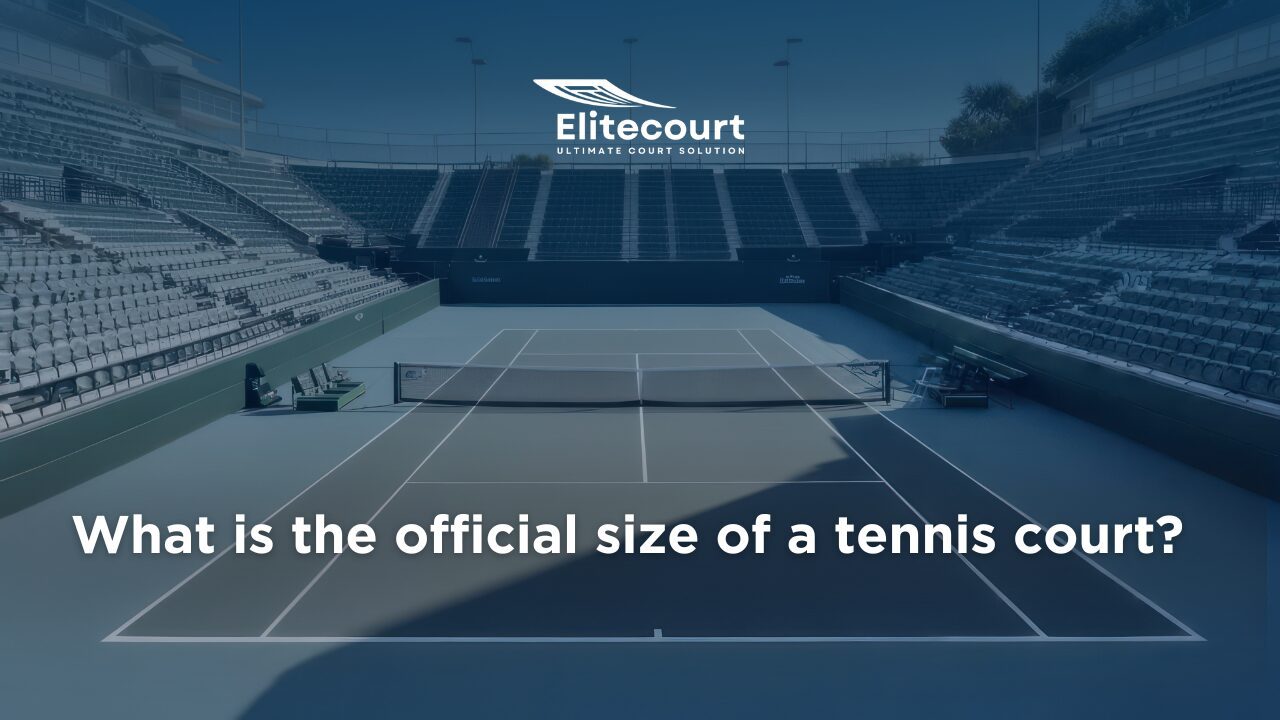
If you’ve ever wondered, “What exactly is the official size of a tennis court?” you’re not alone. The official size tennis court measures 78 feet (23.77 meters) in length and 27 feet (8.23 meters) in width for singles matches, while doubles courts extend to 36 feet (10.97 meters) in width, as per the International Tennis Federation (ITF) standards. Beyond these precise dimensions, the total play area — including safety run-offs — covers approximately 120 feet by 60 feet to ensure player comfort and safety.
For anyone planning a court for a school, academy, or professional facility, knowing these exact measurements is the foundation of proper design.
In this comprehensive guide, Elitecourt, India’s trusted manufacturer of synthetic acrylic sports court flooring, breaks down every detail — from official layout and line marking to surface materials, safety spacing, and performance considerations.
By the end, you’ll understand not just the official size of a tennis court, but also how to design and surface it to international standards with quality materials that ensure consistency, safety, and long-lasting performance.
Understanding the Concept of an Official Size Tennis Court
A tennis court might seem like a simple rectangle with a net across the middle, but it’s actually designed with mathematical precision. Every line, angle, and area is carefully measured and regulated by the International Tennis Federation (ITF) — the global authority governing tennis court dimensions and surface standards.
The ITF defines the official size tennis court as:
- Length: 78 feet (23.77 meters)
- Width (Singles): 27 feet (8.23 meters)
- Width (Doubles): 36 feet (10.97 meters)
- Net Height (Center): 3 feet (0.914 meters)
- Net Height (Posts): 3.5 feet (1.07 meters)
These are non-negotiable measurements for professional or competitive play.
However, the total playing area — including space outside the lines for safe player movement — is larger:
- Overall Length: 120 feet (36.58 meters)
- Overall Width: 60 feet (18.29 meters)
This ensures players have enough room to chase deep shots, perform lateral movements, and play without physical constraints.
| Court Type | Playing Area | Total Area (with Run-off) | Purpose |
|---|---|---|---|
| Singles | 78 ft × 27 ft | 120 ft × 60 ft | Individual matches |
| Doubles | 78 ft × 36 ft | 120 ft × 60 ft | Doubles matches |

Elitecourt Insight: While the playing area is fixed, the surface system — especially in synthetic courts — can be customized for different speed categories (slow, medium, fast), depending on the intended level of play.
Why Official Size Matters in Tennis Court Design
You might wonder, “Why can’t we just make the court a few feet smaller to save space?” The answer is simple: precision ensures fairness.
A slight variation in the official size tennis court can dramatically affect gameplay. The bounce angle, serve accuracy, and player rhythm all depend on the standardized layout. This is why both amateur and professional courts worldwide follow ITF’s dimensional rules.
Key reasons why the official size matters:
- Consistency in Training: Players can practice and perform under identical conditions across different venues.
- Tournament Readiness: Officially sized courts meet ITF certification requirements, making them eligible for competitive events.
- Safety Assurance: Adequate run-off areas prevent collisions and injuries during intense rallies.
- Asset Value: Facilities built to official dimensions maintain higher property and rental value.
Elitecourt Tip: Before installation, ensure your chosen surface system and line marking align with ITF-approved standards to qualify as an official size tennis court.
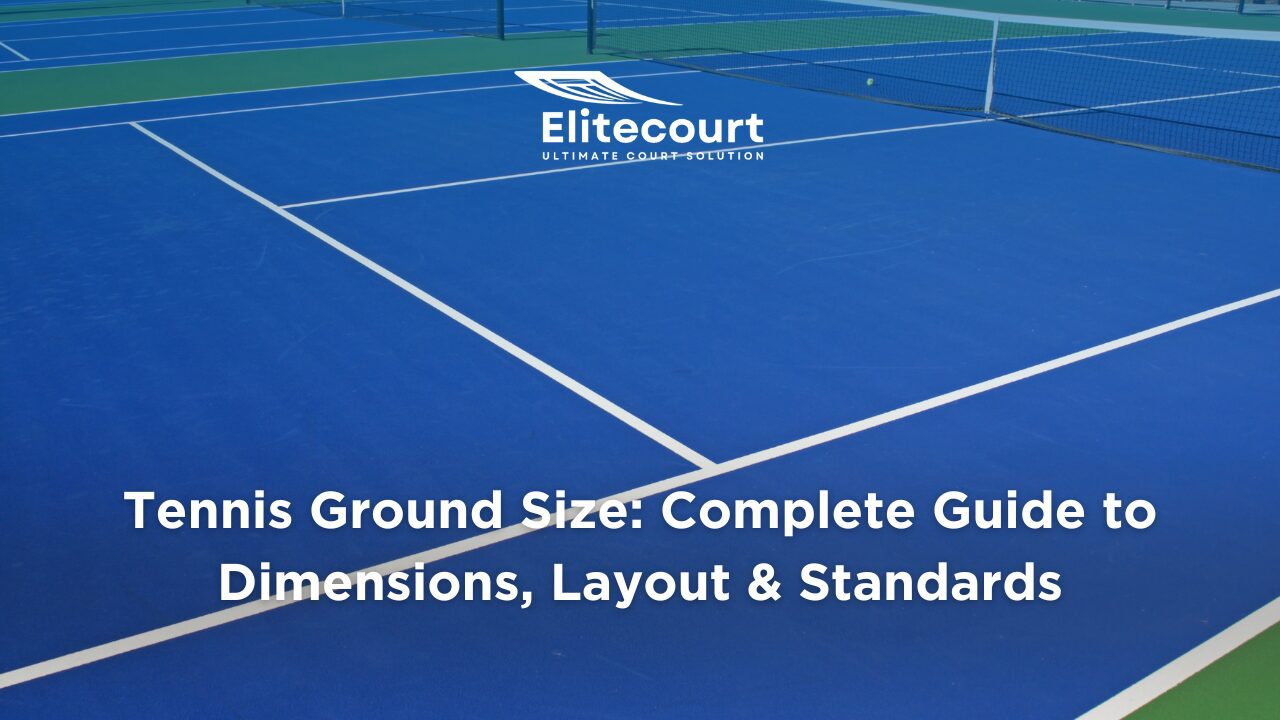
Breakdown of an Official Size Tennis Court Layout
To truly appreciate the design, let’s break down the court into its essential sections:
Baselines and Sidelines
The baseline runs parallel to the net at the farthest end of each side, while the sidelines mark the width boundaries. Singles sidelines are inside the doubles sidelines, forming the narrower playing area.
Service Boxes
Each side of the net has two service boxes divided by the center service line. These are crucial for accurate serving — every serve must land in the diagonally opposite service box.
Center Mark
A short line in the middle of each baseline, the center mark helps players position themselves correctly when serving.
Net and Posts
The net divides the court into two equal halves. It’s supported by posts located 3 feet (0.914 meters) outside the doubles sidelines.
Pro Tip: The tension and height of the net can alter gameplay subtly. Always check the net height regularly to maintain ITF accuracy.
The Ideal Surface for an Official Size Tennis Court
The surface type significantly impacts gameplay characteristics — from ball bounce and speed to player comfort and injury risk. While the dimensions remain the same, surface choice can vary depending on budget, usage frequency, and climate.
The ITF classifies tennis courts into different speed categories, each suited to specific playing styles.
| Surface Type | Ball Speed | Bounce Height | Maintenance | Common Use |
|---|---|---|---|---|
| Acrylic (Synthetic) | Medium–Fast | Consistent | Low | Professional & recreational |
| Clay | Slow | High | Moderate | Training & traditional clubs |
| Grass | Very Fast | Low | High | Prestigious tournaments |
| Artificial Turf/Carpet | Medium | Moderate | Low | Indoor & multipurpose courts |
Among these, synthetic acrylic flooring — Elitecourt’s specialty — stands out as the most reliable and versatile surface for India’s climate.
Elitecourt’s Acrylic Flooring Systems for Official Tennis Courts
At Elitecourt, our acrylic systems are meticulously engineered for official size tennis courts, ensuring superior playability, durability, and compliance with ITF standards.
Key Features of Elitecourt’s Acrylic Surfaces:
- ITF-Compliant Performance: Ensures official ball bounce and speed consistency.
- High UV Resistance: Prevents fading under prolonged sunlight.
- Custom Layering: Choose from cushioned or non-cushioned variants to suit performance levels.
- Seamless Finish: Smooth yet slip-resistant, ideal for competitive matches.
- Low Maintenance: Simple cleaning routines keep the surface in prime condition.
Expert Insight: Elitecourt’s flooring systems use advanced acrylic resins and pigment technology to maintain color brilliance and friction uniformity over time.
Transform Your Sports Facility Today!
Contact us for high-quality synthetic sports flooring material and elevate your space!
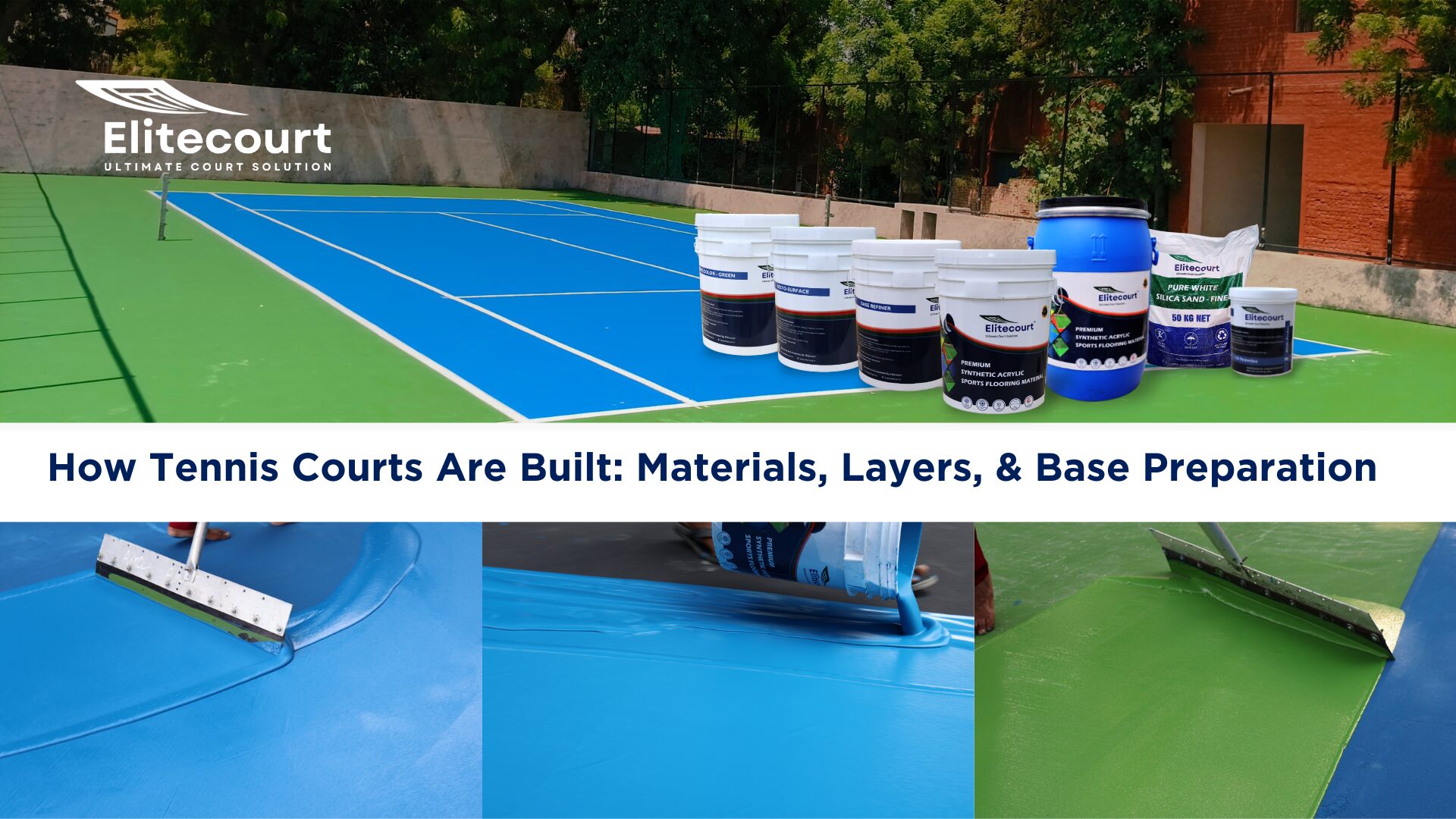
Surface Construction: Layers that Define Quality
A professional-grade official size tennis court isn’t just about dimensions — it’s also about what lies beneath. The surface construction typically includes multiple layers that provide shock absorption, traction, and longevity.
Here’s a simplified structure of a high-performance acrylic system:
- Base Layer (Sub-Base):
Compacted asphalt or concrete forms a stable foundation. Proper slope (1%) ensures efficient water drainage. - Primer Coat:
Promotes adhesion between the base and subsequent layers. - Resurfacer Coat:
Smooths surface imperfections and enhances texture uniformity. - Acrylic Cushion Layers (Optional):
Adds comfort and shock absorption — ideal for schools or recreational use. - Color Coating System:
Two or more coats of high-quality, UV-resistant acrylic for vibrant color and skid control. - Line Marking:
High-opacity, weatherproof white paint defines the official playing zones.
Elitecourt Tip: Always ensure proper surface slope and sub-base compaction before applying acrylic systems to prevent cracks or water stagnation.
Essential Safety and Space Considerations
Building an official size tennis court isn’t just about marking dimensions; it’s also about ensuring safe playability. The ITF recommends additional clearance space beyond the play area:
- Behind each baseline: Minimum 21 feet (6.40 meters)
- Outside each sideline: Minimum 12 feet (3.66 meters)
These safety margins prevent collisions and provide ample movement for fast-paced rallies.
Elitecourt Insight: While many local facilities compromise on run-off space to fit smaller plots, it’s critical for professional training centers to maintain these clearances for player safety and ITF compliance.
Color Schemes and Aesthetic Standards for Official Size Tennis Courts
The appearance of a tennis court may not affect gameplay, but it certainly enhances the visual experience. A well-designed official size tennis court balances performance with aesthetics. Over the years, color contrasts have evolved to improve visibility, player focus, and audience appeal.
Popular Color Combinations
- Blue & Green: The most recognizable scheme globally, used in major tournaments like the US Open. The blue inner court enhances ball visibility, while the green outer zone defines boundaries.
- Red & Green: A traditional combination often used in clubs and schools.
- Custom Colors: Many institutions choose colors that align with their brand identity or local environment.
Elitecourt’s Approach to Color Coating
Elitecourt’s acrylic flooring systems allow full customization with fade-resistant pigments. The company’s advanced color-coating technology ensures long-term brightness, even under harsh UV exposure.
Expert Tip: Always use ITF-approved color tones with matte finishes to avoid glare. Shiny surfaces can reflect sunlight, making it hard for players to track the ball during rallies.
Transform Your Sports Facility Today!
Contact us for high-quality synthetic sports flooring material and elevate your space!
Court Zoning and Visual Impact
The contrasting color zones not only make the court look appealing but also help players maintain visual orientation during fast-paced games. These small details define the difference between a casual court and an official size tennis court built for competitive use.
Drainage, Slope, and Environmental Considerations
A perfectly sized tennis court is useless without effective water management. Even small puddles can lead to surface degradation or slippery conditions.
Ideal Slope and Drainage Design
The official standard slope for a tennis court is between 0.83% and 1%, typically sloping from the center toward both sides or one end. This ensures quick water runoff without noticeable unevenness during play.
Eco-Conscious Design Practices
Elitecourt advocates environmentally sustainable court design, promoting:
- Water-efficient drainage systems to minimize waste.
- Non-toxic materials that meet green building standards.
- Reflective coatings that reduce heat absorption in hot climates.
Elitecourt Insight: Proper slope calculation and drainage are just as vital as surface layering. Even an officially measured court can fail performance tests if drainage isn’t optimized.
Lighting Recommendations for Official Size Tennis Courts
An official tennis court isn’t complete without appropriate lighting, especially for evening or indoor matches.
Lighting Layout Guidelines
According to ITF recommendations:
- The minimum lighting level should be 300 lux for recreational play and 500 lux for professional tournaments.
- Light poles should be positioned outside the court perimeter, ideally at least 3 feet (0.9 meters) from the sidelines and 12 feet (3.6 meters) behind the baselines.
- Uniform light distribution prevents glare and shadow zones.
LED vs. Metal Halide Lights
| Lighting Type | Advantages | Lifespan | Energy Efficiency |
|---|---|---|---|
| LED | Instant brightness, low maintenance | 50,000+ hours | High |
| Metal Halide | Strong beam, traditional choice | 15,000–20,000 hours | Moderate |
Pro Tip: Elitecourt recommends LED lighting systems for official size tennis courts to reduce power consumption while maintaining high brightness uniformity.
Maintenance Practices for Acrylic Tennis Courts
Even the best-constructed courts require regular upkeep to maintain ITF compliance and extend their lifespan.
Routine Maintenance Tasks
- Regular Cleaning: Sweep debris, leaves, and dirt weekly to prevent abrasion.
- Surface Washing: Rinse with mild detergent and water monthly to remove dust and algae.
- Line Repainting: Refresh line markings periodically for visibility.
- Inspection: Check for cracks, bubbles, or drainage issues every six months.
Avoid These Mistakes
- Using high-pressure water jets that can damage coatings.
- Allowing standing water for extended periods.
- Using harsh chemicals that degrade acrylic resin.
Elitecourt Maintenance Tip: Always use soft-bristle brushes and pH-neutral cleaning solutions to preserve surface integrity.
Common Mistakes When Designing an Official Size Tennis Court
Building a tennis court isn’t just about meeting dimensional requirements — small design errors can impact playability and safety.
Here are common pitfalls to avoid:
- Ignoring Drainage: Poor slope design leads to surface cracks and moss growth.
- Incorrect Base Preparation: Weak foundations cause uneven surfaces and peeling.
- Non-Compliant Line Marking: Misaligned lines can disqualify courts from official recognition.
- Improper Surface Selection: Choosing unsuitable material for local weather reduces lifespan.
- Inadequate Perimeter Space: Reduces safety and limits competitive play.
Expert Tip: Always work with a certified flooring manufacturer like Elitecourt who understands ITF standards from the ground up.
Benefits of Building an Official Size Tennis Court with Quality Flooring
When it comes to building a tennis court, size and surface aren’t just technicalities — they define the entire playing experience. A correctly designed and surfaced official size tennis court offers a combination of precision, performance, and longevity that smaller or non-standard courts simply can’t match. Whether it’s a school, club, or private sports facility, adhering to official dimensions and choosing a professional-grade flooring system like Elitecourt’s synthetic acrylic ensures every serve, volley, and rally feels just right.
Let’s explore the key benefits of building an official size tennis court using high-quality acrylic flooring materials:
Consistent Playability and Professional Experience
The greatest advantage of an official size tennis court lies in its precision. Every inch of the court — from baselines to sidelines — is engineered to match ITF standards, which ensures a consistent ball bounce, predictable trajectory, and uniform player movement.
Players, whether beginners or professionals, can train under the same conditions used in tournaments worldwide. This consistency allows them to develop muscle memory, refine technique, and transition seamlessly to competitive play. With Elitecourt’s synthetic acrylic systems, the surface delivers stable friction and controlled pace, helping athletes perform at their best without worrying about surface irregularities.
Long-Term Durability and All-Weather Resilience
A well-constructed tennis court is an investment meant to last for decades. Using subpar materials or incorrect dimensions can lead to cracks, uneven wear, and costly repairs. Elitecourt’s acrylic flooring systems are formulated to resist UV degradation, heavy rainfall, and extreme temperature changes — making them ideal for India’s diverse climate.
Unlike clay or grass courts that require frequent maintenance, acrylic courts retain their structure and vibrancy over time. The multi-layer coating system not only enhances durability but also shields the court from fading and water damage, ensuring year-round usability even after intense monsoons or scorching summers.
Low Maintenance and Cost Efficiency
Maintenance often becomes the deciding factor for facility managers. An official size tennis court with Elitecourt’s premium acrylic surface demands minimal upkeep — simple cleaning routines, periodic inspections, and occasional line repainting keep it match-ready.
The non-porous surface prevents dust buildup and water seepage, reducing the need for frequent resurfacing. This translates into long-term cost savings, both in maintenance and downtime. Facilities can focus on play, not repairs — an essential factor for schools, academies, and clubs operating multiple courts.
Elitecourt Insight: Proper maintenance can extend the lifespan of an acrylic court by several years without compromising play quality, making it one of the most cost-efficient sports investments.
Enhanced Safety and Player Comfort
Safety is a top priority in any sport. The official size tennis court design includes standardized run-off zones to prevent collisions, while the synthetic acrylic surface adds a layer of comfort by reducing impact stress on joints and muscles.
Elitecourt’s cushioned variants go a step further by incorporating elastomeric layers that absorb shock, offering smoother foot transitions and lowering fatigue. For young athletes or frequent players, this comfort factor significantly reduces injury risk and enhances overall endurance.
The anti-slip texture ensures confident footwork even during high-speed lateral movements, allowing athletes to push their limits without fear of slipping or strain.
Aesthetic Appeal and Facility Value
A visually appealing court reflects professionalism and attention to detail. With vibrant, fade-resistant colors, Elitecourt’s acrylic systems make every official size tennis court look tournament-ready. The two-tone color contrast — typically blue for the playing area and green for the perimeter — enhances ball visibility and creates a world-class visual impact.
Beyond aesthetics, courts that meet official size standards carry a higher asset and rental value. Sports facilities and educational institutions benefit from increased credibility, making them more attractive for hosting tournaments, coaching programs, or partnerships.
Pro Tip: A well-maintained, official-size court not only improves player satisfaction but also elevates the reputation of your facility — a winning combination for long-term growth.
Global Standard Compliance and Prestige
When you build an official size tennis court, you align your facility with International Tennis Federation (ITF) regulations. This compliance positions your court among globally recognized infrastructures, opening doors to potential events, certifications, and professional partnerships.
Using ITF-tested materials from Elitecourt ensures your surface meets international performance benchmarks for pace, traction, and bounce. Whether your goal is training future champions or creating a premium recreational space, official compliance sets you apart in the sports ecosystem.
Sustainability and Environmental Responsibility
Modern sports infrastructure must be sustainable — and Elitecourt’s acrylic flooring systems are formulated with eco-friendly, low-VOC materials that minimize environmental impact. By choosing these surfaces, you not only ensure superior performance but also contribute to greener construction practices.
Acrylic surfaces also require less water and chemical use compared to traditional grass or clay courts, aligning with modern environmental goals and long-term maintenance efficiency.
In short, building an official size tennis court with Elitecourt’s high-quality acrylic flooring means investing in precision, performance, and prestige. From professional-grade playability and safety to aesthetic excellence and sustainability, every benefit contributes to creating a facility that meets global standards and inspires every player who steps onto the court.
Transform Your Sports Facility Today!
Contact us for high-quality synthetic sports flooring material and elevate your space!
How to Ensure Compliance with ITF Standards
For a tennis court to be recognized as “official,” it must meet International Tennis Federation (ITF) specifications for both size and surface type.
To verify compliance:
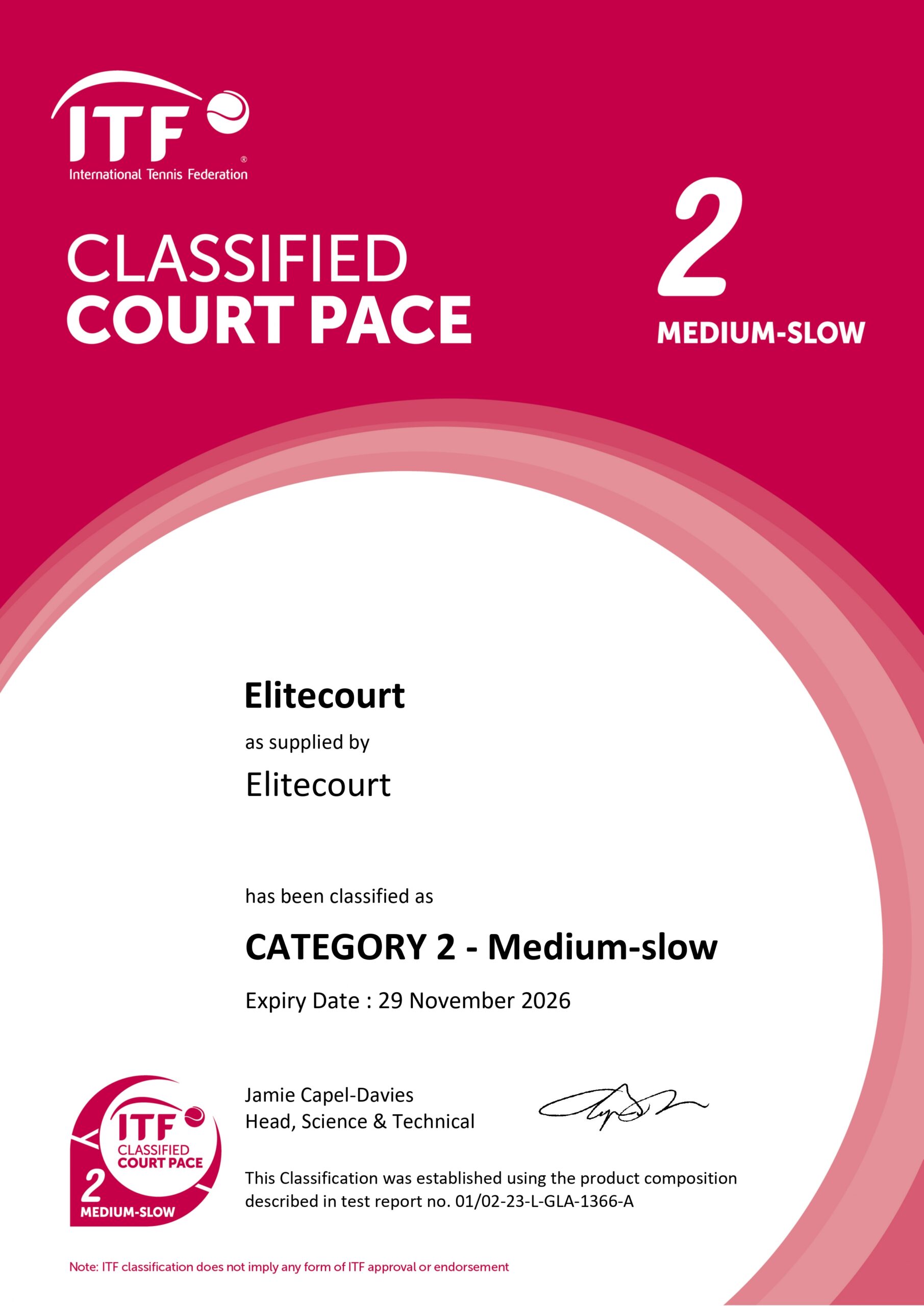
- Follow ITF Court Pace Classification (CPC) guidelines.
- Ensure line markings match official measurements exactly.
- Use ITF-tested and certified materials, especially for the top coating system.
- Maintain accurate net height and run-off space clearances.
For more information, visit the ITF Facilities Guide — the authoritative resource for tennis court construction standards.
FAQs
The official size tennis court measures 78 feet (23.77 meters) in length and 27 feet (8.23 meters) in width for singles, while doubles courts are 36 feet (10.97 meters) wide.
Acrylic synthetic surfaces are most recommended for official tennis courts due to their durability, weather resistance, and consistent play characteristics.
Technically, yes — but it will not meet ITF standards. Reducing size compromises play quality and safety, making it unofficial.
ITF recommends at least 21 feet (6.4 meters) behind the baselines and 12 feet (3.66 meters) outside the sidelines.
Elitecourt is a manufacturer of high-quality synthetic acrylic flooring materials and does not perform installation directly, but our products are widely used by certified installers across India.
Conclusion: Building Precision with Passion
The official size tennis court isn’t just about measurement — it’s about precision, performance, and passion. Every line, layer, and coating contributes to a unified goal: to provide a fair, safe, and enjoyable game experience.
With Elitecourt’s premium acrylic flooring systems, you’re not just choosing a surface; you’re choosing international-level quality trusted by professionals and institutions alike. From exact ITF dimensions to durable coatings and stunning finishes, every court built with Elitecourt materials reflects the perfect blend of engineering and elegance.
Whether you’re upgrading a school court or designing a professional facility, start with the right size, the right standards, and the right surface — start with Elitecourt.