Introduction: What Really Goes Into Building a Tennis Court?
If you’ve ever walked onto a professionally finished tennis court and marveled at its perfectly smooth surface, consistent bounce, and firm underfoot grip, you’ve experienced the result of a complex, multi-layered construction process. Tennis courts are not simply flat stretches of concrete or asphalt poured and painted over. They are precision-engineered playing surfaces built from the ground up — layer by layer — where every material choice and preparation step directly affects how the court performs, how long it lasts, and how safe it remains for players.
The construction of a tennis court involves a carefully sequenced series of decisions: selecting the right base material, preparing the subgrade with proper drainage and slope, applying structural base layers, and finishing with the appropriate surface system. Each stage demands attention to detail, adherence to engineering specifications, and an understanding of the local environment, expected usage, and player requirements.
At the heart of a world-class tennis court lies the surface material — and this is where manufacturers like Elitecourt play a pivotal role. While the base is typically the responsibility of civil engineers and contractors, the surface materials that cap the entire structure are what define the game. Elitecourt engineers its synthetic acrylic flooring materials to deliver consistent ball bounce, appropriate traction, UV resistance, and weather durability — making them the preferred surface for builders who want a court that performs season after season.
This comprehensive guide walks you through every step of tennis court construction, from raw earth to the finished playing surface — and explains why each decision matters.
Understanding Tennis Court Types and Their Impact on Construction
Before the first shovel hits the ground, the most critical decision in tennis court construction is choosing what type of court surface to build. Different surface types require different base preparations, layer thicknesses, and finishing systems. The four main categories of tennis courts are:
Hard Courts (Asphalt and Concrete Base)
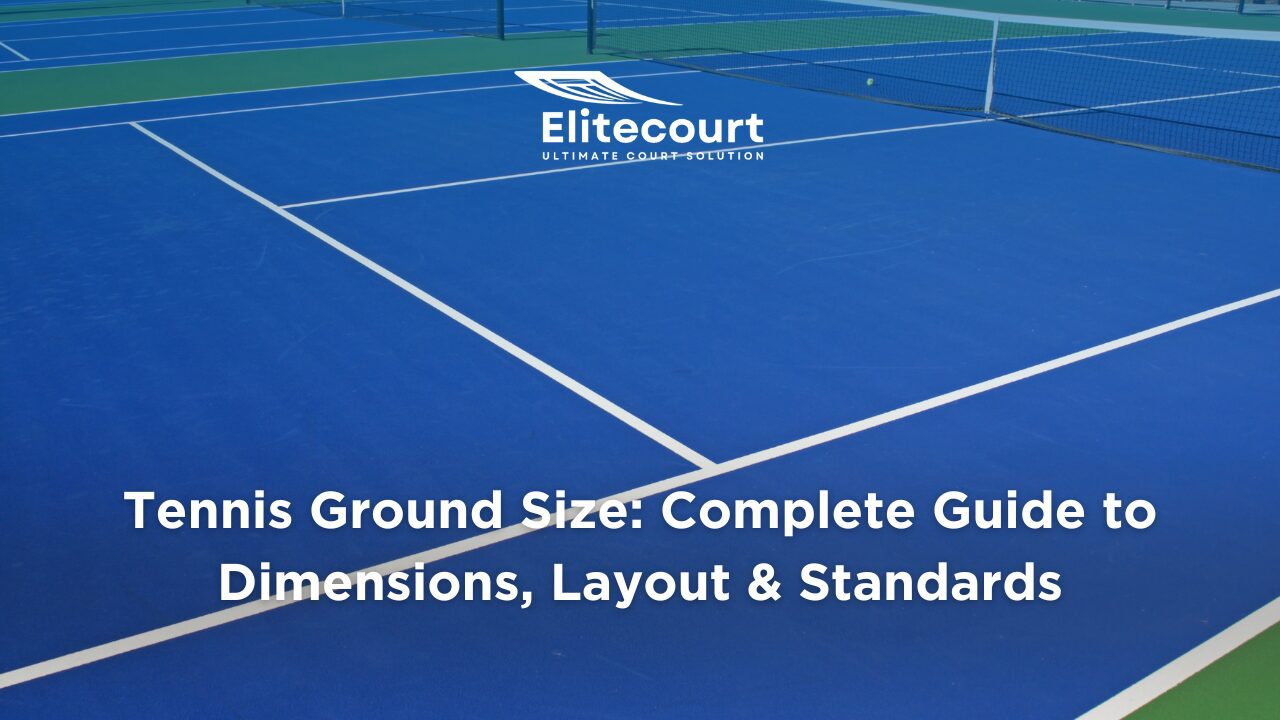
Hard courts are the most widely constructed type globally. They use a rigid base — either asphalt or concrete — and include a synthetic acrylic surface coating system on top. Hard courts deliver a medium-to-fast pace of play, consistent ball bounce, and relatively lower maintenance requirements compared to natural surfaces.
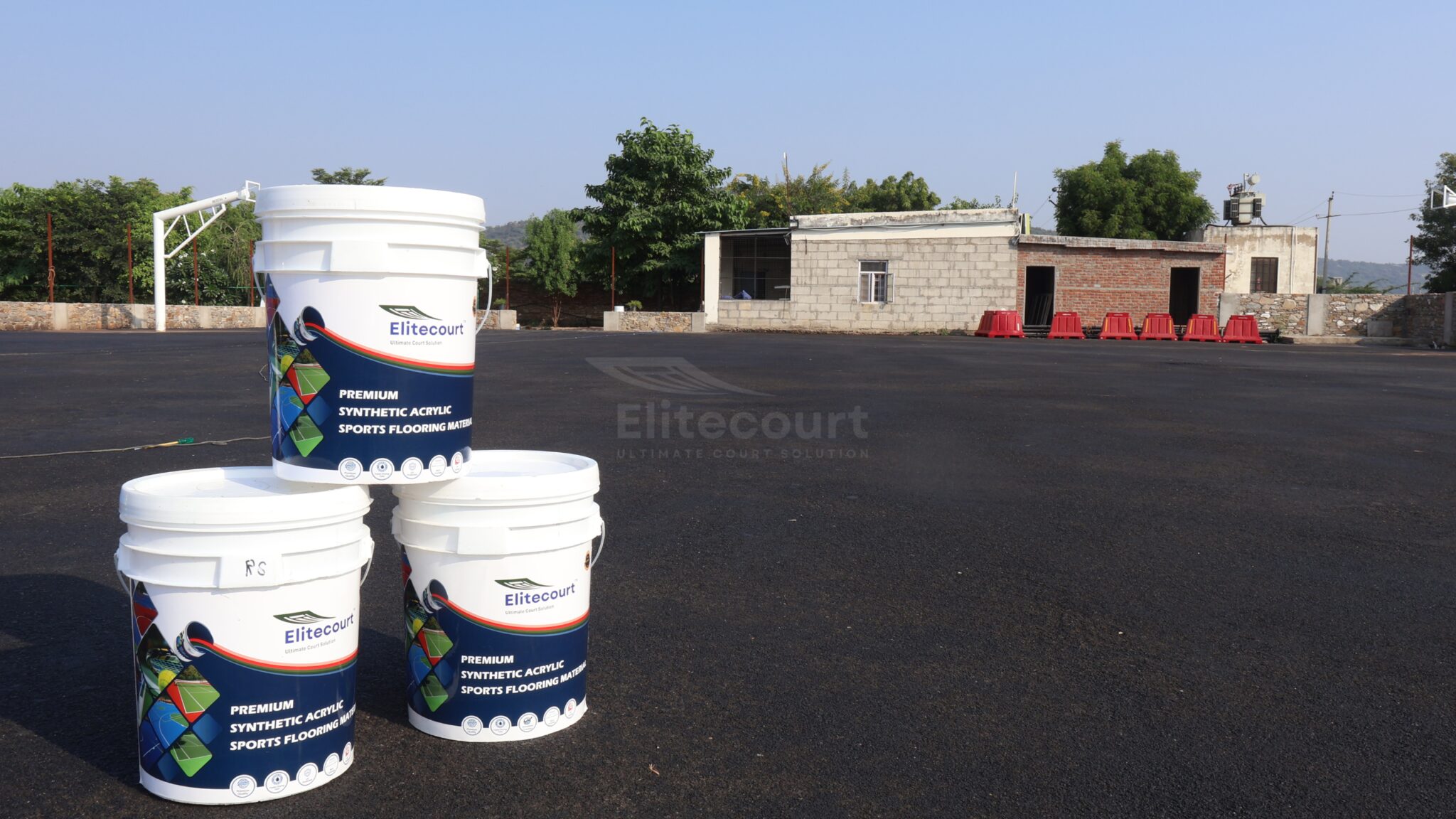
The surface material applied to hard courts is typically a synthetic acrylic coating system, where Elitecourt’s products come into play. These coatings bond to the rigid base, provide texture for ball-to-surface interaction, and resist cracking, fading, and UV degradation over years of play.
Hard courts built with asphalt bases offer slightly more flexibility and perform better in environments with moderate freeze-thaw cycles. Concrete bases, while more rigid and expensive to repair if cracked, provide superior long-term stability and remain popular in warmer climates.
Clay Courts
Clay courts are constructed using layers of granular materials — typically crushed brick, shale, or stone — that create a soft, porous playing surface. These materials allow significant ball bounce variation and produce slower gameplay. While synthetic acrylic coatings are not the primary surface on traditional clay courts, acrylic-clay hybrid systems are increasingly popular in regions seeking the appearance of clay with the structural benefits of a hard court.
Grass Courts
Natural grass courts — the oldest and most prestigious surface in tennis — require a carefully prepared sub-base with exceptional drainage, followed by soil preparation, seed or turf installation, and constant maintenance. These courts are rare in modern construction due to upkeep demands.
Synthetic Turf Courts
Synthetic turf courts replicate the appearance and feel of grass using artificial fiber systems installed over a permeable or impermeable base. They require less maintenance than natural grass but more specialized installation than hard courts.
The Foundation of Every Great Tennis Court — Base Preparation
No surface material, regardless of how advanced it is, can compensate for a poorly prepared base. Base preparation is the single most critical phase in tennis court construction. It determines whether the court remains level and stable for years or develops cracks, drainage problems, and surface irregularities within months.
Subgrade Assessment and Soil Preparation
Every tennis court construction project begins below the surface — with the subgrade, which forms the native soil layer on which builders construct the entire court. Before any construction begins, engineers perform a geotechnical assessment of the subgrade to understand:
- Soil bearing capacity — Can the native soil support the weight of the base layers and surface without settling unevenly?
- Soil type — Clay soils expand when wet and contract when dry, creating movement that can crack the base. Sandy soils drain well but may shift. Loamy soils offer moderate performance.
- Moisture content — Subgrade that is too wet must dry or require treatment with lime or other stabilizing agents before construction proceeds.
- Organic material — Contractors must remove all topsoil, roots, grass, and organic matter to a depth of at least 200–300mm before placing the engineered sub-base.
Once contractors assess and clear the subgrade, they must compact it mechanically to achieve uniform density. They typically use a vibratory roller or plate compactor for this process. Uneven compaction is a leading cause of differential settlement — where different sections of the court sink at different rates, creating an uneven playing surface.
Establishing Proper Drainage and Gradient
Drainage is the single biggest enemy of a tennis court. Standing water on or beneath a court surface causes structural damage, surface bubbling, mold growth, and accelerated deterioration of both the base and the surface coating system.
According to the International Tennis Federation (ITF) — the global governing body for tennis — builders must construct a tennis court with a minimum cross-fall slope of 1:100 (1%) to allow efficient surface water runoff. Engineers must integrate this slope into the subgrade and maintain it through every construction layer above.
🔗 For full specifications, refer to the ITF’s Court Pace Classification guidelines and ITF Approved Test Methods, available at www.itftennis.com.
Proper drainage involves:
- Perimeter drainage channels — Trenches installed around the court perimeter collect and redirect surface runoff away from the court structure.
- Sub-surface drainage — In areas with high water tables or heavy rainfall, contractors install perforated drainage pipes (French drains) below the base layer to carry groundwater away.
- Correct gradient direction — Water should drain to one side or corner of the court consistently, without creating low points where water can pool.
A court built without proper drainage will almost always fail prematurely, regardless of the quality of materials placed on top of it.
Sub-Base Layer — Crushed Aggregate
Above the compacted subgrade comes the sub-base layer, typically composed of crushed stone or granular aggregate (limestone, granite, or recycled concrete). This layer serves several critical functions:
- It provides a stable, load-bearing platform for the structural base above.
- It distributes surface loads evenly across the subgrade.
- It acts as a drainage layer, allowing water to percolate through and move laterally toward drainage systems.
- It helps prevent frost heave in cold climates by breaking the capillary action of water rising from below.
Typical sub-base thickness ranges from 150mm to 300mm depending on subgrade conditions, expected usage, and local climate. In areas with poor subgrade or heavy usage, a thicker sub-base provides additional stability.
The sub-base aggregate must be:
- Well-graded — A range of particle sizes that compact tightly without large voids
- Angular, not rounded — Angular particles interlock better and resist movement
- Clean and free of fines — Excessive clay or silt content reduces drainage and causes instability
After placement, contractors must mechanically compact the sub-base in layers (typically 100mm lifts) to achieve maximum density..
Transform Your Sports Facility Today!
Contact us for high-quality synthetic sports flooring material and elevate your space!
Structural Base Layers — Asphalt vs. Concrete
Once the sub-base is prepared and compacted, contractors place the structural base layer. This is the rigid layer that directly supports the finished surface and gives the court its characteristic firmness.
Asphalt Base Construction
Hot mix asphalt (HMA) serves as the most widely used base material for tennis courts worldwide. It is cost-effective, flexible, quick to install, and produces a smooth surface that bonds well with synthetic acrylic coating systems.
Asphalt Layer Composition
A typical asphalt base for a tennis court consists of:
| Layer | Material | Thickness |
|---|---|---|
| Base Course | Dense-graded coarse asphalt | 50–75mm |
| Binder Course (optional) | Intermediate asphalt mix | 25–50mm |
| Surface Course | Fine-graded smooth asphalt | 25–40mm |
Total asphalt depth typically ranges from 75mm to 150mm, depending on subgrade conditions and intended court use.
Key Requirements for Asphalt Tennis Court Bases
- Surface regularity — The finished asphalt surface must not deviate more than 3mm under a 3-metre straightedge. Any humps, dips, or irregularities will telegraph through the finished surface coating.
- Compaction — Asphalt must be compacted while hot using steel-drum rollers to achieve the specified density. Inadequate compaction leads to rutting and surface instability.
- Temperature sensitivity — Asphalt is a thermoplastic material. In very hot climates, it can soften and deform slightly under heavy rolling loads (such as ball machines or service vehicles driven onto the court). Specifying a higher-stability mix design mitigates this.
- Curing time — Freshly laid asphalt should be allowed to cool and cure before any surface coatings are applied. Premature coating of hot asphalt can cause blistering.
Concrete Base Construction
Concrete is an increasingly popular base material for tennis courts, particularly in commercial facilities, schools, and high-performance venues. While more expensive than asphalt to install, concrete offers superior long-term stiffness, dimensional stability, and resistance to deformation.
Concrete Slab Design
A tennis court concrete slab is typically:
- 100–150mm thick for residential and recreational courts
- 150–200mm thick for institutional and high-use facilities
- Reinforced with steel mesh or fiber reinforcement to control cracking
- Designed with expansion joints (typically every 4–6 metres) to accommodate thermal movement and prevent uncontrolled cracking
Concrete Mix Design Requirements
| Parameter | Requirement |
|---|---|
| Compressive strength | Minimum 25 MPa (28-day) |
| Slump | 75–100mm for workability |
| Aggregate size | Maximum 20mm |
| Air entrainment | Optional in freeze-thaw climates |
| Curing | Minimum 28 days before surface coating |
Concrete must cure fully before any acrylic surface coating system is applied. Applying coatings to green (uncured) concrete traps moisture vapor, which causes bubbling, delamination, and coating failure. This is one of the most common reasons surface coatings fail prematurely on concrete courts.
Expert Tip: Before applying any surface coating to concrete, conduct a moisture vapor emission test (ASTM F1869). Readings above 8 lbs/1,000 sq ft/24 hours typically indicate the concrete is too wet for coating application.
Asphalt vs. Concrete — A Comparative Overview
| Factor | Asphalt | Concrete |
|---|---|---|
| Flexibility | Higher (handles soil movement better) | Lower (more susceptible to cracking) |
| Surface smoothness | Very good | Excellent |
| Repair ease | Easy (local patching) | Difficult (patch visibility) |
| Long-term stability | Good | Excellent |
| Coating bond | Excellent | Excellent (after full cure) |
| Thermal expansion | Moderate | Lower |
| Best for | Residential, budget-sensitive, cold climates | Commercial, long-term investment |
The Surface System — Where Elitecourt’s Materials Come In
With the base fully prepared and cured, attention turns to the surface system — the layers that directly touch the ball, the players’ feet, and the equipment. This is where Elitecourt’s expertise and product range make a defining difference.
A synthetic acrylic surface system for tennis courts consists of five distinct layers, each engineered to serve a specific structural or performance function. Together, they form a complete system — and applicators must apply every layer correctly for the finished court to perform as intended.
Here is a clear overview of all five layers before we explore each in detail:
| Layer | Name | Primary Purpose |
|---|---|---|
| Layer 1 | Base Refiner / Crack Filler | Repair base defects and create a smooth substrate |
| Layer 2 | Acrylic Resurfacer Coat | Seal and level the base; build a uniform foundation |
| Layer 3 | Cushion Coats | Absorb impact energy; enhance player comfort and safety |
| Layer 4 | Acrylic Color Coat (Base Color) | Deliver color, texture, pace, and weather resistance |
| Layer 5 | Acrylic Finishing / Top Coat | Protect and seal; provide final surface performance |
Layer 1 — Base Refiner / Crack Filler
Before a single drop of coating is applied, contractors thoroughly clean, inspect, and repair the base surface. This first step — base refining and crack filling — is arguably the most consequential in the entire surface application process. A surface system is only as good as the substrate it sits on. Any imperfection left unaddressed at this stage will telegraph upward through every subsequent layer, becoming visible and functionally disruptive in the finished court.
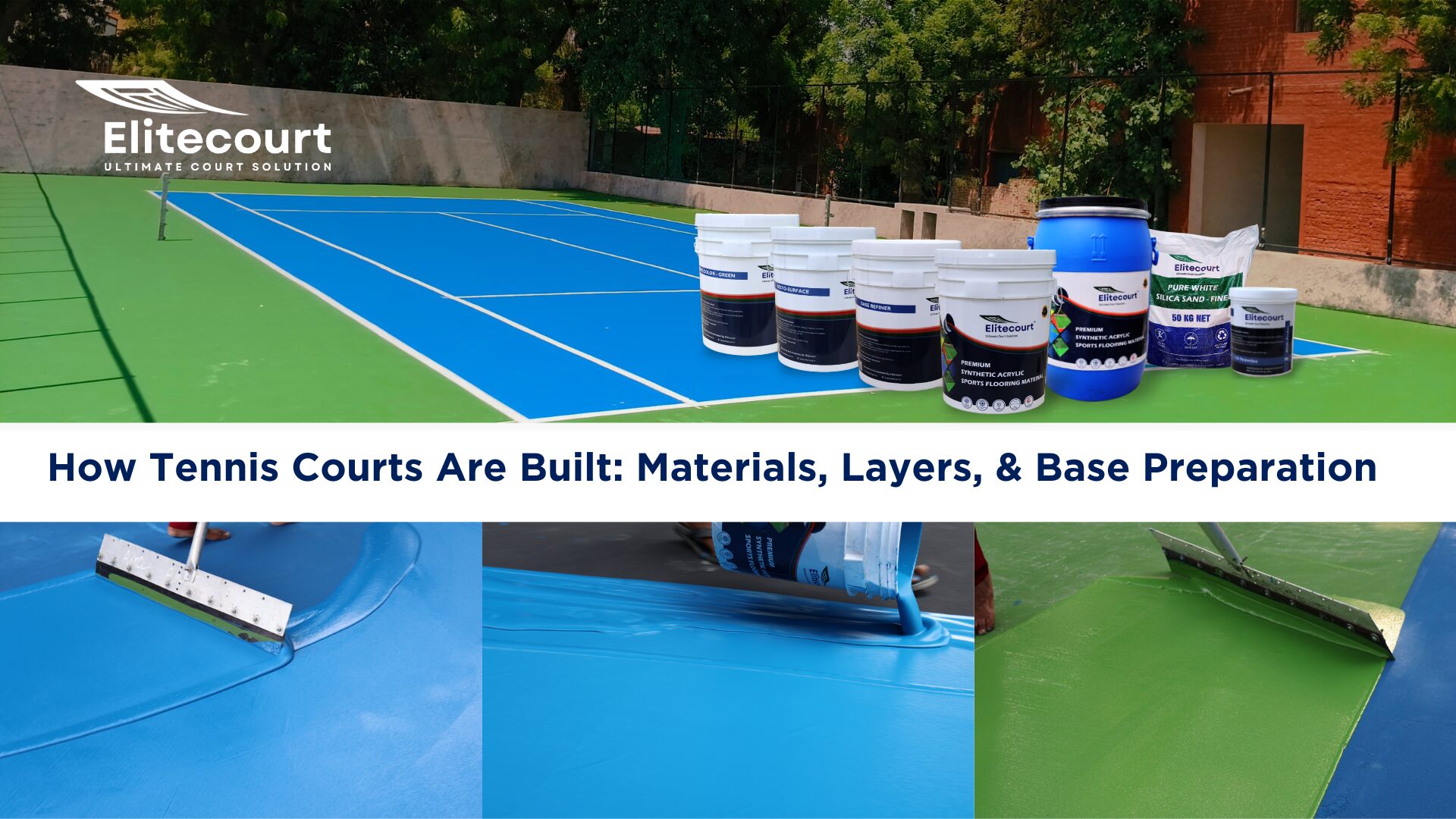
The Base Refiner is a specially formulated compound that addresses common imperfections on asphalt or concrete bases after contractors lay and cure them. Applicators use squeegees or trowels to apply it, filling and leveling the surface before the acrylic coating system begins.
What the Base Refiner / Crack Filler addresses:
- Hairline and minor structural cracks — Cracks in the base, if left untreated, will continue to propagate through the coating system above them. Applicators force crack filler into the crack, allow it to cure, and sand it level to create a seamless repair.
- Surface irregularities and bird baths — Low spots in the base (often called “bird baths” because they collect standing water) require filling and leveling to restore the required gradient and surface regularity.
- Porous or open-textured asphalt — Some asphalt mixes have an open texture that would absorb excessive amounts of the coating layers above. The base refiner seals this porosity, reducing coating consumption and improving system adhesion.
- Trowel marks and construction joints — Concrete bases often show visible form lines, trowel marks, or construction joint edges that require smoothing before coating.
Expert Tip: Skipping or rushing the crack-filling stage is the single most common cause of surface system failure on tennis courts. Properly applied crack filler extends the life of the entire surface system and prevents costly early resurfacing.
Elitecourt formulates its Base Refiner products for compatibility with both asphalt and concrete substrates, ensuring strong adhesion for the layers that follow.
Transform Your Sports Facility Today!
Contact us for high-quality synthetic sports flooring material and elevate your space!
Layer 2 — Acrylic Resurfacer Coat
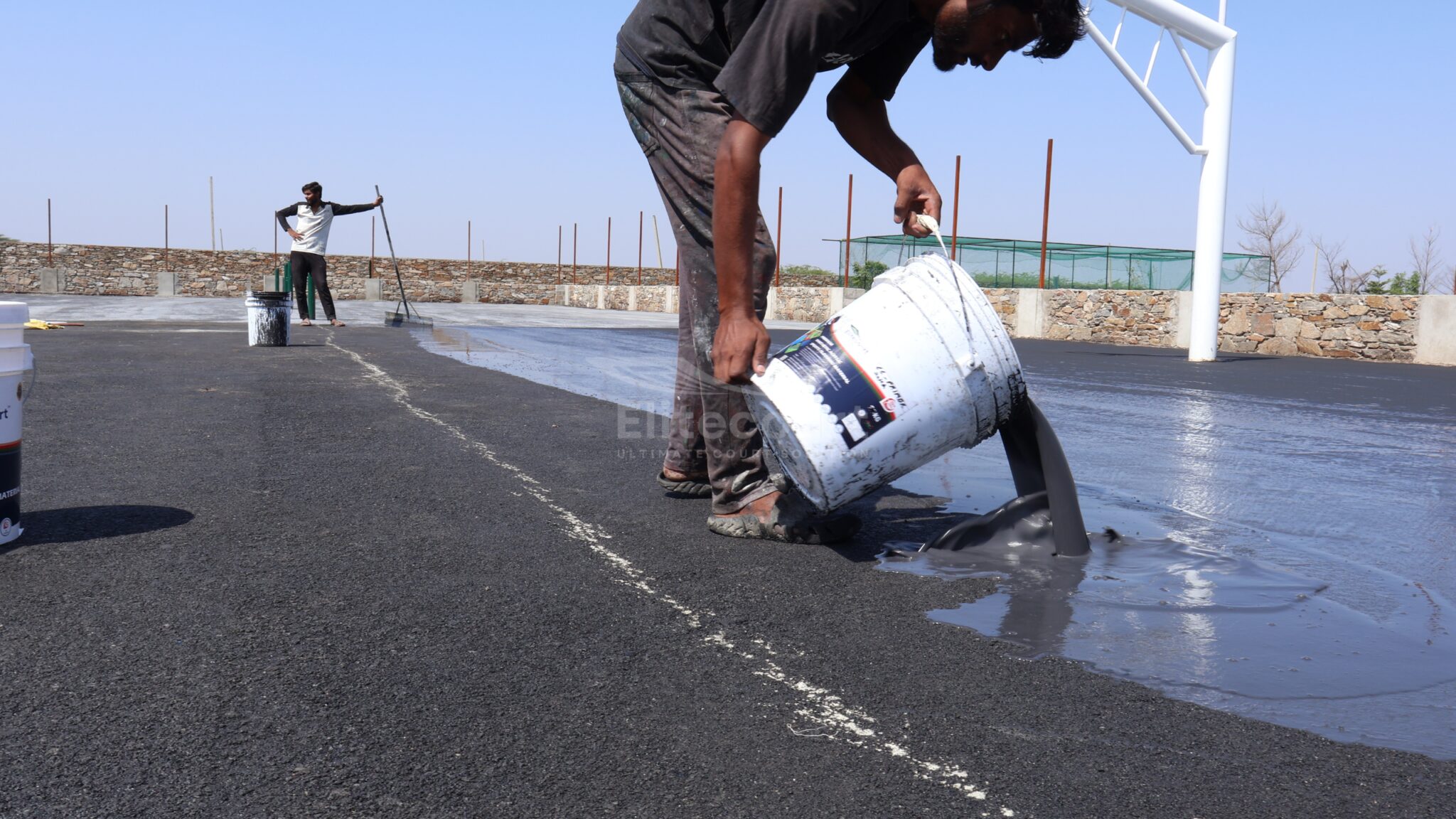
With the base refined and repaired, the Acrylic Resurfacer Coat is the first true coating layer applied across the entire court surface. This is a dense, heavily-filled acrylic product that builds body over the prepared substrate, further sealing the surface and creating a uniform, consistent foundation for the layers above.
The resurfacer is composed of:
- Acrylic polymer binder — Provides strong adhesion to the base material and flexibility to accommodate minor thermal movement in the base
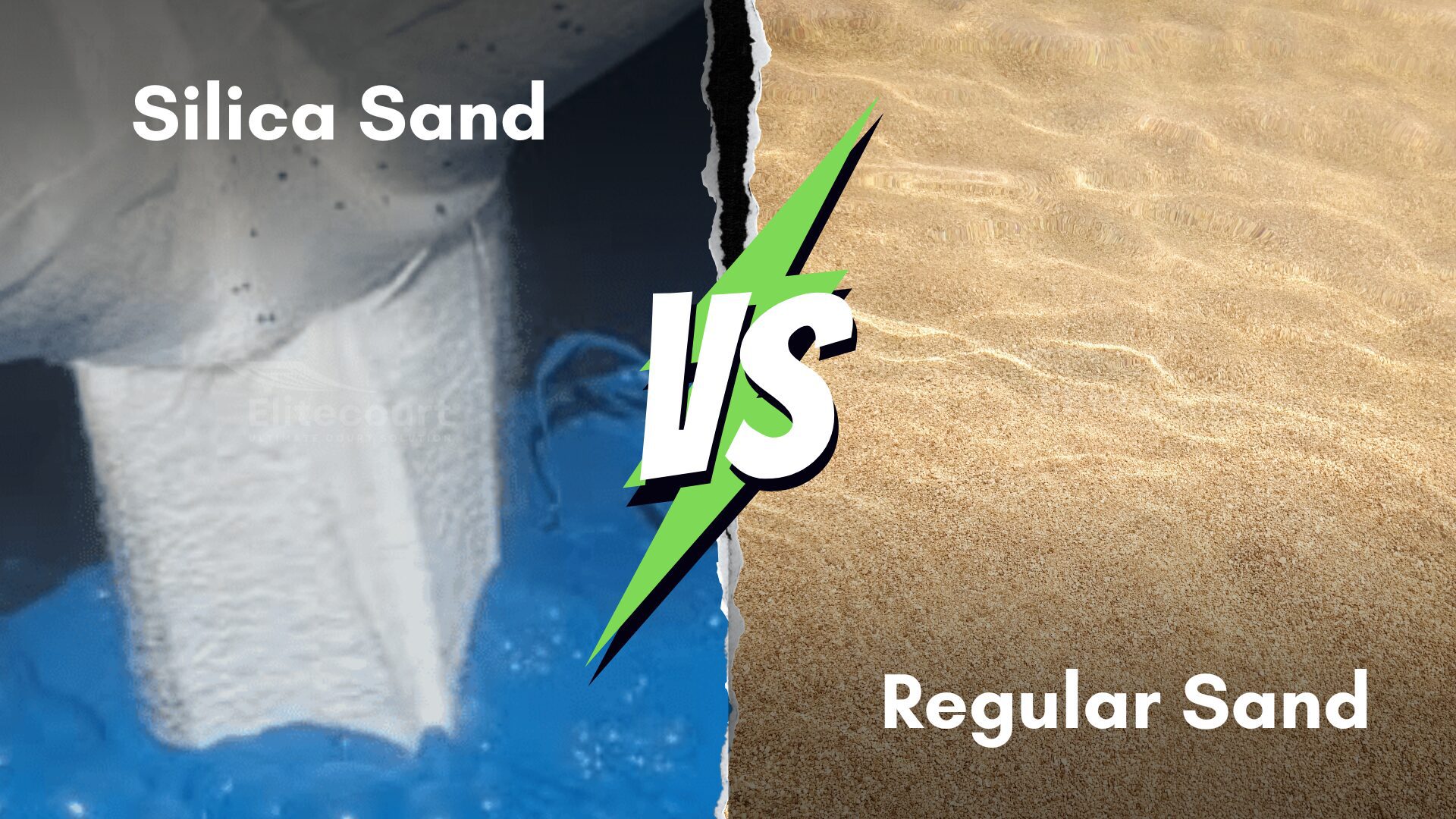
- Silica sand filler — Adds density and body, helping to fill micro-texture and open pores in the base surface
- Stabilizing agents — Improve workability during application and ensure a smooth, level finish
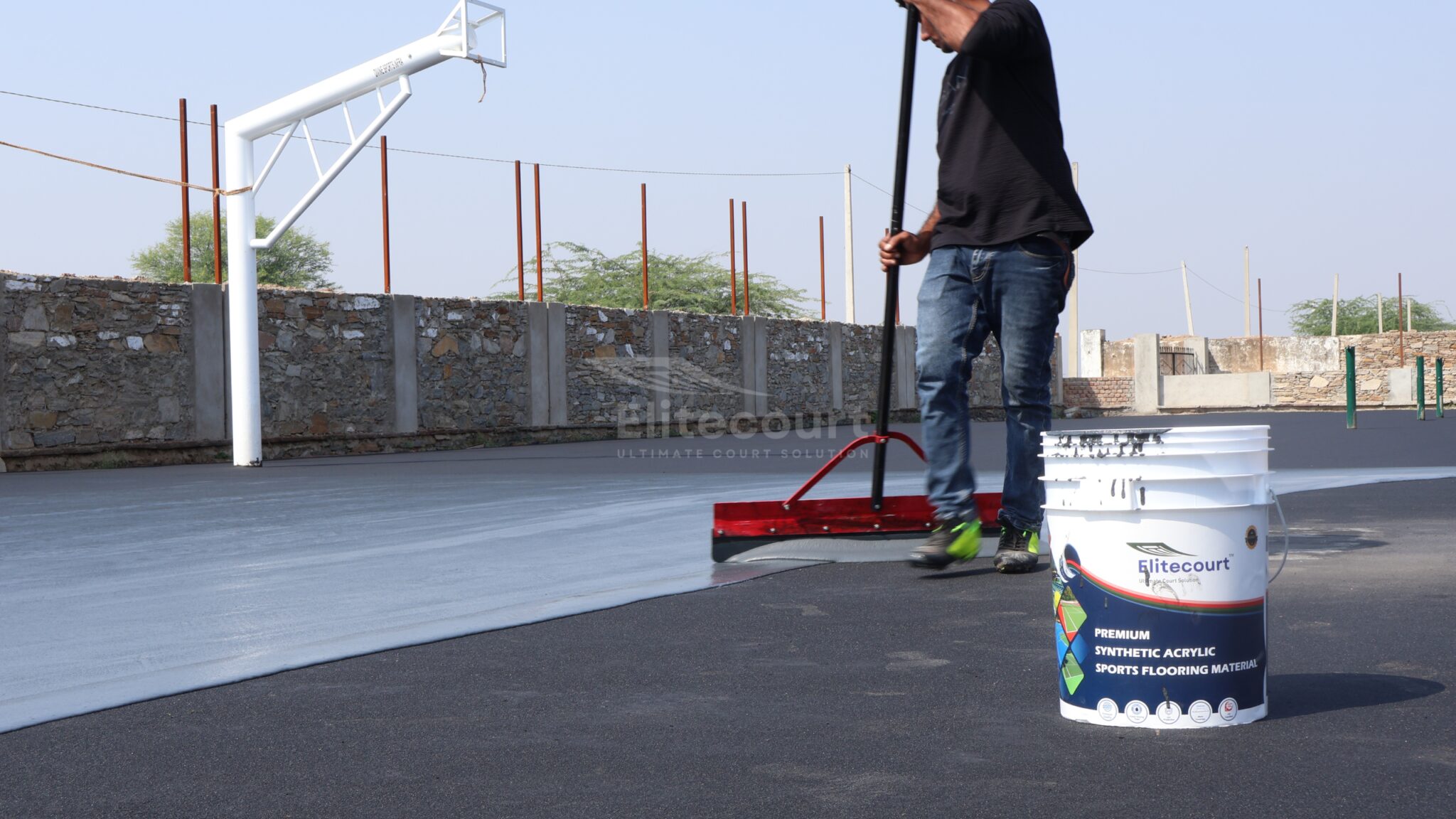
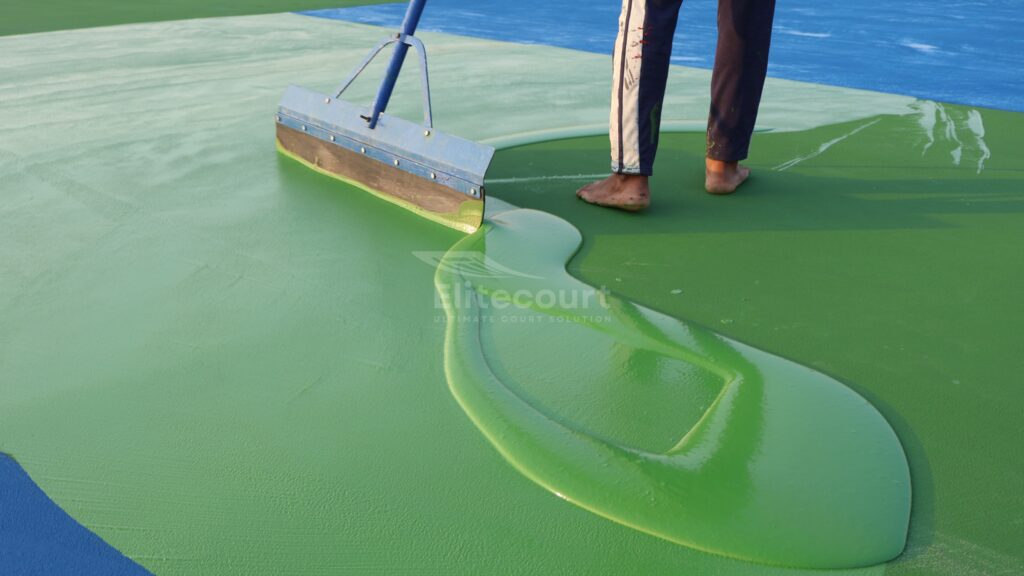
Applicators typically apply the resurfacer coat in one or two passes using a rubber squeegee, spreading the material across the surface in overlapping strokes. On courts with more heavily textured or porous asphalt, they may require two passes to achieve a fully sealed, even surface. Once the resurfacer has cured, the court surface should appear uniformly smooth, with no visible porosity, open texture, or residual imperfections from the base.
This layer plays a crucial transitional role: it bridges the structural world of the base (asphalt or concrete) and the performance world of the acrylic coating system above. Without a proper resurfacer coat, the color and finishing coats above sit on an uneven, partially porous surface — which results in inconsistent texture, uneven color, and reduced adhesion.
Layer 3 — Cushion Coats
The Cushion Coat layer is what separates a standard hard court from a cushioned tennis court system — and it represents one of the most significant advances in sports court surface technology in recent decades. While not present in every tennis court construction, cushion coats are increasingly specified for courts where player welfare, long-term comfort, and injury prevention are priorities.
What Are Cushion Coats?
Cushion coats are rubber-modified or elastomeric acrylic layers that sit between the resurfacer coat and the color coat system. They contain rubber granules or flexible polymer components that introduce controlled elasticity into the surface system — allowing the court to absorb a portion of the impact energy that a player generates with every step, jump, and landing.
On a standard (non-cushioned) hard court, the full impact of the player’s movement transfers through the rigid surface directly to the joints — knees, ankles, hips, and lower back. Over hours of repeated play, this cumulative impact load contributes significantly to player fatigue and long-term joint stress.
Cushion coats interrupt this energy transfer pathway. The elastomeric layer deforms slightly under impact and then springs back — absorbing energy rather than reflecting it. The result is a surface that feels noticeably softer underfoot without compromising ball bounce characteristics.
How Cushion Coats Are Applied
Cushion coats require application in multiple passes — typically two to four coats — with each coat curing before the next application. The number of passes determines the total cushion thickness and thereby the degree of impact absorption. More coats mean a softer feel; fewer coats mean a firmer feel closer to a standard hard court.
Key performance benefits of Cushion Coats:
- Impact absorption — Reduces peak impact forces on players’ lower limbs during play
- Reduced fatigue — Players report less leg tiredness after extended sessions on cushioned courts
- Injury risk reduction — Lower impact forces reduce the risk of overuse injuries, shin splints, stress fractures, and joint inflammation
- ITF compliance — Cushioned court systems can meet ITF standards for force reduction and energy restitution when engineers design them correctly.
- Consistent feel — Properly applied cushion coats deliver uniform energy absorption across the entire court surface
Who Should Specify Cushion Coats?
Cushion coats are particularly valuable for:
- Tennis academies and training facilities — where players practice for many hours daily and cumulative impact load is high
- Schools and community clubs — serving players across a wide age range, including juniors and seniors
- Clubs with veteran and senior member programs — where joint health is a primary concern
- Rehabilitation and medical facilities — where surface compliance directly supports patient care goals
- Any facility competing for membership — where the quality and comfort of the playing surface is a point of competitive differentiation
Elitecourt’s cushion coat products are available in formulations that allow builders to specify the exact level of cushioning required — from lightly cushioned systems with minimal energy absorption to deeply cushioned systems engineered for maximum player comfort.
Transform Your Sports Facility Today!
Contact us for high-quality synthetic sports flooring material and elevate your space!
Layer 4 — Acrylic Color Coat (Base Color)
Above the cushion layer (or directly over the resurfacer on non-cushioned courts) sits the Acrylic Color Coat — the defining layer of the tennis court surface system. It provides the court’s color, controls playing pace, and acts as the first line of defense against UV exposure, weather, and surface wear.
Elitecourt’s synthetic acrylic color coatings are engineered to deliver key performance properties required for competitive play:
- Consistent ball bounce — The texture and hardness of the color coat influence ball behavior. The ITF classifies court pace (ITF 1–5), and the formulation — especially the quantity and particle size of silica sand — determines this classification.
- Traction and grip — The surface must offer balanced grip for movement and direction changes. Too little texture creates slipping risk, while excessive texture increases friction and wears footwear.
- UV and weather resistance — Outdoor courts face sun, rain, and temperature fluctuations. Elitecourt coatings include UV stabilizers and weathering agents to maintain structural integrity and appearance over time.
- Color retention — High-quality pigments and UV resistance ensure long-lasting, vibrant color, preventing premature fading and a worn-out look.
- Water resistance — Once fully cured, the acrylic color coat creates a water-resistant surface film that sheds rain efficiently, reducing drying time after wet weather and enabling play to resume faster.
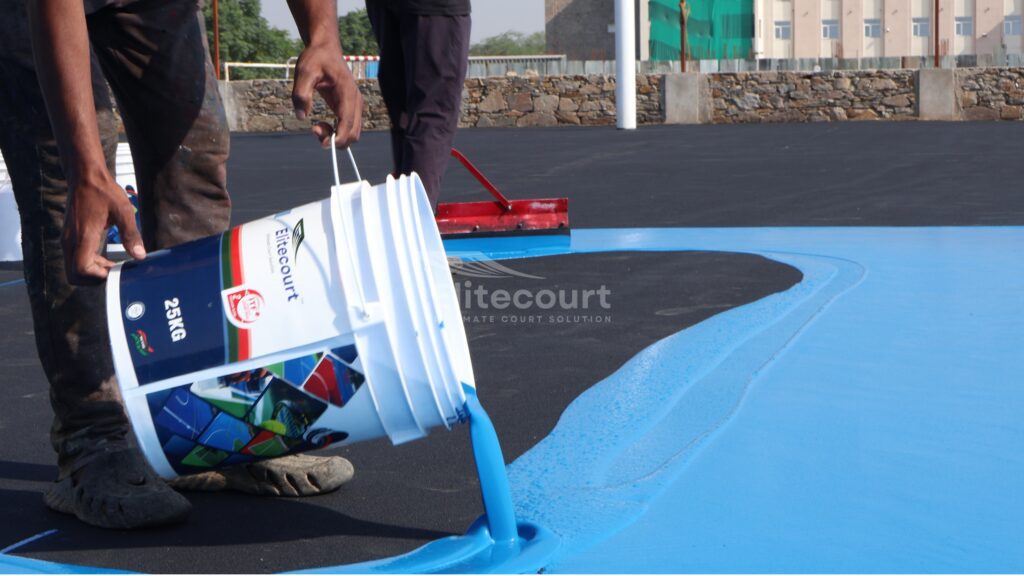
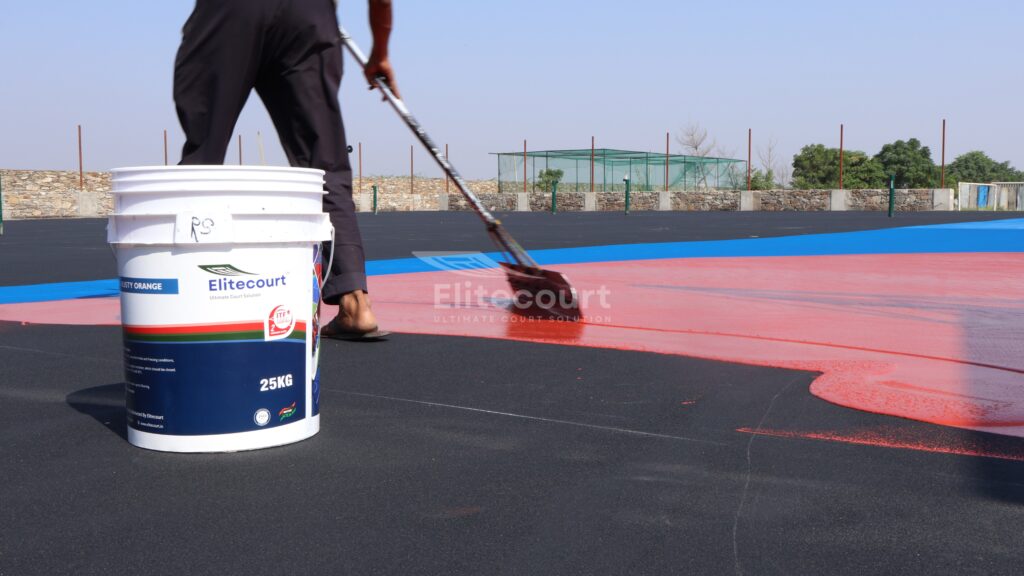
Applicators typically apply the base color coat in two layers using rubber squeegees, rollers, or bladed applicators. They spread each coat uniformly across the full court surface and allow it to cure before applying the next. They carefully control the quantity of silica sand added to the color coat mixture to achieve the specified surface texture and pace classification — a step that demands precision and consistency.
Layer 5 — Acrylic Finishing / Top Coat
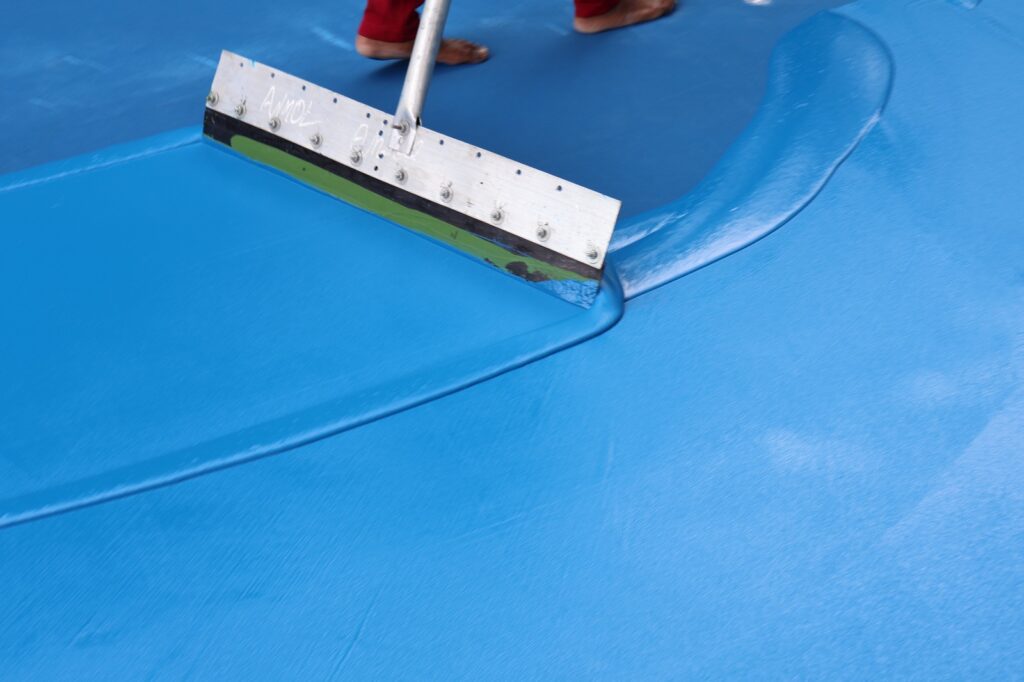
The Acrylic Finishing / Top Coat is the final layer of the surface system and remains in direct contact with the ball, players’ footwear, and maintenance equipment. Though the thinnest layer, it is the most exposed, and its quality directly impacts court performance and overall durability.
The top coat is a refined acrylic formulation engineered for:
- Abrasion resistance — The top coat must withstand the constant mechanical abrasion of tennis balls bouncing and rolling across it, players pivoting and sliding, and maintenance equipment such as brushes and rollers moving over the surface. A high-quality top coat resists this wear without prematurely exposing the layers below.
- Dimensional stability — The coating must resist shrinking, cracking, peeling, or delamination under constant temperature changes and moisture exposure common in outdoor conditions.
- Enhanced UV protection — As the outermost layer, the top coat is the first line of defense against UV degradation. A well-formulated top coat contains higher concentrations of UV stabilizers than the layers below it, protecting the entire system from solar damage.
- Cleanability and resistance to contamination — A smooth, sealed surface prevents dirt, dust, algae, and other contaminants from embedding, making the court easier to maintain and less prone to slippery bio-film formation.
- Surface finish consistency — The top coat creates the final texture of the playing surface — the characteristic feel underfoot and the precise ball-to-surface interaction that players experience. Consistency across the full court area is essential for uniform playing conditions.
In some systems, manufacturers include anti-fungal and anti-algal additives to inhibit biological growth — especially useful in humid or shaded environments where algae and moss can create slip hazards.
Elitecourt designs its acrylic top coat products to integrate seamlessly with the full surface system, allowing them to bond effectively with underlying layers while resisting environmental stress and delivering a durable, high-performance finish.
Transform Your Sports Facility Today!
Contact us for high-quality synthetic sports flooring material and elevate your space!
Court Line Marking
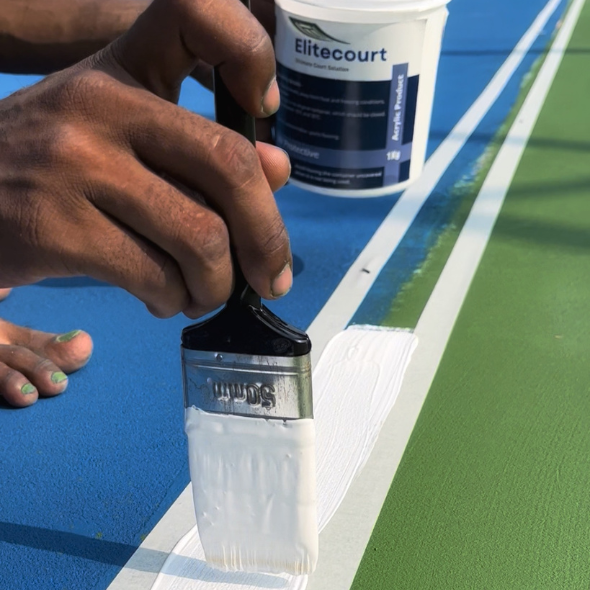
After the color coats are fully cured, line markings are applied. Tennis court lines are painted using acrylic line-marking paint that:
- Bonds permanently to the surface coat below
- Provides high contrast (typically white or yellow) for visibility
- Has a consistent 3mm to 5mm thickness (excessive thickness creates a raised lip that affects ball bounce at line boundaries)
- Resists UV fading and abrasion
Line widths, court dimensions, and positioning are strictly governed by the ITF Rules of Tennis. Baseline width is 100mm; all other lines are 25–50mm wide. The centre service line and centre mark are 50mm wide. These dimensions must be measured and marked with precision using laser levels or professional string-line methods.
Texture, Pace, and Surface Performance — The Science Behind Acrylic Tennis Courts
One of the least understood but most important aspects of tennis court surfaces is pace — how fast or slow the ball travels across the surface after bouncing. The ITF classifies tennis court surfaces into five pace categories:
| ITF Pace Category | Surface Type | Description |
|---|---|---|
| ITF 1 | Slow | Heavily textured; clay-like feel |
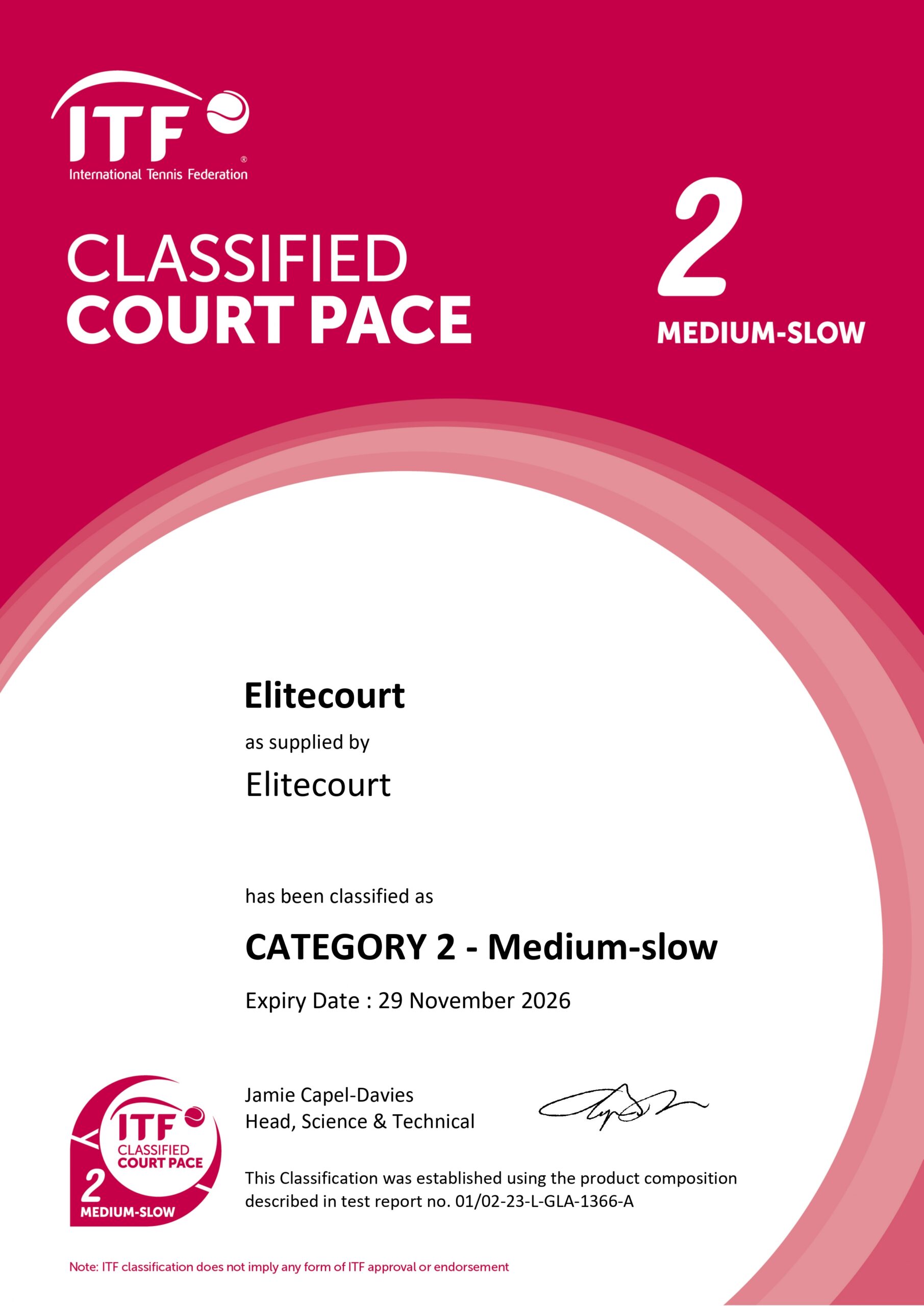
| ITF 2 | Medium-slow | Moderate texture |
| ITF 3 | Medium | Standard hard court pace |
| ITF 4 | Medium-fast | Less texture, faster ball |
| ITF 5 | Fast | Minimal texture; grass-like feel |
The pace of an acrylic tennis court is directly controlled by the quantity and particle size of sand added to the coating system. More sand creates a rougher surface that grips the ball longer at contact, slowing it down. Less sand produces a smoother surface that allows the ball to skid through faster.
This is why specifying the right surface product is so important. Elitecourt’s product range allows builders and facility owners to select surface systems that deliver the desired pace classification — from competition-grade medium-pace hard courts to high-speed performance surfaces for training facilities.
Ball Bounce and Surface Hardness
Beyond pace, the hardness of the playing surface affects player comfort and safety. Surfaces that are too hard (stiff concrete with minimal cushioning) increase impact forces on players’ joints, raising injury risk over time.
Many modern tennis court construction projects incorporate cushioned acrylic systems — where builders introduce layers of rubber or polyurethane-modified acrylic beneath the final color coats. These cushioned systems absorb some of the impact energy that would otherwise transfer to the player’s body, reducing joint fatigue and injury risk over long playing sessions.
Elitecourt’s product line includes both standard acrylic systems (firm, traditional hard court feel) and cushioned acrylic systems for facilities prioritizing player welfare, such as schools, community clubs, and rehabilitation centers.
Transform Your Sports Facility Today!
Contact us for high-quality synthetic sports flooring material and elevate your space!
Court Dimensions, Layout, and Regulatory Compliance
Building a tennis court means adhering to strict dimensional standards set by the International Tennis Federation. Here is a reference table for standard court dimensions:
| Measurement | Singles | Doubles |
|---|---|---|
| Court length | 23.77m | 23.77m |
| Court width | 8.23m | 10.97m |
| Service box length | 6.40m | 6.40m |
| Net height (center) | 0.914m | 0.914m |
| Net height (posts) | 1.07m | 1.07m |
| Baseline clearance (recommended) | 5.49m | 5.49m |
| Sideline clearance (recommended) | 3.05m | 3.05m |
Recommended overall court area (including run-off zones): approximately 36.6m x 18.3m for a full-size doubles court with adequate run-off space.
Designers must incorporate these dimensions into the civil design from day one, because the gradient, drainage direction, base reinforcement, and overall site layout all depend on correctly establishing the court’s footprint before construction begins.

Common Tennis Court Construction Mistakes and How to Avoid Them
Years of experience in the sports flooring industry reveals a consistent set of mistakes that cause premature court failure. Understanding these pitfalls is essential for anyone involved in commissioning or building a tennis court.
Inadequate Subgrade Compaction
The mistake: Rushing or skipping mechanical compaction of the subgrade before placing the sub-base.
The result: Differential settlement causes the court to become uneven over time. Surface cracking follows as different sections of the base move independently.
The solution: Always perform compaction in controlled lifts and verify with density testing before proceeding.
Poor Drainage Design
The mistake: Failing to design and construct adequate perimeter drainage or establishing the wrong gradient direction.
The result: Water pools on or beneath the court, leading to base deterioration, surface bubbling, algae growth, and coating delamination.
The solution: Engage a civil engineer to design the drainage system before construction. Verify gradient compliance with a level survey before placing the base.
Coating on Uncured or Wet Concrete
The mistake: Applying acrylic surface coatings before concrete has cured for at least 28 days, or before moisture testing confirms acceptable vapor emission levels.
The result: Moisture vapor trapped beneath the coating creates bubbles, blisters, and delamination — sometimes within weeks of completion.
The solution: Allow full cure time, conduct moisture testing, and apply only when vapor emission levels are within specification.
Incorrect Sand Loading in Color Coats
The mistake: Adding too much or too little sand to acrylic coatings, either in field or without proper measurement.
The result: Court pace and texture are inconsistent across the playing surface, affecting ball bounce and player safety.
The solution: Follow the manufacturer’s mixing specifications precisely. Elitecourt provides detailed application guides with each product to ensure correct mixing ratios and application methods.
Skipping the Resurfacer / Crack Filler Phase
The mistake: Applying color coats directly to a rough or cracked base without first applying resurfacer or crack filler.
The result: Surface irregularities and cracks are visible through the final surface and continue to propagate through the coating system.
The solution: Treat all cracks and imperfections systematically before any coating work begins. Do not proceed to color coats until the base is smooth and free of defects.
Indoor vs. Outdoor Tennis Courts — Different Requirements, Same Principles
Tennis courts are built both indoors and outdoors, and while the core construction principles are identical, there are important differences in surface specification:
Outdoor Tennis Courts
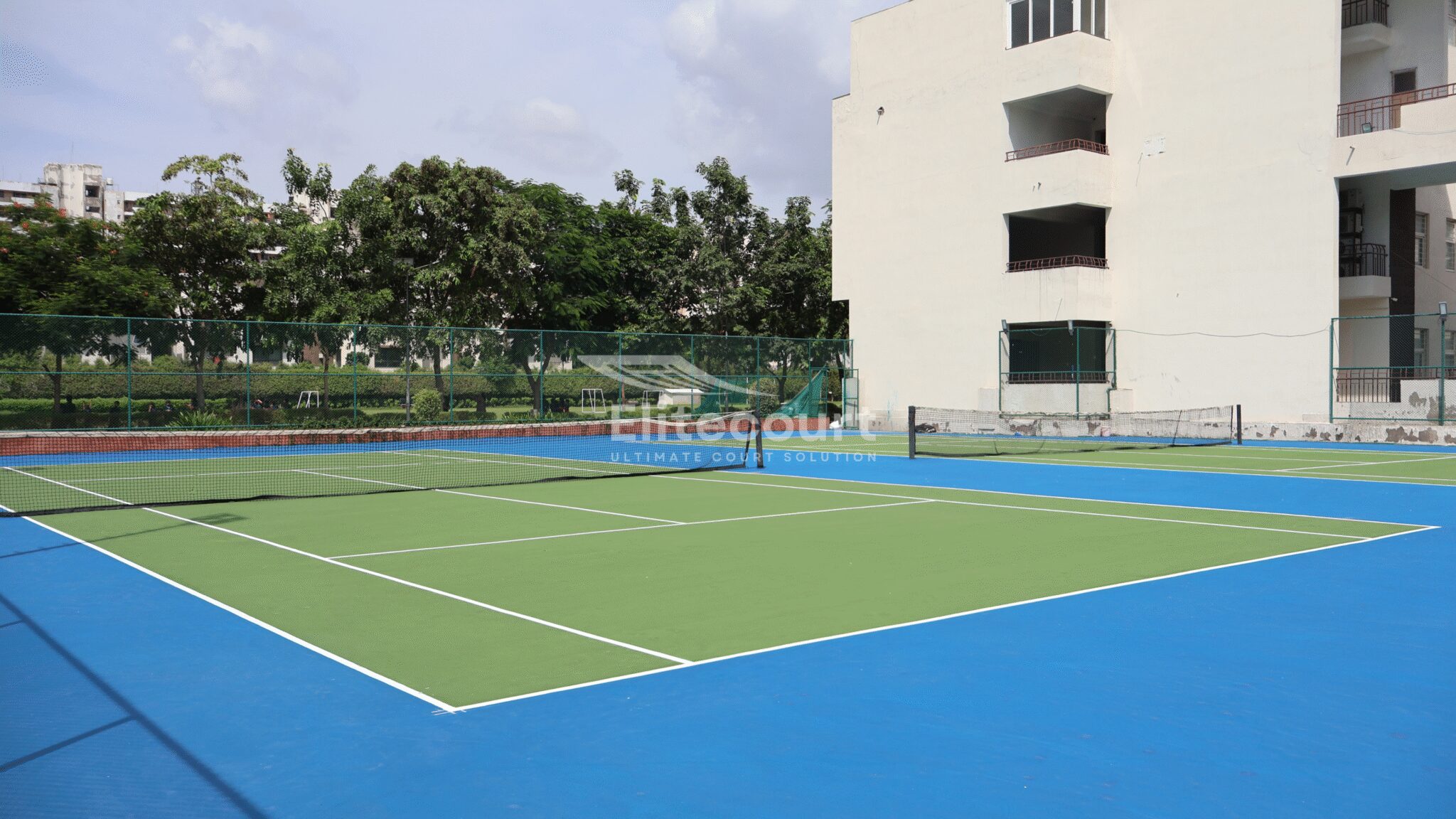
Outdoor courts face the full range of environmental stresses — UV radiation, rain, freeze-thaw cycles, wind-blown debris, bird droppings, and algae growth. Surface systems for outdoor courts must therefore prioritize:
- UV stability — Resistance to color fading and polymer degradation under sunlight
- Weather resistance — Ability to withstand wet-dry and freeze-thaw cycling without cracking or delaminating
- Anti-algae properties — Formulations that resist the growth of algae and moss in damp conditions
- Drainage — Surface texture and slope that encourage rapid water runoff
Elitecourt formulates its outdoor acrylic systems with UV stabilizers and weather-resistant polymers to perform effectively in harsh outdoor environments.
Indoor Tennis Courts
Indoor courts are shielded from UV and weather but face their own challenges:
- Humidity and condensation — Indoor facilities with poor climate control can develop condensation on cold floors, creating slip hazards. Surface systems must be compatible with controlled indoor humidity conditions.
- Artificial lighting — Court colors must be selected for visibility under artificial lighting rather than daylight. Lighter court colors typically perform better under artificial lighting.
- Air quality — Indoor surface materials must not off-gas volatile organic compounds (VOCs) that would affect air quality for players and staff.
- Reflectivity — High-gloss surfaces create glare under artificial lighting and should be avoided for indoor courts.
Elitecourt’s product range includes indoor-specific formulations optimized for these conditions, ensuring performance, safety, and comfort in enclosed sports facilities.
Transform Your Sports Facility Today!
Contact us for high-quality synthetic sports flooring material and elevate your space!
Maintenance of Acrylic Tennis Court Surfaces — Protecting Your Investment
A well-constructed acrylic tennis courts, finished with high-quality surface materials, will last many years before requiring resurfacing — but only if it receives appropriate maintenance.
Routine Maintenance Tasks
| Task | Frequency |
|---|---|
| Remove debris (leaves, dirt) | After each use / weekly |
| Wash surface with water | Monthly |
| Inspect for cracks and surface damage | Quarterly |
| Clean algae / moss growth | As needed |
| Check and re-tension nets | Seasonally |
| Inspect perimeter drainage | After heavy rain |
When to Resurface a Tennis Court
Even the best acrylic surface will eventually show signs of wear — particularly in high-traffic areas like the baseline and service boxes. Signs that resurfacing is needed include:
- Surface roughness has worn smooth or developed bare patches
- Color has significantly faded, affecting visibility
- Hairline cracks have appeared in the surface coating (not in the base)
- Texture inconsistencies are affecting ball bounce and pace
Resurfacing does not require replacing the base. A professional resurfacing process involves cleaning the existing surface, applying crack filler as needed, and re-applying a full acrylic coating system. This restores the court to like-new condition at a fraction of the cost of complete reconstruction.
Elitecourt’s Role in Tennis Court Surface Excellence
Elitecourt does not install tennis courts — the company manufactures the premium synthetic acrylic flooring materials that make great courts possible. This distinction matters because the quality of the surface material is the foundational variable that experienced court builders, contractors, and facility managers select for before any work begins.
What sets Elitecourt apart:
- Years of accumulated manufacturing expertise in synthetic acrylic sports flooring, with a deep understanding of court surface science
- Comprehensive product systems — from base resurfacers and crack fillers to color coat systems, cushioned layers, and line-marking paints — meaning every layer of the surface system works together by design.
- Compliance with international standards — Elitecourt’s products are engineered to help builders achieve courts that meet ITF classification requirements for pace, regularity, and safety
- Technical documentation and support — Detailed application guides, mixing instructions, and technical specifications give installers the information they need to achieve correct results
- Proven performance across climates — From tropical humidity to arid heat to temperate freeze-thaw conditions, Elitecourt’s formulations are tested for performance across the range of environments where tennis is played
When a court builder selects Elitecourt materials, they are selecting a surface system backed by manufacturing rigour and product consistency — the assurance that every batch performs to specification.
Transform Your Sports Facility Today!
Contact us for high-quality synthetic sports flooring material and elevate your space!
Frequently Asked Questions
Asphalt-base courts typically take 3–5 weeks from ground-breaking to completion. Concrete-base courts require an additional 28-day curing period, making the total timeline 7–9 weeks. Site conditions, climate, and number of surface coats can all influence the schedule.
Resurfacing involves applying fresh acrylic coatings over a structurally sound existing base — making it ideal when the surface has worn, faded, or cracked but the base remains intact. Full reconstruction becomes necessary when the base itself fails due to structural cracking, settlement, or drainage problems, and builders must rebuild the court from the ground up.
It depends on intended use. ITF–3 (Medium) suits most recreational and club facilities. ITF–2 (Medium-Slow) benefits training academies and beginner-focused courts. ITF–4 suits high-performance venues preferring a faster game. Elitecourt allows builders to adjust surface systems to achieve the desired pace classification by controlling sand loading in the color coat.
Yes, provided the base is structurally sound, the existing surface is clean and adhesion-ready, and moisture vapor levels are within acceptable limits. Surface irregularities must be corrected first. When conditions are right, recoating with an Elitecourt acrylic system is an effective way to restore full court performance.
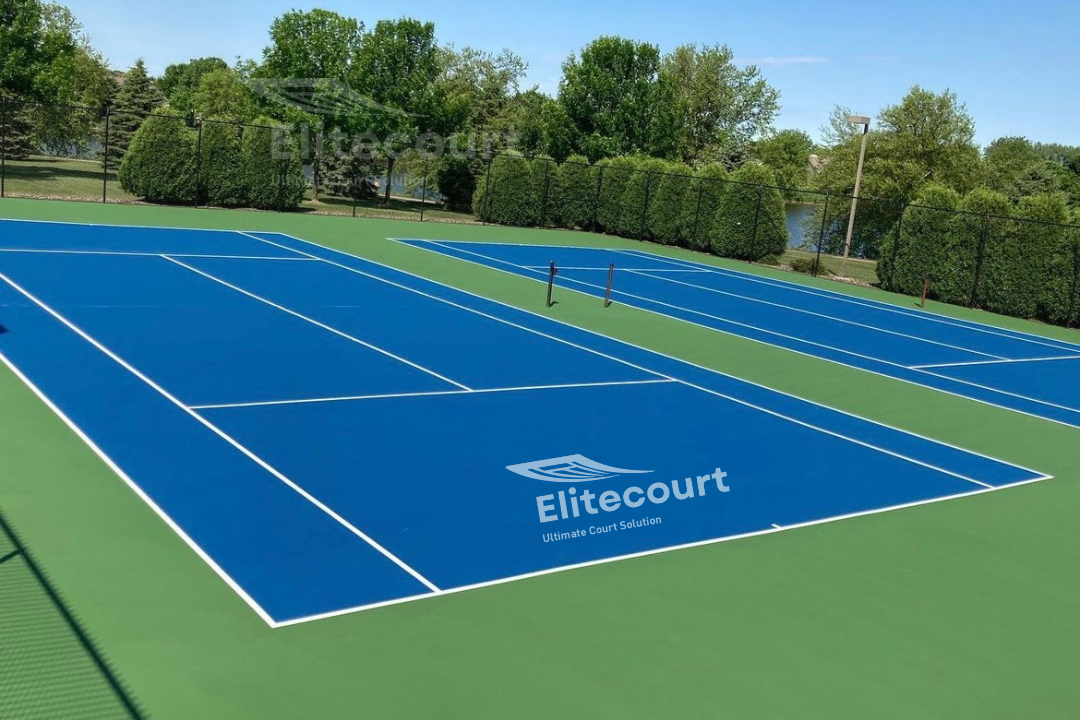
Very. Green and blue are preferred for their contrast against the yellow-green tennis ball. Dark colors absorb more heat; light colors can cause glare indoors. White lines must contrast sharply with the court body color. Elitecourt offers a full color palette to suit both aesthetic preferences and functional requirements.
Sustainability and Environmental Considerations in Tennis Court Construction
Modern tennis court construction increasingly incorporates environmental sustainability into material and design decisions. Elitecourt commits to developing and supplying surface products that minimize environmental impact:
- Low VOC formulations — Elitecourt’s acrylic systems are formulated to minimize volatile organic compound emissions during application and cure, protecting the health of installers and nearby building occupants.
- Water-based chemistry — Synthetic acrylic coatings are water-based, eliminating the need for solvent-based products that pose environmental and health risks.
- Durability as sustainability — A long-lasting court surface reduces the frequency of resurfacing, which in turn reduces material consumption and construction waste over the life of the facility.
- Recyclable packaging — Responsible packaging practices reduce the environmental footprint of product delivery.
Tennis facilities that prioritize sustainability can also incorporate permeable sub-base designs and rainwater harvesting systems to manage stormwater sustainably — design decisions made at the civil engineering stage but complementary to the surface system above.
Conclusion: Building a Tennis Court Right the First Time
The construction of a tennis court is a multi-disciplinary project that demands expertise across geotechnical engineering, civil construction, drainage design, materials science, and sports surface technology. Every layer — from the compacted subgrade at the very bottom to the textured acrylic finish coat at the very top — plays a specific and irreplaceable role in the performance, safety, and longevity of the finished court.
Getting it right the first time is always more economical than repairing, resurfacing, or rebuilding prematurely. That means you must invest in proper base preparation, select the right surface system for the intended use, and partner with manufacturers whose products deliver reliable performance.
Elitecourt’s synthetic acrylic flooring materials represent the culmination of years of expertise in sports surface science — designed to give court builders, sports facility owners, and players the confidence that the surface beneath their feet will perform consistently, season after season. From the resurfacer that bridges base imperfections to the UV-stable color coats that define pace and texture, Elitecourt manufactures every product to meet the exacting standards that great tennis courts demand.
Whether you commission a single recreational court or a multi-court training academy, understanding how tennis courts are built — and why each layer matters — empowers you to make informed decisions, ask better questions, and achieve a result that serves players for many years.