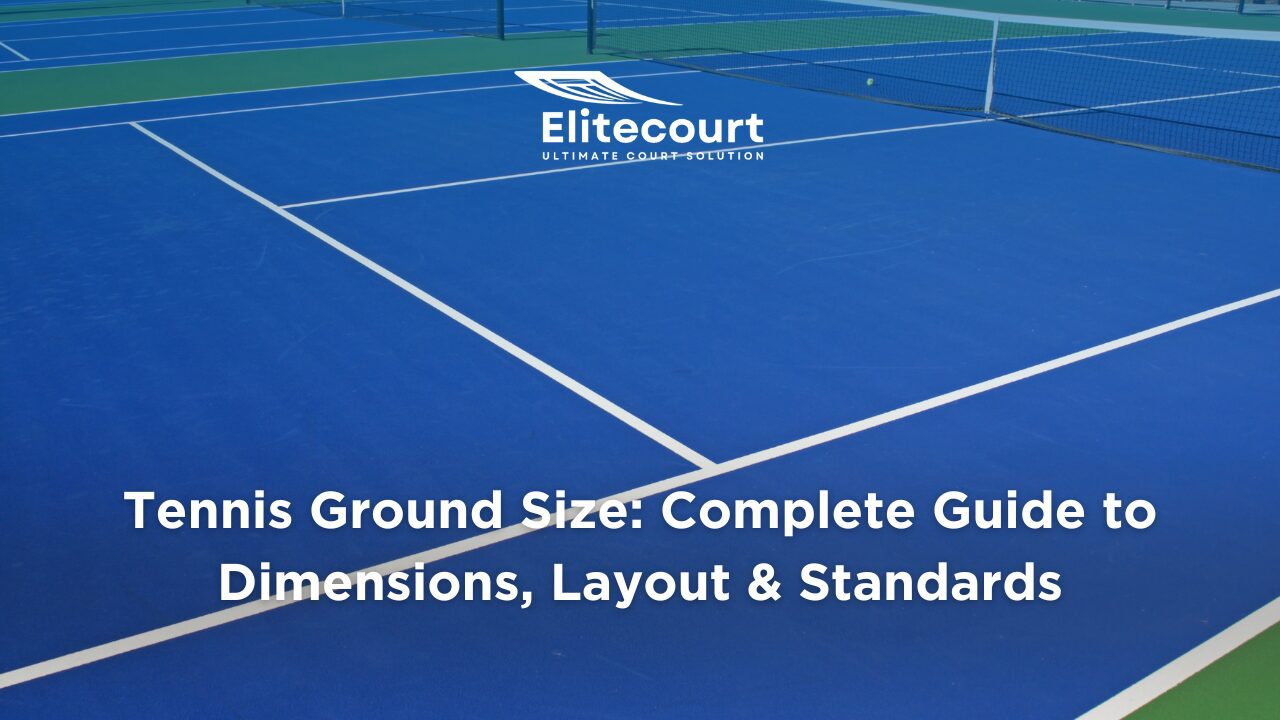
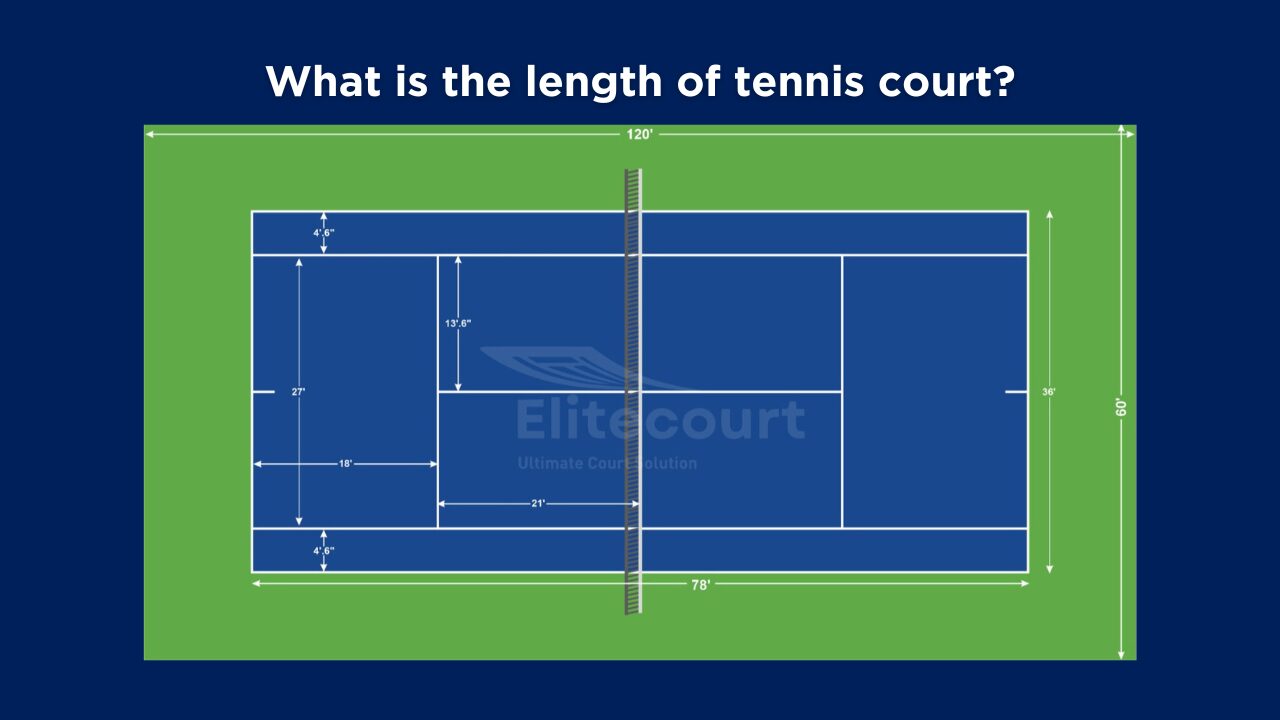
The length of tennis court measures exactly 23.77 meters (78 feet), a standard set by the International Tennis Federation (ITF) for both singles and doubles matches worldwide. This fixed dimension forms the backbone of the game, providing consistency from local clubs to Grand Slams. Understanding this key measurement helps players, coaches, and facility planners create optimal playing environments, as it directly influences footwork, shot selection, and endurance training. Elitecourt’s synthetic acrylic flooring excels in upholding this length of tennis court with durable, seamless surfaces that resist wear and maintain line integrity over time, even under intense usage in varying climates.
When planning a new court or resurfacing an existing one, recognizing the length of tennis court as the core metric ensures compliance with regulatory bodies like the ITF and national federations. This precision not only supports fair competition but also enhances player safety by allowing predictable movement patterns across the full span. Elitecourt’s materials are designed to deliver uniform traction and ball response from one baseline to the other, making every meter count in high-stakes rallies.
Official Length of Tennis Court Explained
The length of tennis court is universally standardized at 23.77 meters, measured from baseline to baseline—the outer boundaries where rallies begin and end. This measurement, precise to the centimeter, ensures fairness across all levels of play, from recreational to professional tournaments. All court measurements extend to the outside of the lines, as specified by ITF guidelines, preventing any ambiguity during matches and allowing referees to enforce rules consistently.
This length divides evenly into two equal halves of 11.89 meters each, separated by the net, with each half further split by the service line at 6.40 meters from the net. The consistency of the length of tennis court allows players to develop reliable footwork patterns, knowing the distance for baseline returns remains constant regardless of venue. Elitecourt’s acrylic coatings provide the ideal traction and bounce on this length, enhancing shot control and endurance during long rallies that can stretch the full 23.77 meters repeatedly. In practice, this means a top player might sprint this distance multiple times per set, relying on the surface to minimize slip risks and maximize energy return.
In feet, the length of tennis court translates to 78 feet, a metric rooted in the sport’s British origins but now globally enforced in metric for precision engineering. This dimension has remained unchanged since formal standardization in the late 19th century, underscoring tennis’s commitment to tradition amid evolving equipment and techniques. For facility builders, this fixed length of tennis court simplifies design, as base layers like concrete or asphalt can be poured to exact specs, topped with Elitecourt’s resilient acrylic for a finish that withstands thousands of hours of play without dimensional drift. The engineering behind this involves layered applications that cure flat, ensuring the measured length holds true year after year.
Complete Tennis Court Dimensions Breakdown
Understanding the full tennis court dimensions provides essential context around the core length of tennis court at 23.77 meters. The complete playing area forms a rectangle measuring 23.77m long by 10.97m wide for doubles (8.23m wide for singles), with lines dividing it into service boxes, tramlines, and baselines. These dimensions create strategic zones: the service line at 6.40m from the net defines the 5.49m deep service box per side, while the net spans the full width at 0.914m high at center (1.07m at posts). Elitecourt’s synthetic acrylic flooring is precision-engineered to support these exact tennis court dimensions, ensuring lines remain crisp and surfaces uniform across every square meter.
Key sub-dimensions integrate seamlessly with the length of tennis court: each doubles alley measures 1.37m wide, added only for doubles play, while the center service line (5cm wide) bisects the court longitudinally. Baselines cap the ends at 40-50mm wide, and all sidelines run parallel to maintain rectangular integrity. For total facility planning, ITF recommends 8-12.5m run-offs (minimum 6.40m ends, 3.66m sides), expanding the footprint to 36.57m x 18.29m. Elitecourt’s multi-layer acrylic application guarantees these tennis court dimensions hold under India’s hot sun and monsoons, with cushioned options absorbing baseline impacts without compromising measurements. Builders verify via diagonal checks (26.98m across), confirming squareness before surfacing.
This comprehensive table of tennis court dimensions anchors planning around the fixed dimensions of tennis court, enabling Elitecourt surfaces to deliver pro-level performance.

Why the Length of Tennis Court Never Changes
Tennis demands uniformity to maintain competitive equity, and the fixed length of tennis court at 23.77 meters achieves this by standardizing player movement and strategy. Variations in length would disrupt serve depths, return positions, and baseline defense tactics, which rely on predictable distances. The ITF enforces this through rigorous court certification, ensuring even minor deviations disqualify venues from sanctioned events, thus protecting the sport’s integrity at every level.
Historically, early tennis courts varied in size, often adapted from croquet lawns with hourglass shapes, but by 1882, the rectangular length of tennis court was locked at 78 feet to facilitate tournaments like Wimbledon. This stability supports data-driven training, where coaches analyze stride counts over the full length to optimize speed and positioning. Elitecourt’s materials contribute by offering consistent ball response across the entire span, minimizing inconsistencies from surface degradation and allowing players to focus purely on skill execution rather than adapting to venue quirks. Modern analytics tools even track player positioning relative to this fixed length, providing insights into efficiency that transcend surface types.
Modern run-off areas extend beyond the length of tennis court by at least 6.40 meters (21 feet) at each end, providing safety buffers for dives and overruns without altering the playing dimensions. These clearances, recommended at 3.66 meters (12 feet) on the sides, total a footprint of about 36.58m x 18.29m for standard courts, emphasizing how the core length anchors the entire layout. Elitecourt’s edge formulations prevent cracking in these high-traffic zones, ensuring the primary length of tennis court remains protected and playable.
Measuring the Length of Tennis Court Accurately
To measure the length of tennis court, start at one baseline’s outer edge and extend a taut string or laser tool to the opposite baseline, confirming 23.77 meters. Lines must be 40-50mm wide for baselines, contrasting sharply with the surface for visibility—crucial on colorful acrylic floors like Elitecourt’s. Professionals use certified tapes or theodolites for sub-millimeter accuracy during construction or resurfacing, often cross-checking with perpendicular widths to verify squareness.
Common pitfalls include overlooking curvature in older courts or thermal expansion on hot surfaces, which Elitecourt’s heat-resistant acrylic mitigates by maintaining flatness. Always measure from the outside of lines, including the full baseline width, to match ITF specs. For verification, diagonal measurements across the court should yield approximately 26.98 meters for a perfect rectangle, a simple geometric check that confirms the length of tennis court integrity before play begins. In humid Indian conditions, Elitecourt’s breathable layers prevent moisture-induced warping, keeping measurements reliable season after season.
Expert Tip: During resurfacing, re-mark the length of tennis court after each acrylic layer cures to avoid cumulative errors—Elitecourt recommends precision tools for lines that withstand thousands of hours of play.
| Measurement | Metric (m) | Imperial (ft) | Purpose |
|---|---|---|---|
| Full Length | 23.77 | 78 | Baseline to baseline |
| Half Court | 11.89 | 39 | Net to baseline |
| Service Line to Net | 6.40 | 21 | Service box depth |
| Run-off (Min) | 6.40 | 21 | Safety beyond baseline |
This table highlights how the length of tennis court integrates with sub-divisions for strategic play.
Transform Your Sports Facility Today!
Contact us for high-quality synthetic sports flooring material and elevate your space!
Singles vs Doubles: Length of Tennis Court Stays Same
Remarkably, the length of tennis court remains 23.77 meters for both singles and doubles, with only width differing—8.23m (27ft) for singles versus 10.97m (36ft) for doubles. Singles players cover the full length in isolation, demanding superior endurance, while doubles teams share lateral responsibilities but match the same forecourt-to-backcourt depth. This uniformity allows seamless transitions between formats on the same surface, a design choice that streamlines club operations and player development programs.
In doubles, the extra alleys (1.37m each side) expand play width but preserve length, enabling cross-court lobs over the identical span. Elitecourt’s synthetic acrylic ensures even ball spin and pace across this length, vital for doubles volleys where positioning hinges on baseline distance. Statistics show doubles rallies average shorter due to net approaches, yet the fixed length prevents serve-and-volley dominance seen in eras past, balancing the formats for spectator appeal. Players often practice doubles on singles lines first to hone length control before alley exploitation.
Players adapt by training full-length drills in both modes; for instance, singles baseline rallies build stamina for the 23.77m sprints, directly transferable to doubles defense. Elitecourt’s consistent medium-fast pace rating across the length of tennis court supports these drills, allowing coaches to replicate tournament conditions without surface variability.
Historical Evolution of Tennis Court Length
The length of tennis court traces back to 1874 when Major Walter Wingfield’s “Sphairistikè” used an hourglass court of varying length, but the All England Croquet Club’s 1877 Wimbledon tweaks introduced the rectangular 78-foot standard. By 1882, the modern length of tennis court was codified, stabilizing the sport amid its global spread and setting the stage for professional circuits. This evolution reflected a shift from aristocratic lawns to accessible public venues, where fixed dimensions enabled rule standardization.
Indoor real tennis influenced early dimensions, with cloister courts around 30m long, but lawn tennis halved this for accessibility. Post-WWII hard courts like acrylic surfaces reinforced the length, as consistent bounce over 23.77m favored baseline power games epitomized by players like Nadal and Federer. Elitecourt continues this legacy with ITF-classified acrylic that honors historical precision while incorporating modern durability for India’s diverse climates. The unchanging length has allowed statistical evolution, with rally lengths increasing from 4 shots in the 1970s to over 8 today, all within the same boundaries.
Over decades, no changes occurred despite surface shifts from grass to clay to synthetics, proving the length of tennis court‘s timeless efficacy in balancing offense and defense. This stability has influenced racket tech and string tensions, all calibrated to the fixed 23.77m playing field.
Impact of Court Length on Playing Strategies
The length of tennis court profoundly shapes tactics: serves must clear the net and land deep in the service box (5.49m from baseline), exploiting the full 23.77m for returns. Baseline players thrive by using the length for topspin loops, while serve-volleyers compress it with net rushes. Data from Grand Slams shows average rally length correlates with court speed, but dimension fixity ensures adaptability across surfaces. Elitecourt’s tunable acrylic speeds allow strategy customization without altering physical length.
Longer perceived length on slower acrylic courts encourages defensive lobbing, whereas the standard allows aggressive groundstrokes. Coaches design drills spanning the exact length of tennis court, timing sprints (elite players cover it in under 5 seconds) to simulate match pressure. Elitecourt’s cushioned layers reduce joint stress over repeated lengths, prolonging careers and enabling sustained high-intensity training. Video analysis often overlays player paths on the 23.77m grid, revealing patterns like deep returns winning 70% of points.
In team events like Davis Cup, the unchanging length levels home advantages, as surfaces vary but dimensions don’t. This fosters global talent development, where Indian players train on Elitecourt surfaces mirroring international standards.
Pro Strategy Callout: Train “length control” by aiming 80% of shots within 1m of the opponent’s baseline—the length of tennis court rewards depth over power alone.
Transform Your Sports Facility Today!
Contact us for high-quality synthetic sports flooring material and elevate your space!
Line Markings Along the Length of Tennis Court
Precise lines define the length of tennis court: baselines (up to 10cm wide), service lines (5cm), and center line bisect the length symmetrically. All lines contrast with Elitecourt’s vibrant acrylic colors (green, blue, red), visible under floodlights for night play. Markings extend fully across width, with singles sidelines inset 1.37m from doubles, creating a layered visual guide that players instinctively follow during fast exchanges.
Re-stenciling every 3-5 years preserves accuracy, as fading erodes the effective length of tennis court. ITF mandates uniform color and width, preventing disputes—e.g., a foot fault just inside the baseline halts play instantly. Elitecourt’s line paints bond permanently with base coats, resisting delamination even after monsoon exposure. Precision masking during application ensures lines run true to the 23.77m endpoints.
- Baselines: Cap the length of tennis court, 5-10cm wide for durability.
- Service Lines: 6.40m from net, framing return zones.
- Center Line: Perpendicular splitter, 5cm wide, aiding serve placement.
These elements make the court a visual roadmap over its fixed length.
Synthetic Acrylic Flooring for Perfect Length Precision
Elitecourt specializes in synthetic acrylic sports court flooring, engineered to flawlessly support the length of tennis court with multi-layer cushioning over asphalt or concrete bases. ITF-classified, our materials deliver Category 3-4 pace ratings, ensuring true bounce across 23.77m without warping. The formulation includes UV stabilizers and anti-slip aggregates, tailored for the repeated longitudinal stress of baseline sliding.
Application involves 8-12 coats, each level curing to form a seamless 23.77m runway resistant to UV, rain, and heavy use. Unlike clay, acrylic maintains dimensional stability, preventing length shrinkage from erosion. Colors like “DecoTurf” greens enhance line pop, ideal for the full span, while textured finishes optimize spin transfer on deep shots. Elitecourt’s porosity controls water drainage, keeping the length of tennis court playable post-rain.
Benefits include low maintenance—sweep and rinse to keep the tennis court pristine—and eco-friendly pigments free of heavy metals. Trusted by Indian clubs, Elitecourt flooring turns standard dimensions into elite performance zones, supporting everything from junior clinics to pro qualifiers.
Expert Tip: Opt for cushioned acrylic to absorb impacts at baseline ends, preserving the length of tennis court‘s integrity for high-volume training.
Variations in Court Length for Juniors and Mini-Tennis
While adult length of tennis court is fixed at 23.77m, youth variants scale down: Stage 3 red courts shorten to 11m length x 5.48m width, easing transitions to full size. Orange (Stage 2) uses 18m length for intermediates, building length endurance gradually. These ITF-approved progressions foster technique before physical demands, reducing injury risk.
Mini-tennis employs 10m lengths for skill drills, but all progress to the standard length of tennis court by age 10. Elitecourt offers scalable acrylic for these, ensuring safe progression without abrupt adaptation shocks. ITF World Tennis Number programs endorse sized-down lengths for retention, with seamless upgrades to full courts using matching materials. Green Stage 1 at 23.77m x reduced width bridges to adult play.
Wheelchair tennis retains full length but adjusts net height, proving the dimension’s versatility. Elitecourt’s shock absorption suits adaptive sports, maintaining consistency.
| Age Group | Length (m) | Width (m) | Focus |
|---|---|---|---|
| Adults | 23.77 | 8.23-10.97 | Full rallies |
| Stage 3 (Red) | 11 | 5.48 | Fundamentals |
| Stage 2 (Orange) | 18 | 6.4 | Endurance build |
Run-Off and Total Space Beyond Length of Tennis Court
Surrounding the length of a tennis court, minimum 6.40m run-offs at ends and 3.66m sides prevent injuries, totaling 36.58m x 18.29m. Tournament specs bump to 39.62m x 21.34m for chairs and cameras. Elitecourt’s durable edges withstand overrun wear, extending court life and allowing full-speed play without hesitation. Gates and spectator barriers align with these extensions.
Fencing 3-4m high encircles this area, with gates aligned to baselines. Indoor ceilings need 10m clearance over the length for lobs. Proper grading slopes run-offs 1% away, preventing puddling that could infiltrate the playing length of tennis court. Elitecourt’s perimeter resilience handles ball rebounds cleanly.
Maintenance to Preserve Length of Tennis Court Integrity
Routine upkeep keeps the length of a tennis court accurate: weekly brooming removes debris, annual resurfacing with acrylic renews lines. Elitecourt’s formula resists cracking over 23.77m, even in India’s monsoon climate. Avoid chemicals that fade markings; use pH-neutral cleaners instead. Baseline reinforcement coats add longevity to high-wear ends.
Monitor for baseline wear from slides—patch promptly to retain true length. Floodlights ensure even illumination across the span, with 500-1000 lux minimum. Quarterly diagonal checks verify no settling shortens the length of tennis court. Elitecourt’s warranty covers material performance under proper care.
Maintenance Checklist:
- Inspect lines quarterly for fading.
- Reapply acrylic resurfacer yearly.
- Level base to prevent length distortion.
- Test bounce uniformity end-to-end.
Transform Your Sports Facility Today!
Contact us for high-quality synthetic sports flooring material and elevate your space!
FAQs
The length of tennis court is precisely 23.77 meters from baseline to baseline, as mandated by ITF for all official play. This holds for both indoor and outdoor venues, ensuring global consistency. Elitecourt’s flooring supports this with flawless flatness over extended use.
No, the length of tennis court remains 23.77 meters for both; only width varies. Doubles uses alleys, but length stays uniform for fair play across formats, simplifying multi-use facilities.
Add at least 6.40 meters run-off per end and 3.66 meters sides, totaling ~668m². This buffers the core length of tennis court safely, accommodating pro-level intensity.
Standardization at 23.77m promotes equity, skill transfer, and tournament integrity since 1882. Variations would unbalance strategies reliant on fixed distances.
Juniors use shorter lengths (e.g., 11m red courts) to build skills, scaling to full 23.77 meters progressively for natural development.
Quality acrylic like Elitecourt’s prevents warping, maintaining exact length of tennis court under heavy use and environmental stress.
For official ITF court standards, visit ITF Facilities Guide.