
Introduction
The standard basketball court size is one of the most fundamental elements of court planning, playability, and sports infrastructure design. Whether you’re building a school-level facility, a recreational court, or an international-standard arena, getting the dimensions right is non-negotiable. The answer, right upfront: a full-size basketball court measures 28 meters × 15 meters under FIBA standards, which are widely used around the world—including most parts of India. Understanding these measurements clearly is essential for maintaining fairness, safety, and uniformity in the game.
But that’s just the starting point. A basketball court is more than a rectangle—it’s a precisely measured combination of lanes, arcs, circles, lines, and clearance zones. Each measurement directly impacts how players sprint, dribble, shoot, defend, and interact with the court. Even small changes in size can dramatically affect gameplay rhythm, shot accuracy, and strategic movement.
This comprehensive guide breaks down basketball court size in the most complete yet accessible way possible. You’ll discover the differences between international standards like FIBA and NBA, understand half-court dimensions, explore every zone’s measurements, learn why sizing matters, and see how manufacturers like Elitecourt ensure accuracy and consistency through high-quality flooring materials. From school facilities to professional sports complexes, this guide will help you make informed decisions about sizing, planning, and layout.
Understanding Standard Basketball Court Size
What Is the Official Basketball Court Size?
The official FIBA basketball court size—the standard used across most countries including India—is 28 meters in length and 15 meters in width. These measurements are globally recognized and designed to support fair, competitive, and safe gameplay. When people search for “basketball court size,” this is usually the benchmark they want.
A court of this size supports standard gameplay for all age groups and competition levels. It allows players to expand their movements, increase speed, and utilize the full tactical width of the court. A properly sized court enhances the quality of practice sessions and ensures consistency across training and competition environments.
Why does this exact measurement matter so much? Because basketball is a precision sport. Strategic spacing—like where players stand during pick-and-rolls, how defenses rotate, or how fast breaks unfold—relies heavily on accurate court dimensions. When the court size deviates from regulation standards, gameplay can feel cramped, rushed, or tactically unbalanced.
Another important point: FIBA court size is different from NBA court size, and this difference influences everything from shooting percentages to player movement patterns. But globally, especially in India, FIBA dimensions remain the most common for schools, academies, and institutions.
In addition to the main playing area, proper clearance space beyond the sidelines and baselines is essential. While not officially part of the “court size,” these zones are necessary for safe stops, transitions, and referee movement.
Accurate basketball court size is not just about following rules—it’s the foundation for structured, enjoyable, high-quality play. Whether outdoors or indoors, players need an environment that supports the natural flow of the game. That begins with correct dimensions.
Comparing Different Types of Basketball Court Sizes
Basketball is a global sport, and its governing bodies set distinct standards depending on competition levels and gameplay styles. Understanding the differences helps coaches, planners, and facility designers choose the right basketball court size for their intended purpose.
Here’s a simplified comparison:
| Court Type | Dimensions (Length × Width) | Governing Body |
|---|---|---|
| FIBA (International) | 28 m × 15 m | FIBA |
| NBA (Professional, USA) | 28.7 m × 15.24 m | NBA |
| NCAA College | 28.7 m × 15.24 m | NCAA |
| High School (USA) | 25.6 m × 15 m | NFHS |
| Recreational / Custom | Varies | Local/Custom |
Key Observations:
- NBA and NCAA courts are slightly larger in both length and width than FIBA courts.
- High school courts are shorter, making them better suited for youth development.
- Recreational courts depend entirely on available space and user needs.
- The larger the court, the more stamina and spacing the game requires.
These subtle differences influence gameplay characteristics. For example, NBA courts feel more open and demand greater lateral movement, while high school courts promote quicker transitions due to reduced length.
For planners and architects in India, FIBA remains the standard, ensuring compatibility with training programs, tournaments, and coaching methodologies widely used across the country.
The Anatomy of a Basketball Court
Key Zones That Influence Basketball Court Size
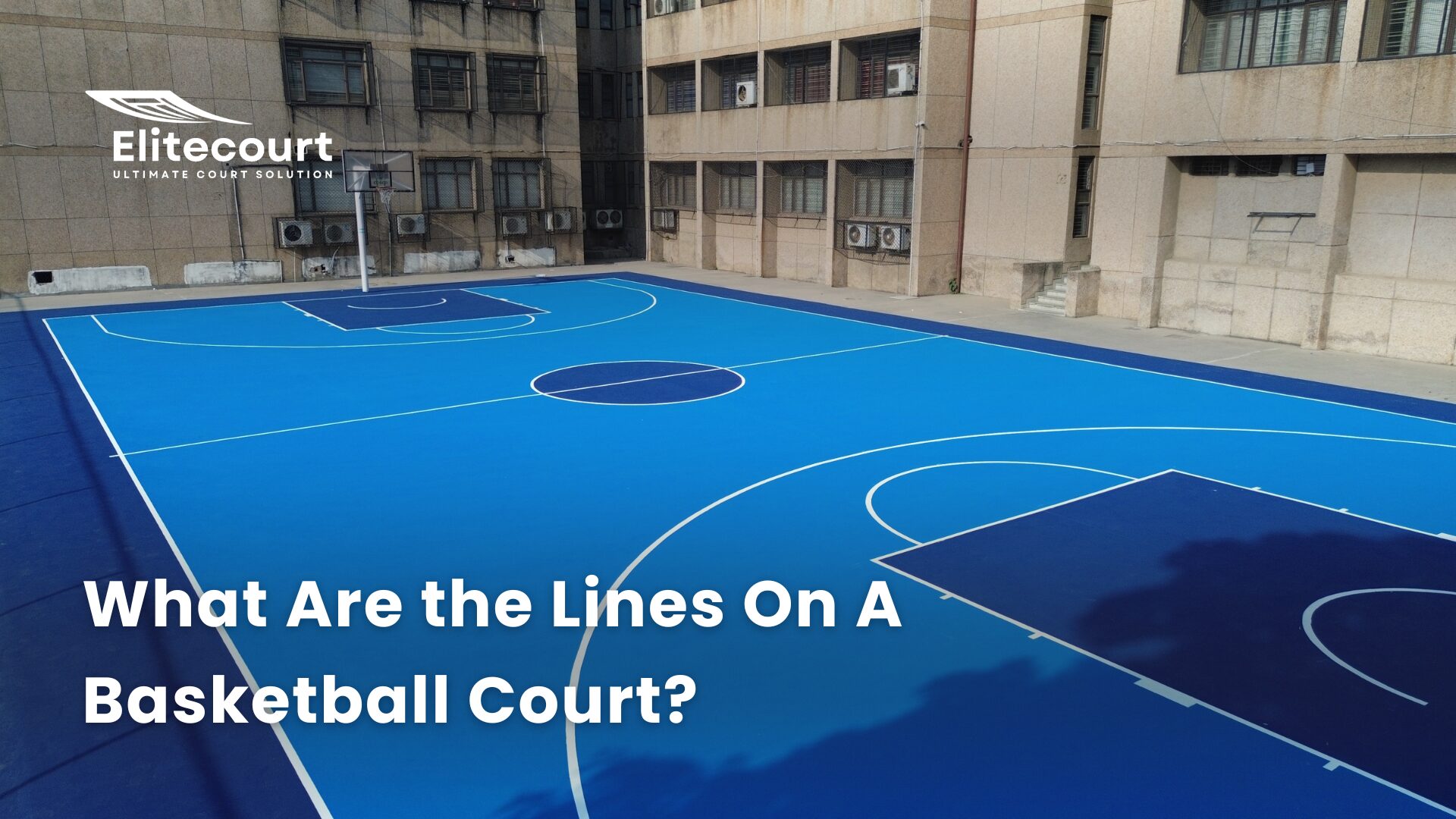
A basketball court is divided into several zones, each with precise dimensions that influence how the game is played. When discussing basketball court size, it’s important to look beyond the outer rectangle and understand the internal layout. These zones collectively create the structure of the game.
Here are the most essential areas:
Playing Area
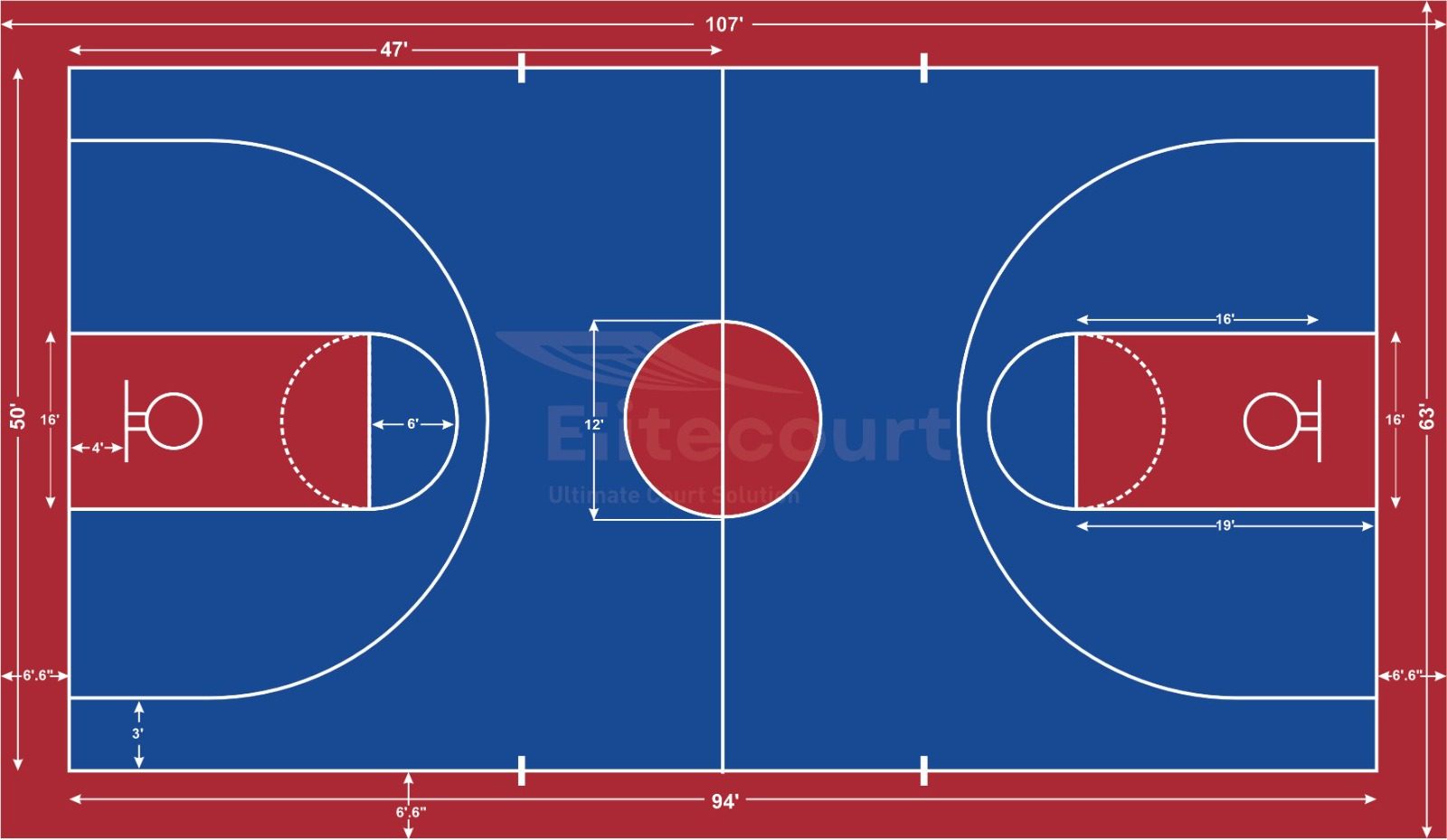
The main playing area is the entire 28 m × 15 m rectangle under FIBA standards. This space accommodates player movement, offensive spacing, defensive setups, and shooting range.
Free-Throw Lane (The Key)
Often called “the paint,” “the lane,” or “the key,” this area dictates how teams execute inside scoring, rebounds, and defensive strategies. The width under FIBA is 4.9 meters.
Three-Point Arc
The three-point line transforms how offenses stretch the floor. Under FIBA:
- Distance from the basket: 6.75 meters
This influences shooting strategies and player spacing significantly.
Baselines & Sidelines
These boundaries define the rectangular limits of the court. Their accuracy is crucial because a few centimeters off can change passing angles and spacing.
Center Circle
The center circle (3.6 m diameter) creates structure for tip-offs and helps maintain symmetry across the court.
Every one of these zones is carefully measured to maintain fairness, consistency, and game rhythm. Even minor inaccuracies can affect shooting perception, player movement, and referee decisions.
Why Each Measurement Matters for Player Performance
Every line, circle, arc, and dimension directly influences how players interact with the court. For example:
- A wider lane limits how long defenders can stay in the paint.
- A deeper three-point arc favors skilled shooters.
- A spacious court allows more dynamic offensive plays.
Proper basketball court size ensures that athletes develop correct instincts, footwork patterns, and court awareness. Coaches rely on precise measurements to train players with consistency, preparing them for competitive environments.
Synthetic acrylic surfaces—such as those manufactured by Elitecourt—support this accuracy by providing stable, uniform, and durable flooring that keeps line markings crisp and long-lasting.
Basketball Court Size for Indoor vs. Outdoor Facilities
Differences in Layout
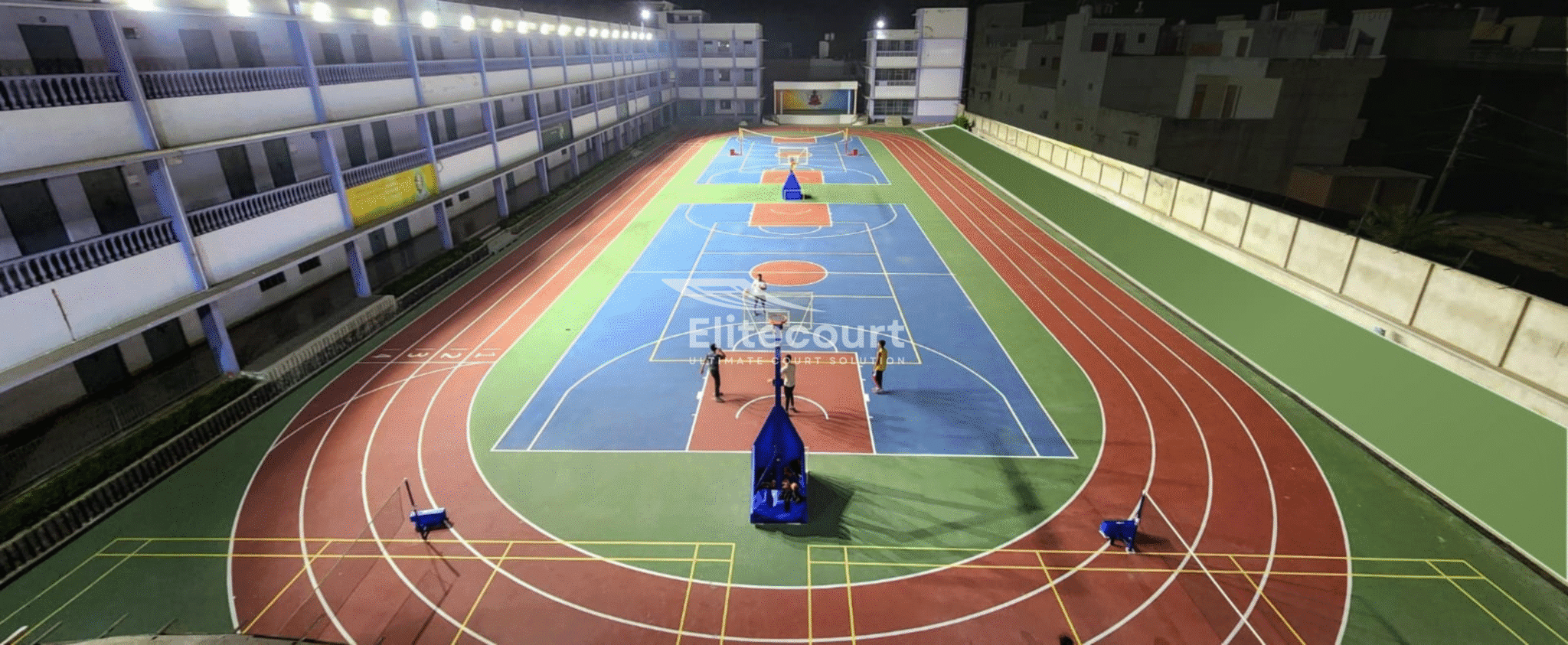
While the basketball court size remains the same for both indoor and outdoor facilities, the layout, surrounding space, and surface requirements often differ significantly. A 28 m × 15 m FIBA-standard court may appear identical on paper, but how it functions in real-world conditions depends heavily on whether it’s housed inside a building or built outdoors in open space.
Indoor courts offer controlled environments: consistent lighting, no wind, no rain, and predictable ball bounce. They allow architects to strictly follow standardized spacing, clearance areas, and symmetry. Because indoor courts are sheltered, they maintain court markings and floor performance for much longer without environmental interference.
Outdoor courts, on the other hand, require planning for sunlight, shadows, dust, wind resistance, weatherproofing, drainage, and surface flexibility. The surrounding zones might be adjusted depending on available space and the intended use. Even though the official basketball court size stays the same, the way the surrounding areas are designed can differ noticeably.
Outdoor courts often incorporate:
- Larger runoff areas to prevent falls
- Extra space for fencing
- UV-resistant, weather-resistant flooring materials
- Slope management for proper water drainage
This is where manufacturers like Elitecourt play a crucial role. Synthetic acrylic flooring performs exceptionally well outdoors due to its durability, slip resistance, and resilience in varying climates.
Even when space is limited, outdoor courts maintain the 28 m × 15 m dimension but may be integrated into multi-use recreational zones. Indoors, however, uniformity is the priority, and precision is easier to maintain due to controlled construction environments. Both settings require strict adherence to basketball court size standards—but each environment demands different planning approaches.
How Court Size Affects Gameplay in Each Setting
The environment around the court influences how athletes perceive space, speed, and ball movement. The basketball court size itself may be fixed, but the feel of the game changes dramatically between indoor and outdoor play.
Key gameplay differences:
Bounce Behavior
Synthetic acrylic indoor surfaces provide a more predictable bounce compared to outdoor courts, where dust or small debris can affect ball movement. Even with the same dimensions, the experience of dribbling feels different.
Movement & Footing
Outdoor environments may introduce factors like moisture, wind, or extreme heat. Players adjust their pace, balance, and stance. Indoors, the pace tends to be faster due to consistent traction, making court size feel more maximized.
Shooting Accuracy
Wind and lighting conditions affect outdoor shots. Indoors, consistent lighting makes players feel more confident taking long-range shots—meaning the three-point arc measurement directly impacts shooting strategy.
Spatial Perception
Walls, ceilings, and indoor acoustics subtly influence how players judge distance. Outdoors, the open sky behind the basket changes depth perception, affecting shot alignment even though the court size never changes.
Player Load
Harder outdoor surfaces may fatigue athletes faster. Indoors, cushioning beneath the acrylic layers can reduce load on joints and support sustained play across the full-sized court.
Court size remains the foundation—but the playability depends on environment-specific performance factors that Elitecourt’s surfaces help standardize.
Basketball Half-Court Size
Official Half-Court Dimensions
A half court is exactly what it sounds like—half of the full basketball court size, but with some important considerations. You don’t simply divide the court in half and call it done; certain elements remain unchanged to maintain balanced play.
Under FIBA standards, a full court is 28 m × 15 m.
A half-court typically measures:
- Length: 14 meters
- Width: 15 meters
- Free-throw line distance: Same as full court
- Three-point arc: Modified layout but same radius (6.75 m) where space allows
Because there is no center circle or backcourt in half-court setups, the gameplay is more compact and focused. This preserves shooting instincts, spacing awareness, and footwork even though players operate in a smaller space.
Half courts are incredibly popular in:
- Schools
- Housing societies
- Training academies
- Community centers
- Recreational facilities
- Gyms
They allow athletes to practice essential skills without needing the full space required by competitive matches.
Transform Your Sports Facility Today!
Contact us for high-quality synthetic sports flooring material and elevate your space!
Half-Court vs. Full-Court: Which Size Works Best?
Choosing between a half-court and full-court depends on purpose, space, and the type of play intended—not just the standard basketball court size.
Advantages of a Half-Court:
- Requires only half the land
- Great for shooting and skill development
- Easier to maintain
- Ideal for recreational play
- Works well in residential or space-limited environments
Advantages of a Full Court:
- Necessary for competitive play
- Supports fast breaks, transitions, and full defensive rotations
- Allows structured coaching and team strategies
- Matches tournament regulations
Which one to choose?
If you want tournament training, competitive practice, or professional preparation, a full-size basketball court is essential. But if the goal is informal play, physical activity, or skill development in limited space, the half-court option is more practical.
Elitecourt’s synthetic acrylic surfaces accommodate both, maintaining consistent performance regardless of court size or design.
Factors That Influence Basketball Court Size Selection
Purpose of the Court
The most important factor in determining basketball court size is how the court will be used. Each application has its own ideal sizing standards.
For example:
- Schools may use slightly modified courts for younger players.
- Training academies typically follow strict FIBA guidelines.
- Community parks focus on accessibility rather than competition.
- Recreational centers prioritize versatility and multi-sport use.
Competitive environments demand full-size courts because game strategy heavily depends on space. On the other hand, training-focused facilities may choose half-courts or compact courts for drills, repetition, and fundamental skill work.
Purpose-driven planning ensures the court feels natural and comfortable for the intended users.
Available Space
A common challenge—especially in urban settings—is limited space. But even with restricted land availability, proper planning helps maintain accurate basketball court size ratios.
Many facilities adopt:
- Space-optimized full courts
- Slightly narrower recreational courts
- Full-width but shorter training courts
- Rotated courts to fit unique land geometry
- Multi-sport layouts sharing boundary lines
While official play requires fixed dimensions, recreational environments allow flexibility where necessary. The key is to preserve correct zone ratios even if the total length varies.
Space assessment, combined with high-quality flooring materials like Elitecourt’s acrylic systems, ensures the space is used efficiently without compromising player experience.
Safety Standards & Clearance Areas
Clearance zones are crucial for injury prevention. Even though they aren’t part of the official basketball court size, they must be considered in construction.
Recommended clearance:
- Minimum 2 meters beyond each sideline
- Minimum 2 meters beyond each baseline
- More for high-level indoor competition
These zones allow players to decelerate safely during fast plays, prevent collisions with surrounding structures, and give referees space to move.
Ignoring these clearance areas—even when the court size is correct—can lead to unsafe playing conditions.
Flooring Material Compatibility
The choice of flooring does not change the basketball court size, but it influences how well the dimensions can be applied and maintained.
Synthetic acrylic flooring—Elitecourt’s core product—offers:
- Crisp and long-lasting line markings
- UV resistance for outdoor courts
- High traction for safe movement
- Balanced ball bounce
- Surface uniformity
- Durability under intense footwork
Accurate sizing is only meaningful when paired with a court surface that remains consistent, smooth, and reliable for years.
Manufacturers like Elitecourt ensure that the flooring layers support proper marking application and measurement precision.
Basketball Court Size and Line Marking Standards
Precision in Court Markings
Correct basketball court size doesn’t stop at the outer boundaries—precision in line markings is equally critical. Every marking plays a role in gameplay, positioning, referee decisions, spacing, and tactical planning. If a line is painted even a few centimeters off, it affects shooting accuracy, perimeter spacing, and movement patterns during a game.
Here are the essential markings on a standard FIBA basketball court:
Three-Point Line
- Radius: 6.75 meters from the basket
- Shape: Arc with straight sections along the sidelines
This is one of the most influential lines in modern basketball, defining long-range scoring and floor spacing.
Free-Throw Line
- 4.6 meters from the backboard
- Aligns perfectly with the center of the key
This area dictates foul shot mechanics, rebounding positions, and lane violations.
Free-Throw Circle
- Diameter: 3.6 meters
Players must stay outside this circle until the ball is released during a free throw.
Restricted Area (No-Charge Zone)
- Radius: 1.25 meters from the center of the basket
Designed to reduce collisions and provide clarity on charging/blocking fouls.
Center Circle
- Diameter: 3.6 meters
Used for the tip-off and helps maintain symmetry on both halves of the court.
Sidelines & Baselines
- Outline the entire 28 m × 15 m basketball court size
- Must be clean, straight, and highly visible
Midcourt Line
- Divides the playing area into two halves
Key for backcourt violation rules and defensive strategies.
Team Bench Areas & Substitution Lines
Important for managing game flow and organization during competitive play.
Because synthetic acrylic surfaces allow extremely sharp, long-lasting line application, Elitecourt’s flooring materials support consistent and precise marking layouts even for heavy-use courts.
Why Proper Line Dimensions Matter
Line markings may seem like small details, but they dramatically influence every aspect of basketball. The court is essentially a map for players, telling them where they can shoot, defend, attack, and reposition.
Key reasons why proper line dimensions are essential:
Ensures Rule Compliance
Referees make decisions based on where players stand. Incorrect markings create confusion, unfair calls, and inconsistent gameplay.
Shapes Team Strategy
Coaches design plays around court geometry—corner threes, mid-range shots, screen placements, and defensive rotations all depend on accurate measurements.
Enhances Player Development
Young athletes learn spacing, footwork, and timing using these boundaries. If the court is wrongly marked, players develop incorrect habits.
Improves Safety
The restricted area, key, and boundary lines guide player movement. Proper placement reduces collisions, missteps, and unsafe landings.
Supports Professional-Level Training
Athletes need standardized markings to prepare for competitive environments—especially when transitioning from academy to professional play.
Elitecourt’s materials help maintain precise, durable lines that don’t fade or distort under weather variations, ensuring long-term accuracy.
Elitecourt’s Expertise in Basketball Court Size & Flooring
How Elitecourt’s Materials Support Accurate Sizing
Manufacturers play a critical role in ensuring that the basketball court size is executed precisely during construction. While Elitecourt does not install courts, its synthetic acrylic flooring materials are engineered to support accurate marking, structural consistency, and performance durability.
Elitecourt’s flooring advantages for accurate court sizing:
- Uniform Surface Texture to maintain straight, clean lines
- High UV Stability to prevent fading and distortion on outdoor courts
- Excellent Adhesion for crisp marking layout
- Optimized Ball Bounce aligned with professional standards
- Consistent Traction that enhances safety across full court dimensions
When the flooring material is stable and consistent, the court maintains its geometry for years without warping, cracking, or altering the placement of key zones. This ensures that athletes always train and play on a true-to-standard court.
Elitecourt’s Role
Elitecourt’s role as a leading sports flooring manufacturer is to provide high-quality materials that uphold global standards for court performance. With years of experience supplying surfaces to schools, clubs, institutions, academies, and sports complexes, Elitecourt understands the importance of maintaining accurate basketball court size through reliable and durable flooring systems.
Elitecourt contributes to proper court sizing through:
- Quality-controlled manufacturing of acrylic layers
- Surface systems compatible with standard court dimensions
- Materials engineered for longevity on both indoor and outdoor courts
- Professional-grade finishes ideal for line marking precision
Even the best court design relies on flooring materials that maintain stability over time. Elitecourt ensures that every surface supports the correct layout, giving players a consistent, high-performance environment.
Q&A
The standard FIBA basketball court size is 28 meters long and 15 meters wide. This measurement is used worldwide, including in India. It ensures proper spacing, movement, and gameplay structure for competitive basketball.
No. NBA courts are slightly larger at 28.7 m × 15.24 m. FIBA courts are 28 m × 15 m. Both support high-level basketball, but they produce different spacing dynamics and play styles.
Backyard courts typically range from half-court size (14 m × 15 m) to custom compact layouts. The ideal choice depends on available space and intended use—recreational play, training, or casual shooting practice.
The size itself doesn’t change—but flooring influences how accurately markings can be applied and how long they remain precise. High-quality synthetic acrylic surfaces allow clean, long-lasting lines.
A clearance zone of at least 2 meters around the entire court is recommended for safe movement, deceleration, and referee access during games.
Expert Tips from Elitecourt
Tips for Choosing the Right Court Size
Choosing the appropriate basketball court size requires careful planning—not just measuring space. Whether the court is for competition, recreation, or training, the right dimensions ensure long-term usability and player satisfaction.
Analyze User Demographics
Consider whether the court will serve:
- School students
- Academy trainees
- Adult players
- Mixed user groups
Younger players may benefit from slightly modified layouts.
Evaluate Available Land
Accurate planning helps fit a full-sized or half-sized court without compromising key dimensions. Even small spaces can host functional courts with creative layouts.
Ensure Proper Clearance Zones
Don’t overlook areas outside the playing rectangle. Safety, usability, and comfort depend on generous buffer space.
Prioritize Surface Quality
High-quality acrylic flooring improves:
- Traction
- Ball bounce
- Marking clarity
- Durability
It ensures that the court maintains accurate dimensions over time.
Consider Long-Term Use
Courts last for years. Choose dimensions that support evolving needs—whether for coaching, practice, or multi-sport use.
Conclusion
The basketball court size is more than a set of measurements—it’s the blueprint for how the game is played, practiced, and experienced. From the full-sized 28 m × 15 m FIBA court to compact training courts, every dimension shapes player movement, coaching strategy, and gameplay rhythm. Understanding these measurements ensures that your facility delivers the right environment for safe, enjoyable, and high-quality basketball.
Elitecourt supports this vision by manufacturing advanced synthetic acrylic flooring systems that uphold global performance standards. With years of experience supplying sports flooring across India, Elitecourt ensures that every court—whether outdoor or indoor—delivers consistent traction, durability, and precision for accurate marking application.
Choosing the right basketball court size requires careful planning, attention to detail, and a surface that maintains structural integrity over time. With reliable materials and informed decisions, any facility can create a court that inspires athletes and supports their growth.
Transform Your Sports Facility Today!
Contact us for high-quality synthetic sports flooring material and elevate your space!
FAQs
The minimum recommended size for recreational play is the half-court dimension: 14 m × 15 m. While smaller courts exist, maintaining proportionate spacing improves playability and training quality.
Proper dimensions teach correct footwork, spacing, shooting range, and strategic movement. Incorrect court sizes can disrupt player instincts and hinder long-term development.
Yes. Recreational or training courts may be scaled down while keeping key areas proportional, preserving natural gameplay flow even in limited spaces.
Absolutely. Half courts are excellent for drills, shooting practice, skill development, and small-sided games. They’re widely used in schools and academies.
Working with high-quality flooring materials like acrylic systems ensures that measurements remain accurate.