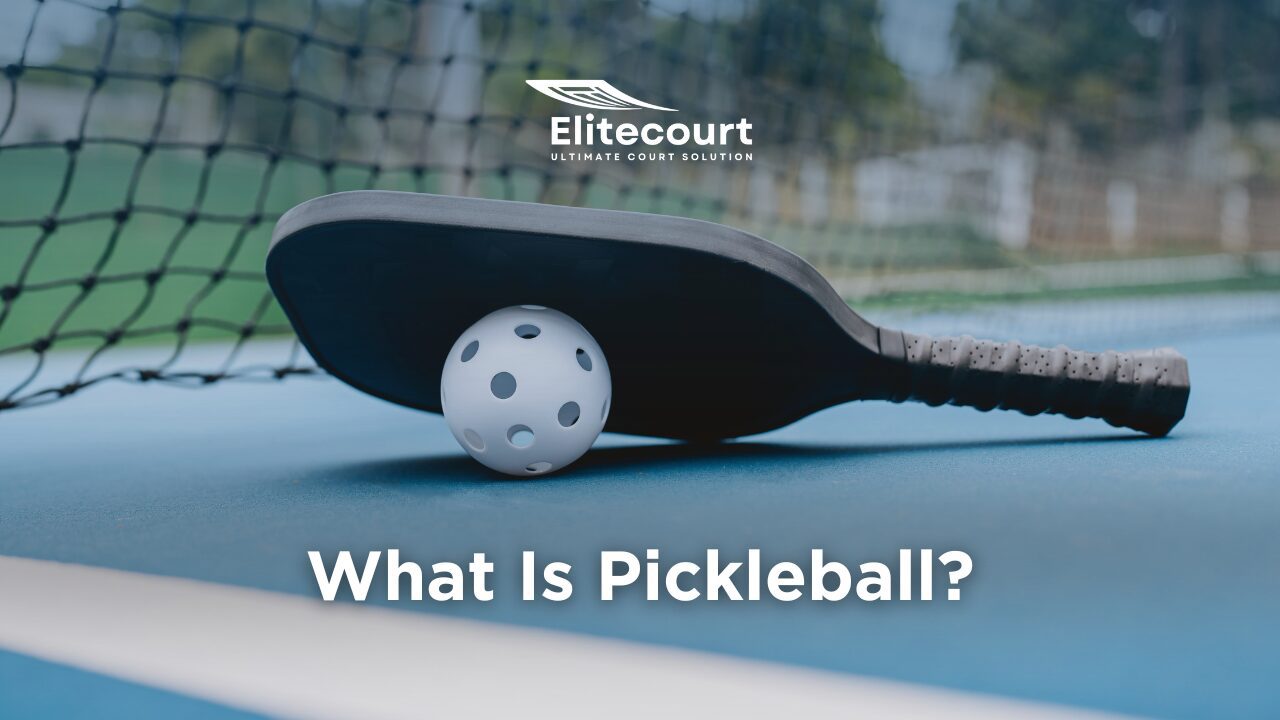
If you have walked past a local park or recreation center recently, you have likely heard a distinctive “pop” sound echoing across the courts. This brings up a common question: what is pickleball?
At its core, pickleball is a fun, fast-paced paddle sport that combines elements of tennis, badminton, and ping-pong. Players use solid paddles to hit a perforated, hollow plastic ball over a net on a badminton-sized court. Players can play it as singles (two players) or doubles (four players), with most players preferring the doubles format. The designers specifically created the game to be highly accessible, giving beginners an easy entry point while still offering advanced players a highly competitive and strategic experience.
Whether you are looking for a new way to stay active, a fun social activity, or a serious athletic challenge, pickleball delivers on all fronts. In this comprehensive guide, we will explore everything you need to know about the fastest-growing sport in the world.
History of Pickleball
To truly understand the game, it helps to look back at its origins. The history of pickleball dates back to the summer of 1965 on Bainbridge Island, Washington. Three fathers—Joel Pritchard, Bill Bell, and Barney McCallum—were looking for a way to entertain their bored children during a family vacation.
They had an old badminton court but could not find the right equipment. Improvising, they gathered ping-pong paddles and a perforated plastic ball. Initially, they placed the net at badminton height, but as they played, they realized the ball bounced well on the asphalt, allowing them to lower the net to 36 inches.
Over the following weekends, players and organizers refined the rules to make the game fair and enjoyable for people of all ages. They introduced the non-volley zone (often called the “kitchen”) to stop aggressive smashing at the net and established the double-bounce rule to ensure both the receiving and serving teams had a fair advantage. By 1972, a group formed a corporation to protect the sport, and in 1976, organizers hosted the first known pickleball tournament in Tukwila, Washington. Today, it has evolved into a global phenomenon, supported by international federations and played by millions.
Why is it Called Pickleball?
One of the most frequently asked questions is how the sport got its unusual name. There are two competing stories about the origin of the name “pickleball,” both stemming from the founding families.
- The Boat Race Theory: According to Joan Pritchard, Joel Pritchard’s wife, she named the game pickleball because the mix of different sports (tennis, badminton, and ping-pong) reminded her of a “pickle boat” in crew, where rowers came from the leftovers of other boats.
- The Dog Theory: The other popular story claims the game was named after the Pritchards’ family dog, Pickles. Pickles would often chase the stray balls during their games and run off with them.
While fans of the sport adore the dog theory, historians and family members have clarified that the dog actually took its name from the sport, confirming the “pickle boat” theory as the true origin. Regardless of how it got its name, the quirky title has only added to the sport’s widespread charm.
Transform Your Sports Facility Today!
Contact us for high-quality synthetic sports flooring material and elevate your space!
Court & Layout
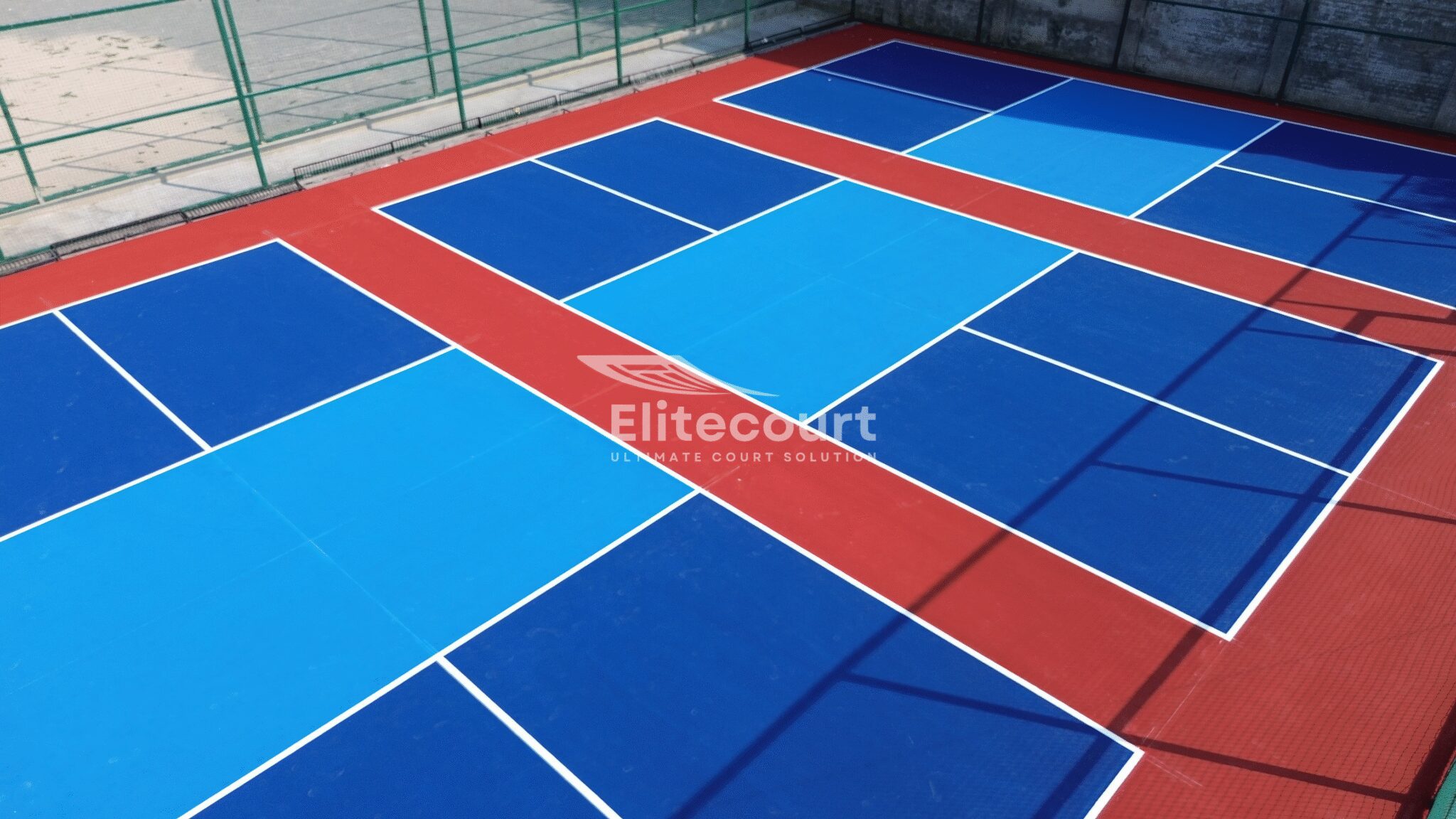
Understanding the playing surface is crucial for anyone learning the game. As an industry leader in synthetic acrylic sports court flooring, Elitecourt knows that a properly dimensioned and surfaced court is the foundation of a great game.
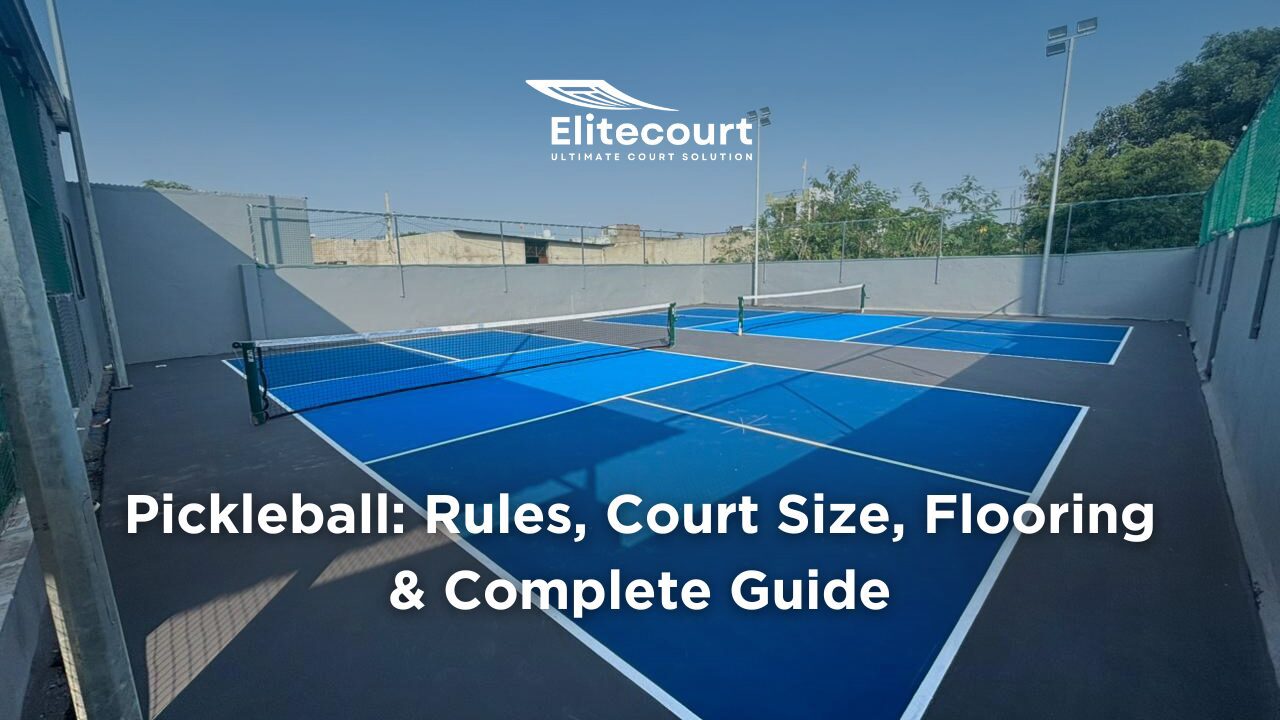
A standard pickleball court is the same size as a doubles badminton court and measures 20 feet wide and 44 feet long for both singles and doubles matches.
Court Dimensions and Lines
The court features several specific lines and zones that dictate how the game is played:
- Baselines: The lines parallel to the net at each end of the court.
- Sidelines: The lines running perpendicular to the net on each side of the court.
- Centerlines: The line extending from the Non-Volley Zone to the baseline, dividing the serving area into two equal halves (right and left service courts).
- Non-Volley Zone (NVZ) Line: Located 7 feet from the net on both sides, this line marks the beginning of the “kitchen.”
Net Specifications
The net in pickleball is slightly lower than a tennis net. It measures 36 inches high at the sidelines and dips to 34 inches high in the center.
| Court Feature | Measurement | Description |
|---|---|---|
| Total Court Size | 20 ft x 44 ft | Applies to both singles and doubles play. |
| Non-Volley Zone | 7 ft x 20 ft | The area immediately adjacent to the net on both sides. |
| Service Court | 15 ft x 10 ft | The area where the serve must land. |
| Net Height | 36″ edges, 34″ center | Creates a natural dip in the middle of the court. |
The surface of a pickleball court is incredibly important. Premium synthetic acrylic sports court flooring provides the ideal combination of grip, bounce, and durability. Proper flooring reduces joint strain for players while ensuring the ball behaves predictably upon impact.

Key Features of Pickleball
What sets this sport apart from other racquet and paddle games? Let us break down the essential features that define the game.
Court and Equipment
As mentioned, the compact court size requires less running than tennis, making it highly accessible. The equipment is equally distinct. Paddles are solid, smaller than a tennis racquet but larger than a ping-pong paddle. The ball is made of smooth plastic with holes, which limits its speed and distance, ensuring rallies are controlled and strategic rather than based solely on raw power.
The “Kitchen”
Perhaps the most unique feature of pickleball is the Non-Volley Zone, affectionately known as the “Kitchen.” This 7-foot area on either side of the net is a restricted zone. You cannot hit the ball out of the air (a volley) while standing inside the Kitchen or touching the Kitchen line. This rule prevents players from standing right at the net and aggressively smashing every ball. It forces a game of finesse, drops, and “dinks” (soft shots that land in the opponent’s Kitchen).
Serving and Scoring
Unlike tennis, where a powerful overhand serve can win points outright, the pickleball serve is defensive. You must serve underhand, making contact with the ball below your waist. Furthermore, you can only score a point when your team is serving. If the receiving team wins a rally, they do not score a point; instead, they win the right to serve (known as a “side out”).
Game Format
Pickleball is overwhelmingly played as a doubles game, though singles play is also popular. Doubles play emphasizes communication, synchronized movement, and quick reflexes at the net. Games are typically played to 11 points, and you must win by 2 points.
Accessibility
One of the greatest features of this sport is its inclusivity. Because the court is small and the ball travels slower than a tennis ball, people of all ages and athletic backgrounds can play together. It is common to see grandparents playing competitively alongside their grandchildren, a rarity in most other sports.
Transform Your Sports Facility Today!
Contact us for high-quality synthetic sports flooring material and elevate your space!
Equipment
Getting started in pickleball requires minimal gear, which is part of its immense appeal. Here is exactly what you need to step onto the court.
Pickleball Paddles
Early paddles were made entirely of wood, making them heavy and cumbersome. Today, high-tech composite materials dominate the market.
- Core Materials: Modern paddles feature a honeycomb core, usually made of polymer, aluminum, or Nomex. Polymer cores are the most popular, offering a great balance of power and touch while being quieter.
- Surface Materials: The face of the paddle is typically made of fiberglass, graphite, or carbon fiber. Carbon fiber provides excellent control and spin, while fiberglass offers more power.
- Weight: Paddles range from 7 to 9 ounces. Lighter paddles offer better maneuverability for net play, while heavier paddles generate more driving power from the baseline.
Pickleballs
Not all pickleballs are created equal. You must choose the right ball based on where you are playing.
- Indoor Balls: These balls have 26 larger holes. They are lighter, softer, and easier to control, making them ideal for gymnasiums and indoor synthetic courts.
- Outdoor Balls: Designed to withstand wind and rough surfaces, outdoor balls are heavier, harder, and feature 40 smaller holes. They play faster and tend to skip off the court surface.
Footwear
Because players need to make quick lateral movements, starts, and stops during the game, coaches strongly discourage running shoes because they lack side-to-side support.
Court shoes (designed for tennis or volleyball) are essential. They provide the necessary stability to prevent ankle rolls and feature durable outsoles meant to grip synthetic acrylic sports court flooring without leaving scuff marks.
Pickleball Rules
To maintain the integrity of the game and ensure fairness, players must adhere to a specific set of rules. For the complete, official regulations, players often refer to the official USA Pickleball Rulebook. Here are the fundamental rules you must know.
The Serve
- The serve must be hit underhand, with the paddle contacting the ball below the server’s waist.
- The server must keep at least one foot behind the baseline until the ball is struck.
- The serve must be hit diagonally crosscourt and must land entirely within the opponent’s opposite service court, clearing the Non-Volley Zone and its line.
- Only one serve attempt is allowed per server, except in the case of a “let” (if the ball hits the net but still lands in the correct service court, the serve is replayed).
The Double-Bounce Rule
This rule dictates how the first two shots of every point must be played.
- When the ball is served, the receiving team must let it bounce once before returning it.
- When the ball is returned to the serving team, the serving team must also let it bounce once before hitting it back.
- After these two initial bounces have occurred, players may either volley the ball (hit it in the air) or play it off a bounce. This rule eliminates the serve-and-volley advantage and extends rallies.
Kitchen Rules (Non-Volley Zone)
- You cannot volley the ball while any part of your body or clothing is touching the Non-Volley Zone or the lines surrounding it.
- Your momentum cannot carry you into the NVZ after hitting a volley outside of it.
- You can step into the NVZ to hit a ball that has already bounced.
Faults
A fault stops play and results in either a loss of serve or a point for the serving team. Common faults include:
- Hitting the ball out of bounds.
- Hitting the ball into the net.
- Violating the Double-Bounce Rule.
- Committing a Kitchen violation (volleying from the NVZ).
- Being struck by the ball anywhere other than the paddle hand below the wrist.
Pickleball Scoring
Scoring can seem like a foreign language to beginners, primarily because it requires keeping track of three different numbers in doubles play.
The Three-Number System
Before every serve in doubles, the server must announce the score as three numbers:
- The serving team’s score
- The receiving team’s score
- The server number (1 or 2)
For example, if the score is 3 to 2, and you are the second server on your team, you will announce: “3, 2, 2.”
How Serving Progresses
Points are only scored by the serving team. When a game begins, the team serving first only gets one fault before the serve turns over to the opposing team (to prevent the first serving team from gaining an unfair early lead). The starting score is called as “0, 0, 2.”
Once a side out occurs, the opposing team gets to serve. The player on the right side of the court serves first (Server 1). If they win the point, they score, switch to the left side, and serve again. They continue serving until their team loses a rally. Once they lose a rally, it becomes the second partner’s turn to serve (Server 2). When Server 2 loses a rally, it is a “side out,” and the ball goes back to the other team.
Games are played to 11 points, and a team must win by 2 points. Tournament matches sometimes go to 15 or 21 points, but the win-by-two rule always applies.
How to Play Pickleball
Ready to step onto the court? Here is a step-by-step guide on how a standard point plays out.
- The Serve: The game begins with the player on the right side of the baseline serving diagonally to the opponent’s right service court. The serve is underhand and must clear the Kitchen.
- The Return: The receiving team waits for the ball to bounce (First Bounce). They then hit a deep return shot back over the net, ideally pushing the serving team back toward their baseline.
- The Third Shot: The serving team must wait for the return shot to bounce (Second Bounce). This fulfills the Double-Bounce Rule. The serving team now has a strategic choice. They can attempt a “Third Shot Drop,” which is a soft, arcing shot that lands gently in the opponent’s Kitchen, allowing the serving team to run up to the net. Alternatively, they can hit a “Third Shot Drive,” a powerful shot aimed low over the net.
- The Rally: Once the two bounces have occurred, both teams typically try to advance to the Non-Volley Zone line. From here, the game turns into a rapid exchange of “dinks” (soft shots) and quick reflex volleys. The goal is to force your opponents to pop the ball up, creating an opportunity for an aggressive smash.
- Ending the Point: The rally continues until a team commits a fault. If the serving team wins, they score a point and switch sides. If the receiving team wins, no point is scored, but they either force a second serve or achieve a side out.
Why is Pickleball so Popular Today?
The explosive growth of the sport is no accident. Several key factors have contributed to its status as a cultural phenomenon.
First, it is incredibly easy to learn. Unlike tennis or golf, which require months of frustrating lessons just to achieve basic competency, a beginner can learn the rules and start having competitive, enjoyable rallies within their first 30 minutes on the court.
Second, the social aspect is unmatched. Because the court is small, players are physically closer to one another, making conversation easy. The culture of the sport highly encourages open play, where players place their paddles in a rack to mix and match with strangers, instantly building a sense of community.
Third, it provides a fantastic workout. While it is easier on the joints than tennis, a competitive match provides excellent cardiovascular exercise, improving agility, balance, and hand-eye coordination.
Finally, cities, municipalities, and private clubs are rapidly converting old spaces or building new dedicated facilities to keep up with demand. As manufacturers like Elitecourt continue to provide premium synthetic acrylic sports court flooring for these projects, the playing experience is becoming safer and more enjoyable for everyone involved.
Transform Your Sports Facility Today!
Contact us for high-quality synthetic sports flooring material and elevate your space!
Frequently Asked Questions (FAQs)
Pickleball uses a solid paddle and plastic ball on a smaller court, with unique rules like underhand serves and the “Kitchen” zone, making it more accessible than tennis.
Yes, with modifications. Temporary lines and a lower net allow tennis courts to host multiple pickleball games.
No. Pickleball is designed for all ages and fitness levels and is easy to start, offering both casual and competitive play.
A dink is a soft shot that lands in the Non-Volley Zone, used to control play and prevent aggressive returns.
Most games last 15–25 minutes, making it easy to enjoy several matches in one session.