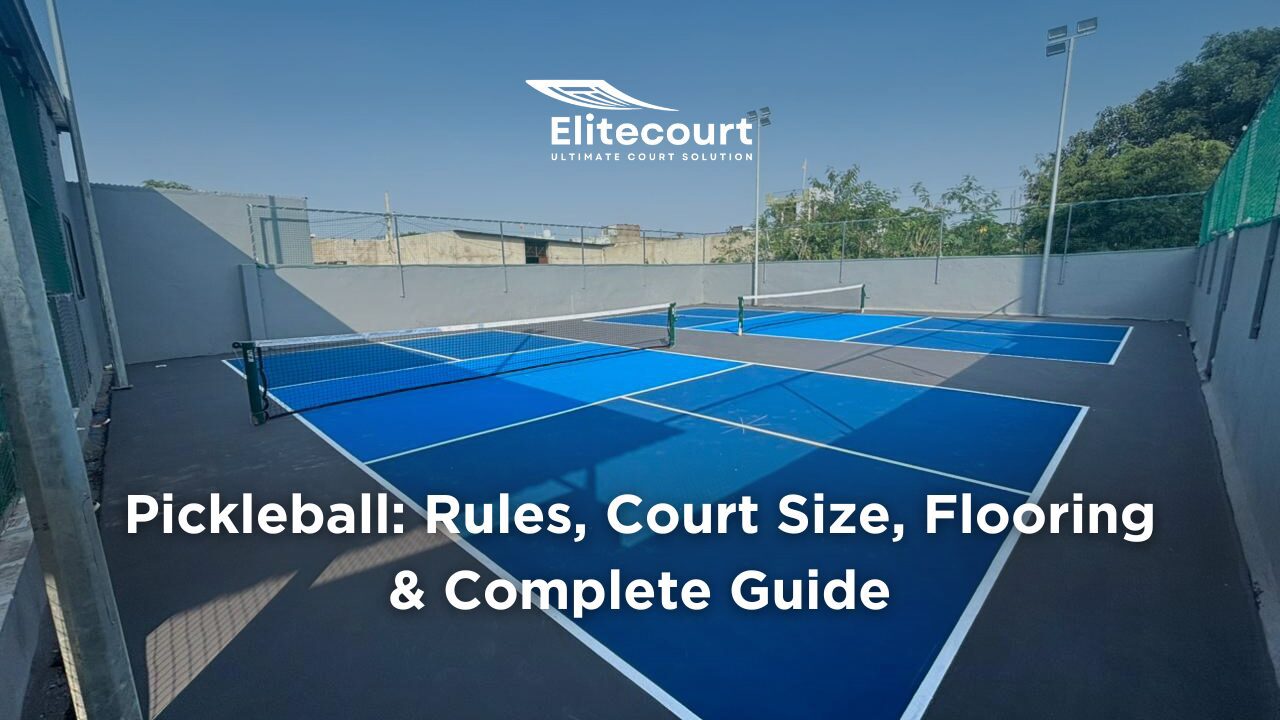
Synthetic acrylic flooring systems most commonly surface pickleball courts, typically installed over asphalt or concrete bases. Facilities favor these systems because they deliver the right balance of ball response, player traction, durability, and outdoor performance—qualities essential for a sport that combines speed, agility, and precision. While alternative surfaces exist, acrylic-based sports flooring remains the global benchmark for competitive and recreational pickleball courts.
The sections that follow explain why pickleball courts use acrylic flooring, how it performs compared to other options, which technical characteristics matter most, and how manufacturers like Elitecourt engineer surfaces specifically for pickleball play.
Understanding the Unique Flooring Requirements of Pickleball
Pickleball may look simple at first glance, but from a flooring perspective, it places very specific demands on the playing surface. The sport combines quick lateral movements, short sprints, abrupt stops, and precise ball control. Flooring that fails to support these movements can compromise both performance and player safety.
Unlike sports such as basketball or badminton, pickleball is primarily played outdoors and uses a perforated polymer ball. This means the surface must deliver consistent bounce, resist weather-related wear, and maintain texture without becoming abrasive. The flooring also needs to support players with a wide range of skill levels, from competitive athletes to recreational participants.
Another critical factor is the court size and play intensity. Because pickleball courts are smaller, foot traffic concentrates in key zones, especially around the non-volley zone (kitchen). Flooring systems must therefore resist localized wear while maintaining uniform performance across the entire court.
Key performance requirements for pickleball court flooring include:
- Predictable ball bounce with minimal dead spots
- Controlled surface texture for traction without skin abrasion
- UV and weather resistance for outdoor longevity
- Low maintenance characteristics suitable for frequent play
- Compatibility with standard court line markings
After understanding these demands, it becomes clear why certain flooring systems dominate the sport.
Why Synthetic Acrylic Flooring Is the Preferred Choice
The global pickleball community widely recognizes synthetic acrylic flooring systems as the preferred surface for pickleball courts. These systems apply engineered coatings over stable asphalt or concrete bases to create a seamless, cushioned, and textured playing surface.
One of the primary reasons acrylic flooring is used for pickleball courts is its surface consistency. Acrylic layers create a uniform texture that ensures the ball reacts the same way across the entire court. This consistency is critical in pickleball, where placement and control matter more than raw power.
Acrylic systems are also highly adaptable. Manufacturers like Elitecourt design multi-layer acrylic systems that allow customization of speed, cushioning, and texture. This flexibility enables facilities to tailor courts for recreational play, training environments, or competitive use without altering the core surface technology.
Another advantage is outdoor durability. Acrylic flooring is formulated to resist UV degradation, moisture exposure, and temperature fluctuations. Unlike modular tiles or bare concrete, acrylic systems maintain their playing characteristics over extended periods when manufactured with quality binders and pigments.
Key reasons acrylic flooring dominates pickleball courts:
- Excellent ball bounce accuracy for perforated pickleballs
- Slip-resistant textured finish for controlled footwork
- Seamless surface with no joints or interlocking edges
- Weather-resistant composition suitable for outdoor installations
- Compatibility with official court color schemes and markings
After considering these benefits, it becomes evident that acrylic flooring aligns naturally with the functional and regulatory expectations of pickleball courts.
Types of Flooring Used for Pickleball Courts
While synthetic acrylic flooring is the most widely adopted option, it is not the only surface ever used for pickleball. Understanding the broader landscape helps clarify why acrylic systems remain the industry standard.
Pickleball courts can technically be constructed using several surface types, each with its own advantages and limitations. However, not all surfaces meet the performance consistency and durability standards expected for long-term use.
Common Pickleball Court Flooring Options
| Flooring Type | Surface Characteristics | Suitability for Pickleball |
|---|---|---|
| Synthetic Acrylic Coating | Textured, seamless, cushioned | Highly suitable and preferred |
| Bare Concrete | Hard, non-textured | Limited suitability |
| Asphalt (Uncoated) | Slight texture, porous | Not recommended alone |
| Modular Sports Tiles | Interlocking, elevated | Situational use |
| Indoor Wood Flooring | Smooth, resilient | Indoor-only adaptation |
Each of these options behaves differently under pickleball play conditions. Bare concrete and asphalt may be economical from a structural standpoint, but they lack the surface refinement required for consistent bounce and player comfort. Modular tiles can offer shock absorption, but seams and panel movement can interfere with ball behavior.
Synthetic acrylic systems stand out because they transform structural bases into sport-specific playing surfaces, rather than relying on the base material itself.
How Acrylic Pickleball Court Flooring Is Constructed
Acrylic pickleball court flooring is not a single layer but a system of specialized coatings, each serving a distinct purpose. The performance of the final court depends on how these layers work together.
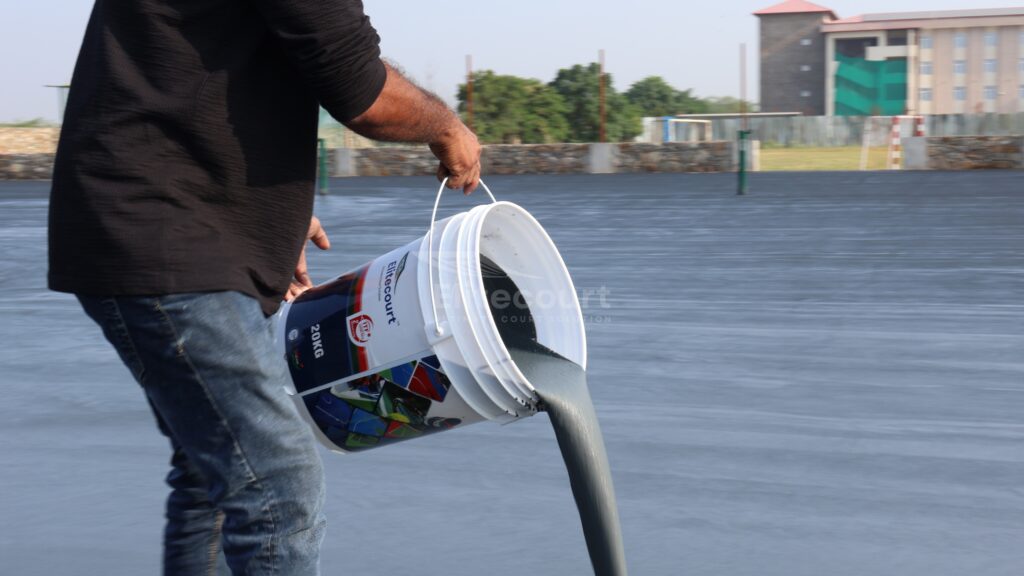
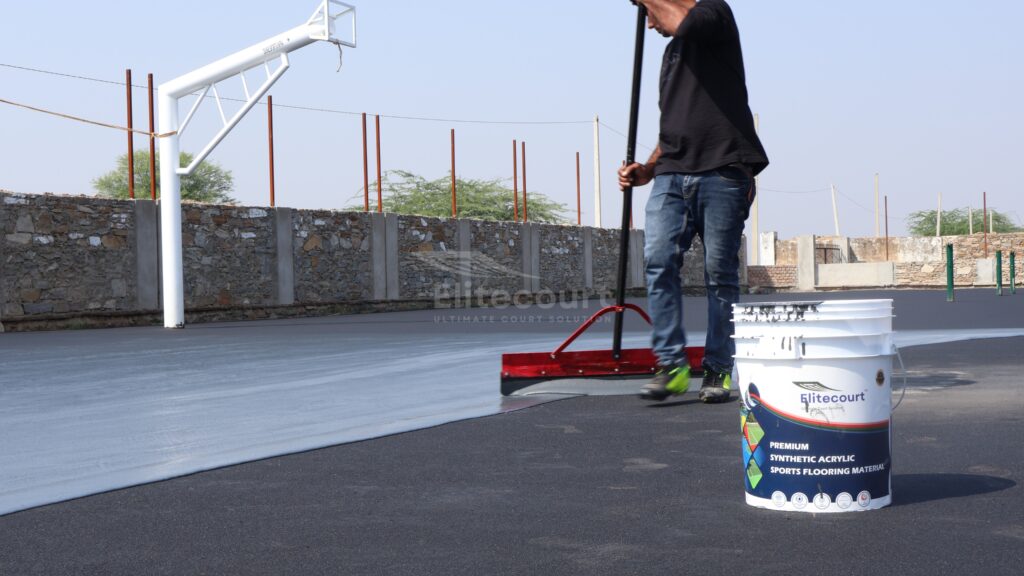
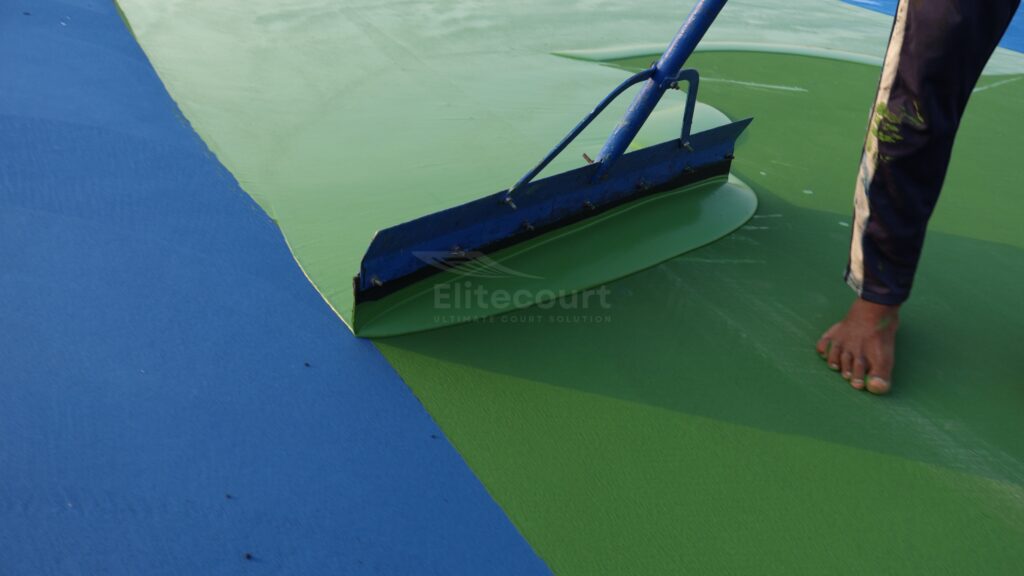
The process begins with a stable asphalt or concrete base, which provides structural integrity. Over this base, manufacturers apply acrylic resins mixed with graded aggregates. These aggregates determine surface texture, traction, and speed of play.
Elitecourt formulates its acrylic systems to maintain material consistency across layers, reducing the risk of uneven texture or premature wear. The layered structure also allows for optional cushioning, which can enhance comfort without affecting ball response.
Typical Acrylic Flooring Layer Structure
- Base preparation layer for adhesion and leveling
- Resurfacer coats to smooth minor surface imperfections
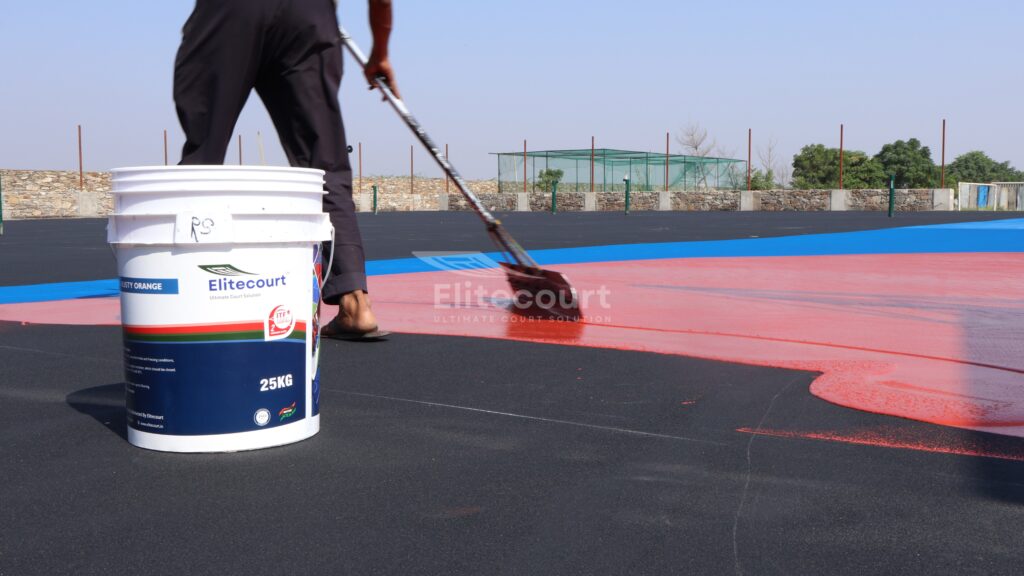
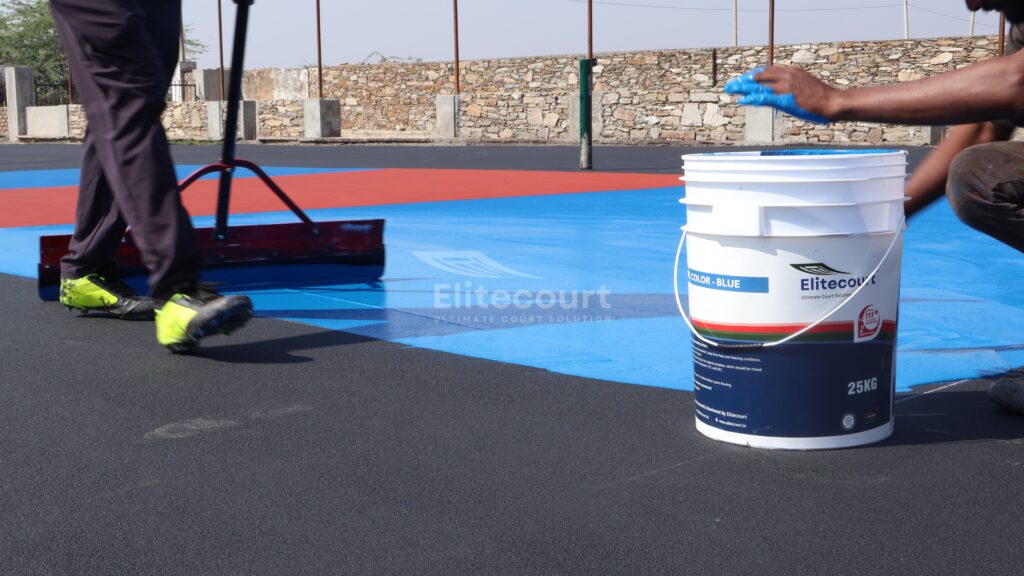
- Textured acrylic color coats for traction and playability
- Line marking layers using high-contrast acrylic paint
This layered approach ensures that pickleball courts achieve uniform performance characteristics rather than relying on a single coating or raw surface.
Surface Texture and Ball Bounce in Pickleball Flooring
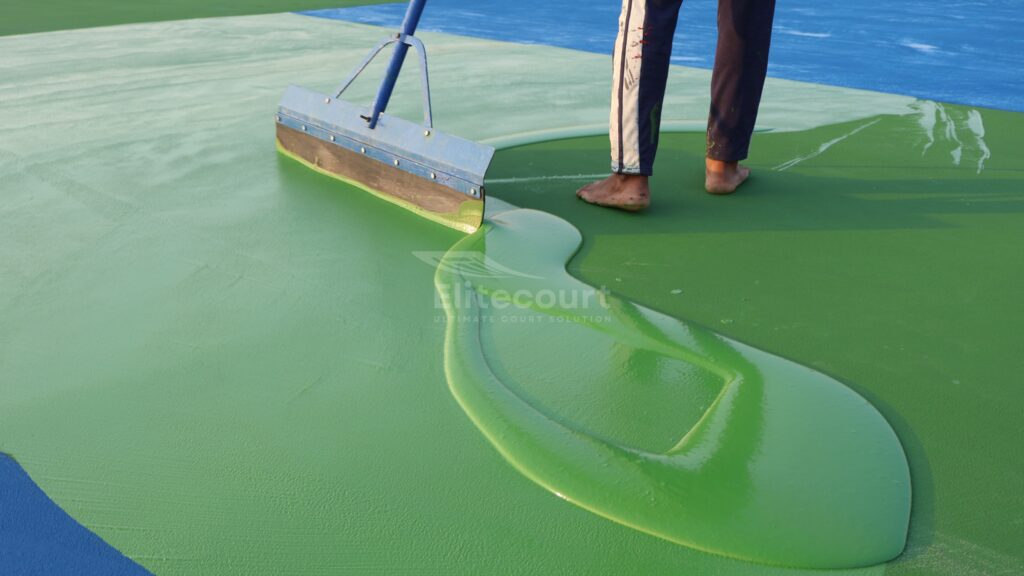
Surface texture and ball bounce are inseparable factors in pickleball court performance. Because pickleball relies on a lightweight perforated ball, even subtle surface inconsistencies can affect rally speed, shot placement, and player confidence. Flooring systems that are too smooth result in skidding and unpredictable bounce, while overly rough textures can cause excessive friction and surface abrasion.
Synthetic acrylic pickleball flooring delivers a controlled medium-texture finish that allows the ball to interact with the surface predictably. Precise aggregate grading and uniform dispersion within the acrylic binder create this balance. Elitecourt formulations emphasize texture consistency across the entire court, preventing performance variation between high-use zones and peripheral areas.
Ball bounce is influenced not only by surface roughness but also by surface elasticity and coating uniformity. A properly designed acrylic system absorbs micro-impact energy without deadening the bounce, ensuring that the ball rebounds at a height and speed consistent with player expectations and governing body guidelines.
Role of Surface Texture in Pickleball Play
Surface texture directly affects how players move and how the ball responds after contact. Elitecourt designs its acrylic systems to provide directional grip without locking the foot, enabling quick pivots and controlled stops.
Texture-related performance functions include:
- Controlled coefficient of friction for safe lateral movement
- Even aggregate exposure to avoid slick or abrasive patches
- Reduced surface glare, improving outdoor visibility
- Balanced skin-contact behavior to limit abrasion during falls
After application, the aggregates bind securely within the acrylic matrix, which keeps the texture stable instead of allowing loose surface particles. This ensures that traction does not degrade unevenly with use.
How Acrylic Flooring Regulates Ball Bounce
Ball bounce in pickleball must remain consistent across rallies, serves, and volleys. Acrylic flooring regulates bounce by maintaining a uniform energy return profile across the court.
| Bounce Influence Factor | Acrylic Flooring Response |
|---|---|
| Ball impact angle | Predictable rebound trajectory |
| Repeated contact zones | Minimal bounce variation |
| Temperature exposure | Stable surface response |
| Surface wear | Gradual, uniform change |
Because acrylic systems are seamless, there are no joints or panel edges to disrupt bounce behavior. This continuity is essential for fair play and competitive consistency.
In pickleball, players adapt quickly to surface behavior. Acrylic flooring ensures that adaptation happens once—not differently on every part of the court
Transform Your Sports Facility Today!
Contact us for high-quality synthetic sports flooring material and elevate your space!
Elitecourt Layer Systems for Pickleball Court Flooring
One of the defining strengths of Elitecourt as a synthetic acrylic sports flooring manufacturer lies in its layer-based system approach. Multiple layers working together determine pickleball court performance, delivering surface consistency, durability, traction balance, and play comfort. Elitecourt designs its acrylic flooring solutions as integrated layer systems, allowing planners and architects to specify performance levels based on usage intensity, player profile, and environmental exposure.
Each additional layer in an acrylic system is not about thickness alone. It represents functional enhancement, such as improved surface leveling, better aggregate distribution, increased wear resistance, or added comfort underfoot. By offering multiple layer configurations, Elitecourt allows pickleball courts to support recreational, institutional, or competitive use without compromising surface integrity or ball response.
Elitecourt engineers its layer systems with material compatibility across coats to ensure strong interlayer bonding, uniform curing, and long-term stability. This approach reduces surface fatigue, minimizes texture loss, and maintains predictable play characteristics over extended use cycles.
Overview of Elitecourt Acrylic Layer Systems
| Elitecourt System | Structural Focus | Performance Emphasis | Ideal Usage Profile |
|---|---|---|---|
| 5 Layer System | Essential surface build-up | Basic playability & traction | Recreational pickleball courts |
| 6 Layer System | Enhanced leveling & texture | Improved consistency & durability | Schools and community facilities |
| 7 Layer System | Balanced performance layering | Better comfort & wear resistance | Multi-court sports complexes |
| 8 Layer System | Advanced surface refinement | High play frequency readiness | Competitive & training venues |
| 9 Layer System | Maximum system optimization | Long-term performance stability | Professional-grade facilities |
This structured range allows specifiers to select a system that aligns with expected foot traffic, environmental exposure, and performance expectations, without altering the core acrylic technology.
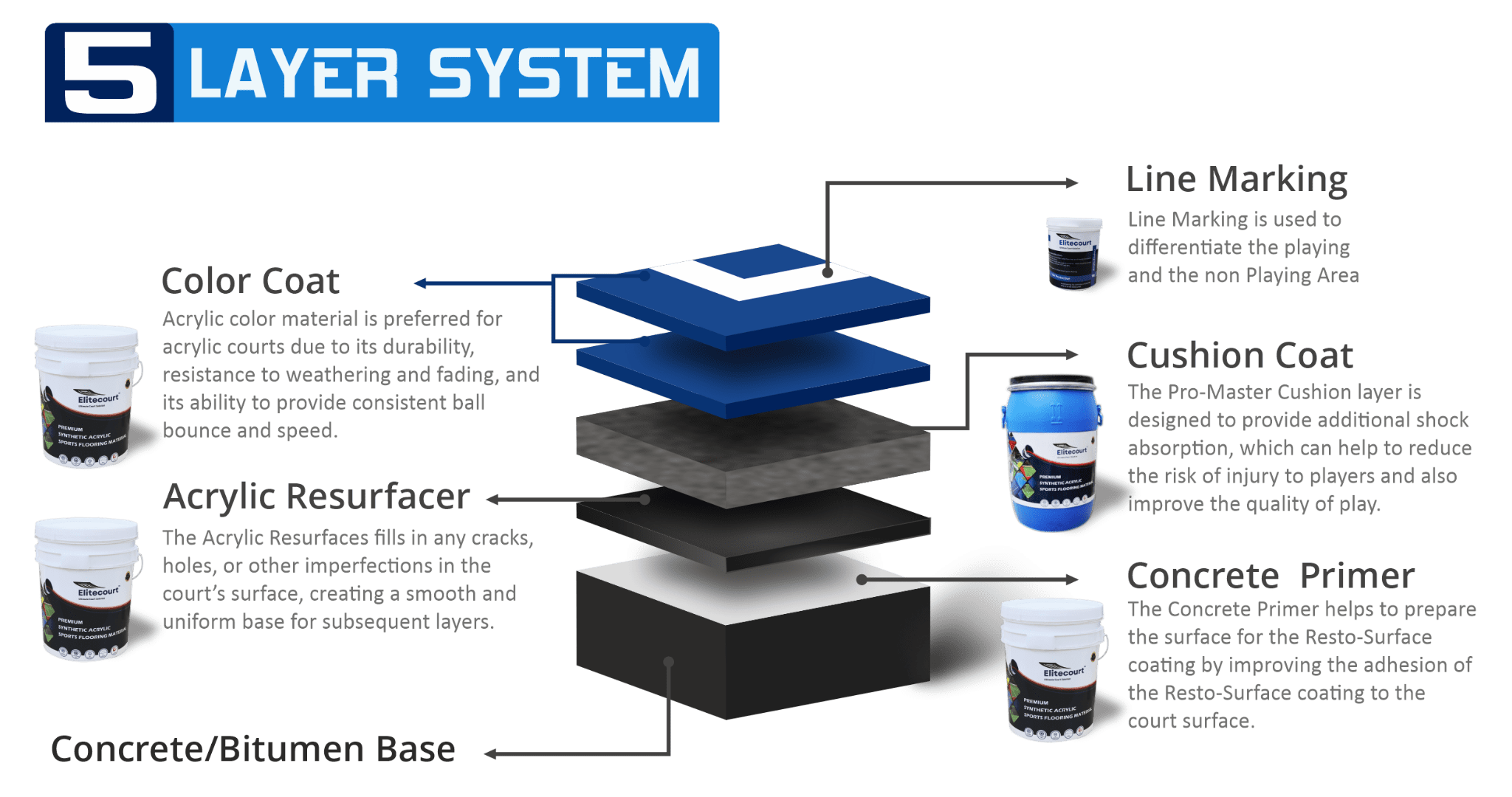
5 Layer Pickleball Court System
The 5 layer system represents Elitecourt’s foundational acrylic flooring configuration for pickleball courts. This system converts a properly prepared asphalt or concrete base into a playable, regulation-aligned surface with essential performance characteristics.
This system typically focuses on surface sealing, basic leveling, and textured color coats. It provides reliable traction and acceptable ball bounce for recreational play, making it suitable for low-to-moderate usage environments.
Key characteristics of the 5 layer system:
- Establishes uniform surface texture
- Provides basic slip resistance
- Supports standard pickleball court markings
- Maintains surface stability under normal use
While the 5 layer system meets functional requirements, controlled play intensity and limited daily usage make it the most suitable environment for this configuration. For higher durability and consistency, additional layers offer measurable benefits.
6 Layer Pickleball Court System
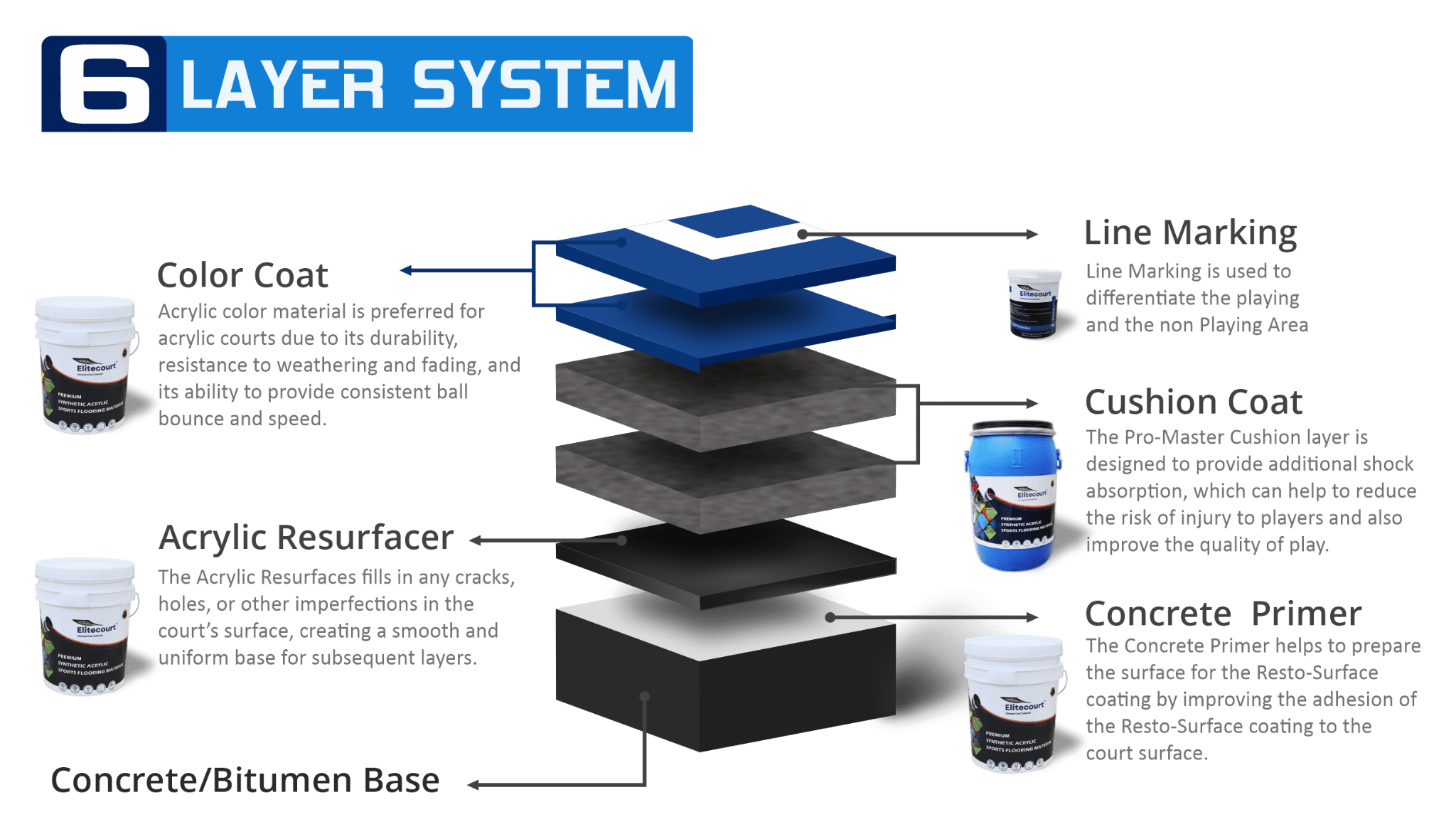
Elitecourt’s 6 layer system builds upon the foundational structure by introducing enhanced resurfacing and texture control. The additional layer improves surface leveling and aggregate distribution, which directly impacts ball response and player movement.
This configuration is often preferred for institutional settings where courts experience regular scheduled play. The added layer contributes to better wear distribution, reducing early texture loss in high-use zones such as the non-volley area.
Performance advantages of the 6 layer system include:
- Improved surface uniformity
- More consistent ball rebound behavior
- Enhanced abrasion resistance
- Better retention of surface texture over time
The 6 layer system strikes a balance between performance and material efficiency, making it a popular specification choice for community pickleball infrastructure.
7 Layer Pickleball Court System
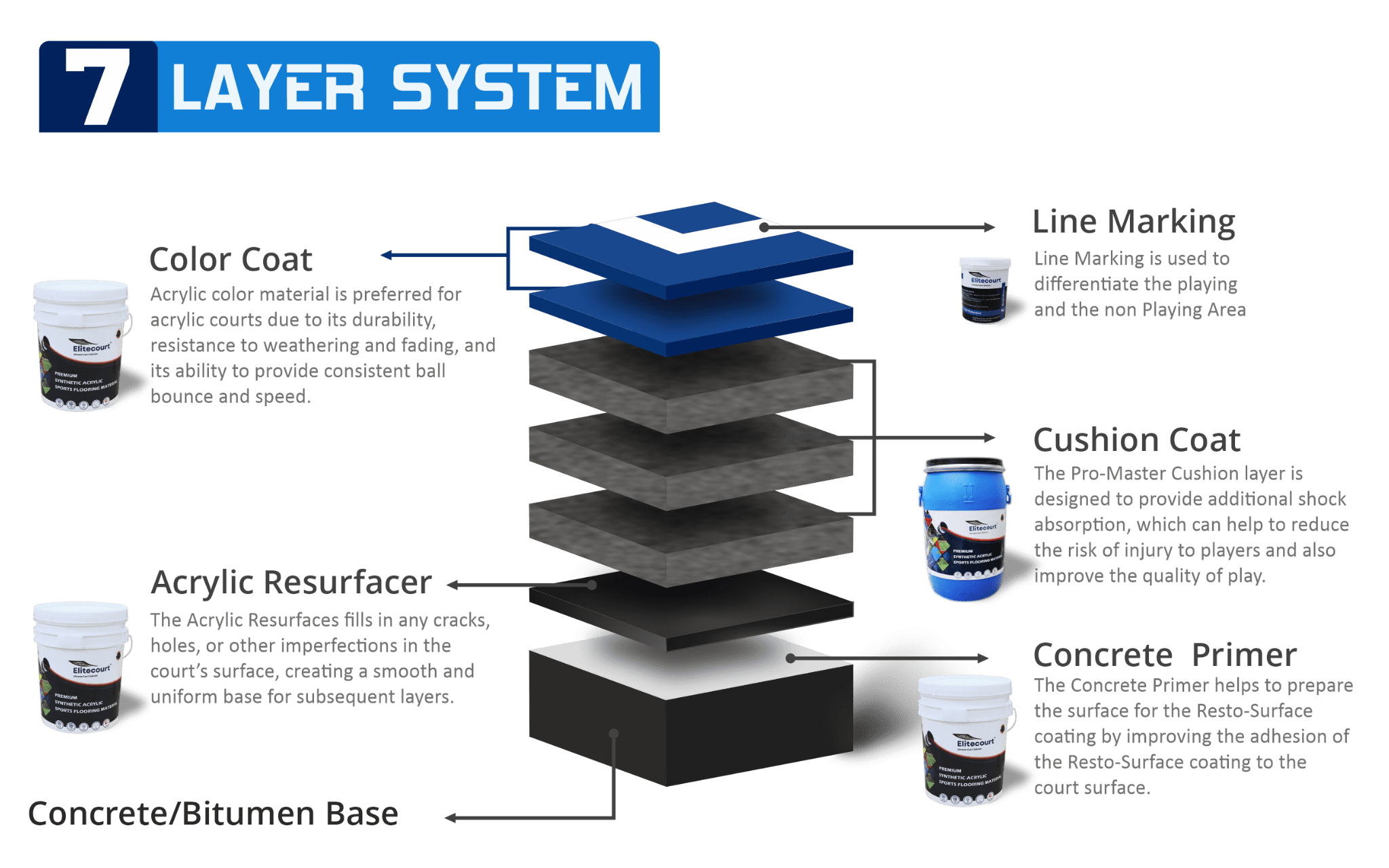
The 7 layer system is designed for facilities that demand a balanced combination of comfort, durability, and play precision. At this level, layering allows Elitecourt to fine-tune surface elasticity without compromising ball speed or bounce predictability.
This system introduces additional coats that enhance micro-level surface resilience, helping the court maintain its playing characteristics even under frequent directional movement and concentrated foot traffic.
Key benefits of the 7 layer system:
- Improved player comfort underfoot
- Greater resistance to localized wear
- Stable traction during rapid lateral movement
- Consistent visual and surface performance
For multi-court venues and sports complexes, the 7 layer system provides a dependable solution that supports both recreational and semi-competitive pickleball play.
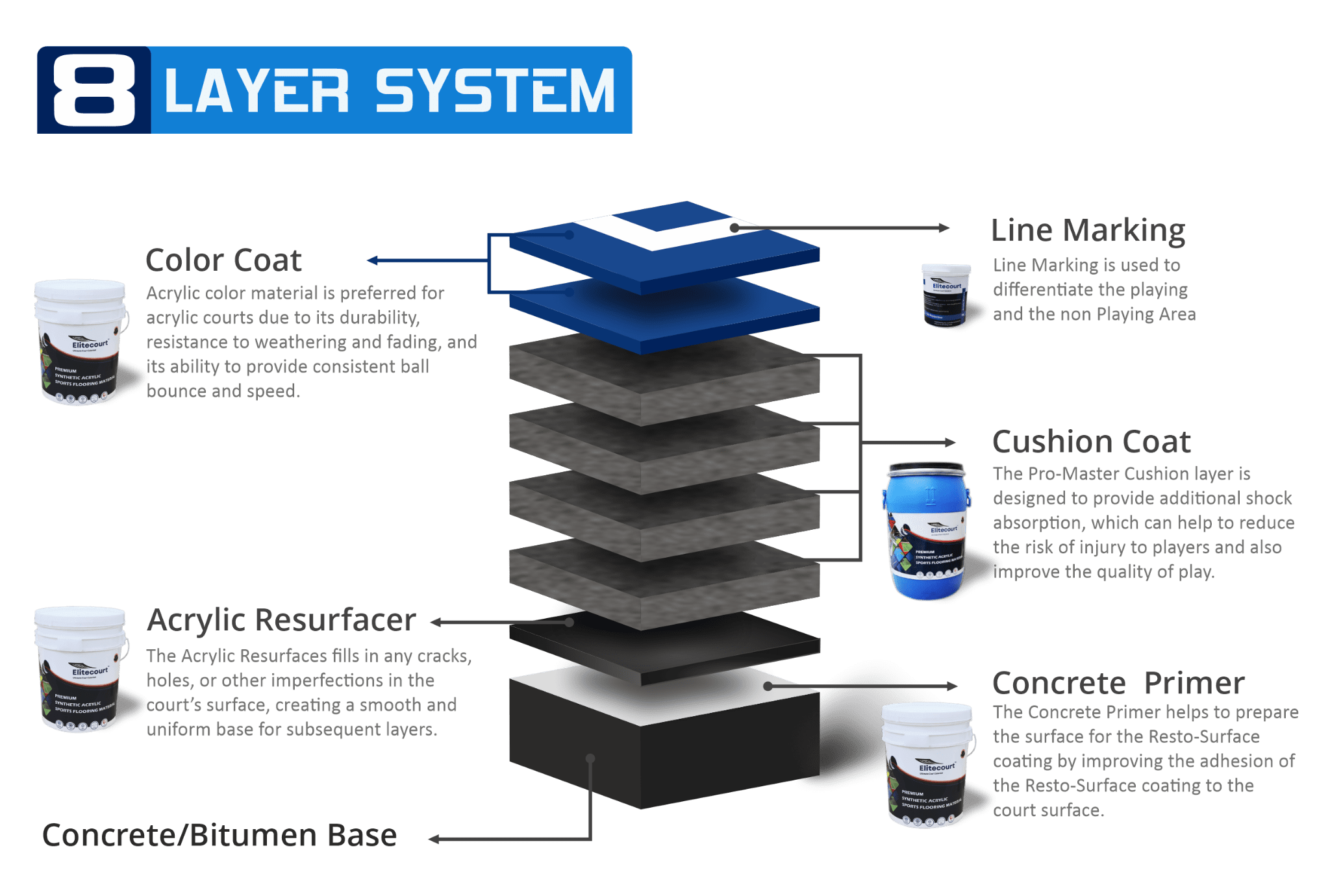
8 Layer Pickleball Court System
Elitecourt’s 8 layer acrylic system is engineered for high-frequency pickleball environments, where courts are in near-constant use. At this level, surface refinement becomes more pronounced, and each layer plays a specific role in maintaining long-term performance.
The additional layering enhances intercoat bonding strength, reduces surface fatigue, and supports better stress distribution across the playing area. This is particularly important for pickleball, where repeated short movements place stress on the same zones of the court.
Distinct advantages of the 8 layer system include:
- High wear tolerance under continuous play
- Superior texture retention
- Enhanced color stability
- Reduced performance variation across court zones
This system is well-suited for competitive training environments where consistency and reliability are non-negotiable.
9 Layer Pickleball Court System
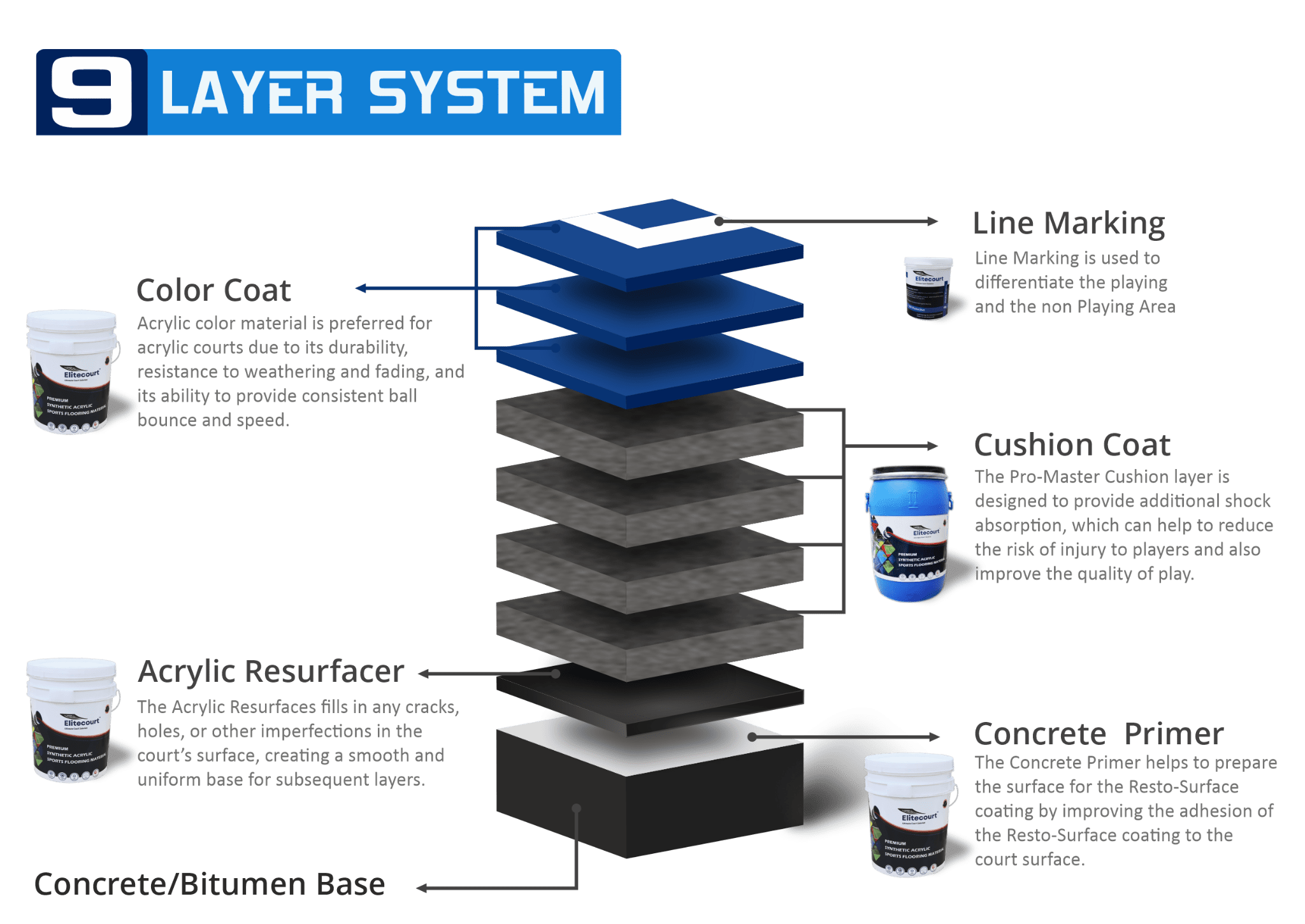
The 9 layer system represents Elitecourt’s most comprehensive acrylic flooring configuration for pickleball courts. Facilities that prioritize maximum performance stability, surface longevity, and professional-grade playability rely on this system.
With this system, layering allows for meticulous control over surface behavior, ensuring that traction, bounce, and comfort remain consistent even after prolonged use. The structure supports long-term surface integrity while maintaining compliance with recognized pickleball playing standards.
Performance highlights of the 9 layer system:
- Highest level of surface durability
- Exceptional play consistency
- Optimized stress absorption and distribution
- Long-term texture and color preservation
Facility planners typically specify the 9 layer system when they expect pickleball courts to deliver high-level performance over extended periods with minimal deviation.
Why Layer Systems Matter in Pickleball Flooring
The importance of layered acrylic systems lies in their ability to engineer performance rather than rely on base materials alone. Each layer contributes to surface behavior, and together they define how the court feels, plays, and lasts.
Elitecourt’s tiered layer offerings give decision-makers technical flexibility without complexity, ensuring that pickleball courts can be specified accurately based on functional needs rather than generic surface descriptions.
A well-designed layer system does not change how pickleball is played—it ensures that the game is played the same way every time, on every court, under every condition.
Indoor vs Outdoor Pickleball Court Flooring
Players use pickleball courts both indoors and outdoors, but each environment places significantly different demands on flooring systems. Outdoor courts face environmental stressors, while indoor courts prioritize shock absorption and acoustics.
Outdoor pickleball courts almost exclusively use synthetic acrylic flooring systems due to their resistance to weather, UV exposure, and moisture. Indoor courts may adapt acrylic systems or use alternative resilient sports flooring, depending on facility design.
Comparison of Indoor and Outdoor Flooring Needs
| Aspect | Outdoor Pickleball Courts | Indoor Pickleball Courts |
|---|---|---|
| Weather Exposure | High | None |
| UV Resistance | Essential | Not critical |
| Moisture Tolerance | Required | Moderate |
| Surface Speed | Medium-fast | Adjustable |
| Flooring Preference | Acrylic coatings | Acrylic or resilient systems |
Even in indoor settings, facilities often choose acrylic flooring because it delivers familiar ball behavior for players who also compete outdoors. Consistency between environments enhances skill transfer and reduces adaptation time.
Durability and Wear Resistance of Pickleball Court Flooring
Durability is a critical requirement for pickleball court flooring, particularly in facilities where courts are used daily. Pickleball concentrates movement within smaller court dimensions, resulting in intense localized wear, especially near the kitchen line and baseline service zones. Flooring systems must therefore resist both surface abrasion and structural fatigue.
Synthetic acrylic flooring systems are designed to distribute wear gradually and evenly. Rather than exposing the base material to direct contact, the acrylic layers act as sacrificial performance surfaces. High-quality acrylic binders retain aggregate positioning, ensuring that texture does not break down prematurely under repetitive foot traffic.
Elitecourt’s manufacturing approach focuses on material consistency and interlayer bonding strength. This design approach reduces the risk of surface delamination, peeling, or rapid texture loss, even when frequent directional stress affects the courts.
Common Wear Patterns in Pickleball Courts
Understanding wear patterns helps explain why acrylic systems outperform untreated surfaces.
Typical high-stress zones include:
- The non-volley zone, where players remain stationary for extended rallies
- Baseline service areas, exposed to repetitive foot placement
- Center court transitions, affected by constant lateral movement
Acrylic flooring systems prevent these zones from deteriorating faster than the rest of the court, preserving uniform playability.
Material Properties That Enhance Durability
Durability in acrylic pickleball flooring comes from formulation, not thickness alone. Elitecourt designs its materials to maintain performance through controlled wear.
| Durability Factor | Acrylic System Advantage |
|---|---|
| Aggregate retention | Sustains surface texture |
| UV exposure | Preserves color integrity |
| Moisture contact | Limits surface degradation |
| Repeated abrasion | Gradual, even wear |
Because acrylic systems are compatible with resurfacing cycles, performance can be restored without disturbing the structural base—an important consideration for long-term facility planning.
Durable pickleball courts are not those that never wear, but those that wear evenly and predictably without altering play behavior.
Slip Resistance and Player Safety Considerations
Player safety is central to pickleball court design, and flooring plays a direct role in injury prevention. Slips, trips, and joint strain can often be traced back to inappropriate surface selection.
Acrylic pickleball court flooring offers engineered slip resistance, achieved through textured coatings rather than artificial grip additives. This approach ensures traction without creating abrasive hotspots that could cause skin injuries.
The absence of seams or joints in acrylic systems further enhances safety. Seamless surfaces eliminate edge-related trip hazards commonly found in modular flooring systems.
Safety-focused flooring characteristics include:
- Consistent traction in dry conditions
- Controlled surface roughness to reduce skin burn
- Even plane without panel movement
- Clear line visibility for spatial awareness
By prioritizing these features, manufacturers like Elitecourt contribute to safer play environments for users of all ages.
Compliance With Pickleball Court Standards
While pickleball does not have a single global governing authority, most facilities align with standards issued by recognized sports organizations. Flooring must support accurate court dimensions, line clarity, and surface performance.
Synthetic acrylic flooring systems are widely accepted because they allow precise line marking using compatible acrylic paints. This ensures that court layouts remain sharp and regulation-compliant over time.
Authoritative bodies such as the USA Pickleball Association provide guidelines that indirectly influence flooring choices by emphasizing consistent bounce and safe traction.
Acrylic flooring aligns naturally with these expectations due to its controllable surface properties.
Transform Your Sports Facility Today!
Contact us for high-quality synthetic sports flooring material and elevate your space!
Color Systems and Visual Performance
Color selection is not merely aesthetic in pickleball court flooring. Visual contrast affects player perception, ball tracking, and overall playing experience.
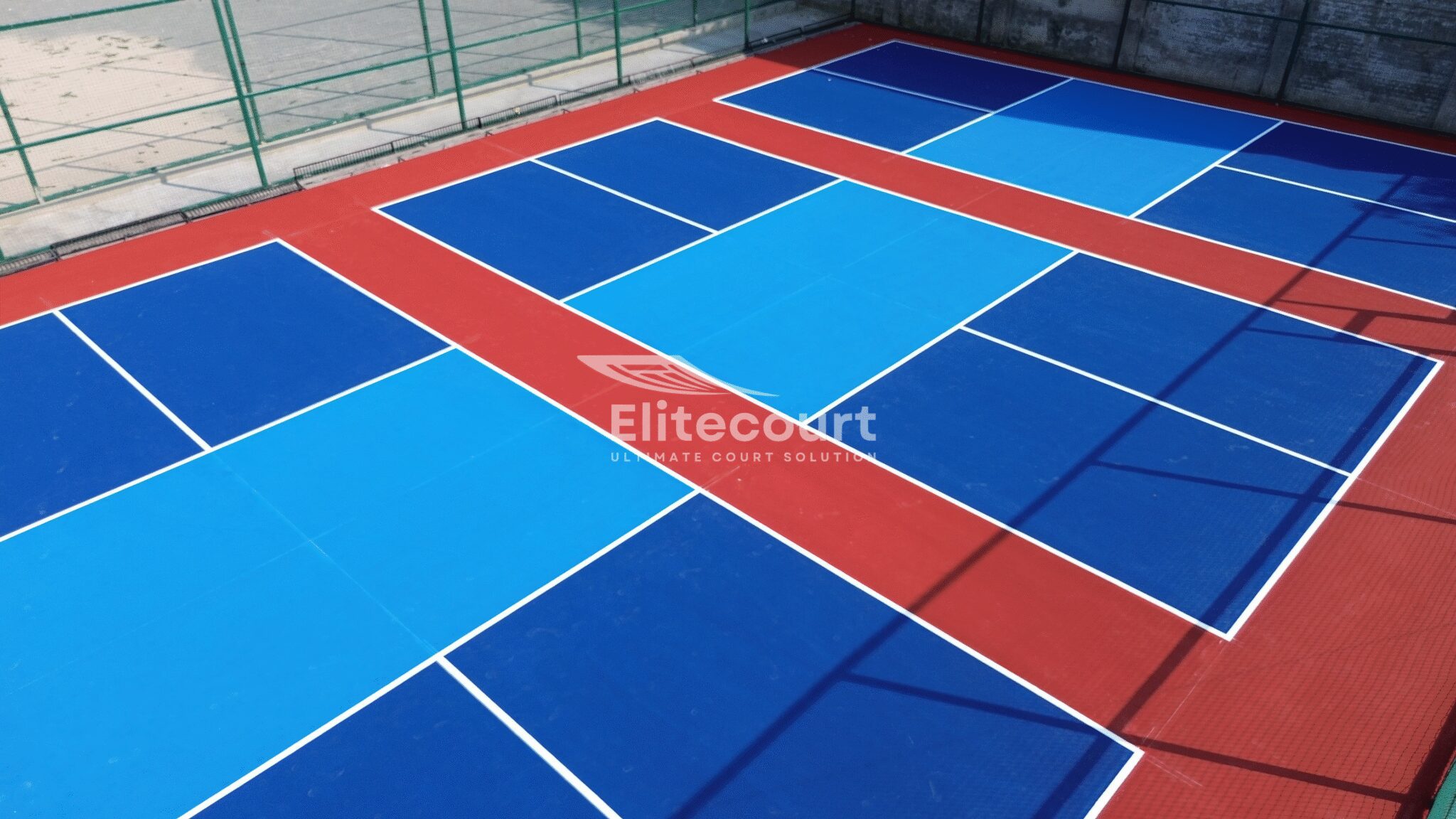
Acrylic systems allow manufacturers to create high-contrast color combinations between the playing area and surrounding zones. This visual separation improves depth perception and reduces eye strain during extended play.
Elitecourt formulations emphasize UV-stable pigments, ensuring that colors remain vibrant and distinct without fading unevenly. This consistency is particularly important for multi-court facilities where uniform appearance matters.
Visual performance benefits include:
- Enhanced ball visibility against court background
- Clear boundary definition for accurate calls
- Reduced glare under sunlight conditions
- Consistent appearance across multiple courts
These visual factors contribute subtly but significantly to the overall quality of play.
Maintenance Characteristics of Acrylic Pickleball Flooring
Maintenance requirements influence long-term usability and surface performance. Acrylic pickleball courts are valued for their low-maintenance nature, especially compared to untreated concrete or modular systems.
Routine maintenance typically involves surface cleaning to remove dust and debris. Because the surface is non-porous when properly sealed, contaminants do not penetrate deeply.
From a material standpoint, acrylic systems are compatible with periodic resurfacing, allowing facilities to restore texture and color without reconstructing the base.
Maintenance-friendly attributes include:
- Ease of cleaning with standard methods
- Resistance to staining from outdoor exposure
- No moving parts or joints to repair
- Surface renewal compatibility through recoating
These factors make acrylic flooring a practical choice for long-term facility planning.
Role of the Manufacturer in Pickleball Flooring Performance
The performance of pickleball court flooring depends not only on the surface type but also on the quality of materials supplied by the manufacturer. Consistency in formulation, raw material sourcing, and quality control directly impacts court behavior.
Elitecourt, as a dedicated manufacturer of synthetic acrylic sports flooring materials, focuses on material reliability and application consistency. By supplying engineered coatings rather than generic paints, manufacturers help ensure predictable outcomes across different projects.
Manufacturer-driven performance factors include:
- Controlled aggregate grading
- Stable acrylic binder composition
- Batch-to-batch color consistency
- Compatibility across system layers
These behind-the-scenes factors are often overlooked but are critical to professional-grade pickleball courts.
Transform Your Sports Facility Today!
Contact us for high-quality synthetic sports flooring material and elevate your space!
Environmental and Climatic Suitability
India’s diverse climate presents unique challenges for outdoor sports flooring. From high UV exposure to seasonal rainfall, pickleball court surfaces must withstand environmental stress without degrading.
Acrylic flooring systems are formulated to remain dimensionally stable under temperature variations. Properly engineered coatings resist softening in heat and embrittlement in cooler conditions.
Elitecourt materials are designed with climatic adaptability in mind, ensuring performance reliability across regions without altering play characteristics.
Common Misconceptions About Pickleball Court Flooring
Several misconceptions persist around pickleball court surfaces, often leading to suboptimal choices.
One common belief is that bare concrete is sufficient. While structurally sound, concrete lacks the surface refinement required for safe and consistent play. Another misconception is that indoor wooden floors are universally suitable, ignoring differences in ball behavior.
Understanding the technical reasons behind flooring selection helps dispel these myths and reinforces the value of purpose-built acrylic systems.
Frequently Asked Questions
Acrylic flooring is widely recommended due to its performance consistency and safety characteristics. Most professional and recreational facilities adopt acrylic systems to meet player expectations.
Pickleball can be played on concrete, but performance and safety are compromised. Concrete lacks texture control and cushioning.
Acrylic flooring resists UV exposure, moisture, and temperature changes, making it ideal for outdoor use.
Yes, color contrast influences visibility and depth perception. Acrylic systems allow optimized color schemes.
Architects, sports planners, and facility owners should specify materials in consultation with experienced manufacturers.
Conclusion
So, what flooring is used for pickleball courts? The answer is clear: synthetic acrylic sports court flooring systems are the preferred and most effective choice. They deliver the precise combination of surface texture, durability, safety, and performance consistency that pickleball demands. Supported by experienced manufacturers like Elitecourt, acrylic flooring transforms structural bases into purpose-built playing surfaces that meet modern expectations for quality and reliability.