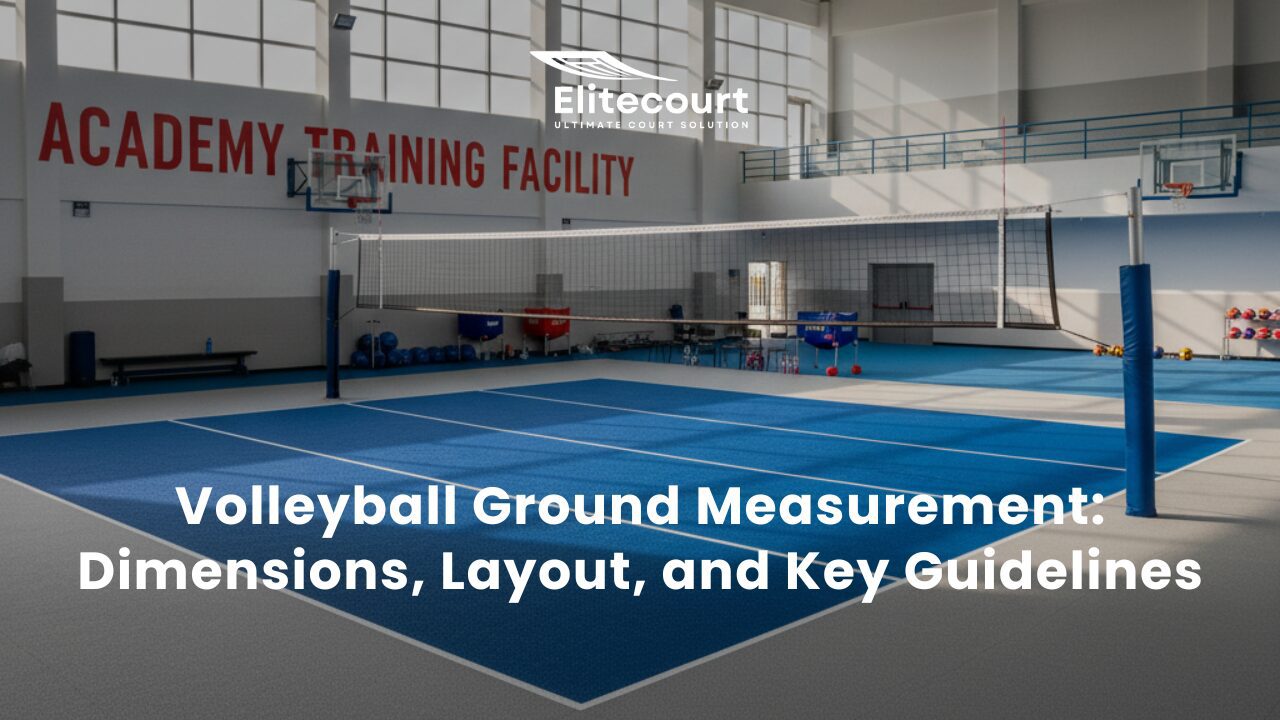
Understanding the correct volleyball ground measurement is the first and most critical step in building a court that is safe, fair, and ready for competition. Whether you are planning a new facility, renovating an existing space, or simply ensuring your current court meets official standards, precision is key. This comprehensive guide will walk you through every aspect of volleyball court dimensions, from the primary playing area to the essential surrounding zones, ensuring you have all the information needed to create a regulation-compliant court.
We will explore the specific measurements required by governing bodies like the Fédération Internationale de Volleyball (FIVB), breaking down the complexities into clear, actionable information. You will learn not just the “what” but also the “why” behind each line and zone, providing a deeper appreciation for how court layout influences the game.
The Foundation of the Game: Understanding Official Volleyball Ground Measurement
At its core, volleyball is a game of precision, power, and strategy. The court itself does more than provide a playing surface; it creates a carefully designed space where these elements come to life. When you use accurate volleyball ground measurement, every match—from a friendly local game to a professional championship—takes place on a level playing field. This guarantees fairness and consistency, allowing athletes to perform at their best.
The official dimensions of a volleyball court are standardized globally to ensure uniformity across all levels of play. These standards, primarily set by the FIVB, are the benchmark for competition. Adhering to these measurements is non-negotiable for any facility aspiring to host sanctioned events or provide a professional-grade experience.
For facility managers, contractors, and sports club administrators, mastering these dimensions is fundamental. It impacts everything from initial construction planning and material estimation to the long-term usability and reputation of the venue. A court that deviates from official specifications can lead to disputes, disqualify a venue from hosting tournaments, and even pose safety risks to players.
Why Precision in Measurement Matters
- Ensuring Fair Play: Standardized dimensions mean that teams are competing under the same conditions, no matter where they are in the world. The distance for serving, the size of the attack zone, and the overall court area are identical, removing any variables related to the court itself.
- Player Safety and Performance: Correct measurements, particularly for the free zone around the court, are crucial for player safety. Athletes often dive, slide, and chase balls well beyond the boundary lines. An adequate free zone provides the necessary space to do so without risk of collision with walls, spectators, or other obstacles.
- Compliance and Certification: For a venue to be certified to host official tournaments, it must strictly adhere to the governing body’s regulations. This includes not only the court dimensions but also factors like ceiling height, lighting, and flooring type.
- Optimizing Player Strategy: The court’s layout directly influences game strategy. The depth of the service area, the position of the attack line, and the width of the court all play a role in how teams organize their offense and defense. Players train based on these specific dimensions, and any deviation can disrupt their tactical execution.
Core Court Dimensions: The Playing Area Deconstructed
The specific boundary lines shape the primary playing court into a rectangle. Each line belongs to the area it defines. Let’s break down the essential measurements for a standard indoor volleyball court.
The Overall Playing Court
The main playing area for a standard indoor volleyball court forms a rectangle measuring 18 meters (59 feet) long and 9 meters (29 feet 6 inches) wide. The center line divides this rectangular area in half, creating two equal team courts, each measuring 9m x 9m.
- Length: 18 meters (59′)
- Width: 9 meters (29′ 6″)
- Shape: Rectangle
These measurements are the universal standard for all high-level competitions, including the Olympics, World Championships, and professional leagues.
Expert Tip: When laying out a new court, always double-check your measurements with a high-quality laser measure or steel tape. Even a small error of a few centimeters can have significant implications for certification and gameplay.
The Lines of the Court
All lines on a volleyball court must be 5 centimeters (2 inches) wide. They must be a light color that contrasts clearly with the color of the court and the free zone. This contrast is vital for players and officials to make accurate line calls.
Boundary Lines
Two sidelines (the longer lines) and two end lines (the shorter lines) mark the perimeter of the playing court. These lines are part of the court area. If a ball lands on any part of a boundary line, it is considered “in.”
- Sidelines: 18 meters long
- End Lines: 9 meters long
The Center Line
The center line splits the playing court into two equal halves of 9m x 9m. It runs underneath the net from one sideline to the other. The main rule for the center line requires players to avoid interfering with their opponents’ play by crossing into their court. Players may touch the opponent’s court with a foot or feet, as long as some part of the penetrating foot or feet stays in contact with or directly above the center line.
The Attack Line
In each team’s court, the attack line runs 3 meters (9 feet 10 inches) back from the center line. This line marks the front zone. Back-row players cannot attack the ball from in front of this line if the ball is entirely above the top of the net at the moment of contact.
- Distance from Center Line: 3 meters (9′ 10″)
- Function: Defines the front zone and restricts back-row attacks.
The attack line often extends with a series of dashed lines (five 15cm dashes, spaced 20cm apart) for 1.75 meters beyond each sideline. These dashed lines help officials judge illegal attacks that originate from outside the court.
The Zones of the Volleyball Court
The lines on the court create specific zones, each with unique rules and strategic importance. When you understand these zones, you gain a complete grasp of volleyball ground measurement.
The Front Zone
The front zone on each team’s court is the area between the center line and the attack line. It is limited by the sidelines. This zone is where most of the attacking and blocking action occurs.
- Dimensions: 9 meters wide by 3 meters deep.
- Key Rules:
- The libero (a specialized defensive player) cannot complete an overhand finger pass to set up an attack if they are in the front zone.
- Back-row players cannot execute an attack hit from within the front zone if the ball is fully above net height.
The Service Zone
The service zone stretches 9 meters wide behind each end line. Two short lines, each 15 cm long, sit 20 cm behind the end line to extend the sidelines and set the lateral limits of this zone. The service zone’s depth runs all the way to the end of the free zone. Players must stand within this zone when they contact the ball for a serve.
- Width: 9 meters
- Depth: Extends to the end of the free zone.
The Substitution Zone
This zone is where substitutes wait before entering the game. It is located between the extensions of both attack lines up to the scorer’s table.
The Libero Replacement Zone
This is part of the free zone on the side of the team benches, located between the extension of the attack line and the end line. Liberos can only be replaced within this designated area.

Table of Standard Indoor Volleyball Court Dimensions
| Feature | Measurement (Metric) | Measurement (Imperial) | Notes |
|---|---|---|---|
| Playing Court Length | 18 m | 59 ft | Measured between outer edges of end lines. |
| Playing Court Width | 9 m | 29 ft 6 in | Measured between outer edges of sidelines. |
| Line Width | 5 cm | 2 in | All lines must be this width. |
| Attack Line | 3 m from center line | 9 ft 10 in from center line | Parallel to the center line. |
| Front Zone Area | 9 m x 3 m | 29 ft 6 in x 9 ft 10 in | Area between center line and attack line. |
| Service Zone Width | 9 m | 29 ft 6 in | The area behind the end line. |
| Service Zone Depth | To the end of the free zone | To the end of the free zone | Typically at least 3 meters. |
Transform Your Sports Facility Today!
Contact us for high-quality synthetic sports flooring material and elevate your space!
Beyond the Boundaries: The Critical Role of the Free Zone
While the 18m x 9m court is the heart of the action, the game of volleyball frequently spills beyond these lines. This is why the free zone—the area surrounding the court—is just as important as the playing court itself. An adequate free zone is a non-negotiable safety requirement and a key component of a regulation-compliant facility.
The free zone surrounds the playing court as a clear, unobstructed space. Players use this area to safely play balls that go out of bounds, finish their follow-through on serves, and dive for defensive plays without risking injury.
Free Zone Dimensions: FIVB and USA Volleyball Standards
The required dimensions for the free zone vary depending on the level of competition. For top-tier international events, the standards are stricter.
- FIVB World and Official Competitions:
- Sidelines: The free zone must measure a minimum of 5 meters from the sidelines.
- End Lines: The free zone must measure a minimum of 6.5 meters from the end lines.
- Regional or National Competitions (e.g., USA Volleyball):
- Recommended minimum of 2 meters (6 feet 6 inches), although more is always better. For new constructions, aiming for at least 3-4 meters is advisable to accommodate a wider range of play levels.
It is absolutely crucial that this entire area is flat, uniform, and free of any obstacles. This includes player benches, scorer’s tables, and spectator seating. These items must be placed outside the designated free zone.
What is the Importance of a Correctly Sized Free Zone?
- Player Safety: The free zone primarily protects players. It creates a buffer that stops players from crashing into walls, posts, or spectators at high speed. A diving or running player brings significant kinetic energy, and this space safely absorbs it.
- Uninterrupted Play: A larger free zone allows for more spectacular defensive plays. Players can chase down errant passes and shanked balls, leading to longer rallies and a more exciting game for spectators.
- Flexibility and Multi-Sport Use: In a multi-purpose facility, a generous free zone around a volleyball court can make it easier to transition the space for other sports or events. It provides valuable buffer space that can be adapted as needed.
Expert Tip: When planning a new facility, always design for the highest level of competition you might ever want to host. It is far more cost-effective to build a larger free zone from the start than to try and expand it later. For flooring, ensure the material used in the free zone is identical to the playing court to provide a consistent and safe surface, like the synthetic acrylic systems provided by Elitecourt.
Vertical Volleyball Ground Measurement: Net Height and Ceiling Clearance
The volleyball ground measurement is not just a two-dimensional plan. The vertical dimension—the height of the net and the clearance above the court—is equally critical to the game’s integrity and safety.
Official Volleyball Net Height
The height of the volleyball net varies between men’s and women’s competitions and is measured at the center of the net. At both ends of the net (over the sidelines), the height must be exactly the same. It cannot exceed the official center height by more than 2 cm.
- Men’s Competition: 2.43 meters (7 feet 11 5/8 inches) from the playing surface.
- Women’s Competition: 2.24 meters (7 feet 4 1/8 inches) from the playing surface.
There are also varying net heights for younger age groups to accommodate their developmental stage. For example:
- Ages 13-14: 2.24 meters (7′ 4 1/8″) for all players.
- Ages 11-12: 2.13 meters (7′ 0″) for all players.
These adjustments ensure the game remains challenging but achievable for younger athletes, promoting proper skill development.
Net Structure and Ancillary Equipment
The net itself is 1 meter deep and 9.5 to 10 meters long, made of 10 cm square black mesh. At the top is a horizontal band, 7 cm wide, made of two-fold white canvas. A flexible cable runs through this band to fasten the net to the posts and keep its top taut.
- Antennae: These are two flexible rods, 1.8 meters long and 10 mm in diameter, made of fiberglass or a similar material. They are fastened at the outer edge of each sideband. The top 80 cm of each antenna extends above the net and is marked with 10 cm stripes of contrasting color (usually red and white). The antennae are considered part of the net and laterally delimit the crossing space. A ball is out if it crosses the net outside of the antennae.
- Posts: The posts supporting the net are placed at a distance of 0.50 to 1.00 meter outside the sidelines. They are 2.55 meters high and preferably adjustable. For FIVB World and Official Competitions, the posts must be placed 1 meter outside the sidelines. They must be rounded and fixed to the ground without wires.
Ceiling Height: The Unseen Boundary
The minimum required ceiling height is another crucial vertical measurement. A low ceiling can interfere with the trajectory of the ball, particularly on high sets and serves.
- FIVB World and Official Competitions: The free playing space must be a minimum of 12.5 meters (41 feet) high from the playing surface.
- Standard Facilities: For school gyms or local recreational centers, a minimum height of 7 meters (23 feet) is recommended. However, anything less than this can significantly impact play.
Any obstruction above the court, such as basketball hoops, lighting fixtures, or structural beams, must be above this minimum height clearance. If a ball hits the ceiling or an obstruction on your side of the court, you can continue to play it (provided it’s not your third touch). If the ball crosses the net after hitting the ceiling, it is a fault.
Transform Your Sports Facility Today!
Contact us for high-quality synthetic sports flooring material and elevate your space!
Beach Volleyball vs. Indoor Volleyball: Key Measurement Differences
While they share a name and many core skills, indoor and beach volleyball are played on vastly different surfaces with different court dimensions. Understanding these distinctions is vital for facility planners and players alike.
Is a Beach Volleyball Court Smaller Than an Indoor Court?
Yes, a standard beach volleyball court is significantly smaller than an indoor court. Here’s a quick breakdown of why this is and what the official measurements are.
Why the Difference?
Beach volleyball is typically played with two players per team, whereas indoor volleyball has six. The smaller court size for beach volleyball accounts for the reduced number of players needing to cover the area. Additionally, moving and jumping in sand requires more energy than on a hard court, so a smaller court keeps the pace of the game fast and rallies achievable.
Official Beach Volleyball Court Dimensions:
- Playing Court: A rectangle measuring 16 meters long by 8 meters wide (52’6″ x 26’3″).
- Team Courts: Two 8m x 8m squares.
- Free Zone: A minimum of 3 meters on all sides is recommended for recreational play. For FIVB World Competitions, the free zone must be a minimum of 5 to 6 meters on all sides.
- Surface: The playing surface must be composed of leveled sand, as flat and uniform as possible, free of rocks, shells, and anything else that could pose a risk to players.
Key Takeaway: The volleyball ground measurement for a beach court is 16m x 8m, which is 2 meters shorter and 1 meter narrower than an indoor court’s 18m x 9m dimensions. There is also no attack line on a beach volleyball court.
Comparing Indoor and Beach Court Specifications
| Feature | Indoor Volleyball (6-a-side) | Beach Volleyball (2-a-side) |
|---|---|---|
| Court Size | 18m x 9m | 16m x 8m |
| Team Court Size | 9m x 9m | 8m x 8m |
| Attack Line | Yes (3m from center line) | No |
| Minimum Free Zone | 5m (sides), 6.5m (ends) for FIVB | 5-6m (all sides) for FIVB |
| Surface | Hard, uniform surface (e.g., synthetic acrylic) | Leveled sand |
| Net Height (Men) | 2.43m | 2.43m |
| Net Height (Women) | 2.24m | 2.24m |
The Impact of Flooring on Volleyball Ground Measurement
The choice of flooring is intrinsically linked to the process of court measurement and line marking. A high-quality sports flooring system, like the synthetic acrylic surfaces manufactured by Elitecourt, provides the ideal canvas for precise and durable court markings.
Why Synthetic Acrylic Flooring is Ideal for Volleyball
- Uniformity and Precision: Elitecourt’s synthetic acrylic flooring systems are applied as a liquid, creating a seamless, monolithic surface. This eliminates joints or seams that could interfere with ball bounce or player footing. This uniformity is the perfect base for applying crisp, accurate line markings that meet volleyball ground measurement standards down to the millimeter.
- Optimal Surface Friction: Our flooring is engineered to provide the perfect balance of grip and slide. Players can pivot, jump, and dive with confidence, knowing the surface will respond consistently. This reduces the risk of joint and muscle injuries.
- Durability of Lines: The lines on a volleyball court are not just painted on top; they are integrated into the flooring system. The color coats used for line marking are chemically bonded to the surface coats, making them incredibly durable. They resist scuffing, fading, and wear, ensuring the court’s measurements remain clear and visible for years of heavy use.
- Excellent Shock Absorption: While providing a firm surface for performance, our multi-layered acrylic systems incorporate cushioning layers that absorb impact energy. This reduces stress on athletes’ bodies, allowing them to play longer and safer.
- Vibrant, Contrasting Colors: Adhering to line marking rules requires a distinct color contrast. We offer a wide palette of vibrant, UV-stable colors that allow facilities to create courts that are not only compliant but also visually stunning. The contrast between the playing area, free zone, and lines can be customized to match team or facility branding while meeting official regulations.
The Process of Marking a Volleyball Court on a Synthetic Surface
Marking a court is a task that demands precision. Here’s a general overview of the process on a new acrylic surface:
- Surface Preparation: The base surface must be perfectly clean, dry, and cured.
- Measurement and Layout: Using professional-grade tools, the layout technician will measure and mark the exact positions of all boundary lines, the center line, and the attack lines according to the official volleyball ground measurement blueprint.
- Masking: High-quality masking tape is applied to outline the areas where the lines will be painted. This ensures perfectly straight edges.
- Application: The specialized acrylic line paint is applied within the masked areas. Multiple coats may be required to achieve the correct opacity and color depth.
- Curing: The tape is removed, and the lines are left to cure completely, bonding with the court surface.
This meticulous process ensures that the finished court is a perfect representation of the official dimensions, ready for the highest levels of play. For more detailed information, consult the official rulebooks, such as the one provided by the Fédération Internationale de Volleyball (FIVB).
Transform Your Sports Facility Today!
Contact us for high-quality synthetic sports flooring material and elevate your space!
Frequently Asked Questions (FAQs)
Official courts must be 18m x 9m, but smaller courts are used for recreation or training. These do not meet regulation standards.
A regulation court with free zones requires a clear area of approximately 31m x 19m and vertical clearance of 12.5m.
Yes. Sitting volleyball courts are 10m x 6m with a net height of 1.15m for men and 1.05m for women.
If the ball hits the ceiling on your side and you have touches left, you can keep playing. If it goes over the net after hitting the ceiling, it’s a fault.
Yes. Lines are 5cm wide and are part of the court area they define. Balls landing on any line are considered in.