Introduction
Understanding volleyball court dimensions is essential before planning, designing, or constructing a court—whether it’s for schools, recreational spaces, sports clubs, or professional training facilities. The official volleyball court dimensions are 18 meters long and 9 meters wide, and this measurement forms the absolute core of the sport’s standardized layout. Along with this, the court must include a proper free zone, correct attack lines, center lines, and service zones. The net height and sideline space also play crucial roles in ensuring the court is compliant with international standards.
But knowing the measurements alone isn’t enough. To create a court that feels right to the players, supports competitive gameplay, and meets performance expectations, it must also be built on a surface that is even, slip-resistant, and responsive. That’s exactly where quality flooring—like Elitecourt’s synthetic acrylic systems—becomes essential. A well-designed volleyball court starts with correct dimensions, and its long-term performance depends on the durability of the flooring that brings those dimensions to life.
In this comprehensive guide, we break down every important detail about volleyball court dimensions, including indoor, outdoor, and beach variations. You’ll learn how different zones work, how markings should be placed, why net height changes with category, and how much free space is required around the court for safe movement. We’ll also explore key technical points that influence performance, such as flooring quality, line thickness, spacing accuracy, and how court architecture impacts gameplay.
Whether you’re a sports coordinator, court builder, PE educator, or just someone planning a new facility, this guide will help you clearly understand the structure, layout, and technical details that define a professional volleyball court. And throughout the article, we’ll share expert insights to ensure your court aligns with recognized standards.
Understanding Standard Volleyball Court Dimensions
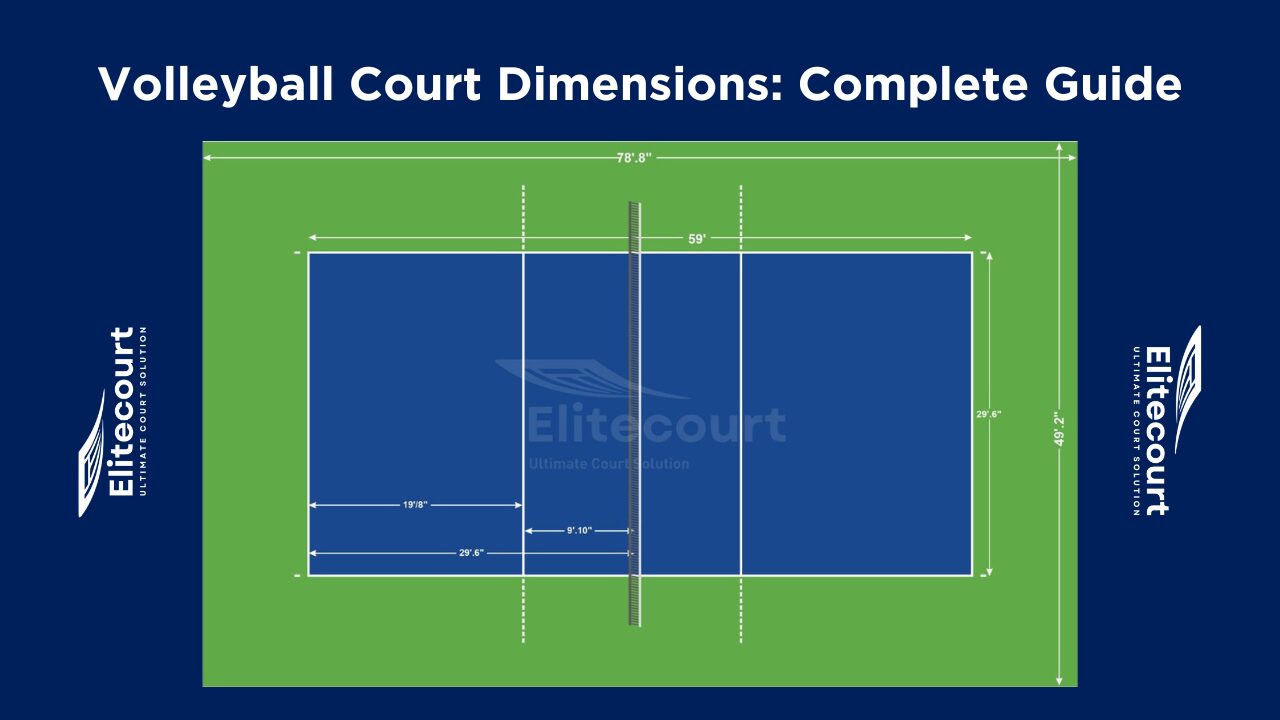
The official volleyball court dimensions are universally set at 18 meters in length and 9 meters in width, forming the core playing area used in indoor and outdoor hard-court volleyball. These measurements are not random—they are designed to support balanced spacing, smooth player movement, and fair competitive play. Every action in volleyball, from serves and digs to spikes and blocks, depends on players having a predictable and correctly measured space to operate in.
Beyond the main playing rectangle, every volleyball court must include a free zone surrounding the court. This free zone must be at least 3 meters wide on all sides. It ensures players can safely chase the ball beyond the boundary lines without colliding with obstacles. In high-level competitions, this free zone is often expanded to provide additional safety and freedom of movement.
A regulation court also requires proper overhead clearance. The minimum recommended unobstructed height above the playing surface is 7 meters. Adequate vertical space prevents interference with high sets, defensive lobs, or float serves. Without the correct overhead clearance, gameplay becomes restricted, and players cannot perform naturally.
Understanding the distinction between the playing area and the full court layout is essential. The playing area is strictly the 18 m × 9 m rectangle, while the full layout includes the free zone, referee positions, and net setup. The accuracy of both areas ensures consistency with global standards.
These dimensions, when paired with precise markings and high-quality flooring like Elitecourt’s synthetic acrylic systems, create a professional playing environment that supports safety, fairness, and performance. Accurate measurements are the foundation of every successful volleyball facility.
Playing Area vs. Free Zone
The playing area is solely dedicated to active gameplay. It must be perfectly flat, level, and marked with high-contrast colors to ensure every ball landing near the line can be judged accurately. Meanwhile, the free zone offers a buffer of safe mobility, ensuring that dives and last-second saves don’t result in injuries. A court that complies with regulation volleyball court dimensions must include both these areas because gameplay dynamics demand them.
Clearance Requirements Around the Court
Apart from horizontal space, there must also be adequate vertical clearance above the court—an often-forgotten component of official volleyball dimensions. International standards require a minimum of 7 meters of unobstructed vertical space above the entire playing area to allow defensive lobs, high sets, and deep float serves without interference. Indoor courts that lack proper ceiling height can severely limit the style and quality of gameplay.
For full official specifications, refer to the FIVB Volleyball Rules
Indoor Volleyball Court Dimensions Explained
The indoor volleyball court follow the most universally recognized specifications because global competitions, training academies, and most institutional facilities adopt these standards. The foundational measurement remains the same—18 meters long and 9 meters wide—but indoor courts include several additional markings and structural requirements that define how the game is played. These zones create the strategic framework for rotations, attacks, defensive coverage, and service formations. Every mark on the floor has a tactical purpose, and when these markings are inaccurate or misaligned, a match’s fairness and rhythm can be disrupted. This is why precision in both dimensions and line markings matters so much for indoor volleyball facilities.
Indoor courts must also have flooring that supports rapid footwork, sudden direction changes, and explosive jumps. Surfaces like synthetic acrylic, which Elitecourt manufactures, offer predictable ball bounce, controlled friction, and safe grip—qualities essential on an indoor playing environment where matches are faster and more tactical compared to outdoor variants. Without the right flooring, even a correctly dimensioned court can feel unstable or unsafe, affecting both performance and the durability of the surface.
Length, Width, and Zone Markings
Beyond the primary court rectangle, indoor courts include several key zones that must be accurately marked. One of the most important is the attack line, located 3 meters from the centerline on both sides of the court. This creates the front zone where front-row players can spike and block, while back-row players must jump from behind this line if they want to attack the ball above net height. Because the attack line directly influences offensive strategies, its placement must be millimeter-accurate. A misplaced line can confuse players, mislead referees, and create disputes during competitive gameplay.
The center line, dividing the court into two equal halves, runs directly below the net. Each team’s 9 m × 9 m area must be perfectly square and aligned with this central reference point. Along with this, sidelines and end lines must be 5 cm thick and marked in a strong contrasting color so their visibility is not affected during fast rallies or harsh lighting conditions.
Ceiling Height Requirements
Indoor courts have another critical dimension: minimum ceiling height. While the playing area size is horizontal, ceiling clearance defines the vertical freedom needed for high arcs and defensive plays. Regulations recommend a minimum of 7 meters of unobstructed vertical space, though many competitive arenas provide far more. A ceiling that is too low can interfere with high sets, float serves, and emergency defensive plays, forcing players to adapt unnaturally. This can also affect training, as athletes need the correct vertical space to develop proper ball control and trajectory judgment.
Why Indoor Court Dimensions Matter for Performance
Indoor volleyball is built on precision—both in player actions and court specifications. The accuracy of the attack line, service zone, center line, and free zone allows referees to make correct calls and players to execute complex rotations confidently. Indoors, the game becomes faster, more vertical, and more reliant on tight coordination. If the dimensions are off even slightly, everything from timing to scoring accuracy can be compromised. When paired with the right flooring—like Elitecourt’s engineered acrylic systems—these dimensions create an environment where athletes can focus on performance, not inconsistencies.
Transform Your Sports Facility Today!
Contact us for high-quality synthetic sports flooring material and elevate your space!
Outdoor Volleyball Court Dimensions
The Outdoor volleyball court follow the same core measurement—18 meters by 9 meters—but the environment, layout considerations, and safety requirements differ significantly from indoor courts. Outdoor courts must accommodate weather variations, sunlight exposure, wind, and a wider variety of playing surfaces. Because of these external factors, outdoor volleyball courts often require additional adjustments to the free zone, flooring type, and surrounding space to ensure predictable gameplay and long-term durability.
The fundamental rectangular playing area remains unchanged across all standardized volleyball formats. However, outdoor courts must be designed with greater emphasis on surface stability, drainage, and line visibility since dust, moisture, and outdoor light can influence how players perceive markings. This is why synthetic acrylic flooring—such as that manufactured by Elitecourt—is widely preferred in outdoor installations. Acrylic surfaces remain stable under sunlight, resist weather fluctuations, and keep court markings sharp and long-lasting.
Standard Measurements
Although the official playing area remains 18 m × 9 m, outdoor courts require a minimum 3-meter free zone around the perimeter. In ideal conditions—such as institutional facilities or sports complexes—this can be expanded up to 5 meters or more to give players enough space for safe dives and recoveries. Outdoor gameplay often involves more lateral movement and unpredictable ball trajectories because of wind, making the free zone even more crucial for safety.
The court lines must be made of durable, outdoor-resistant materials. UV-stable acrylic colors are preferred because they do not fade quickly and maintain contrast even under harsh sunlight. Additionally, outdoor courts may include extra surface coating layers to enhance slip resistance, especially in areas where rainfall or dew is common.
Common Variations for School, College, and Recreational Use
Many educational institutions and recreational parks follow simplified or slightly modified versions of official volleyball court dimensions to match available space. While the 18 m × 9 m playing area is maintained, the free zone may be slightly reduced due to space constraints. In such cases, the key focus should always be on maintaining the clarity of essential lines—attack lines, centerline, end lines, and sidelines—so that gameplay fundamentals are not compromised.
For younger age groups or entry-level play, the net height may sometimes be adjusted, but the court area typically remains the same to encourage skill development within standardized space. Recreational spaces may also use more flexible flooring materials, but synthetic acrylic remains the ideal choice for consistent performance and longevity.
Safety Considerations for Outdoor Courts
Outdoor courts demand special attention to safety because players interact with natural elements like uneven ground, moisture, and wind. A well-leveled surface is non-negotiable because uneven ground can cause ankle twists or loss of balance during high-speed plays. Acrylic sports flooring reduces these risks by offering a consistent, cushioned, and slip-resistant finish.
Visibility is another safety factor. Outdoor lighting conditions vary throughout the day, so court markings must be bright, UV-resistant, and sharply defined. The free zone should also be cleared of obstacles such as poles, fences, benches, or uneven patches to ensure players have unobstructed space during dives and chases.
Outdoor courts built using correct volleyball court dimensions, along with high-quality surface materials, provide a safer, more enjoyable, and more consistent playing environment for athletes of all levels.

Beach Volleyball Court Dimensions
Beach volleyball is one of the most dynamic variants of the sport, and its court dimensions differ noticeably from indoor and outdoor hard-court volleyball. While the indoor and outdoor courts maintain the official 18 m × 9 m playing area, beach volleyball uses a more compact layout. This difference exists because sand affects movement, jumping ability, and overall speed of play. As a result, a smaller court creates a fairer and more balanced environment for beach volleyball athletes, who must cover more ground with slower movement on sand.
The official beach volleyball court dimensions are 16 meters long and 8 meters wide. This reduction in both length and width changes how players move, strategize, and defend. Because there are only two players on each team in competitive beach volleyball (unlike the six-player format indoors), the smaller layout ensures that rallies stay competitive and do not become exhausting chases across overly large areas. Sand naturally reduces speed and jump height, so a reduced court space is essential to maintain the sport’s excitement and playability.
Standard Beach Court Size
The beach volleyball playing rectangle—16 m × 8 m—is surrounded by a recommended 5-meter free zone on all sides. This is larger than the typical 3-meter free zone used in indoor volleyball. The reason? Sand surfaces involve far more diving and extended chases, and players need extra room to pursue the ball safely. Since the ground is softer, broader free zones are accepted and encouraged to support the sport’s acrobatic play style.
Beach volleyball also eliminates the attack line that exists in indoor courts. Because players compete in pairs, restricting attacks behind a 3-meter line would limit the flow of the game. Without zones like the attack line or rotational areas, beach volleyball emphasizes creativity, athleticism, and on-the-spot strategy.
Differences Between Indoor & Beach Volleyball Dimensions
There are clear and intentional distinctions between the two formats:
- Court Size:
- Indoor/Outdoor: 18 m × 9 m
- Beach: 16 m × 8 m
- Number of Players:
- Indoor: Six players per side
- Beach: Two players per side
- Attack Line:
- Indoor: Present (3 m from centerline)
- Beach: Absent
- Free Zone:
- Indoor: Minimum 3 m
- Beach: Preferably 5 m
- Surface:
- Indoor: Hard surface (often synthetic acrylic)
- Beach: Sand surface
These differences influence gameplay tempo, strategy, and match style. Beach volleyball emphasizes endurance, ball control, and open-court defense, while indoor volleyball highlights vertical play, speed, and complex rotations.
Why Dimensions Differ Across Formats
The distinctions in court size are rooted in the physical realities of each playing surface. Sand significantly slows movement, making the larger indoor dimensions unsuitable for two-player gameplay. Meanwhile, indoor surfaces allow explosive speed, quick transitions, and multi-player rotations, requiring larger dimensions to maintain spacing and strategic flow.
In essence, court dimensions adapt to the nature of the sport, ensuring fairness, safety, and an enjoyable competitive environment. These differences also highlight how essential it is to use the correct dimensions depending on the type of volleyball being played.
Volleyball Court Lines and Markings
Volleyball is a sport where precision matters just as much as athletic ability. Every inch of the court influences how referees make decisions, how players position themselves, and how teams execute strategies. This is why the lines and markings on a volleyball court must follow exact specifications that align with official volleyball court dimensions. Even a slight variation in line width or placement can alter how a rally is judged, affecting the flow and fairness of the game. When courts are designed with attention to detail, players develop a correct sense of spatial awareness, enabling cleaner rotations, more accurate defensive reads, and consistent attacking patterns.
On a standard volleyball court—measuring 18 meters by 9 meters—the lines define not only the boundaries but also the strategic zones within the playing area. These lines are typically 5 cm thick and must be painted in a color that sharply contrasts the playing surface. This ensures optimal visibility during matches, regardless of lighting conditions. Synthetic acrylic flooring, such as the material manufactured by Elitecourt, provides a non-glare finish and holds color integrity for years, making it ideal for crisp and lasting court markings.
Types of Lines Used
Several key lines structure the court:
- Boundary Lines (Sidelines and End Lines):
These define the playing perimeter. Sidelines run along the 18-meter length, while end lines run across the 9-meter width. A ball that touches any part of these lines is considered “in,” making their clarity extremely important. - Center Line:
Positioned exactly at the midpoint of the court’s length, the center line divides the playing area into two equal halves of 9 m × 9 m. It lies directly beneath the volleyball net and ensures equal space distribution for both teams. - Attack Line (3-Meter Line):
Marked 3 meters from the center line on each side, this line separates the frontcourt from the backcourt. It determines where back-row players can legally attack from and helps structure offensive systems. - Service Zone Lines:
Located behind each end line, this area marks the legal space from which players must serve. Although this area is not a continuous boundary line on the court surface itself, its alignment with end lines must follow exact measurements.
Transform Your Sports Facility Today!
Contact us for high-quality synthetic sports flooring material and elevate your space!
Marking Specifications
The official marking specifications follow internationally recognized guidelines. All lines must be uniform in width—5 centimeters—and the corners must meet at sharp right angles. Uneven lines or blurry edges can influence player perception, which is why acrylic flooring offers excellent sharpness for line definition. Markings must be durable, slip-resistant, and resistant to weathering if used outdoors.
For indoor courts, markings are usually painted using premium acrylic colors embedded into the surface layers. On outdoor courts, UV-stable pigments are preferred to prevent fading due to prolonged sun exposure.
Color, Thickness & Visibility Considerations
The choice of color is more than aesthetic—it’s a technical requirement. Line colors should contrast distinctly from the floor, ensuring visibility during rapid play sequences. On acrylic courts, white or yellow lines are commonly used because they stand out against blue, green, or red playing surfaces.
Poorly visible lines can lead to wrong referee calls, disrupt player positioning, and negatively affect competitive fairness. This is why correct line thickness, contrast, and material quality are non-negotiable elements of proper volleyball court dimensions and layout standards.
Volleyball Net Height and Pole Positioning
The volleyball net is one of the central structural components of the court, and its dimensions must align perfectly with the official volleyball court dimensions to ensure fair gameplay. The height of the net, its alignment with the center line, and the placement of the poles determine how players execute attacks, blocks, and defensive formations. Even a small misalignment can disrupt the rhythm of the game or create inconsistencies in ball trajectory. Therefore, precision is absolutely essential when setting up a volleyball net.
A properly installed net not only enhances the quality of play but also brings uniformity to training sessions and competitive matches. When athletes practice with accurate net measurements, their timing improves, their muscle memory develops correctly, and their overall gameplay becomes more consistent. A court that adheres to official standards supports both performance and safety.
Official Net Height Specifications
The official net height varies depending on the category of play:
- Men’s Net Height: 2.43 meters
- Women’s Net Height: 2.24 meters
These heights are measured at the center of the court, directly above the center line. The variation supports physiological differences in average jumping height and ensures balanced competitive conditions. For junior categories or recreational play, net height may be slightly adjusted, but competitive volleyball strictly follows the standard values.
It is important that the net height is consistent across its entire width. Nets tend to sag in the middle if not tensioned properly, which is why side cables and tensioning mechanisms must be well-adjusted. The height at the two ends of the net should match the center height with minimal deviation.
Net Material and Width
Official volleyball nets measure 1 meter in width and 9.5 to 10 meters in length. This allows the net to extend slightly beyond the sidelines so it can be properly affixed to the poles. The material typically used is a durable, weather-resistant mesh that can withstand repeated ball impact without tearing or loosening.
A top and bottom cable or cord runs through reinforced bands to maintain net shape. The top band enhances visibility for both players and referees, especially during close net plays like blocks or jousts. Nets must be taut, stable, and free from gaps that could cause the ball to pass through irregularly.
Pole Position Alignment with Court Dimensions
The poles must be installed at a precise distance from the sidelines to maintain the official 9-meter width of the playing area between the posts. Poles are typically placed 0.5 to 1 meter outside the sidelines. This spacing prevents poles from interfering with gameplay and ensures player safety, especially during close net battles.
Poles must be padding-equipped, even when positioned outside the free zone. In professional venues, pole padding is mandatory because players sometimes make contact during blocks or defensive recoveries. For acrylic courts, the pole base should be positioned on stable flooring to avoid imbalance during tension adjustments.
The alignment of poles also affects the net’s tension. If poles are misaligned, the net may tilt or sag, creating unfair playing conditions. Proper installation ensures that the center line and net form a perfectly straight axis across the full width of the court.
By maintaining accurate net height and pole placement, the overall court setup becomes truly regulation-ready. When these components align with official volleyball court dimensions, players experience consistent gameplay, predictable ball behavior, and a safer environment for competitive action.
Zones Within the Volleyball Court
A volleyball court is far more than a simple rectangle marked with lines. The official volleyball court dimensions create a structured layout of zones, each serving a strategic purpose during gameplay. These zones guide rotations, attacks, defenses, substitutions, and libero movements. When players understand these spaces, their decision-making improves, communication becomes stronger, and team coordination reaches a higher level. For coaches, trainers, and facility managers, getting these zones right is essential to ensuring that both practice and competition follow correct standards.
The zones within the court are defined by the court’s markings, specifically the center line, attack line, and sidelines. Each zone supports a particular type of play, and players must remain aware of their positioning at all times. This is especially true in competitive matches, where rotational faults or incorrect positioning can result in immediate loss of points. Accurate markings help prevent confusion and ensure that the game remains fair, structured, and easy to officiate.
Front Court Zone
The front court zone extends from the center line to the 3-meter attack line on each side of the court. This area is where front-row players perform most of their offensive actions—spikes, quick attacks, blocks, and jousts at the net. The front court is action-heavy, requiring athletes to move explosively, react to opponents’ attacks, and coordinate blocking strategies.
Because the front court is closer to the net, its precision directly affects attack timing and set placement. A misplaced attack line could interfere with back-row attack rules or confuse players about their legal hitting positions. This zone also influences offensive systems such as quick sets, combination plays, and middle-blocker attacks. When marked accurately on high-quality flooring like Elitecourt’s acrylic systems, the front court zone offers clarity and consistency, helping players refine advanced offensive movements.
Back Court Zone
The back court zone extends from the attack line to the baseline. This area is primarily responsible for serve reception, defensive coverage, digging, and long-range attacks. Players in the back court must follow strict rules—especially regarding back-row attacks, which must be executed from behind the 3-meter line if the ball is hit above net height.
In competitive volleyball, back-row specialists and liberos spend most of their time in this zone. They rely on the visibility of markings to judge positioning, anticipate plays, and decide when to shift forward or drop deeper for defense. The back court is also where servers prepare and execute their serves, making its clarity essential for fair play.
Substitution Zone
The substitution zone is located near the scorer’s table, along the sideline between the attack line and center line. This zone facilitates orderly substitutions during the match. Players must enter and exit through this designated space so referees can monitor rotational order and ensure compliance with rules.
If the substitution zone is unclear or incorrectly marked, it can lead to rotation errors, illegal substitutions, or timing confusion—all of which affect the flow of the game. Proper alignment of the attack line is particularly important because the substitution zone directly borders it.
Libero Replacement Zone
Unlike standard substitutions, libero replacements occur in a special zone known as the libero replacement zone, located between the end line and the attack line along the sideline. Libero replacements do not require formal substitution procedures, so the libero must use this area exclusively when switching with a back-row player.
Clear markings and adequate space are essential here. If players accidentally use the wrong zone, it can result in a rotation fault. The libero, a defensive specialist, relies heavily on correct markings to maintain proper rotational alignment.
These zones, though visually simple, play a massive strategic role in volleyball. When correctly laid out according to official volleyball court dimensions, they contribute to smooth gameplay, fair officiating, and professional-level performance.
Transform Your Sports Facility Today!
Contact us for high-quality synthetic sports flooring material and elevate your space!
Space Requirements Around the Volleyball Court
When discussing volleyball court dimensions, most people focus solely on the main playing area—18 meters by 9 meters. But professional volleyball is heavily influenced by what surrounds the court just as much as what happens inside it. The area outside the boundary lines, known as the free zone, is a crucial part of official court standards. This space ensures players can move safely, pursue the ball without obstruction, and complete rallies without unnecessary physical hazards. Without an adequate free zone, even a perfectly marked court becomes unsuitable for competitive play.
The minimum free zone requirement is 3 meters on all sides of the playing area. This means the total surface footprint of a standard volleyball court becomes at least:
24 meters long (18m + 3m + 3m) and 15 meters wide (9m + 3m + 3m).
This extended area allows players the space to sprint, dive, and track high passes or deflections without crashing into obstacles. Volleyball is a sport of sharp reactions, and players often step beyond the boundary while keeping the ball in play. The free zone gives them the confidence to push their limits without fear of injury.
In professional events or international competitions, the free zone is often expanded to 5 meters or more. This extra space supports fast-paced gameplay, media coverage setups, and greater margin for athletes’ extended movements. Even in school-level courts or local facilities, maintaining at least the minimum 3-meter free zone is essential for both safety and rule compliance. Anything less restricts gameplay significantly, making it harder for teams to execute standard defensive formations or pursue wide balls.
Free Zone Measurements
The free zone must be level, clear, and free from any obstructions. This means no poles, benches, sports bags, walls, fencing, or equipment can intrude into this area. The zone should ideally share the same surface texture as the court or be smooth enough to allow safe player transitions. On acrylic courts, the seamless finish provides excellent safety around the edges, reducing tripping risks and allowing players to respond naturally to the game’s rapid shifts.
This zone also includes the overhead free space, which must be at least 7 meters above the entire court surface. Many indoor facilities overlook this detail and build low ceilings that interfere with high sets or defensive lobs. Maintaining clear overhead space is crucial so the ball can travel naturally without artificial constraints.
Safety Buffer Requirements
Safety extends beyond the free zone too. Adjacent walls should ideally be padded or positioned several meters away from the boundary. Spectator seating should be placed strategically to avoid conflict with gameplay. The purpose of these buffers is to prevent injuries during high-energy rallies—especially when players dive aggressively toward the sidelines.
In outdoor courts, safety buffers are even more important. Uneven ground, drains, or hard surfaces around the court can pose serious injury risks. The perimeter should be fully leveled and free from stones or abrupt edges. Synthetic acrylic systems offer a stable, cushioned, and weather-resistant edge transition, enhancing the overall safety profile.
Why Extra Space Improves Gameplay
Volleyball is unique because it frequently extends beyond the court lines. Many spectacular saves happen outside the boundaries, and limiting this space reduces both the excitement and fairness of gameplay. Proper free zones allow players to perform wall-chases, deep digs, and emergency recoveries safely. Coaches and referees benefit from unobstructed visibility, while players gain more freedom to express their athleticism and tactical creativity.
When sports facilities respect both the playing surface and its surrounding dimensions, they build courts that feel more professional, support advanced skill development, and reduce the risk of injury. In combination with high-quality acrylic flooring, these expanded spaces create a volleyball environment that meets global standards and elevates the athlete experience.
Technical Standards for Volleyball Court Flooring
While the markings, net height, and layout receive much of the attention, the flooring itself is one of the most critical factors that influence the overall quality of a volleyball court. Regardless of how accurately the volleyball court dimensions are measured, the surface beneath the players’ feet determines safety, speed, ball behavior, and gameplay consistency. A well-engineered volleyball surface allows athletes to make explosive jumps, land safely, slide predictably, and change direction without slipping. These attributes come from using high-quality, regulation-friendly flooring systems—such as the synthetic acrylic sports flooring manufactured by Elitecourt.
Volleyball involves repeated impact, lateral movements, and quick acceleration. An unsuitable surface—like rough concrete, faded asphalt, or uneven natural ground—not only distorts gameplay but increases fatigue and injury risks. This is why technical standards for flooring must be followed with the same precision as the official court layout.
Key Flooring Properties
A regulation-ready volleyball court floor must provide:
- Shock Absorption:
The surface should offer enough cushioning to reduce the impact on joints during jumps and landings. Volleyball is a vertical sport, and shock absorption helps protect the ankles, knees, and hips. - Consistent Ball Bounce:
A predictable bounce ensures accurate passing, setting, and rally continuation. Uneven floors lead to bad reads and unnecessary errors. - Slip Resistance:
Players frequently dive and change direction rapidly. A surface with controlled grip prevents accidental slips while still supporting smooth player movement. - Weather Resistance (For Outdoor Courts):
UV rays, rain, and temperature changes should not affect the floor’s integrity. Acrylic systems are excellent because they remain durable and color-stable under varying weather. - Surface Evenness:
Any dips or bumps disrupt ball movement and increase injury risk. Professional-grade acrylic surfaces help maintain level uniformity throughout.
Elitecourt’s acrylic flooring systems are engineered specifically to meet these technical requirements, creating courts that stay durable, smooth, and performance-ready for years.
Why Synthetic Acrylic Flooring Is Ideal
Synthetic acrylic is one of the most preferred materials for volleyball courts globally because it delivers the perfect balance between durability, comfort, and performance. Unlike basic cement or asphalt, acrylic flooring includes multiple layers that enhance playability:
- Base Layers: Provide cushioning and shock absorption.
- Surface Layers: Offer a seamless, non-abrasive texture ideal for both indoor and outdoor play.
- Color Coats: Improve aesthetics and enhance visibility of court lines.
- Top Seal Layers: Increase durability and UV resistance.
Acrylic surfaces also allow crisp, high-definition court markings—essential for maintaining accurate volleyball court dimensions. The texture of an acrylic court enhances grip but does not burn the skin during dives, an advantage over other harder surfaces.
Elitecourt’s Manufacturing Quality Advantages
Elitecourt’s manufacturing approach focuses on delivering flooring systems that match the precision required for professional volleyball. Each layer is engineered for durability, consistent performance, and superior traction. Elitecourt uses high-quality resins, UV-stable pigments, and performance-tested coatings to ensure that courts built with its materials remain stable over time. Because volleyball involves continuous jumping and quick deceleration, the floor must not chip, crack, or lose friction. Elitecourt’s surfaces maintain these properties even after long-term usage.
Moreover, acrylic flooring supports flawless application of attack lines, center lines, and boundary lines—ensuring that the playing area remains consistent with official standards. Whether used in schools, clubs, training centers, or competitive environments, Elitecourt flooring helps courts stay regulation-ready while offering a premium playing experience.
Volleyball Court Dimensions
Even though the complete explanation of volleyball court dimensions is essential for full understanding, having a quick-reference table helps coaches, players, facility planners, and sports administrators verify measurements instantly. Volleyball is a precise sport, and these standard values guide everything from training drills to competitive match setups. Below is a clear, easy-to-read table summarizing the most important dimensional requirements across different volleyball formats.
This table also helps distinguish the variations between indoor, outdoor, and beach volleyball courts—three formats that share similarities yet maintain unique structural characteristics. Keeping this reference handy ensures that every zone, marking, and space is prepared in accordance with global standards.
Volleyball Court Dimensions – Standard Reference Table
| Category | Dimensions / Requirement |
|---|---|
| Indoor/Outdoor Court Size | 18 m × 9 m |
| Beach Court Size | 16 m × 8 m |
| Free Zone (Indoor/Outdoor) | Minimum 3 m on all sides |
| Free Zone (Beach) | Preferably 5 m |
| Overhead Free Space | Minimum 7 m |
| Attack Line Distance from Center Line | 3 m |
| Net Height – Men | 2.43 m |
| Net Height – Women | 2.24 m |
| Net Width | 1 m |
| Net Length | 9.5–10 m |
| Line Width | 5 cm |
| Service Zone | Behind the end line, full width of court |
This table simplifies the essential information needed to ensure proper court construction and marking. For facility managers, sports coordinators, and architects designing volleyball courts, such quick references are invaluable for keeping measurements consistent and aligned with official rules. When these measurements pair with high-quality surfaces like Elitecourt’s acrylic flooring, the resulting court becomes reliable, durable, and compliant with international guidelines.
Expert Tips for Designing a Volleyball Court
Designing a volleyball court requires far more than just marking the surface. Whether for a school, training academy, sports complex, or recreational facility, the official volleyball court dimensions must be combined with thoughtful planning, appropriate surface selection, and correct surrounding space. Even small oversights—like misaligned attack lines or improper drainage—can impact player safety and gameplay consistency.
Below are expert insights to ensure that your volleyball court performs at professional standards:
How to Get Dimensions Accurate
Start with a properly leveled base. Any unevenness in the ground will distort measurements and affect line straightness. Use professional measurement tools like laser alignment kits or high-quality measuring tapes to mark the 18 m × 9 m playing area. Begin at the center, drawing the court outward to maintain proportional geometry. Mark the center line first, then measure the 3-meter attack lines, end lines, and sidelines in sequence. Always double-check corners to ensure they meet at exact right angles.
Drawing diagonal measurements is another expert tip. The diagonal distance between opposite corners should match official specifications, confirming the rectangular shape. For outdoor courts, consider slight surface slope (1–2%) for drainage, but ensure it does not affect the accuracy of the lines or the leveling of the playing area.
Surface Preparation Advice
Surface preparation greatly influences flooring durability and marking clarity. Acrylic sports flooring—like Elitecourt’s—requires a clean, smooth, and well-prepared substrate. Dust, cracks, or moisture pockets must be addressed before coating begins. A strong primer layer ensures proper bonding of the acrylic system, while multiple coats guarantee resilience and slip resistance.
Outdoor installations must account for UV exposure, so using UV-stable colors and protective topcoats is crucial. Indoor courts benefit from anti-glare coatings to improve visibility under LED lighting. Correct surface finish also enhances the visibility and longevity of attack lines, borders, and center lines.
Expert Note: Why Incorrect Dimensions Affect Gameplay
Incorrect measurements can disrupt gameplay in significant ways. A misplaced attack line alters back-row attack legality. An extended or shortened court can distort serve-reception formations. Even slight deviations in net-pole alignment lead to improper net tension, affecting blocks and spikes. By ensuring that every dimension—from the 18 m × 9 m layout to the 3-meter attack line—is exact, the court becomes a dependable space for both competitive matches and training.
Precision is more than technical compliance; it shapes the experience of the sport itself.
Common Mistakes People Make With Volleyball Court Dimensions
Even with clear guidelines, many volleyball courts end up being improperly marked or inaccurately measured—especially in schools, community centers, parks, and smaller sports facilities. These mistakes may seem minor at first glance, but they can greatly affect gameplay quality, referee decisions, and player safety. Understanding these common errors helps facility planners and managers avoid costly corrections later. When courts follow the correct volleyball court dimensions, athletes can train with proper muscle memory, coaches can run standard drills, and competitions can be conducted fairly.
Below are the most frequent mistakes seen during court construction and marking, along with the reasons they disrupt the sport.
Wrong Court Length/Width Settings
One of the most common mistakes is failing to maintain the precise 18 m × 9 m rectangle. Sometimes the court ends up slightly shorter or wider due to space limitations, surface irregularities, or measuring errors. Even small deviations can distort team spacing, especially during rotations and attack transitions. Players rely heavily on accurate spatial perception—whether it’s judging ball trajectory near the sidelines or making split-second decisions on out-of-system balls.
An incorrectly sized court can also disrupt balance between offense and defense. For example, a shorter court gives attackers an unfair advantage because the ball reaches defenders faster, while a wider court makes service reception harder. These issues highlight why correct dimensions aren’t optional—they are fundamental to fair play.
Incorrect Line Widths or Faded Markings
Lines must be 5 cm thick and sharply visible. Many facilities use uneven strokes, overly thick lines, or faded paint that blends with the playing surface. These inconsistencies make it difficult for players and referees to judge whether a ball is in or out.
Acrylic sports flooring, when paired with high-quality line paint, maintains its contrast for years. Without such materials, courts quickly lose their professional integrity. Faded attack lines, unclear center lines, or uneven sidelines can confuse players, negatively impact rotations, and cause officiating disputes during matches.
Improper Free Zone Allocation
The free zone is often underestimated or ignored—especially in smaller gyms or outdoor areas with space constraints. Facilities sometimes leave less than the required 3 meters around the court, reducing space for dives, defensive recoveries, and backpedal movements. This can significantly increase the risk of injuries as players may collide with walls, fences, or uneven surfaces.
A restricted free zone also limits players’ tactical movements. Volleyball often extends beyond the court perimeter, and limiting this space restricts rally potential and reduces the sport’s excitement. The free zone is essential for both safety and gameplay integrity.
Misaligned Attack Lines and Center Lines
Attack lines that are not exactly 3 meters from the center line affect the legality of back-row attacks. It also disrupts blocking synchronization because front-row players rely heavily on these markings to time their jumps and align their positioning. Misaligned center lines can affect the net installation and cause uneven team areas—leading to confusion and unfair conditions.
Net Poles Placed Too Close to Sidelines
When poles are installed too close to the sidelines, players face a significant risk of injury during tight net plays. Poles must always be positioned slightly outside the sidelines (typically 0.5 to 1 meter) and padded for safety. Incorrect placement also affects net tension, causing sagging or misalignment.
Avoiding these mistakes ensures that the court is safe, regulation-ready, and enjoyable for players of all skill levels. Precision, clarity, and correct spacing maintain the sport’s integrity and prevent long-term issues.
Transform Your Sports Facility Today!
Contact us for high-quality synthetic sports flooring material and elevate your space!
Why Accurate Volleyball Court Dimensions Matter for Performance & Safety
The importance of adhering to official volleyball court dimensions goes far beyond aesthetics or formality. These measurements are designed to optimize the sport’s flow, ensure fairness, and protect athletes. A court that meets global standards enhances player development, strategy execution, and overall match quality. Conversely, incorrect dimensions can compromise safety, confuse rotations, distort gameplay mechanics, and create avoidable risks.
Player Movement Mechanics
Volleyball is a sport based on quick direction changes, explosive jumps, lateral shuffles, dives, and rapid transitions from defense to offense. These movements require predictable spacing. When the court is too small, players become crowded; when it is too large, defenders must cover excessive ground. Both situations alter the natural rhythm of the sport.
Correct dimensions allow players to navigate the court instinctively, improving coordination and teamwork. Spatial consistency also helps athletes develop accurate muscle memory, essential for professional-level performance.
Referee Accuracy
Referees rely heavily on court markings to make precise decisions. A ball landing near the line demands instant judgment, and if lines are inaccurately marked or poorly visible, mistakes are inevitable. Misplaced attack lines lead to incorrect back-row attack calls. Misaligned center lines disrupt serve legality and rotational accuracy. By maintaining exact measurements and crisp markings, referees can confidently enforce rules, ensuring fair competition.
Reduced Injury Risk
Safety is one of the biggest reasons proper dimensions matter. The free zone is designed to protect players during dives, chases, and high-speed transitions. An inadequate free zone or uneven surface increases the risk of sprains, collisions, and falls. Similarly, poorly placed poles or cramped sidelines create unnecessary hazards.
Accurate dimensions combined with high-quality acrylic flooring contribute significantly to injury prevention. The surface provides controlled grip and cushioning, while the layout ensures players can move freely without encountering dangerous obstacles.
Ultimately, correct dimensions foster fairness, protect athletes, and enhance gameplay quality—making them essential for every volleyball facility.
Conclusion
Understanding and applying volleyball court dimensions correctly is the foundation of creating a professional, safe, and performance-ready playing environment. Whether you’re planning an indoor, outdoor, or beach volleyball court, maintaining precision in measurements ensures players experience the sport the way it was intended. From the 18 m × 9 m playing area and the 3-meter attack lines to the free zone, net height, and surrounding space—every detail matters.
With high-quality synthetic acrylic flooring materials manufactured by Elitecourt, facilities can achieve long-lasting durability, excellent traction, consistent ball behavior, and crisp line visibility. When accurate dimensions meet superior flooring, players enjoy a premium, reliable court that supports both training and competitive sports.
A well-dimensioned court elevates performance, enhances safety, and reflects a commitment to excellence in sports infrastructure.
FAQs
The official volleyball court measures 18 meters in length and 9 meters in width, divided equally into two 9 m × 9 m halves by the center line. These dimensions apply to both indoor and standard outdoor hard courts.
A minimum 3-meter free zone is required on all sides of the court for safety and playability. In professional venues, this can extend up to 5 meters to accommodate fast-paced rallies and extended defensive plays.
The attack line is placed 3 meters away from the center line on each side of the court. This line separates the front court from the back court and determines where back-row players can legally attack the ball.
No. Beach volleyball courts are smaller, measuring 16 meters by 8 meters, with a larger recommended free zone. The reduced size supports two-player teams who must cover more ground on sand.
Synthetic acrylic flooring offers excellent slip resistance, consistent ball bounce, UV stability, and long-term durability. It is ideal for both indoor and outdoor courts and enhances the visibility of court markings, ensuring accurate play.