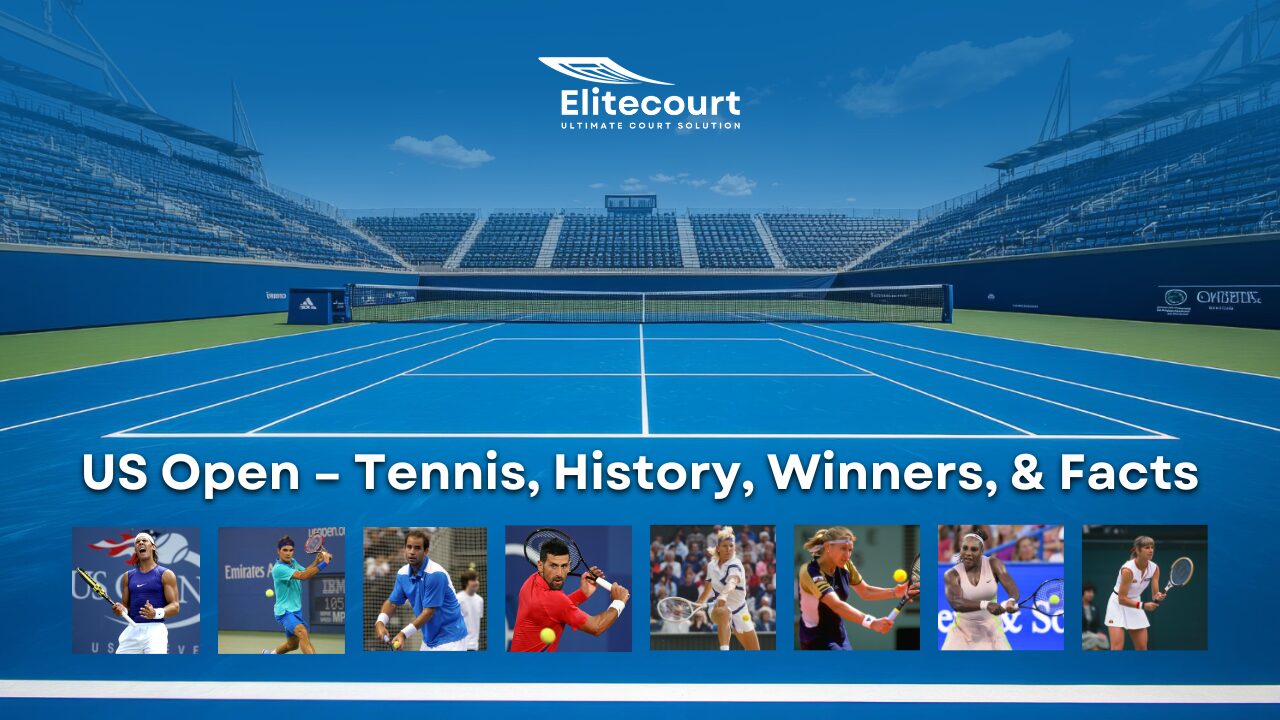
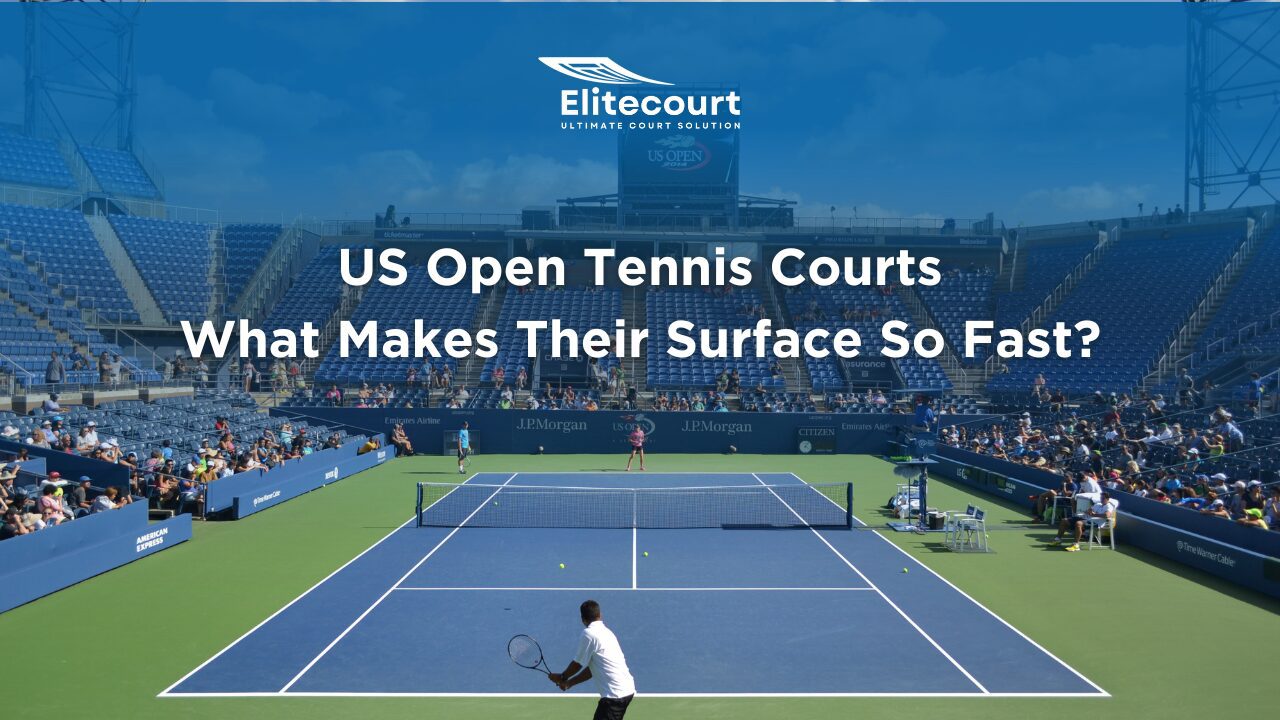
The roar of the crowd, the stunning speed of a 130-mph serve, the lightning-fast rallies—these are the hallmarks of the US Open Tennis Championships. While the incredible athleticism of the players is front and center, another key player influences every single point: the court surface itself. The iconic blue and green hard courts of Flushing Meadows deliver fast play and create a dynamic and exciting brand of tennis. So, what exactly makes the US Open tennis court surface so fast?
The answer lies in a sophisticated, multi-layered system of acrylic coatings applied over an asphalt or concrete base. A single element does not determine the speed. The precise composition of these layers determines it, especially the texture of the final color coats. A smoother top surface with a specific blend of fine silica sand results in lower friction, allowing the ball to skid more and retain its pace after the bounce. This creates the fast, low-bouncing conditions that define US Open tennis.
As a premier manufacturer of the advanced acrylic materials used in these systems, Elitecourt understands the intricate science behind creating world-class tennis surfaces. This article will explore every facet of the US Open tennis courts, from their material composition and construction to their impact on player strategy and the evolution of the game.
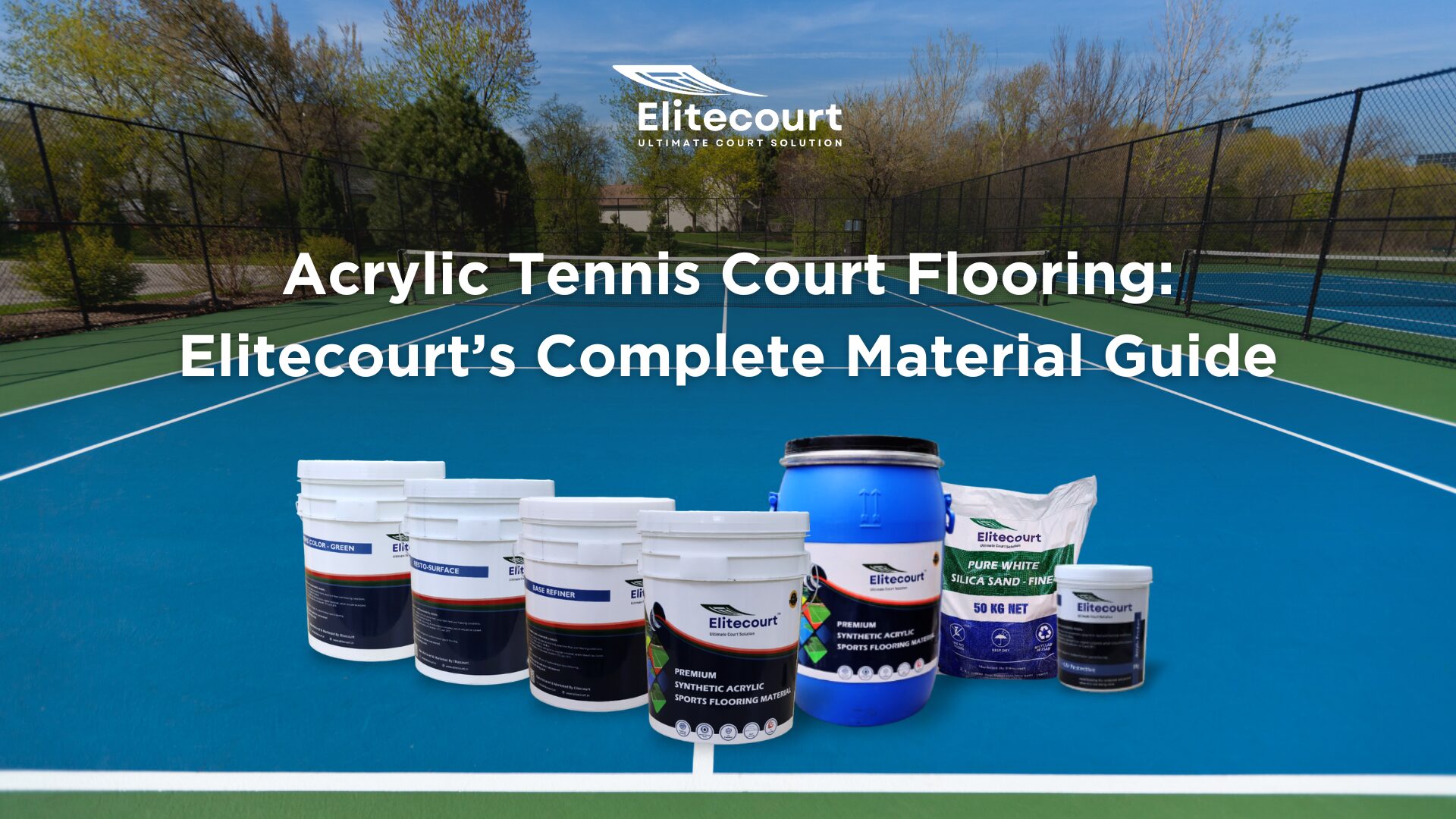
The Anatomy of a US Open Hard Court Surface
A US Open-style hard court is much more than just a layer of paint on concrete. It is an engineered system designed for performance, consistency, and durability. Each layer plays a critical role in determining the court’s characteristics, including its pace, bounce, and player comfort.
The Foundation: Asphalt or Concrete
Everything starts with a stable base. Builders typically construct the foundation of a professional tennis court with either asphalt or concrete. The choice between the two depends on factors like climate, ground conditions, and budget.
- Asphalt: Often preferred for its slight flexibility, which can be more forgiving on players’ joints over time. Builders construct it similarly to a road, using multiple layers of compacted aggregate and hot-mix asphalt.
- Concrete: Known for its rigidity and long-term durability. A post-tensioned concrete slab is a popular choice, as it resists cracking and provides a perfectly uniform plane.
Regardless of the material, builders must create a perfect slope in the base—typically a one-percent grade from side to side or end to end—to allow proper water drainage. Any imperfections in the base will be magnified in the final surface, so precision during this stage is non-negotiable.
The Resurfacer Layers
Once the base has cured, the acrylic system application begins. Contractors apply the acrylic resurfacer layers first. These layers contain heavy sand filling and serve two primary functions:
- Filling Voids: They fill any minor pores and imperfections in the asphalt or concrete, creating a smooth, uniform substrate for the subsequent layers.
- Building Texture: They establish the foundational texture of the court, acting as a primer and ensuring a strong bond for the layers to come.
These initial coats are squeegeed across the entire surface, providing a consistent base that is essential for uniform ball bounce.
The Cushion Layers: Where Comfort Meets Performance
One of the most significant innovations in modern hard courts is the inclusion of cushion layers. Contractors apply these layers between the resurfacer and the final color coats. Composed of a special blend of acrylic binders and fine rubber granules, these layers are the secret to reducing player fatigue and impact on the body.
The number of cushion layers can vary, directly impacting the level of shock absorption. A court with more cushion layers will absorb more force, leading to:
- Reduced Impact: Less stress on players’ ankles, knees, and lower backs.
- Slightly Slower Pace: The cushioning absorbs some of the ball’s horizontal energy, causing it to “bite” into the surface more and slow down slightly upon impact.
- Lower Ball Bounce: The energy absorption also results in a slightly lower bounce compared to an uncushioned hard court.
The US Open courts feature a cushioned system to help players withstand the grueling two-week tournament, even though the event is known for speed. The balance between cushioning and pace is a delicate one, engineered to meet specific tournament standards.
The Color and Pace Layers
The final layers are the color coats, which give the US Open its signature look and, most importantly, determine the final court pace. These layers consist of:
- Acrylic Binder: A durable, weather-resistant polymer that holds everything together.
- Pigments: High-quality pigments create the vibrant “US Open Blue” and “US Open Green” colors, chosen for their high visibility for players, spectators, and television audiences.
- Silica Sand: This is the most crucial component for determining court speed.
The amount, size, and shape of the silica sand mixed into the color coats dictate the surface’s texture. A smoother surface with less sand creates less friction, causing the ball to skid and maintain its speed. A rougher surface with more sand creates more friction, slowing the ball down and producing a higher bounce. The US Open’s fast pace is a direct result of a specific formula that uses a finer grade of sand and a precise application method to achieve a relatively smooth finish.
Transform Your Sports Facility Today!
Contact us for high-quality synthetic sports flooring material and elevate your space!
What is ITF Court Pace Rating?
Question: How is tennis court speed officially measured and classified?
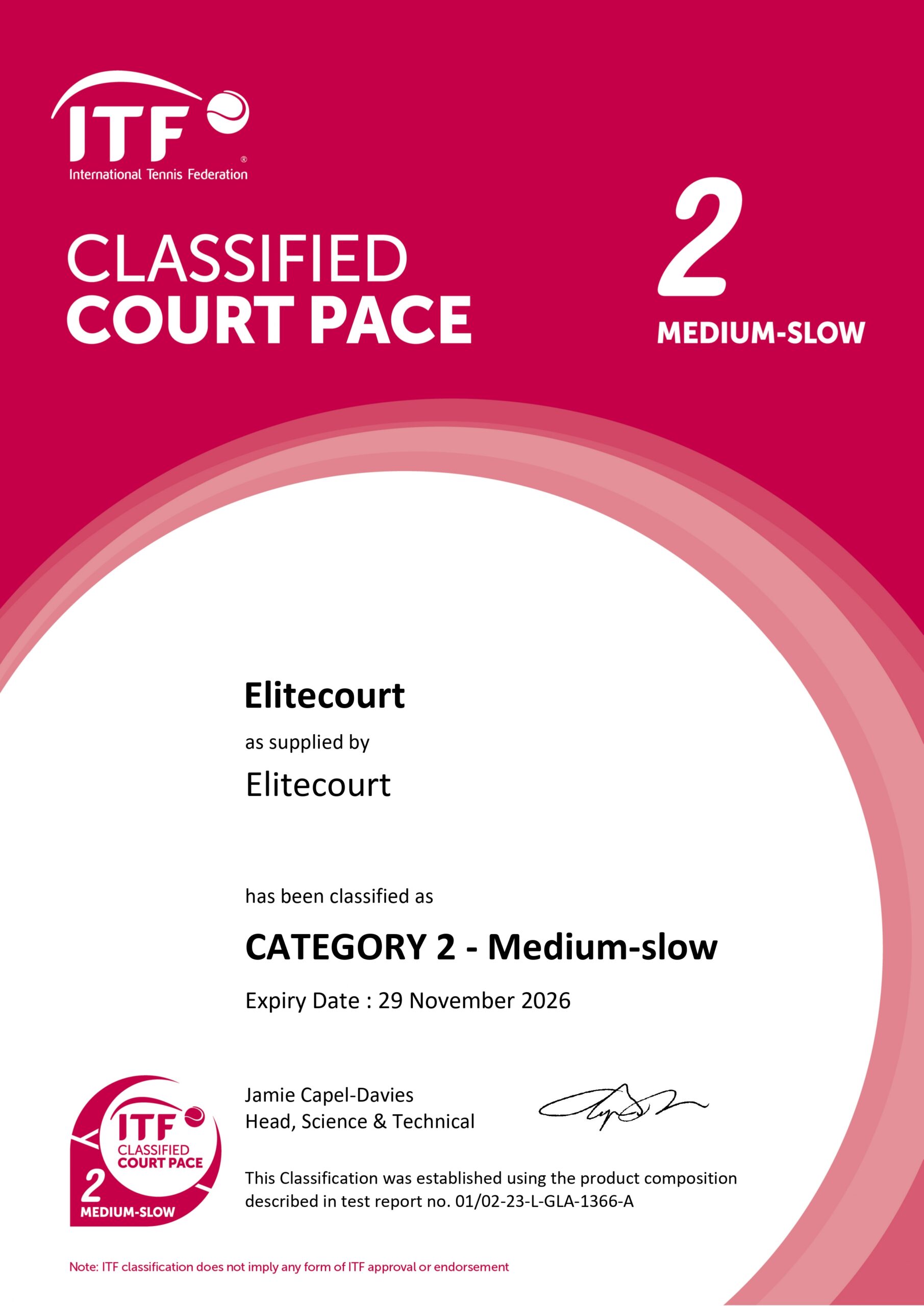
Answer: The International Tennis Federation (ITF) has a Court Pace Rating (CPR) program that provides a technical and objective measure of court speed. The rating is determined using specialized equipment that fires a tennis ball at the surface at a specific speed and angle. Sensors measure the ball’s velocity before and after the bounce, as well as the time between impacts.
Based on these measurements, the ITF calculates a CPR value and categorizes the court into one of five categories:
- Category 1: Slow
- Category 2: Medium-Slow
- Category 3: Medium
- Category 4: Medium-Fast
- Category 5: Fast
The US Open courts are classified as Category 4 (Medium-Fast), striking a balance that rewards aggressive, powerful play while still allowing for extended rallies. This contrasts with the slower clay courts of the French Open (Category 1) and the faster grass courts of Wimbledon (often Category 5).
How Surface Speed Impacts US Open Tennis Strategy
The medium-fast pace of the US Open courts has a profound effect on how players approach the game. It shapes strategies, favors certain playstyles, and is a major factor in the tournament’s identity.
Favoring the Attacking Game
Fast surfaces reward players who play an aggressive, offensive style of tennis.
- Big Serves: A powerful serve is a major weapon at the US Open. The fast surface helps the ball retain speed after the bounce. This makes it harder for the returner to hit the ball. It results in more aces and service winners. Servers can hold their games more easily.
- First-Strike Tennis: Players who can dictate the point from the very first shot—either with a big serve or a powerful return—have a distinct advantage. The goal is often to end the point within the first four shots.
- Flat Hitters: Players who hit the ball with less topspin (flat) see their shots penetrate the court more effectively. The ball stays low and skids, rushing opponents and forcing them into defensive positions. Players like Daniil Medvedev and Naomi Osaka have used their flat, powerful groundstrokes to great success in New York.
The Challenge for Defensive Players
While not impossible, it is more challenging for defensive-minded players or clay-court specialists to thrive at the US Open.
- Less Time to React: The speed of the court gives players less time to set up for their shots. Baseliners who rely on grinding down their opponents with long, looping topspin rallies find it harder to deploy their usual tactics.
- Difficulty in Generating Spin: While topspin is still crucial for control, the lower bounce means players can’t get the same high, “kicking” effect they achieve on clay. The ball tends to stay in the opponent’s strike zone.
- Pressure to Be Offensive: Even natural counter-punchers and defensive players must find ways to inject pace into their own game and look for opportunities to attack, rather than simply retrieving balls.
The All-Court Player Advantage
Players with a complete, all-court game are often the most successful at the US Open. These athletes can seamlessly switch between offense and defense. They possess:
- A reliable serve to win free points.
- Powerful groundstrokes to control the baseline.
- The ability to come to the net and finish points with volleys.
- Excellent movement to defend against aggressive shots.
This versatility allows them to adapt their strategy based on their opponent and the match situation, making them a threat on any surface, but especially on the balanced hard courts of the US Open.
The Evolution of the US Open Surface
The US Open hasn’t always been played on blue and green acrylic hard courts. The tournament has a rich history of surface changes, each move reflecting a shift in the sport’s direction and technology.
From Grass to Clay
The tournament, originally known as the U.S. National Championships, was first held in 1881. For nearly a century, it was played on grass courts, primarily at the West Side Tennis Club in Forest Hills, New York. This era favored a classic serve-and-volley style of play.
In a move to make the tournament more accessible and align it with the growing popularity of clay-court tennis in the 1970s, the US Open switched to green clay (Har-Tru) in 1975. This was a dramatic shift. The tournament remained at Forest Hills for three years on clay, a period that saw clay-court specialists like Chris Evert and Guillermo Vilas find success. The switch also made Jimmy Connors the only player to win the US Open on three different surfaces (grass, clay, and hard court).
The Move to Flushing Meadows and the Hard Court Era
The tournament’s modern identity was forged in 1978. That year, the US Open moved from the cozy confines of Forest Hills to a brand-new, larger facility in Flushing Meadows, Queens: the USTA National Tennis Center (now the Billie Jean King National Tennis Center). With this move came another surface change—this time to cushioned acrylic hard courts.
This decision was strategic. Hard courts were seen as a democratic surface, a middle ground between the extremes of grass and clay. They didn’t favor one style of play as heavily as the other surfaces, opening the door for a wider variety of players to compete for the title. Initially, the courts were green, but that was about to change.
The Iconic Blue Courts
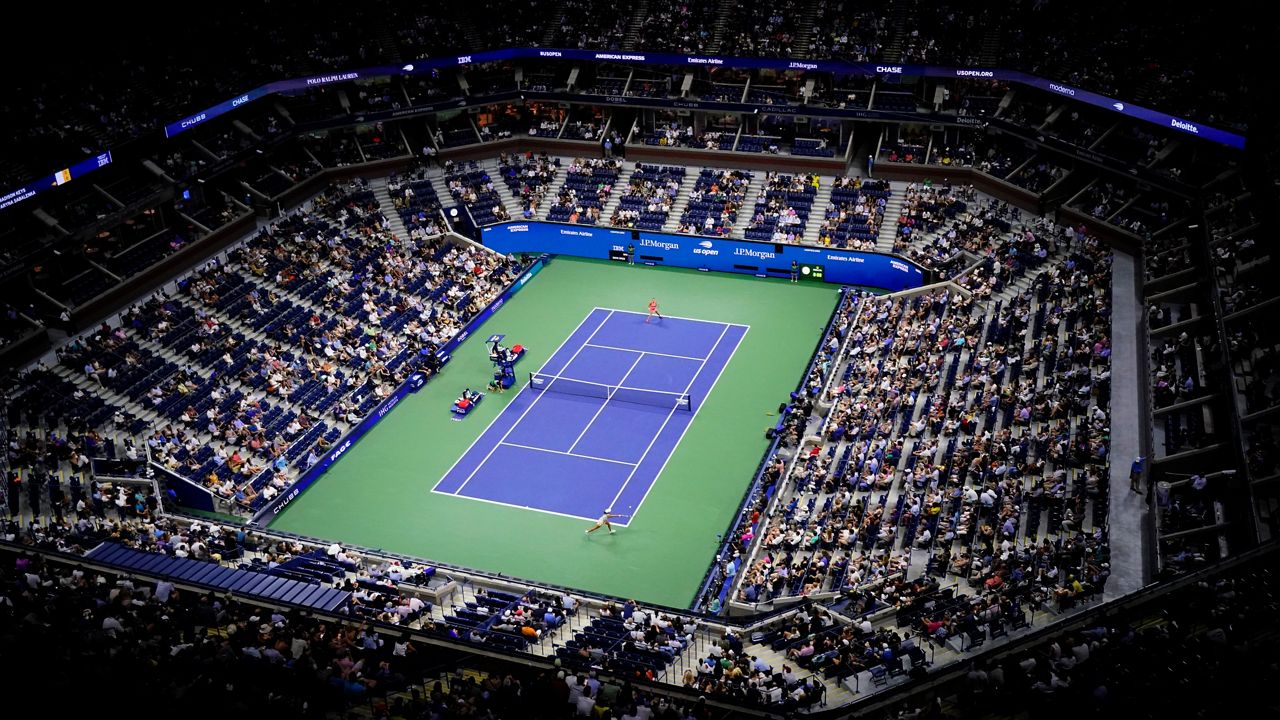
In 2005, the US Open made a visual yet practical change that would come to define its brand: it changed the color of its courts from all-green to the now-famous combination of a blue inner court and a green outer court.
This decision was not just about aesthetics. The “US Open Blue” color was chosen after extensive research. Research showed it offered the best contrast with the yellow tennis ball. This improved visibility for players and television viewers. The move proved extremely successful. Many tournaments later adopted it. Examples include the Australian Open and other hard-court events worldwide
The Manufacturing and Quality Control of Championship Surfaces
Creating a Grand Slam tennis court surface requires a meticulous process. The process demands precision, consistency, and high-quality materials. As a manufacturer of specialized acrylic flooring systems, Elitecourt understands these strict standards.
Raw Material Excellence
The process begins with the raw materials. The quality of the final surface is entirely dependent on the quality of its components.
- Acrylic Polymers: The binders must be 100% acrylic. This ensures maximum durability against UV radiation from the sun, preventing fading and degradation over time. Lower-quality binders can become brittle and lose their color.
- Rubber Granules: The rubber used in the cushion layers must be of a specific size and purity to provide the desired level of shock absorption without becoming too soft or breaking down.
- Silica Sand: The sand is not just any sand. It must be a specific type of hard, angular silica that is carefully graded for size. The shape and size distribution are critical for achieving the exact texture needed for the desired court pace.
- Pigments: The pigments are specially formulated for outdoor athletic surfaces. They must be lightfast (resistant to fading), chemically stable, and free of any contaminants that could affect the final performance.
Transform Your Sports Facility Today!
Contact us for high-quality synthetic sports flooring material and elevate your space!
The Role of the Manufacturer vs. The Installer
It is important to distinguish between the roles of the material manufacturer and the court installer.
- Elitecourt as a Manufacturer: Our role is to formulate and produce the individual components of the court surface system—the resurfacers, cushion layers, and color coats. We conduct rigorous quality control in our facilities to ensure every batch of material meets precise specifications for viscosity, solids content, color, and texture. We provide a proven, consistent product to our network of professional installers.
- The Professional Installer: The installer is the trained artisan who takes these manufactured materials and applies them to the court base. Their expertise is crucial. They are responsible for preparing the base, mixing the components correctly on-site, and applying each layer with precision using specialized squeegees. The skill of the installer in achieving the correct thickness and texture for each layer is just as important as the quality of the materials themselves.
Ensuring Consistency Across All Courts
A major challenge at a tournament like the US Open is ensuring that every single one of the dozens of competition and practice courts plays identically. A player should not have to adjust their game when moving from an outer court to Arthur Ashe Stadium.
This consistency is achieved through a strict protocol:
- Single-Source Materials: All materials for all courts come from the same manufacturer and the same production batches to eliminate any variation.
- Standardized Application: The installation team follows a highly detailed set of procedures for every court, specifying the number of coats, the mix ratios of sand and paint, and the application techniques.
- On-Site Testing: After installation, courts are tested to verify their pace and bounce characteristics fall within the tournament’s narrow range of acceptance. The ITF Court Pace Rating system may be used to confirm this.
This obsessive attention to detail ensures a level playing field for all competitors, where the outcome of a match is decided by skill, not by variations in the court surface.
Expert Insight: The Science of Squeegee Application
The simple act of applying the acrylic layers with a squeegee is a science in itself. The speed and pressure used by the installer directly influence the final texture of the court.
- Faster Squeegee Pass: A quick pass tends to leave more material on the surface, creating a slightly thicker layer and a rougher texture.
- Slower Squeegee Pass: A slow, deliberate pass allows the sand to settle more evenly and results in a smoother, faster finish.
- Squeegee Angle and Pressure: The angle at which the installer holds the squeegee and the pressure they apply also affect how the sand is distributed within the acrylic binder.
Experienced installers develop a feel for the materials and conditions, adjusting their technique to achieve the perfect finish demanded by tournaments like the US Open.
Maintenance and Durability of US Open Tennis Courts
A US Open tennis court experiences tremendous wear and tear. This happens not only during the two-week main event. Qualifying rounds, practice sessions, and other events also add to the usage. Proper maintenance helps preserve performance and appearance.
Routine Maintenance
Daily and weekly maintenance is relatively simple but vital.
- Cleaning: The courts must be kept free of dirt, leaves, and other debris. This is typically done with blowers or soft brooms. A dirty surface can become slippery and can also affect ball bounce.
- Washing: Periodic gentle washing with water and a mild detergent can remove stains and accumulated grime that blowing alone cannot. High-pressure washing is generally avoided as it can damage the acrylic surface and displace the texture-giving sand.
- Inspection: Regular visual inspections help identify any minor issues, such as small cracks or scuffs, before they become bigger problems.
Resurfacing and Longevity
Despite being incredibly durable, acrylic hard courts do not last forever. Constant pounding from players and tennis balls slowly wears down the surface. Sun, rain, and temperature changes also contribute to surface deterioration.
Typically, a professionally installed acrylic hard court will need to be resurfaced every 4 to 8 years. The exact timeframe depends on factors like:
- Usage: Courts at a major tournament facility see far more use than a private residential court.
- Climate: Areas with extreme temperature swings or high UV exposure may require more frequent resurfacing.
- Quality of Installation: A court built on a stable base with high-quality materials will last longer.
The resurfacing process involves thoroughly cleaning the existing surface, repairing any cracks or low spots (birdbaths), and then applying new acrylic resurfacer and color coats. This process restores the court’s pace, appearance, and texture to like-new condition without having to replace the entire concrete or asphalt base. The US Open courts are meticulously maintained and resurfaced on a regular schedule to guarantee they meet Grand Slam standards each and every year. For a more detailed look at the standards these courts adhere to, the ITF Technical website provides extensive documentation on court construction and testing.
Transform Your Sports Facility Today!
Contact us for high-quality synthetic sports flooring material and elevate your space!
The Player’s Perspective: What It Feels Like to Play at the US Open
To truly understand the surface, it helps to see it from the players’ point of view. They speak of the US Open courts with a mix of respect and trepidation, acknowledging both the opportunities and the challenges they present.
The Ball’s Behavior
Players often describe the ball as “skidding” or “staying low” after the bounce. This means they have to adjust their technique:
- Lower Center of Gravity: Players must bend their knees more and get down to the ball, which can be physically taxing over a long match.
- Shorter Backswings: With less time to prepare, players often shorten their swings to make contact with the ball earlier.
- Taking the Ball on the Rise: The most effective players on this surface are those who can step inside the baseline and hit the ball before it reaches the peak of its bounce. This takes time away from their opponents and allows them to maintain an aggressive court position.
The Physical Toll
The combination of a fast surface and a cushioned system creates a unique physical challenge. While the cushioning helps reduce the sharp, jarring impacts, the speed of play leads to more explosive, anaerobic movements. Matches often involve short, intense bursts of sprinting, stopping, and changing direction. This can be more taxing on the muscular system than the long, grinding rallies of clay, which are more of a test of cardiovascular endurance. The two-week, best-of-five-set format for men makes the US Open one of the most physically demanding tournaments in the world.
Frequently Asked Questions (FAQs)
The blue color, introduced in 2005, offers the best contrast with the yellow tennis ball. It improves visibility for players, spectators, and television viewers.
No. Court speed depends on the amount of silica sand in the acrylic coating. More sand creates a slower, rougher surface; less sand makes it faster. The US Open surface is medium-fast.
A hard court has an asphalt or concrete base with acrylic layers for a firm, true bounce. Clay courts are made of crushed stone or brick, producing a slower game with higher bounces and longer rallies.
Hard courts are non-porous, so water stays on the surface and must be cleared manually. A slight slope helps drainage but play remains paused until the surface is fully dry.
Yes. Using premium acrylic systems and expert installation, you can replicate the performance and appearance of a US Open surface for commercial or residential courts.