
Introduction
When the question “What is the best material for a tennis court?” comes up, the answer is clear and widely accepted in the sports flooring industry: high-quality synthetic acrylic remains the leading choice for most modern tennis courts worldwide. Whether it’s training academies, recreational clubs, professional venues, or community sports complexes, acrylic-based systems consistently deliver the best balance of durability, performance, safety, and long-term stability.
Choosing the right tennis court material is not just about the look or the feel of the surface—it affects ball bounce consistency, player comfort, surface speed, weather resistance, and overall court longevity. This is why selecting a proven material matters just as much as choosing the right manufacturer. With years of specialization in synthetic acrylic systems, Elitecourt has become one of India’s most trusted names in the sports flooring industry.
In this article, we’ll break down everything you need to know—from surface types and technical characteristics to performance comparisons and expert insights—so you can clearly understand which material stands out and why. We’ll explore the science behind modern acrylic surfaces, player-focused benefits, maintenance considerations, building methods, and how Elitecourt’s advanced formulations enhance long-term performance.
Understanding Tennis Court Materials
To understand why synthetic acrylic is considered the best material for tennis courts today, it’s important to first understand what tennis court flooring really needs to achieve. A court is more than just a flat surface. It is an engineered system designed to support performance, consistency, impact absorption, safety, and durability.
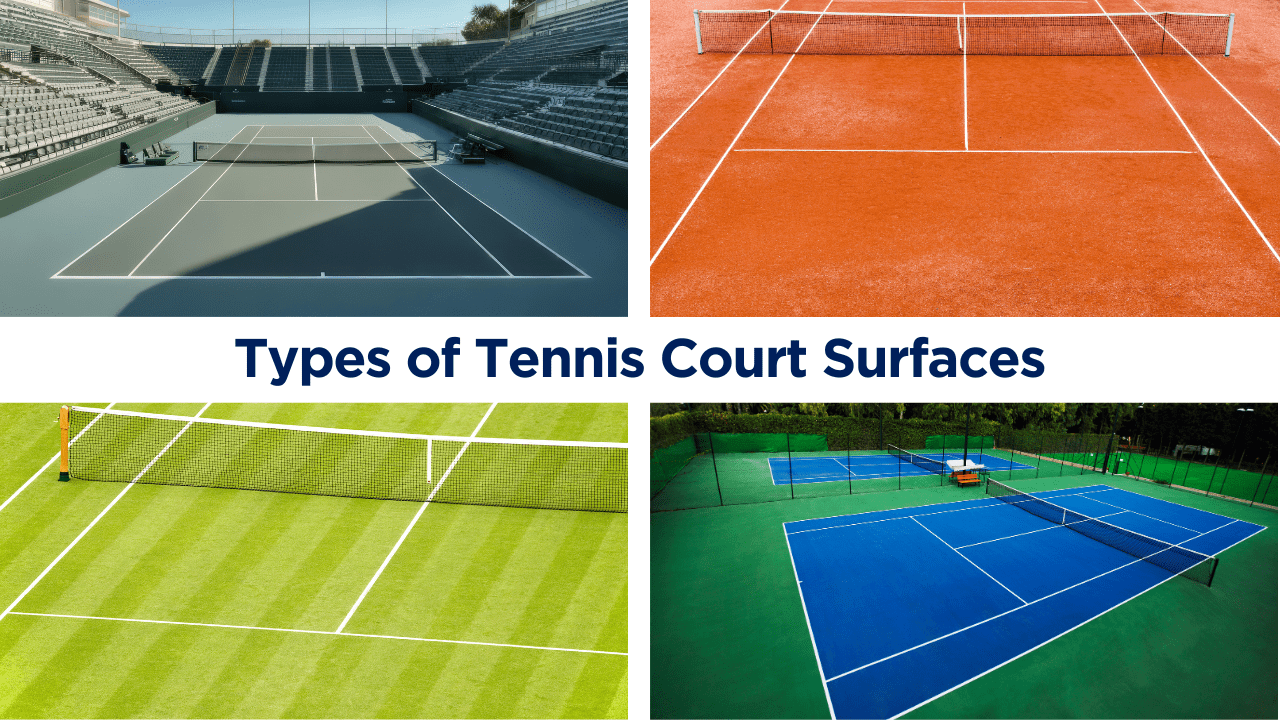
Different materials offer different advantages, and each one influences how the game feels. For example, a clay surface allows for more sliding, a grass court offers fast and unpredictable bounce, while a synthetic acrylic court delivers a predictable, controlled, and stable playing experience suitable for all skill levels. Modern tennis has evolved to prioritize surfaces that are not only high-performing, but also easy to maintain, weather-resistant, and long-lasting, which is why acrylic systems continue to dominate.
Key Factors That Determine Tennis Court Performance
Here are the essential characteristics every tennis court material must deliver:
Traction
Players need firm and reliable traction to accelerate, decelerate, pivot, and change direction safely. Inconsistent traction can increase the risk of slips and injuries. Acrylic courts are known for their excellent grip balance, offering stability without being overly abrasive.
Ball-Bounce Consistency
The heart of tennis lies in the predictability of ball bounce. A good tennis court material must ensure a uniform ball rebound across the entire surface. Acrylic courts excel in this area because their layered system and controlled texture produce extremely consistent bounce patterns.
All-Weather Durability
India’s climate can swing across extremes—from harsh sunlight to heavy monsoon rains. A high-quality tennis court material should withstand UV exposure, water, temperature fluctuations, and wear. Acrylic coatings are engineered specifically for outdoor stability, keeping the surface intact season after season.
Player Comfort & Joint Protection
Long training sessions and matches demand a surface that reduces fatigue and protects joints. Cushion acrylic systems provide shock-absorbing layers that enhance comfort while maintaining performance integrity, making them ideal for athletes of all ages.
Longevity & Ease of Upkeep
Some tennis court materials require constant grooming, resurfacing, or maintenance. Acrylic surfaces stand out because they require minimal care, making them cost-effective (without mentioning costs), time-saving, and ideal for facilities with continuous play.
Understanding these factors sets the stage for exploring the different surface types and ultimately identifying why synthetic acrylic leads the pack.
Transform Your Sports Facility Today!
Contact us for high-quality synthetic sports flooring material and elevate your space!
Main Types of Tennis Court Surfaces
The world of tennis traditionally recognizes four main categories of court materials—acrylic hard courts, clay courts, grass courts, and synthetic turf. Each one has its own personality, technical makeup, and playing style. Let’s break them down in detail.
Acrylic Hard Courts
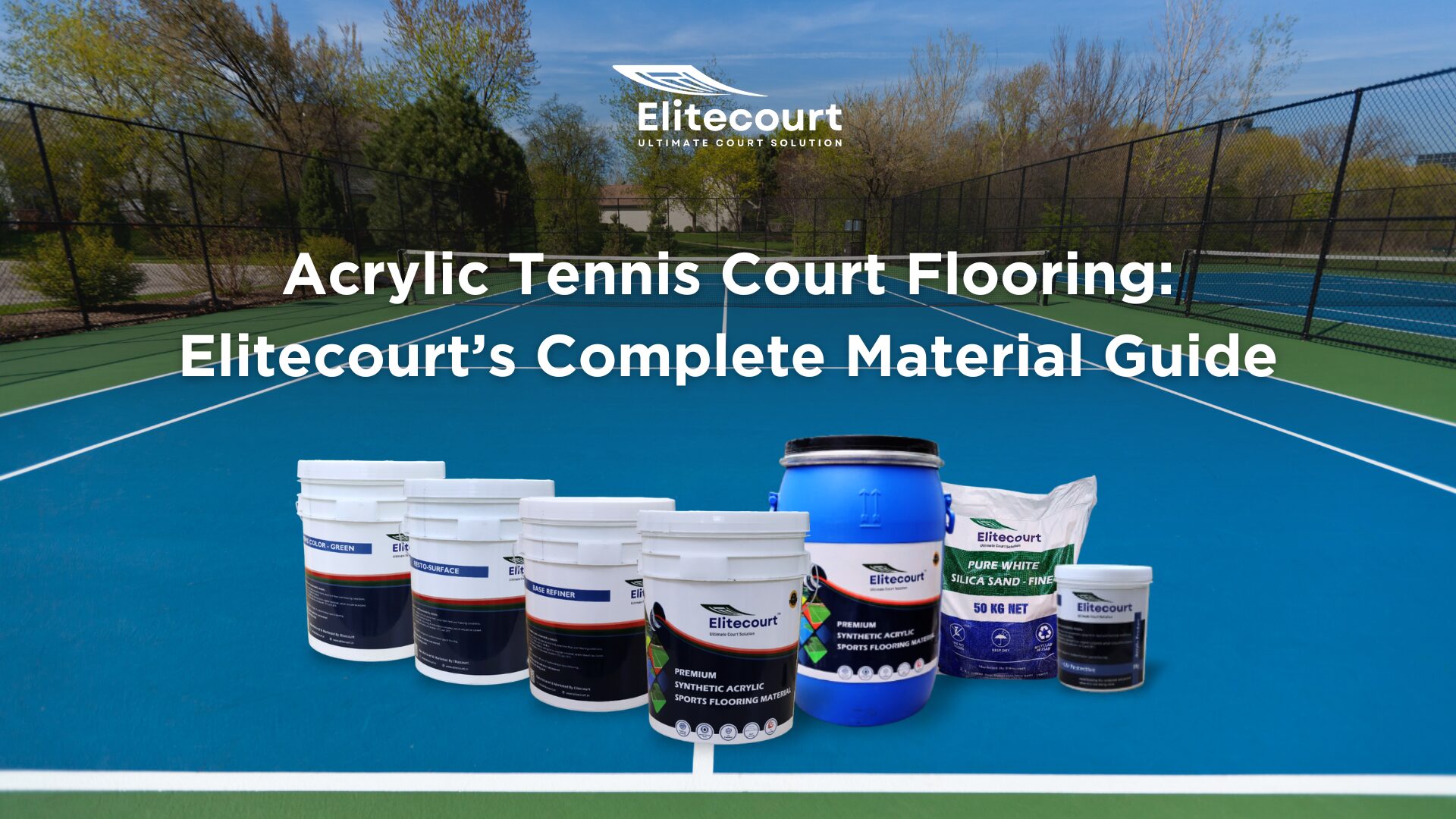
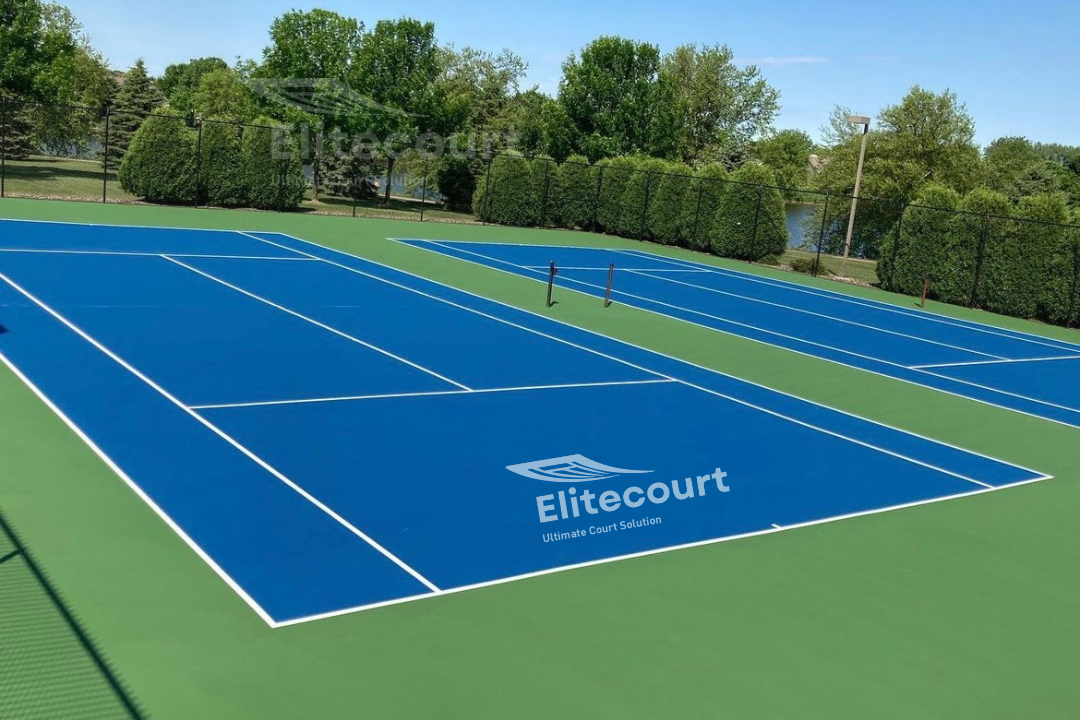
Acrylic hard courts are the most widely used tennis court surfaces globally. They are built using a multi-layered system consisting of resurfacers, filler coats, color coats, and top wear layers, all made from high-quality acrylic material. These courts offer a medium to fast surface speed, which is ideal for competitive play and versatile enough for recreational use.
What makes acrylic hard courts stand apart is the uniformity of the surface texture, which results in a consistent ball bounce and dependable traction. These qualities make acrylic the preferred choice for professional tournaments, training academies, and institutions worldwide.
Because acrylic systems are engineered to resist UV rays and weather damage, they maintain their color vibrancy and surface integrity longer than many other materials. Their low-maintenance nature also keeps them performing well for extended periods without requiring heavy upkeep routines.
Beyond performance and durability, acrylic courts offer customization in color, texture, and speed, giving facility planners immense flexibility to design a court that suits their specific needs.
Acrylic courts form the foundation of modern tennis—and for good reason.
Clay Courts
Clay courts are known for producing a slower game pace, higher ball bounce, and longer rallies. Made from crushed shale, stone, or brick, they offer a unique playing experience where sliding becomes part of the movement technique. While clay helps build endurance and improves defensive skills, it also comes with several limitations that make it less ideal for most long-term or high-usage facilities.
Clay requires frequent grooming, including brushing, watering, and leveling, to maintain surface uniformity. The material tends to shift easily, creating dead spots or inconsistent bounce areas if not maintained correctly. Additionally, clay is more sensitive to weather; rain can make the surface unplayable for long periods, while dry conditions require repeated watering to keep dust levels down.
Despite its beauty and history in tennis, clay is simply not the most practical surface for modern facilities that require durability, consistency, and minimal maintenance. That’s where acrylic systems offer a clear advantage.
Grass Courts
Grass courts are iconic, with a rich tradition and a unique playing style characterized by fast pace and low ball bounce. However, they are widely viewed as the least practical court surface for most regions—especially in climates where weather swings are unpredictable. Grass is extremely maintenance-heavy, requiring frequent mowing, watering, rolling, line marking, and turf care.
Even in well-maintained conditions, natural grass can wear down rapidly in high-play zones, leading to bare patches and uneven bounce. The surface is also highly sensitive to moisture, making it slippery after rainfall and challenging to keep in top playing shape throughout the year.
While grass courts remain part of tennis heritage, they are rarely chosen for modern installations because superior synthetic alternatives—like acrylic—provide significantly better consistency and playability with far fewer maintenance requirements.
Synthetic Turf Courts
Synthetic turf is sometimes used as an alternative tennis surface, particularly in multi-sport facilities. It combines artificial grass fibers with an infill layer that provides cushioning and traction. While turf courts offer a comfortable playing experience and require less maintenance than natural grass, they still do not achieve the ball bounce consistency or durability that acrylic courts offer.
Turf also tends to compact over time, altering the bounce behavior and requiring periodic grooming to keep the infill evenly distributed. For tennis-specific performance, turf simply cannot match the precision, texture control, or ball response that acrylic provides. Turf is suitable for recreational spaces, but for dedicated tennis environments, acrylic remains the superior material.
Cushion Acrylic Systems
Cushion acrylic systems take the standard acrylic surface and elevate it by adding cushion layers made of flexible acrylic compounds. These layers enhance shock absorption, reducing player fatigue and improving comfort, especially during long matches or training sessions. The surface speed can still be customized, making it suitable for players of all skill levels.
Cushion acrylic is widely preferred by academies and institutions focused on athlete development because it provides a more forgiving surface while retaining the consistent bounce and durability that acrylic is known for. This combination of performance and comfort makes cushion acrylic one of the most advanced tennis court materials available today.
Why Acrylic-Based Surfaces Are Considered the Best
Acrylic flooring consistently ranks as the top choice for modern tennis courts, not just in India but globally. Whether for training, competitive play, or recreational use, acrylic systems check all the boxes for performance, stability, and player satisfaction. Here’s why they stand out so clearly:
Consistent Ball Bounce
Acrylic courts provide one of the most uniform ball bounce experiences in tennis. The texture of the surface is carefully engineered to ensure predictable rebound angles and heights across the entire court. Unlike clay or turf, where conditions can change throughout the day, acrylic maintains its consistency from match to match.
Low Maintenance
One of the strongest advantages of acrylic courts is their minimal upkeep needs. The surface does not shift, deform, or require constant grooming. Occasional cleaning is usually enough to maintain peak performance. This makes acrylic perfect for facilities that expect frequent or daily use.
All-Weather Durability
Elitecourt’s acrylic coatings are composed of UV-stable resins and pigments that resist fading and surface degradation. Acrylic courts handle harsh sunlight, moisture, and temperature changes exceptionally well. This weather resistance ensures long-term reliability.
International Federation Standards
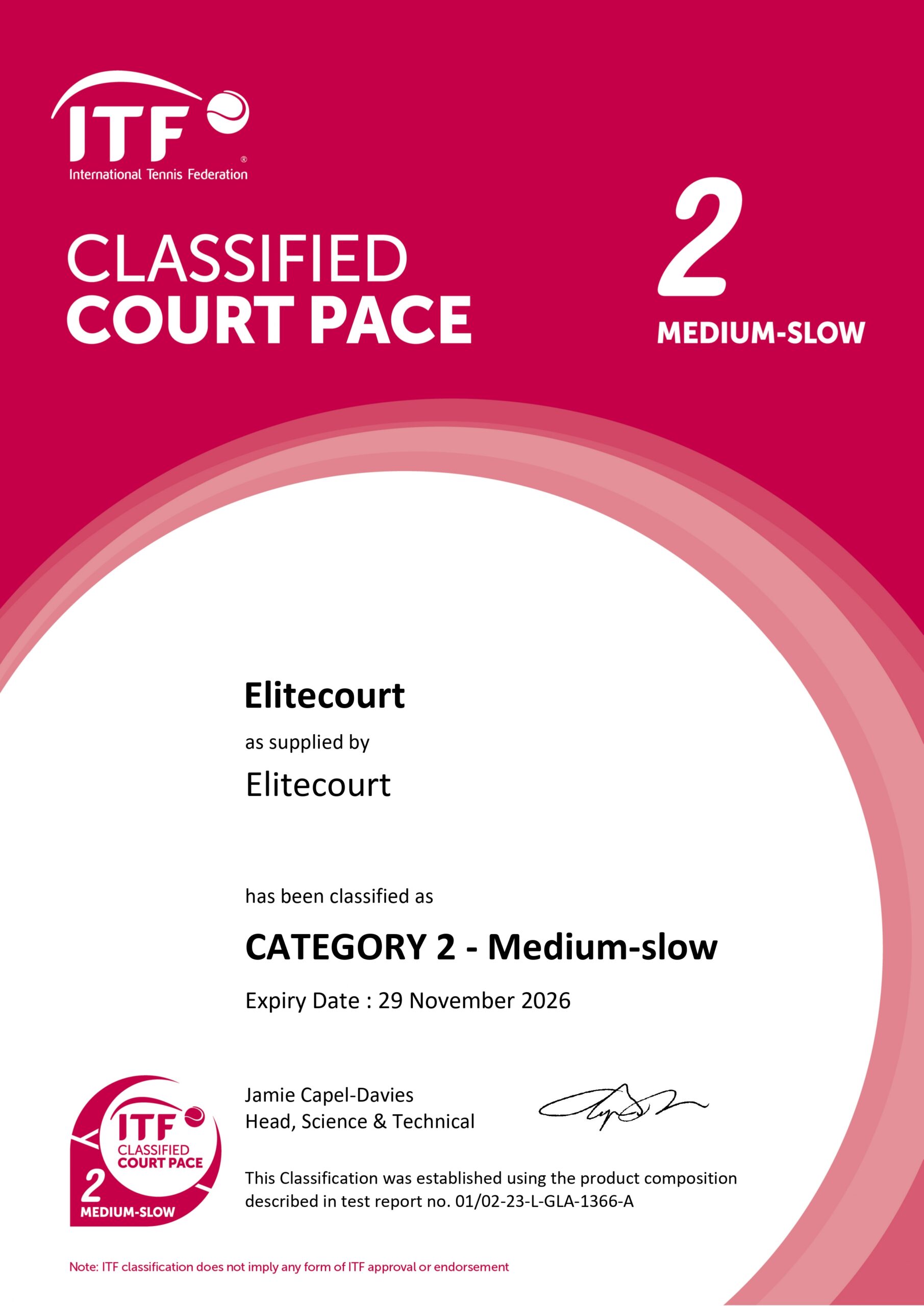
Acrylic court systems align with global standards set by leading sports bodies such as the International Tennis Federation (ITF). Their predictable performance makes them suitable for players ranging from beginners to advanced competitors.
Customizable Speed & Texture
Acrylic surfaces can be tailored to create different levels of surface speed—slow, medium, or fast—depending on the facility’s needs. The texture is carefully controlled through the use of silica and acrylic sand mixes, making the court highly adaptable.
What Makes Synthetic Acrylic the Best Tennis Court Material Today
While several materials can be used to build a tennis court, none offer the complete package the way high-performance synthetic acrylic does. Let’s explore the technical reasons acrylic dominates.
Layered System Design
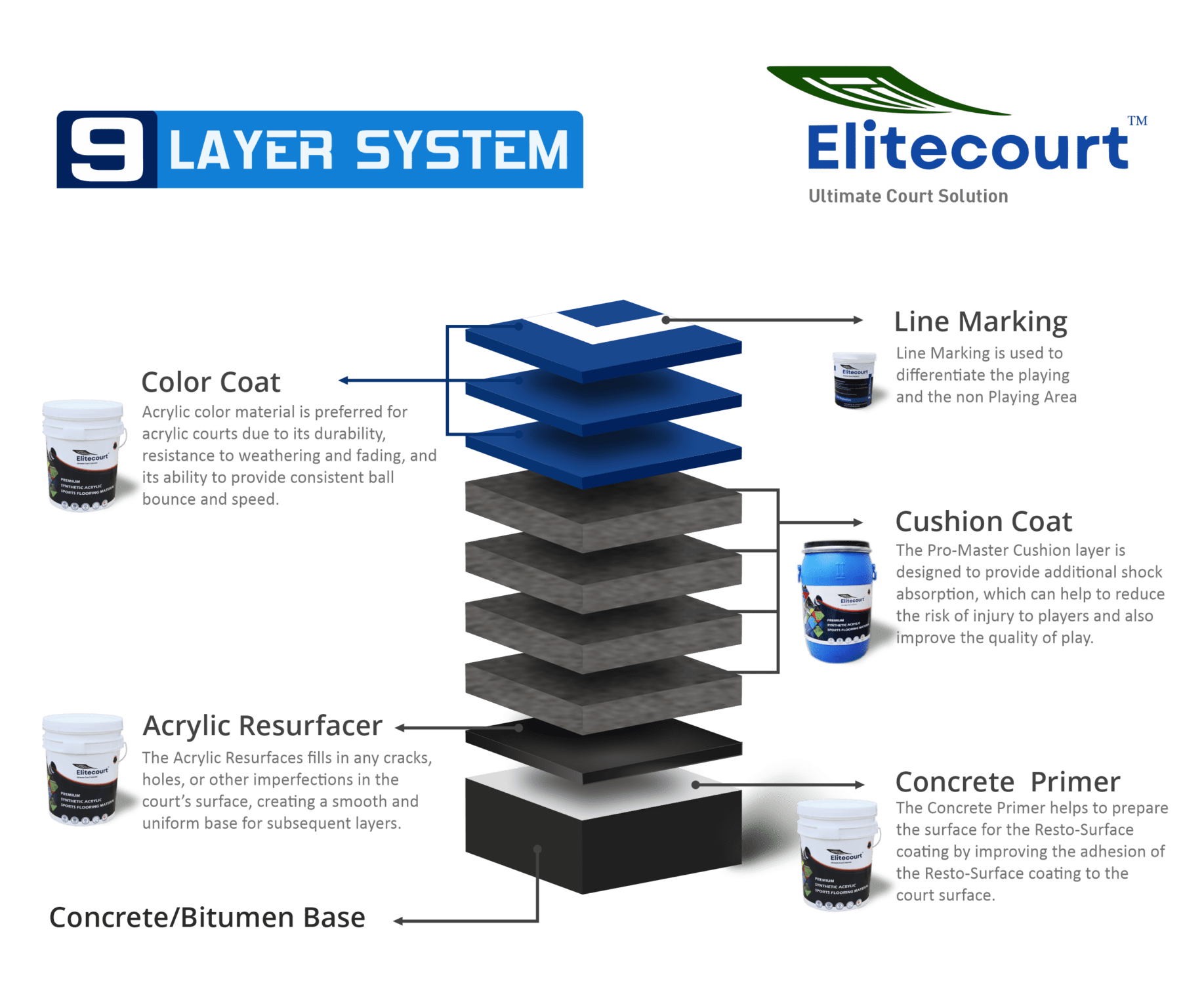
Acrylic courts are built with precision-engineered layers:
Resurfacer Layer
This layer smoothens the base and promotes strong adhesion for subsequent coats. It fills surface imperfections and ensures a uniform finish.
Cushion Layers (Optional)
For facilities desiring greater comfort, premium cushion layers provide impact absorption without affecting ball behavior.
Acrylic Coating Layers
These are the colored layers that create the actual playing surface. They’re formulated with high-grade acrylic emulsions, pigments, and fine silica for controlled texture.
The layered structure is what gives acrylic courts their unmatched durability, consistency, and customization potential.
UV Stability & Weather Resistance
One of the defining strengths of high-quality synthetic acrylic systems is their exceptional resistance to ultraviolet rays and fluctuating outdoor conditions. Tennis courts endure constant exposure to sunlight, rain, dust, and temperature variations. Inferior materials tend to fade, crack, or lose texture over time, resulting in uneven bounce and unsafe traction.
Acrylic surfaces, however, are engineered to withstand these environmental stressors. The resins used in acrylic formulations have strong UV stability, which helps the court retain its color vibrancy and texture uniformity even after years of outdoor exposure. This resistance to weather not only ensures consistent play but also minimizes the need for frequent resurfacing. Because acrylic systems do not absorb water, the surface dries quickly after rainfall, allowing courts to return to play faster compared to clay or grass.
For regions with intense heat or monsoon conditions—common across many parts of India—acrylic drastically outperforms traditional court materials. This combination of weather resilience and performance consistency reinforces acrylic’s position as the most reliable tennis court material in today’s climate-driven world.
Slip Resistance & Athlete Safety
Player safety is a top priority in tennis court design, and the material plays a major role in how safely athletes can move. Acrylic surfaces are formulated to provide balanced traction, offering enough grip for quick directional changes while still allowing smooth footwork without excessive abrasion.
The fine silica texture in the top acrylic layers is carefully calibrated to prevent slips, even during intense lateral movements. This controlled surface friction reduces the risk of falls, ankle twists, or strains. Additionally, cushion acrylic systems add a layer of impact absorption, enhancing joint protection and reducing player fatigue.
Unlike clay (which can become slippery when dry) or grass (which becomes treacherous when wet), acrylic retains its traction characteristics regardless of weather conditions. This reliability makes it a favorite among coaches, clubs, academies, and sports planners who prioritize athlete well-being as much as performance.
Long-Term Performance
What sets acrylic material apart is not just its immediate performance but its ability to maintain that performance over years of play. Acrylic surfaces are inherently dimensionally stable, meaning they do not expand, contract, or deform easily under environmental stress. This stability ensures that ball bounce, grip, and surface speed remain consistent.
High-quality acrylic coatings resist surface wear from repeated foot traffic, ball impact, and daily use. The top layers are designed to hold their texture longer, preventing premature smoothness or patchiness. Because the surface does not shed loose particles (unlike clay) or thin out rapidly (unlike turf), players enjoy a predictable experience every time they step onto the court.
Elitecourt’s advanced acrylic formulations enhance this longevity by using premium resins and pigments that maintain their structural integrity over time. Facilities that choose acrylic benefit from years of reliable performance with only minimal periodic maintenance.
Why Elitecourt’s Synthetic Acrylic Flooring Stands Out
Elitecourt has established a strong reputation as a leading manufacturer of synthetic acrylic sports flooring materials in India. Our focus on quality, research-driven formulation, and manufacturing precision has made our acrylic systems a preferred choice for facilities across the country. Here’s what sets Elitecourt apart:
Advanced Formulation Technology
Elitecourt’s materials are produced using high-quality acrylic emulsions, durable pigments, and carefully selected aggregates. Our formulations emphasize UV resistance, wear durability, and weather-proof performance. By maintaining strict quality control at every production stage, we ensure that each batch delivers optimal consistency and reliability.
Consistency, Quality & Material Reliability
One of the biggest challenges in sports flooring is maintaining uniformity across the entire court. Elitecourt’s acrylic systems are engineered to distribute texture, color, and performance characteristics evenly. This guarantees consistency in traction, bounce, and play feel throughout the surface.
Facilities trust Elitecourt because our materials are dependable, long-lasting, and engineered for real-world play conditions, from intense training schedules to community recreation.
Wide Range of Performance Options
Every facility has unique requirements—some prioritize speed, others value cushioning, while others need a balanced all-round surface. Elitecourt offers multiple acrylic system combinations, including:
- Standard hard court acrylic
- Cushion-enhanced acrylic systems
- Customizable texture and surface speed options
- High-durability topcoats for heavy-use environments
This versatility allows planners to tailor the tennis court surface to the exact needs of players and coaching staff.
Elitecourt’s Trusted Reputation in the Sector
With years of specialization in sports flooring material manufacturing, Elitecourt has earned the trust of numerous academies, institutions, and sports organizations. Our credibility is built on delivering materials that perform consistently, withstand Indian climatic conditions, and meet the expectations of both recreational and competitive play environments.
Because Elitecourt focuses exclusively on material manufacturing, we ensure every product meets rigorous quality benchmarks—allowing installers and planners to build high-performance courts that last.
Transform Your Sports Facility Today!
Contact us for high-quality synthetic sports flooring material and elevate your space!
Is acrylic flooring good for professional tennis courts?
Absolutely. Acrylic is the preferred surface for professional-level play across the world due to its consistency, durability, and adherence to performance standards. Its predictable ball bounce and customizable speed make it suitable for advanced athletes training for competitive events. Acrylic courts also support high-impact movements and retain their structural integrity even under frequent usage. For these reasons, top coaches and sports planners overwhelmingly favor acrylic surfaces for professional environments.
How does synthetic acrylic compare to clay and grass?
Acrylic surfaces outperform clay and grass in almost every practical category. While clay requires extensive daily grooming and grass demands delicate maintenance, acrylic offers long-term stability with minimal upkeep. The playing experience on acrylic is more consistent, safe, and suitable for players of all skill levels. Unlike clay—which shifts with use—or grass—which wears unevenly—acrylic remains stable, uniform, and highly reliable.
Does acrylic support year-round play?
Yes. Acrylic’s weather resistance makes it ideal for year-round use. It withstands sunlight, rain, humidity, and temperature changes without compromising performance. Even after rainfall, acrylic courts dry quickly and return to play far faster than clay or grass. This year-round reliability is one of the biggest reasons why acrylic is considered the best tennis court material globally.
Is acrylic safe for high-impact movements?
Yes. The combination of controlled traction and optional cushion layers makes acrylic safe for lateral movement, sprinting, sudden stops, and turns. The surface grip prevents slips while the cushion layers protect joints, reducing fatigue and injury risk. It provides a perfect balance between stability and comfort.
Transform Your Sports Facility Today!
Contact us for high-quality synthetic sports flooring material and elevate your space!
How Tennis Court Material Affects Playing Style
The material used on a tennis court has a direct and significant impact on how the game is played. Players often adjust their strategy, footwork, shot selection, and movement patterns depending on the nature of the surface. This is why choosing the right material is crucial—not only for performance but also for developing well-rounded athletes. Acrylic courts excel in this area because they offer a balanced playing experience that suits a wide range of playing styles.
Speed of the Game
Acrylic tennis courts typically produce a medium to medium-fast playing speed, making them ideal for competitive and training environments. The surface holds up well under fast-paced rallies, allowing both offensive and defensive players to perform at their best. Unlike clay, where the ball slows dramatically, or grass, where the bounce stays low and fast, acrylic offers a perfect mid-point that enhances overall playability.
Ball Bounce Height
One of the biggest advantages of acrylic is its uniform bounce height across the court. Players can anticipate the ball more accurately, leading to stronger shot-making and improved consistency. Because the surface texture is engineered and controlled, there are no unexpected irregular bounces, making the game fair, predictable, and enjoyable.
Player Footwork Requirements
Players on acrylic surfaces experience a firm, stable footing that supports precise footwork and clean directional changes. The grip is neither too sharp nor too forgiving, ensuring smooth transitions without excessive slipping or abrupt halts. This balance helps players build footwork discipline while reducing risk of injury.
Fatigue & Comfort Over Long Matches
For tennis facilities that see long training sessions, academy drills, or extended match play, fatigue becomes an important factor. Cushion acrylic systems provide extra shock absorption, reducing impact on knees, ankles, and hips. Even on standard acrylic courts, the surface remains relatively comfortable compared to harder materials like asphalt. This helps players perform longer with reduced strain.
Step-by-Step: How an Acrylic Tennis Court Surface is Built
Understanding how acrylic court surfaces are built helps highlight why the material performs so consistently and lasts for years. Each stage of construction contributes to the surface’s durability, playability, and structural strength.
Base Preparation
Every good tennis court begins with a solid foundation. The base—typically made of concrete or asphalt—must be well-leveled and free from cracks. Proper slope is incorporated to ensure efficient drainage. The longevity and consistency of the acrylic layers depend heavily on the quality of the base, making precision a vital part of this stage.
Resurfacer Application
Once the base is ready, a resurfacer coat is applied. This layer fills minor surface imperfections and creates the ideal texture for acrylic adhesion. Resurfacers improve the smoothness of the court while establishing a uniform substrate for the layers that follow.
Cushion Layer Application
If the court requires enhanced comfort and impact absorption, cushion layers are added next. These layers consist of flexible acrylic compounds that add resilience without affecting ball bounce. Cushion systems are highly recommended for training academies and facilities where players spend long hours on the court.
Acrylic Coatings
Following the cushion layer, several coats of high-quality acrylic color material are applied. These coats include carefully graded sand and pigments to provide the desired surface texture. They determine the court’s play speed, traction, and visual aesthetics. The acrylic layers also offer UV resistance and weather protection.
Court Lines & Finishing
Finally, bright, crisp, durable line markings are applied using specialized acrylic line paint. These lines are slip-resistant and formulated to stay vibrant even under intense play conditions. After the lines cure completely, the court is ready for use—offering a professional, reliable, and visually striking playing surface.
Comparison Table: Acrylic vs Clay vs Grass vs Turf
Below is a clear comparison of tennis court materials to help illustrate why acrylic remains the top choice.
| Feature | Acrylic | Clay | Grass | Synthetic Turf |
|---|---|---|---|---|
| Bounce Consistency | Excellent | Moderate | Low | Moderate |
| Surface Speed | Adjustable | Slow | Fast | Medium |
| Weather Resistance | High | Low | Low | Medium |
| Maintenance Needs | Low | Very High | Very High | Medium |
| Traction Stability | High | Variable | Variable | Moderate |
| Longevity | High | Moderate | Low–Moderate | Moderate |
| Player Comfort | High (with cushion) | High | Moderate | High |
| Suitability for All Skill Levels | Excellent | Good | Limited | Good |
This table highlights why acrylic courts consistently outperform other materials in nearly every meaningful category, particularly for long-term use and predictable gameplay.
Transform Your Sports Facility Today!
Contact us for high-quality synthetic sports flooring material and elevate your space!
Expert Tips for Choosing the Best Tennis Court Material
Choosing the right tennis court material is a major decision. Here are expert insights to help facility planners, coaches, and administrators make the right choice:
Identify the Purpose of the Court
If the court is intended for tournaments, professional training, or consistent daily practice, acrylic is the ideal choice. Its stability, low maintenance, and customizable speed make it suitable for all levels of play.
Consider Climate Conditions
Acrylic surfaces are exceptionally resilient in areas with heavy rain, extreme sun exposure, or humidity. Clay and grass struggle under such conditions, making acrylic the practical choice for year-round reliability.
Think About Player Profiles
Acrylic surfaces serve a wide range of players, from beginners to advanced athletes. Cushion acrylic systems add comfort for younger players and reduce joint strain for older ones, making them versatile for multi-age facilities.
Durability Expectations
Acrylic courts provide outstanding long-term performance with minimal maintenance. If longevity and reliability are top priorities, acrylic delivers consistent results with far fewer upkeep demands compared to alternate surfaces.
Common Mistakes When Selecting Court Material
Choosing the right tennis court material is crucial for performance, safety, and long-term satisfaction. However, many decision-makers—whether sports administrators, facility owners, or planners—make avoidable mistakes during the selection process. Understanding these pitfalls ensures that the final court meets expectations and delivers a high-quality playing experience.
Choosing Without Considering Climate
One of the most common mistakes is selecting a material without accounting for the region’s climate. Clay courts struggle in areas with heavy rain or excessive dryness, while grass requires meticulous care that isn’t feasible in extreme temperatures. Acrylic, however, adapts well to most climates, making it a more reliable choice year-round. Ignoring climate conditions can lead to rapid surface deterioration and inconsistent play.
Overlooking Surface Speed
Players and coaches often underestimate how much surface speed influences the playing experience. Each court material delivers a different pace, affecting rallies, footwork, reaction time, and training outcomes. Acrylic provides customizable speed options, which means facilities can tailor the court to their exact needs. Choosing a material with a fixed speed limitation—like grass or clay—may not support the intended use of the facility.
Ignoring Material Certification
Quality certifications are essential when evaluating tennis court materials. International standards, such as those recognized by bodies like the International Tennis Federation (ITF), ensure that the surface meets professional performance criteria. Using uncertified or low-grade materials can result in poor traction, inconsistent bounce, rapid wear, and safety concerns. Since acrylic systems are widely tested and approved globally, they provide assurance of quality and consistency.
Best Practices for Maintaining an Acrylic Tennis Court Surface
While acrylic courts require minimal upkeep compared to other surfaces, proper maintenance still plays a crucial role in preserving performance and longevity. Implementing basic care routines helps keep the court vibrant, safe, and enjoyable for years.
Regular Cleaning Routines
Dust, dirt, and organic debris naturally accumulate on outdoor courts. Regular cleaning—either with soft brooms, blowers, or low-pressure washing—prevents buildup that can affect traction and surface appearance. Cleaning also reduces the risk of algae or stains developing during humid or rainy seasons.
Preventing Surface Wear
Even though acrylic surfaces are durable, certain actions help prevent premature wear. Avoid dragging heavy equipment, placing sharp objects directly on the court, or allowing vehicles to drive over it. Monitoring high-traffic zones and addressing minor surface changes early helps maintain uniform texture and bounce.
Increasing Longevity
To maximize the life of the acrylic coating, periodic inspections are recommended. Look for signs of color dullness, texture changes, or minor cracks in the underlying base. Early detection allows facilities to plan timely resurfacing before larger issues arise. The combination of routine cleaning, basic care, and periodic checks ensures the court maintains its professional look and feel for many years.
Transform Your Sports Facility Today!
Contact us for high-quality synthetic sports flooring material and elevate your space!
Conclusion
Selecting the best material for a tennis court requires a thoughtful understanding of performance, durability, and player needs. While clay, grass, and turf each have their unique characteristics, synthetic acrylic emerges as the clear leader for its superior consistency, safety, all-weather durability, and low maintenance requirements. Its ability to deliver uniform bounce, customizable speed, and long-term surface stability makes it the preferred choice for academies, clubs, schools, and sports facilities worldwide.
Elitecourt’s advanced synthetic acrylic systems elevate this excellence even further. With years of manufacturing expertise, meticulous material formulation, and a deep understanding of India’s climate conditions, Elitecourt provides court surfaces that are reliable, performance-focused, and trusted by the sports community. Whether you’re building a new court or upgrading an existing one, choosing acrylic—and choosing Elitecourt—ensures a world-class playing experience that stands the test of time.
FAQs
Acrylic surfaces are among the most durable tennis court materials available. They resist UV rays, rain, and continuous play while maintaining consistent bounce and traction. Their layered structure and weather-resistant formulation contribute to excellent long-term performance.
Yes. Acrylic systems are versatile and suitable for both indoor and outdoor tennis courts. Their ability to withstand varying temperatures, moisture levels, and continuous usage makes them ideal for almost any environment.
For beginners, acrylic courts provide stability, predictable ball bounce, and reliable traction—making learning easier. For professionals and advanced players, the customizable surface speed, consistency, and comfort support high-intensity training and competitive play.
Yes. Acrylic surfaces can be engineered to create slow, medium, or fast court speeds. This customization is achieved through controlled texture, sand distribution, and coating formulations, making them adaptable for various training needs.
Acrylic surfaces are commonly recognized and approved by international sports bodies such as the International Tennis Federation (ITF). Their standards help ensure that acrylic courts meet global performance and safety criteria.