
Introduction
The official tennis court size follows globally accepted standards: 78 ft in length, with a width of 27 ft for singles and 36 ft for doubles. These dimensions are not just guidelines—they are essential for accurate gameplay, safe movement, and proper training environments. Whether you’re planning a court for a school, academy, club, or institutional facility, knowing the exact measurements is the first step in achieving a court that truly performs at a professional level. When the base layout is accurate, everything else—from player comfort to the precision of line markings—falls naturally into place.
Correct tennis court size also plays a major role in how modern synthetic acrylic flooring systems behave. Because engineers design acrylic surfaces for consistent ball bounce, optimal grip, and uniform texture, these materials deliver their best performance only when the court’s dimensions stay accurate. A court built even slightly off-spec can impact how evenly coatings settle, how the ball responds, and how players experience the surface during play. Precision matters long before anyone applies the top layers of color and texture.
Elitecourt, one of India’s leading manufacturers of synthetic acrylic sports flooring materials, supports this precision by offering surface systems designed to align with official court dimensions. Elitecourt supplies materials across the country and earns trust for the reliability, consistency, and professional-grade performance of its products. When paired with a regulation-size court, these acrylic systems deliver smooth playability, excellent durability, and a surface that meets training and competitive standards alike.
Understanding Standard Tennis Court Size
A tennis court looks simple from a distance, but the International Tennis Federation (ITF) defines the official tennis court size as a precise and regulated layout. Every millimeter matters. These measurements directly shape how the ball performs, how players move, and how the acrylic surface aligns during installation. That’s why the first step toward a professional-grade facility is understanding the exact standard dimensions.
Official Court Dimensions
The length of a standard tennis court is 78 feet (23.77 meters).
The width, however, changes depending on whether the court is being used for singles or doubles:
- Singles Width: 27 feet (8.23 meters)
- Doubles Width: 36 feet (10.97 meters)
These numbers are not optional—they are mandatory for tournament play across the world. Even for school or academy courts, sticking to the official size helps ensure proper player development and a consistent playing experience.
Service Areas and Baseline Distances
Within the overall tennis court size, several internal measurements define how the game is played. For example:
- The service line is placed 21 feet (6.40 m) from the net.
- The center service line bisects the court into two equal service boxes.
- The baseline, although part of the total court length, has additional functional requirements related to player movement and space usage.
Each of these lines plays a vital role in shot angles, serve placement, rallies, and player positioning. When installers use Elitecourt’s acrylic systems, they follow strict marking guidelines and ensure every line stays accurate, straight, and perfectly aligned across the full length of the court.
Measurement Tolerance and Accuracy
ITF guidelines allow extremely minimal tolerance variations, usually within a few millimeters. However, professional planners avoid relying on these tolerances and instead aim for perfect accuracy. This ensures:
- Consistent ball bounce
- Predictable movement patterns
- No biases toward one side
- Proper performance of the acrylic layers across the surface
Acrylic flooring, by nature, must be laid evenly and precisely. If the base area does not match the official dimensions, the layers may shift in thickness, resulting in inconsistent playing characteristics.
Why Standard Dimensions Matter for Every Facility
Whether it’s a private court or a multi-court institutional facility, the tennis court size must remain identical. A player trained on an inaccurately sized court may struggle in tournaments, while a poorly measured court risks alignment issues, poor bounce, and surface stress. Elitecourt materials make it easier to maintain dimensional accuracy across the base and all layers because the systems deliver consistency, long-term performance, and precision throughout the full length of the court.
Singles vs. Doubles Tennis Court Size
Understanding the difference between singles and doubles tennis court size is essential for anyone designing, planning, or constructing a court. Both formats share the same length, but the width changes significantly, shaping how players move, how rallies develop, and how planners mark the court. This section breaks down everything you need to know.
Key Differences Between Singles and Doubles Dimensions
The most important distinction lies in the width:
- Singles court width: 27 ft (8.23 m)
- Doubles court width: 36 ft (10.97 m)
The length, regardless of format, remains 78 ft (23.77 m).
The additional width in doubles comes from the doubles alleys, which extend along both sides of the court. These alleys, each 4.5 ft (1.37 m) wide, are not part of singles play but become active zones in doubles matches.
This wider playing area affects tactical choices, shot placement, and the movements of all players on the court. Elitecourt requires installers to apply its acrylic surfacing materials with full precision along these wider boundaries so every line, alley, and angle stays perfectly aligned for official play.

How These Differences Affect Gameplay
The extra width introduces new strategies in doubles:
- Teams use wider angles to move opponents.
- Net play becomes more dynamic due to the increased lateral space.
- Placement shots into alleys force coordination between partners.
For singles, the narrower court puts more emphasis on endurance, precision, and baseline rallies. A smaller width means players cover less side-to-side distance, but shot accuracy becomes even more critical.
Because of this, the correct tennis court size ensures that players experience realistic gameplay and develop skills suited for competitive conditions.
Visualizing the Space
Imagine two overlapping rectangles:
- The inner rectangle is the singles court.
- The outer rectangle—the singles area plus the alleys—is the doubles court.
Both share the same center lines, net placement, and overall structure; only the playable width changes.
Elitecourt’s acrylic systems allow clear, crisp differentiation between singles and doubles lines, ensuring players instantly recognize the correct playing boundaries.
Why Simplifying or Adjusting Width Is Not Recommended
Some facility owners consider narrowing or widening the court to fit available land. However, altering the official tennis court size leads to:
- Incorrect ball trajectories
- Reduced training value
- Inaccurate match simulation
- Poor performance of acrylic surface layers applied to non-standard bases
Maintaining ITF-standard dimensions ensures longevity, consistency, and fairness—whether you’re creating a recreational court or a professional-grade facility.
Transform Your Sports Facility Today!
Contact us for high-quality synthetic sports flooring material and elevate your space!
Tennis Court Size in Feet, Meters & Yards
One of the most important aspects of designing a tennis court is understanding how the tennis court size translates across different measurement systems. International standards list dimensions in meters, but many planners, architects, and contractors still use feet or yards based on regional practices. A clear conversion helps avoid costly mistakes and ensures that every marking, line, and boundary complies with ITF standards.
Why Multiple Measurement Units Matter
Sports infrastructure projects often involve collaboration between multiple teams—civil engineers, architects, flooring manufacturers, subcontractors, and consultants. Each of these groups may reference different units. For example:
- Engineers may use meters for structural planning.
- Contractors may use feet for site layout and marking.
- Documentation for international events may specify yards or traditional measurements.
Incorrect conversions can lead to misaligned lines, uneven acrylic layers, or even a complete redesign of the playing area. That’s why referencing an accurate measurement table is critical.
Standard Tennis Court Dimensions: Feet vs. Meters vs. Yards
Below is a simple breakdown of the official tennis court size in three units:
| Court Component | Feet | Meters | Yards |
|---|---|---|---|
| Court Length | 78 ft | 23.77 m | 26 yds |
| Singles Width | 27 ft | 8.23 m | 9 yds |
| Doubles Width | 36 ft | 10.97 m | 12 yds |
| Service Line to Net | 21 ft | 6.40 m | 7 yds |
| Net Height (Center) | 3 ft | 0.914 m | 1 yd |
| Doubles Alley Width | 4.5 ft | 1.37 m | 1.5 yds |
This table is a quick reference for planners working across different standards. Elitecourt’s flooring systems maintain dimensional precision when installers apply them over courts that follow these exact measurements.
Importance of Correct Conversions in Acrylic Court Surfacing
Acrylic surfacing materials require a uniform distribution of layers. If the court size is miscalculated—especially during conversion—the acrylic layers may stretch unevenly, causing:
- Variations in court texture
- Differences in ball bounce
- Uneven color uniformity
- Premature surface wear
Elitecourt supplies materials that deliver dimensional stability, coverage consistency, and long-court uniformity, but planners must still measure with complete accuracy.
Avoiding Conversion Errors in Real-World Court Planning
A simple conversion slip—like rounding 23.77 m to 24 m—may seem minimal but can create major layout issues. Planners must measure courts down to the centimeter or fraction of an inch, especially before they apply the flooring layers. As a best practice, professional planners use dual-unit diagrams and cross-verification methods to ensure absolute precision.
By keeping conversions accurate, the integrity of the tennis court size remains intact from the blueprint stage all the way to the final acrylic coating.
The Playing Area vs. Total Court Size
Many people assume that the tennis court size refers only to the marked playing area. However, the true size of a tennis court includes not just the playable zone but also the runoff or free space surrounding it. This surrounding space is essential for safe movement, proper gameplay, and overall player performance. Without adequate runoff, players risk injury or restricted movement, and the court cannot meet training or tournament standards. Let’s break down how the playing area differs from the total area needed.
Understanding the Playing Area
The playing area refers strictly to the space within the boundary lines used during a match. It includes:
- The full 78 ft × 27 ft singles area
- The full 78 ft × 36 ft doubles area
- All internal markings: service boxes, center mark, alleys, and baselines
This area is where balls must land for points to be considered valid. The bounce, texture, friction, and comfort within this zone depend heavily on the acrylic surface quality. Elitecourt designs its synthetic acrylic systems to deliver consistent performance by keeping the entire playing space uniform.
What Is the Runoff Area?
The runoff area is the safety margin surrounding the playing area. It allows players to chase wide balls, stretch for difficult shots, and recover safely without leaving the court or colliding with barriers. According to ITF recommendations, the total area should ideally measure:
- 120 ft (36.58 m) in length
- 60 ft (18.29 m) in width
This includes both the internal playing area and the additional free space. Although the court markings do not extend into this runoff space, the flooring must. That’s why accurate planning of the total tennis court size matters long before any acrylic layers are applied.
Why the Runoff Area Matters for Acrylic Flooring
Installers must spread acrylic flooring systems—like the ones Elitecourt manufactures—across the entire total area, not just the marked playing zones. If the runoff space is too narrow, the flooring process becomes compromised. Uneven edges, insufficient buffer zones, and poorly aligned coatings may result, affecting both performance and durability.
The runoff area also ensures:
- Smooth player movement
- Reduced risk of injury
- Improved match accuracy
- Adequate space for coaching and training drills
Additionally, acrylic layers require proper expansion and contraction space based on temperature and weather conditions. Without the correct total court dimensions, this natural behavior could lead to cracking or wear.
Total Court Size in Practical Planning
When designing a facility, planners often underestimate the overall space required. The playing area might seem manageable, but once you add runoff areas, fencing, seating, or lighting posts, the total footprint increases significantly. By following official tennis court size standards, facilities ensure long-term usability and a professional playing environment.
With proper planning and Elitecourt’s precision-engineered acrylic materials, the total court area becomes an optimized zone for safety, comfort, and high-performance gameplay.
Tennis Court Layout: Understanding Every Line & Marking
A tennis court goes far beyond a simple rectangle; it functions as a carefully engineered layout where every line, marking, and measurement shapes the flow of the game. The tennis court size relies not just on the outer boundaries but also on the detailed network of internal markings that guide players, officials, and the pace of each point. When installers apply Elitecourt’s synthetic acrylic flooring systems, they place these markings with precise technique to ensure full accuracy and long-term visibility. Let’s explore the layout in depth.
The Baseline
The baseline forms the back boundary of each side of the court. Players stand behind it during serves and position themselves around it in most rallies. Baselines must be straight, perfectly aligned, and measured exactly across the full width of the court:
- Singles baseline width: 27 ft
- Doubles baseline width: 36 ft
Because players frequently stop, slide, pivot, and accelerate around this area, acrylic surfacing must offer optimal traction without sacrificing comfort. Even a few millimeters of misalignment disrupt the accuracy of gameplay and surface installation.
The Service Lines
The service lines run parallel to the net and define the depth of the service boxes. Each service line is placed 21 ft (6.40 m) from the net. These lines are essential for determining valid serves:
- A serve must bounce inside the correct service box.
- Miscalculations in line marking can invalidate gameplay.
Elitecourt materials ensure crisp, long-lasting visibility even after extended exposure to sun, foot traffic, and gameplay intensity.
Center Service Line & Center Mark
The center service line divides the service boxes vertically.
The center mark, a small line on the baseline, guides players on where to stand when serving. These might look minor, but they hold significant importance:
- They help players align their serve position.
- They maintain consistency during matches.
- They ensure fairness by giving both sides identical visual structure.
Applying these with acrylic paint requires precise measurement and proper masking techniques to maintain perfectly straight geometry.
Doubles Alleys
The doubles alleys are the outer corridors used only in doubles play. Each alley is 4.5 ft (1.37 m) wide on both sides. Their purpose is simple but impactful: they expand the court’s playable width from singles to doubles format. This space influences angles, passing shots, and tactical depth. When surfacing the court, Elitecourt ensures the alleys are marked with accurate line thickness and clear color contrast.
Net, Net Posts, and Their Alignment
The net divides the court into two equal halves. While net height is discussed separately, its placement directly influences the layout. The net posts stand 3 ft (0.914 m) outside the doubles sideline. Aligning the net and posts correctly ensures the center line intersects the midpoint and the entire court remains symmetrical.
The Role of Line Thickness
ITF standards define the thickness of lines—typically between 2 inches (5 cm) and 4 inches (10 cm) depending on the type of line. Uniform thickness is crucial for:
- Consistency in visual reference
- Fair play
- A professional appearance
Acrylic coatings must adhere cleanly to these widths without bleeding, cracking, or fading.
Why Layout Accuracy Matters
A tennis court’s performance hinges on layout accuracy. Even small deviations can lead players to misjudge distances, angles, or ball trajectories. Elitecourt’s precision acrylic systems help ensure every marking retains durability, visibility, and performance—making the court trustworthy for years of use.
Tennis Net Height & Position
While the focus of a tennis court usually begins with the length and width, the net height and positioning are equally critical components of the official tennis court size. The net defines the central point of play, dictating ball trajectory, shot selection, rally style, and the overall competitive integrity of the match. Even a slight deviation—an inch too high or too low—can significantly alter gameplay dynamics. Understanding its exact specifications ensures a court meets ITF standards and offers players a professional experience.
Official Tennis Net Height Standards
A regulation tennis net must have two height measurements:
- At the center: 3 ft (0.914 m)
- At the net posts: 3 ft 6 in (1.07 m)
This slight upward curve is intentional. The ball crosses the net far more frequently near the center, so the lower height encourages long rallies and balanced gameplay. Meanwhile, the higher outer height helps maintain fairness for angled and sideline shots.
Elitecourt’s acrylic flooring systems do not include net hardware, but they play a critical role in ensuring a perfectly flat, even surface so the net stands at the correct height across its entire span.
Net Position and Placement
The net posts are positioned 3 ft (0.914 m) outside the doubles sidelines, regardless of whether the court is being used for singles or doubles. This means:
- Even if players use singles sticks to narrow the net width, the posts remain in their fixed doubles position.
- The total post-to-post distance equals 42 ft (12.8 m).
The net must bisect the 78-ft court length precisely, sitting at the exact halfway mark. If the court dimensions are off—even slightly—the net may sit off-center, creating imbalances in play.
Accurate base construction and flawless acrylic surfacing are essential for ensuring the net line aligns perfectly with the center point without visual distortion.
Why Net Height Affects Perception of Court Size
Players naturally use the net as a visual and spatial reference. When the net height is incorrect:
- The court appears visually distorted.
- Players misjudge depth and shot angles.
- Serves may appear higher or lower than intended.
These perceptual issues are particularly noticeable on acrylic courts because the smooth, uninterrupted surface highlights symmetry. Elitecourt’s systems help maintain this symmetry by ensuring consistent coloration, texture, and reflectivity across the court, enhancing line visibility and net alignment.
Achieving Proper Net Tension
ITF regulations require the net to be taut but not overly tight. Too much tension can pull the posts inward; too little causes sagging. Both conditions can disrupt the official net height and compromise gameplay.
While tensioning hardware is handled separately from surfacing, the evenness of an acrylic court plays a vital role. An uneven or sloped base can:
- Distort the apparent height of the net
- Cause one side to appear lower than the other
- Affect player perception during rallies
This is why precision in the tennis court’s total size and surfacing is so important.
The Net’s Relationship With the Playing Lines
The net aligns directly above the center line and perpendicular to the baselines. If markings are slightly off—whether shifted by a few millimeters or misaligned diagonally—the net will appear crooked even if installed correctly. The consistent line definition provided by Elitecourt’s acrylic coatings ensures the net integrates seamlessly with the layout.
Tennis Court Size for Schools, Academies & Clubs
When designing a tennis facility for schools, academies, or clubs, the tennis court size must follow official standards—not only to meet ITF regulations but also to support proper training and skill development. Young players, recreational athletes, and competitive trainees all depend on accurate court dimensions to practice realistically and transition smoothly to higher levels of play. The right court size ensures safety, comfort, and performance, while the wrong dimensions can hinder progress and reduce the lifespan of the court itself.
Why Standard Dimensions Are Crucial in Training Environments
Schools and academies often cater to players who are still learning technique, footwork, and tactical movement. If the court size is inaccurate—for example, if it is narrower or shorter—the player develops habits that do not translate well to standard courts.
Using the correct dimensions:
- Helps players learn accurate footing
- Teaches them realistic ball trajectories
- Encourages proper spacing and positioning
- Allows coaches to run standardized drills
- Ensures smooth transition to district, state, or national competitions
A mismatched tennis court size can affect rally length, shot execution, and even player confidence. This is why every training environment must respect official court dimensions.
Space Optimization for Multi-Court Facilities
Schools and training academies often need multiple courts within limited land availability. While some may consider shrinking runoff areas to fit more courts, this approach is counterproductive. The runoff area is essential for safety and must be preserved.
Instead, planners can optimize space through thoughtful layout strategies:
- Aligning courts side-by-side with shared fencing zones
- Designing staggered orientation to maximize sunlight control
- Utilizing long rectangular plots to place several courts in a row
- Ensuring proper space between adjacent courts for safe play
Elitecourt’s acrylic systems work seamlessly across such layouts, providing uniform performance and durability across multi-court clusters.
Why Consistency in Surface Matters for Institutional Courts
Schools and academies typically have high foot traffic. Players train daily, often performing repetitive drills across the entire surface. This creates unique demands on the flooring. When acrylic systems are applied over correctly measured tennis court size layouts, the surface:
- Maintains consistent ball bounce
- Supports predictable slide and grip
- Handles repeated foot impact without premature wear
- Offers comfortable cushioning for students and trainees
Elitecourt’s materials are engineered to deliver these qualities on courts that follow precise size standards.
Safety Considerations in Education & Club Facilities
Young players and amateurs tend to chase balls aggressively, often running into the runoff space. If the court’s total size is compromised, it increases the risk of injuries. Adequate free space and correct acrylic layering reduce hazards related to slipping, tripping, or abrupt surface transitions.
Accurate tennis court size ensures:
- Safe player recovery zones
- Smooth edging and transitions
- Proper installation of fencing and lighting without interfering with play
When the dimensions are correct, the entire facility becomes more functional, safe, and enjoyable for regular use.
Indoor vs. Outdoor Tennis Court Size
A common question in facility planning is whether indoor and outdoor tennis courts require different dimensions. The short answer: the playing area stays exactly the same. The official tennis court size—whether for singles or doubles—does not change based on whether the court is built inside a structure or outdoors in open air. However, what does change is the total space requirement, environmental considerations, structural allowances, and the way flooring materials behave under different conditions. Understanding these nuances is essential for building a long-lasting, high-performance court.
Standard Court Dimensions Remain Identical
According to ITF rules, both indoor and outdoor courts must follow the same measurements:
- Length: 78 ft (23.77 m)
- Singles width: 27 ft (8.23 m)
- Doubles width: 36 ft (10.97 m)
The internal markings, service boxes, baselines, and net height also follow the same regulations. A player should feel zero difference in spatial orientation whether playing on an indoor court in a sports complex or an outdoor court in a school or academy.
Differences in Total Space Requirements
Where indoor and outdoor courts begin to diverge is in the total area needed around the playing zone. Indoor courts require extra clearance for:
- Roofing height
- Structural beams or columns
- Interior wall buffering
- Light fixtures
- Ventilation systems
To maintain safety and prevent players from hitting walls or equipment during rallies, indoor courts need generous clearance around all four sides.
While outdoor courts only require open runoff space and fencing, indoor courts must integrate this safety margin into the building structure itself. This makes planning absolutely crucial; any miscalculation impacts both construction and the final playability.
Elitecourt’s acrylic systems adapt extremely well to both environments, providing the same performance, durability, and visual uniformity regardless of the enclosure.
Environmental Differences That Influence Court Performance
Indoor courts offer environmental control, which affects how acrylic flooring behaves. Outdoor courts, on the other hand, must withstand natural factors such as:
- UV exposure
- Heat variations
- Rain
- Dust
- Temperature fluctuations
Elitecourt’s engineered acrylic materials are designed to handle all of these outdoor challenges while maintaining color stability, texture consistency, and predictable bounce.
Lighting Considerations for Indoor Tennis Courts
Because indoor courts rely entirely on artificial lighting, the layout must ensure no shadows fall across the playing surface. Shadows or uneven lighting can make the court appear visually distorted—even if the tennis court size is correct.
Proper acrylic surfacing enhances light reflection and visibility, especially when paired with high-quality line markings. Elitecourt’s acrylic systems help maintain visual clarity under both natural and artificial lighting.
Ventilation, Moisture & Surface Behavior
Indoor courts must manage moisture levels and airflow to prevent conditions like:
- Slick surfaces
- Slow drying after cleaning
- Condensation-related slipperiness
While the tennis court size remains standard, the flooring experience can differ drastically if moisture control is poor. Elitecourt’s acrylic surfaces are engineered for stability, minimizing the effects of humidity and ensuring year-round consistent play.
Does Court Orientation Matter Indoors vs. Outdoors?
Outdoor courts typically follow a north–south orientation to minimize sun glare. Indoors, this is not a concern, but lighting direction becomes crucial. The playing experience must remain uniform across both halves of the court.
Conclusion of This Section
While indoor and outdoor tennis courts share the same official size, the planning considerations surrounding them differ significantly. Understanding both the structural and environmental demands ensures the court delivers optimal performance, safety, and longevity. When paired with Elitecourt’s precision acrylic systems, both indoor and outdoor environments can achieve professional-grade playability and long-term durability.
Mini Tennis Court Size Variations
When discussing the official tennis court size, it’s important to also understand the adapted court sizes used for young players. These are not alternatives to the full-size court but developmental stages designed to help children build skills gradually. Known internationally as the Red, Orange, and Green stages, each level features modified court dimensions, ball types, and net heights to suit a child’s age and physical abilities. These formats are recognized by global tennis bodies, including the International Tennis Federation (ITF), and are essential for modern training programs.
Why Mini Tennis Courts Are Important
Children cannot begin their tennis journey on a full-size court. The distances are too large, the bounce is too high, and the movement patterns are too demanding. Mini tennis solves this by:
- Creating age-appropriate environments
- Encouraging proper stroke development
- Building confidence and consistency
- Allowing more rallies and interactive learning
- Reducing risk of injury
By scaling down the tennis court size, children learn technique naturally rather than struggling with power and reach.
Although Elitecourt manufactures professional acrylic flooring systems, these same high-quality surfaces are often used to create multi-purpose courts that incorporate mini tennis training areas. Acrylic flooring provides excellent grip, comfort, and durability—essential qualities for youth development.
Red Stage Court Size (Ages 5–8)
- Court size: 36 ft x 18 ft (10.97 m x 5.48 m)
- Net height: Approximately 2 ft 9 in (0.85 m)
This stage focuses on fun, coordination, and basic rally skills. The smaller format enables children to reach the ball easily and maintain control, laying the foundation for later advancement.
Orange Stage Court Size (Ages 8–10)
- Court size: 60 ft x 21 ft (18.29 m x 6.40 m)
This is essentially a “three-quarter” court. Children learn directional control, footwork patterns, and tactical use of angles. The transition from Red to Orange helps young players develop physical readiness for longer rallies.
Green Stage Court Size (Ages 9–12)
- Court size: Full length (78 ft) but slightly narrower than full doubles
The Green stage introduces players to near-normal gameplay but with a more controlled pace. This prepares them for the jump to a full-size court, both physically and mentally.
Surface Considerations for Mini Tennis
Because these courts are used by young athletes, comfort and safety are top priorities. Acrylic surfaces provide:
- Smooth, slip-resistant texture
- Consistent bounce suitable for low-compression balls
- Adjustable pace depending on training needs
- Reduced impact on joints
Even when mini courts are temporarily marked on full courts, Elitecourt’s acrylic coatings ensure that the lines remain visible, durable, and properly aligned.
Why Mini Tennis Courts Must Still Follow Standards
Mini tennis courts are not random playground reductions. Each stage has clearly defined guidelines to match children’s developmental stages. Proper dimensions help:
- Ensure fair competition
- Provide uniformity across schools and academies
- Create a familiar training progression
- Support long-term athletic development
By maintaining accurate size standards at every stage, young players grow into the full-size court with confidence, skill, and readiness.
Transform Your Sports Facility Today!
Contact us for high-quality synthetic sports flooring material and elevate your space!
Why Tennis Court Size Matters for Flooring Performance
While most people look at tennis court size from a gameplay or planning perspective, the dimensions of a court also have a profound impact on the flooring performance—especially when using synthetic acrylic systems like those manufactured by Elitecourt. Every square foot of the court affects the behavior of the ball, the comfort of player movement, and the durability of the surface. A correctly sized court ensures the flooring layers are distributed evenly, aligned properly, and optimized for long-term performance.
Impact on Ball Bounce and Surface Consistency
Acrylic surfaces are engineered to deliver a consistent ball bounce throughout the playing area. When the court dimensions are correct, the layers can be applied uniformly, ensuring that the ball reacts predictably no matter where it lands. However, if the court size deviates even slightly:
- The acrylic layers may become uneven
- The ball bounce may differ across regions
- Players may experience irregular speeds and unpredictable shot responses
This is why precise measurements matter before the first layer of acrylic is applied. Elitecourt’s materials depend on consistency—and accurate court size provides exactly that.
Player Movement and Footwork Efficiency
Tennis involves rapid lateral movement, sudden stops, explosive sprints, and constant changes in direction. If the court is too narrow, too wide, or incorrectly measured:
- Players struggle with realistic footwork
- Movement patterns become unnatural
- Training effectiveness decreases
By following official tennis court size standards, players can practice on a surface that mirrors professional conditions. Elitecourt’s flooring systems offer controlled friction, optimal traction, and a comfortable yet durable texture that supports safe player movement when applied on a regulation-size base.
Precision in Acrylic Layer Application
A high-performance acrylic court typically involves multiple layers—from primer coats to texture coats, cushioning coats (optional), and top-color coats. These layers must be applied evenly across the entire surface to maintain:
- Uniform pace
- Consistent cushioning
- Color stability
- Long-term durability
When the court dimensions are off—even by inches—the material calculations and application process become inaccurate. A larger or smaller area than expected may cause:
- Uneven layering
- Shortages or overuse of material
- Visible texture differences
By using precise tennis court size standards, installers and planners can perfectly calculate material quantities and achieve a flawless surface.
Maintaining Proper Slopes and Drainage
Although the playing area looks flat, tennis courts require a slight slope for water drainage (typically around 1%). This slope must be consistent across the exact dimensions of the court. If the court size is inaccurate:
- Water may pool in unwanted areas
- Surface wear may increase
- The acrylic layers may warp or weaken over time
A correctly sized court ensures that drainage slopes align perfectly with the boundaries and runoff zones, preserving surface longevity.
Enhanced Longevity of the Court
Acrylic systems are long-lasting, but only when installed on properly measured and prepared surfaces. An accurate tennis court size ensures that:
- The sub-base supports the acrylic layers properly
- There is no stress from uneven pressure or dimensional shifts
- The court stays visually symmetrical and structurally stable
Elitecourt’s materials are specifically engineered to maintain performance across long-term use—but the foundation must match official dimensions to maintain that performance consistently.
Common Mistakes in Deciding Tennis Court Size
Selecting the correct tennis court size may seem straightforward, but many planners, institutions, and private owners unknowingly make errors that compromise safety, performance, and long-term usability. These mistakes often occur during the planning or layout phase—long before any acrylic flooring is applied. Understanding these mistakes in advance helps ensure the court meets ITF standards, functions properly for players, and supports Elitecourt’s high-performance acrylic surface systems.
Mistake 1: Ignoring the Required Runoff Area
A common issue is planning only for the marked playing area while overlooking the essential free space surrounding the court. Without proper runoff zones:
- Players cannot chase wide or deep balls safely
- Coaches lack movement space for drills
- Fencing ends up too close to the boundary
- The court becomes non-compliant for competition
Even if the internal playing area is perfectly measured, improper runoff space makes the entire facility restrictive and unsafe.
Mistake 2: Using Non-Standard Dimensions Due to Space Limitations
Some planners shrink the width or length of the court to fit available land. This might seem like a practical compromise, but it creates major performance issues:
- Players develop incorrect footwork habits
- Rally patterns and ball trajectories become unrealistic
- The court feels too tight or visually distorted
Elitecourt’s acrylic surfacing systems are engineered for professional conditions, so using the correct tennis court size is essential to get the expected ball bounce and play experience.
Mistake 3: Misalignment of Markings
Incorrectly placed lines are one of the most common errors, particularly when measurements are taken without proper tools or reference points. Misalignment leads to:
- A crooked or off-center net
- Uneven service boxes
- Inconsistent distances across the surface
- Visual imbalance
Accurate line marking is crucial because tennis relies heavily on visual cues for judging boundaries and making split-second decisions.
Mistake 4: Relying on Rough Measurements
Some builders rely on approximations or “eyeballing” distances, which introduces small but significant deviations. Tennis court dimensions must be precise down to centimeters. Even slight variations lead to:
- Incorrect layering of acrylic systems
- Poor ball response
- Confusion during training sessions
- Non-compliance with ITF regulations
Using professional-grade measuring tapes, laser tools, and verified diagrams is essential.
Mistake 5: Incorrect Conversion Between Units
Switching between feet, meters, and yards can easily cause mistakes. For example, rounding 23.77 m to 24 m may look insignificant, but it results in a measurable layout difference across the full length of the court. Such conversion errors compromise the symmetry and performance of the court.
Mistake 6: Overlooking the Impact of Slope
Tennis courts require a slight slope for drainage. If planners ignore the court’s exact size while calculating slope percentages:
- Water may pool
- Acrylic layers may weaken or discolor
- The bounce may become inconsistent
This makes it critical to apply drainage slopes precisely across the correct tennis court size.
Mistake 7: Insufficient Space for Net Posts
Sometimes court width is measured correctly for singles but not adjusted for doubles, leading to incorrect net post placement. If the posts are installed too close:
- The net tension becomes inconsistent
- The visual width feels incorrect
- The playing area does not match official standards
This mistake can be costly to fix later.
Why Avoiding These Mistakes Matters
A tennis court is a long-term investment, and small measurement errors can reduce its lifespan, usability, and safety. By following official standards and using Elitecourt’s precision-friendly acrylic materials, planners can achieve a court that performs flawlessly and remains durable for years.
How Elitecourt Ensures Perfect Tennis Court Size Accuracy
Achieving the correct tennis court size is not simply a matter of marking lines on a surface—it is a technical process that requires precision, reliable materials, and an understanding of how different flooring layers interact with base construction. As one of India’s leading manufacturers of synthetic acrylic sports flooring materials, Elitecourt plays a vital role in helping planners, architects, and contractors achieve flawless court dimensions. While Elitecourt does not perform installation, its engineered systems are designed specifically to support accuracy, consistency, and long-term performance on regulation-sized courts.
Precision-Engineered Acrylic Materials for Dimensional Stability
Elitecourt’s acrylic systems are developed with high-quality polymers, pigments, and fillers that enhance uniformity across large court surfaces. When a court is dimensionally accurate:
- The acrylic layers distribute evenly
- Texture consistency remains uniform
- Color transitions stay smooth without visible patching
- Ball bounce behaves predictably across all zones
This stability is critical because even small deviations in tennis court size can create weak spots or uneven sections. Elitecourt materials maintain their structure, adhesion, and thickness over the entire surface when applied over correctly measured courts.
Supporting Planners With Accurate Technical Guidance
Even though Elitecourt is a materials manufacturer, planners rely on its product guidelines to ensure proper layering and surface performance. These guidelines help installers and civil teams align their work with ITF-compliant court dimensions. This includes:
- Recommended layer thicknesses
- Step-by-step surface preparation instructions
- Application sequences for base coats and top coats
- Ideal environmental conditions for each stage
By following these guidelines on a correctly sized tennis court, contractors achieve a professional finish that retains its integrity for years.
Uniform Surface Behavior Across Regulation Dimensions
A full-size tennis court spans a large area, and any inconsistency in size can affect how acrylic layers perform. Elitecourt’s formulations are designed to maintain:
- Uniform friction
- Optimal grip levels
- Balanced cushion effect (if cushion systems are used)
- Even pace across baseline, mid-court, and service boxes
These features ensure that players experience identical performance whether they are hitting from deep behind the baseline or playing close to the net.
Minimizing Measurement Error Through High-Quality Marking Products
Elitecourt’s acrylic line marking paints are manufactured for exceptional visibility and precision. When applied over regulation tennis court size layouts:
- The lines remain crisp
- They resist fading under sunlight
- They maintain traction without being slippery
- They offer excellent contrast for players and coaches
Accurate markings enhance player confidence and allow coaches to run structured training sessions without second guessing boundaries.
Long-Term Durability Linked to Proper Dimensions
When the base court dimensions are accurate, Elitecourt’s materials bond more effectively and wear more uniformly. This directly contributes to:
- Lower maintenance needs
- Longer surface life
- Reduced risk of cracking or uneven wear
- Improved aesthetics and visual symmetry
Correct tennis court size is not only a rule—it’s a foundation for long-term surface health.
Why Elitecourt Materials Are Trusted Nationwide
With years of experience supporting facilities across schools, academies, clubs, and institutional complexes, Elitecourt’s materials have been used in numerous projects requiring strict dimensional accuracy. Planners, builders, and sports consultants trust these systems because they are engineered to perform consistently on regulation-size tennis courts, helping ensure professional playability and long-term reliability.
Transform Your Sports Facility Today!
Contact us for high-quality synthetic sports flooring material and elevate your space!
Expert Tips for Planning a Tennis Court
Designing a tennis facility requires more than just knowing the official tennis court size. It requires smart planning, proper site evaluation, and an understanding of how environmental conditions and base preparation influence the final playing experience. Whether the court is for a school, academy, club, or recreational center, these expert tips will help planners achieve a long-lasting, high-performance court—especially when paired with Elitecourt’s premium acrylic flooring materials.
Evaluating the Site Before Deciding the Court Layout
Before marking a single line or preparing the foundation, the first step is a detailed site evaluation. Planners must examine:
- Topography: Natural slopes, high points, and low-lying regions.
- Soil Quality: The soil’s compaction strength and drainage capability.
- Space Availability: Ensuring enough area for the full playing zone plus runoff space.
- Surrounding Environment: Trees, buildings, walls, wind flow, and sunlight direction.
A miscalculated site can lead to water pooling, uneven surface tension, or long-term structural issues. When the land is properly studied, the official tennis court size fits naturally and safely into the available space.
Sun Orientation for Outdoor Courts
Sun orientation plays a major role in outdoor courts. The standard recommendation is a north–south orientation so players are not directly blinded by sunlight during early morning or late afternoon play. If the orientation is incorrect:
- One side becomes more difficult to play from
- Players may struggle with lobs and high balls
- Training consistency is affected
Proper orientation enhances visibility and ensures a uniform playing experience across the court.
Drainage and Slope Considerations
Even though a tennis court appears flat, it must have a subtle slope—usually around 1%—to allow rainwater to drain efficiently. This slope must run:
- Laterally (from one side to the other), or
- Longitudinally (from baseline to baseline), depending on the site
A court built with incorrect slope across the official tennis court size risks:
- Water stagnation
- Surface degradation
- Color fading
- Uneven bounce
Elitecourt’s acrylic systems perform best when applied on well-drained, properly sloped surfaces, ensuring long-term safety and performance.
Sub-Base Preparation Before Acrylic Application
The foundation beneath the acrylic layers is as important as the surface itself. A perfect tennis court size requires a perfectly prepared sub-base:
- Concrete or asphalt base must be smooth, stable, and crack-free.
- No undulations should appear across the playing surface.
- Expansion joints must be properly designed (for concrete courts).
- Edges and runoff zones must match the exact planned dimensions.
Any irregularities in the sub-base affect how acrylic layers settle, influencing bounce, speed, and surface longevity.
Ensuring Obstacle-Free Zones Around the Court
For safety and professional play, the total tennis court size must remain free from nearby obstructions. Avoid placing:
- Light poles too close to the court
- Fences that restrict movement
- Drainage channels at the very edge
- Seating arrangements inside runoff zones
Adequate free space ensures players have safe movement during intense rallies.
Choosing the Right Acrylic System for the Intended Use
Training academies may prefer slightly cushioned systems for repetitive drills, schools may require durable all-weather coatings, while clubs may prioritize smoother, higher-pace courts. Whatever the requirement, Elitecourt’s expert-engineered acrylic materials provide consistent performance across all purposes—as long as they’re applied on standard-size courts.
Final Planning Tip
Always finalize the tennis court size and site plan before ordering materials. Accurate dimensions help ensure precise calculations, minimal wastage, and optimal surface behavior once Elitecourt acrylic systems are applied.
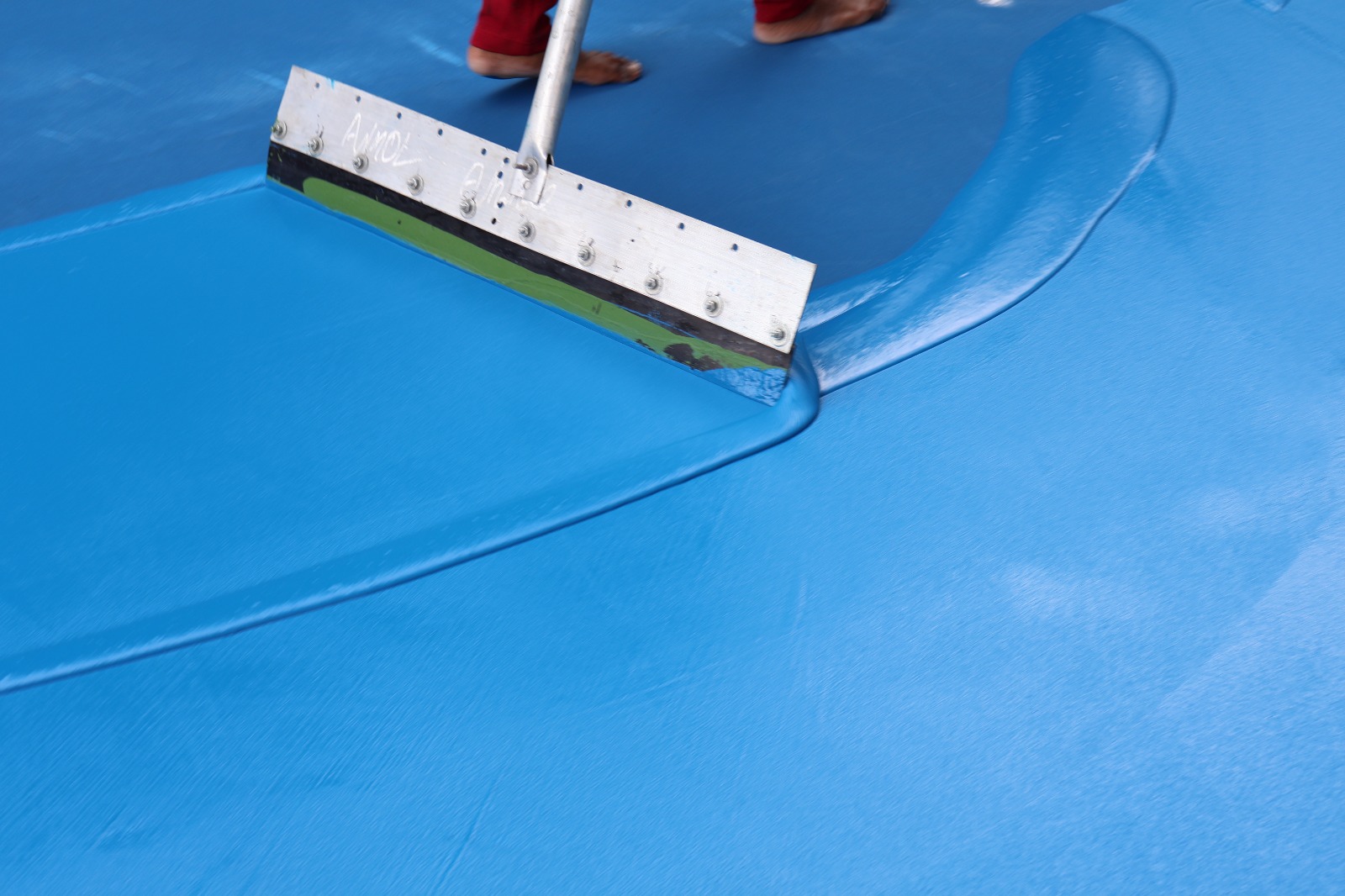
Complete Tennis Court Size Breakdown
Understanding the official tennis court size becomes easier when all the key measurements are presented in a detailed, structured table. This helps planners, architects, and sports facility managers visualize every dimension clearly—from the length and width of the playing area to the specific distances and marking widths that make up a regulation tennis court. Accurate reference tables are especially important during construction planning, blueprint drafting, and acrylic surfacing preparation. Below is a comprehensive, easy-to-follow breakdown of all major court dimensions.
Full Tennis Court Dimensions Table
| Court Component | Measurement (Feet) | Measurement (Meters) |
|---|---|---|
| Court Length | 78 ft | 23.77 m |
| Singles Court Width | 27 ft | 8.23 m |
| Doubles Court Width | 36 ft | 10.97 m |
| Total Playing Area (Doubles) | 2808 sq ft | 260.87 sq m |
| Service Line Distance from Net | 21 ft | 6.40 m |
| Baseline to Baseline | 78 ft | 23.77 m |
| Doubles Alley Width (each side) | 4.5 ft | 1.37 m |
| Center Mark Length | 4 in | 10 cm |
| Net Height (Center) | 3 ft | 0.914 m |
| Net Height (Posts) | 3 ft 6 in | 1.07 m |
| Net Post Distance Outside Doubles Line | 3 ft | 0.914 m |
| Ideal Total Court Area (with Runoff) | 120 ft × 60 ft | 36.58 × 18.29 m |
| Service Box Width | 13.5 ft | 4.11 m |
| Service Box Length | 21 ft | 6.40 m |
| Recommended Line Widths | 2–4 in | 5–10 cm |
This table consolidates the essential measurements needed to ensure compliance with international standards. It is a valuable tool during every stage of planning and construction.
How to Use This Table During Court Planning
The table helps planners:
- Cross-check dimensions during plotting and marking
- Calculate runoff area requirements
- Verify the spacing for net posts
- Ensure accurate line marking before acrylic paint application
- Prevent dimensional errors that might affect gameplay
Having these measurements accessible significantly reduces the margin for error.
Why Tabulated Dimensions Are Essential for Acrylic Surfaces
Acrylic systems are layered with high precision. Every coat—whether it’s a primer, texture layer, color coat, or cushioning layer—must be applied evenly across the entire surface area. When planners rely on standardized tennis court size tables, they ensure:
- Accurate material estimation
- Balanced surface distribution
- Smooth color consistency
- Ideal performance characteristics
Elitecourt’s engineering emphasizes surface uniformity, which depends heavily on accurate measurements. This table helps installers maintain the same level of precision Elitecourt’s materials are designed for.
Increasing Precision With Visual Mapping
Many planners use this table alongside:
- CAD drawings
- Laser measurement tools
- Chalk line grids
- Pre-measured masking tapes
By using this table as the base reference, every marking—from baseline to net line—can be replicated precisely.
Official Dimensions Referenced From Global Standards
All measurements in the table align with internationally recognized tennis standards, including documentation available from the International Tennis Federation (ITF).
With these dimensions in mind, planners can confidently prepare a court that looks, performs, and feels identical to courts used in high-level training environments worldwide.
FAQs
Even though the official tennis court size is standardized globally, planners, players, and facility owners often have several questions about specific measurements, layout considerations, and how dimensions impact actual gameplay. These FAQs are designed to provide clear, detailed explanations that help you understand every aspect of court sizing—making it easier to design, plan, and maintain a professional-quality tennis court surface, especially when paired with Elitecourt’s acrylic flooring systems.
Below are the most commonly asked questions with in-depth but easy-to-understand answers.
A standard tennis court is 78 ft long. The width is 27 ft for singles and 36 ft for doubles. The net height remains the same for both formats.
Yes. Tennis court size is standardized globally by international bodies like the ITF to maintain consistent play, training, and competition everywhere.
No. The official dimensions refer only to the playing area. However, a complete court requires about 120 ft × 60 ft including safe runoff zones.
The net is higher at the posts (3 ft 6 in) to maintain proper tension, so it settles at the official 3 ft height at the center.
Yes. Mini tennis uses three standard formats—Red, Orange, and Green—each with reduced dimensions to support age-appropriate training.
Conclusion
Understanding the exact tennis court size is essential for any facility looking to create a professional, safe, and high-performance tennis environment. From the official 78 ft × 36 ft doubles dimensions to the importance of proper runoff space, every measurement plays a crucial role in how well the court performs and how confidently players can move. Accurate dimensions also directly influence the quality and consistency of flooring systems—especially premium acrylic surfaces like those manufactured by Elitecourt.
With years of experience supplying high-quality acrylic flooring materials across academies, schools, and sports complexes, Elitecourt ensures reliable, durable, and high-performance surfaces engineered specifically for regulation-size courts. When measurements are precise, the playing experience improves, surface longevity increases, and the court remains visually balanced and structurally sound for years.
Whether you’re planning a new court or upgrading an existing one, always start with the correct tennis court size—because every great playing experience begins with perfect dimensions.