Building a professional sports facility requires absolute precision. Whether you are designing an international tournament arena, a university sports hall, or a community recreation center, understanding the exact badminton court dimensions is critical. Badminton is a high-speed sport that relies heavily on accurate boundary lines, proper net heights, and superior surface traction.
The Badminton World Federation (BWF) sets strict guidelines for court measurements. Getting these measurements right ensures fair play, optimal player safety, and compliance with global sporting standards. Beyond the lines and measurements, the actual material forming the court surface plays a massive role in performance. Elitecourt manufactures premium synthetic acrylic sports flooring materials engineered to meet these exacting standards, providing the perfect foundation for any indoor or outdoor court.
This guide provides a comprehensive breakdown of the official badminton court dimensions in both meters and feet, explains the purpose of every line, details the clearance requirements, highlights how premium acrylic materials elevate the playing experience, and explores related infrastructure essentials for world-class courts.
The Standard Badminton Court Dimensions
A standard badminton court serves two main types of play: singles and doubles. While the court length remains identical for both formats, the width and the service areas change depending on the type of match.
Singles Court Dimensions
In a singles match, two players compete against each other. The court is long and narrow.
- Length: 13.4 meters (44 feet)
- Width: 5.18 meters (17 feet)
- Diagonal Length: 14.366 meters (47.13 feet)
Doubles Court Dimensions
In a doubles match, four players (two teams of two) compete. The court utilizes the maximum available playing area, making it wider than the singles court.
- Length: 13.4 meters (44 feet)
- Width: 6.1 meters (20 feet)
- Diagonal Length: 14.723 meters (48.3 feet)
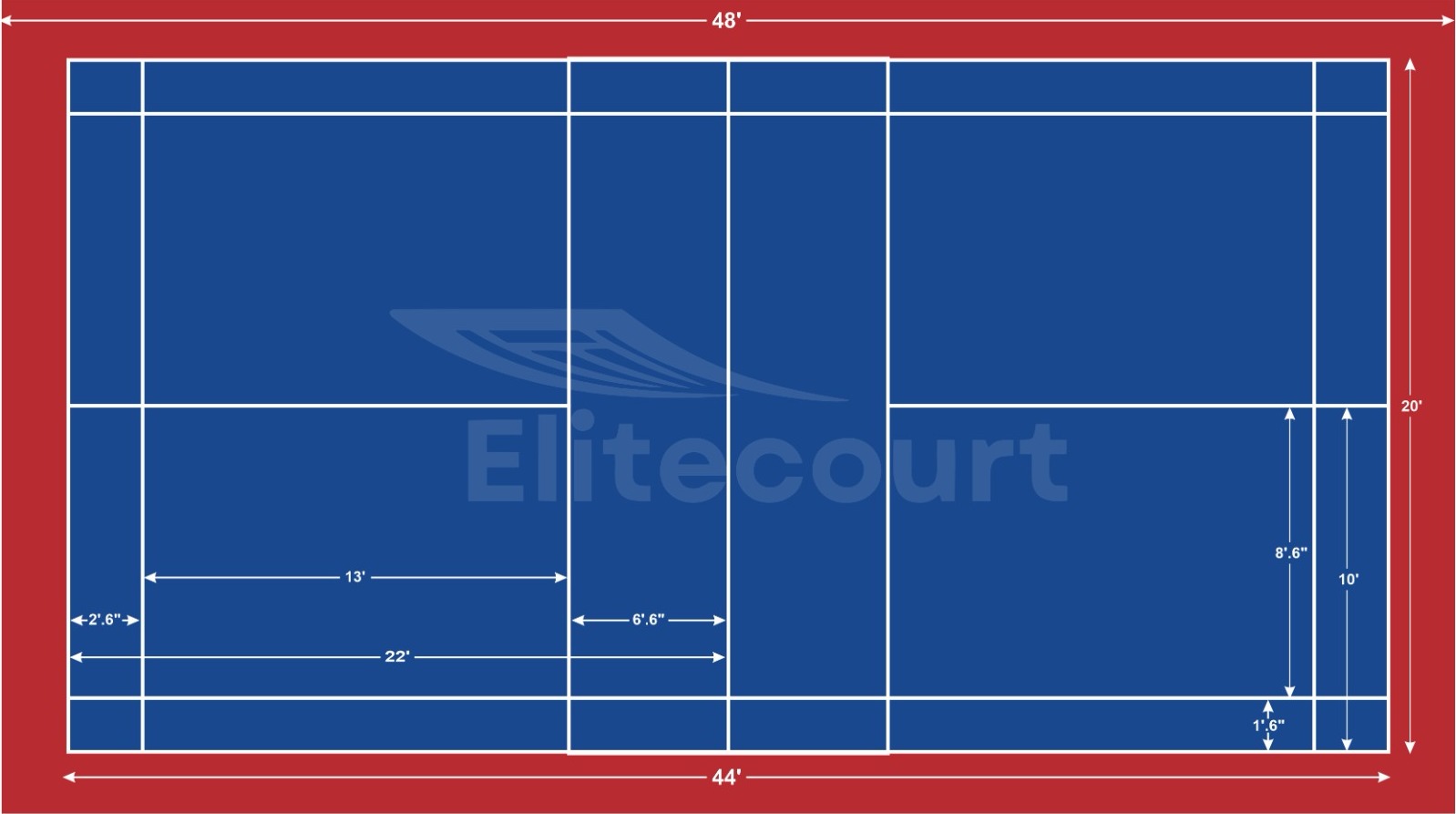
Dimensional Comparison Table
To make planning and material estimation easier, the table below compares the official BWF badminton court dimensions across different units of measurement.
| Court Dimension | Meters (m) | Feet (ft) | Inches (in) |
| Singles Length | 13.40 | 44.0 | 527.5 |
| Singles Width | 5.18 | 17.0 | 204.0 |
| Doubles Length | 13.40 | 44.0 | 527.5 |
| Doubles Width | 6.10 | 20.0 | 240.0 |
| Diagonal (S) | 14.366 | 47.13 | 565.6 |
| Diagonal (D) | 14.723 | 48.30 | 579.6 |
| Line Width | 0.04 | 0.13 | 1.57 |
Transform Your Sports Facility Today!
Contact us for high-quality synthetic sports flooring material and elevate your space!
A Closer Look at Badminton Court Markings and Zones
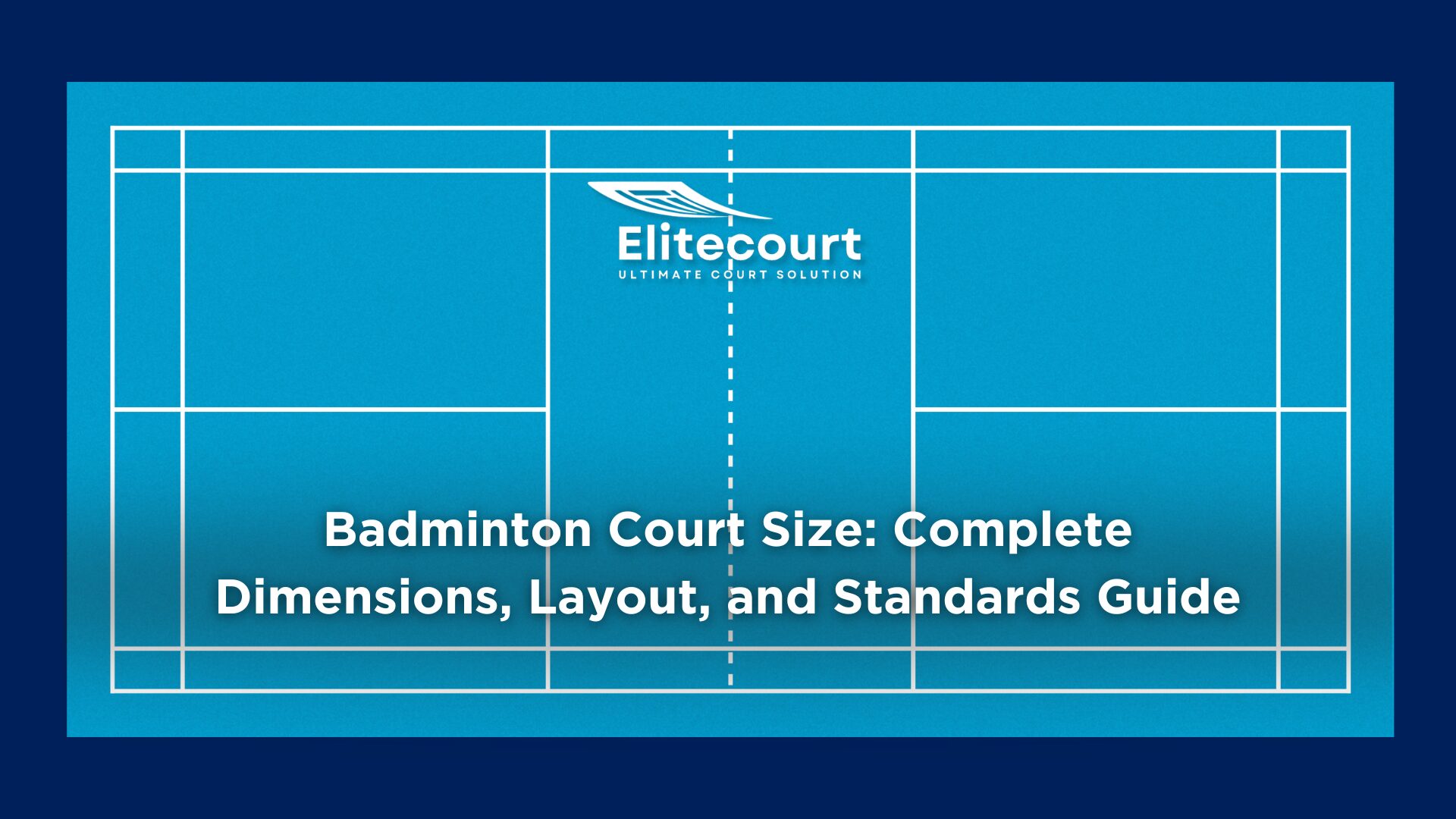
Badminton courts are more than just rectangles. Each line and section serves a unique role in standardizing gameplay and ensuring matches are fair.
Service Courts
Each side of the net is divided into two service courts: left and right. In singles, the server alternates sides based on the score (even/odd). In doubles, the service rules change, but the division remains consistent.
- Right Service Court: Used to serve at 0 or even scores.
- Left Service Court: Used to serve at odd scores.
Center Line
The center line divides the width of the court into two equal halves, marking the left and right service courts.
Short Service Line
Ensures that serves cannot be hit too short. Serves must pass this line to be considered valid.
- Distance from net: 1.98 meters (6.5 feet)
Long Service Lines
- Singles: The outermost back boundary line.
- Doubles: Marked at 0.76 meters (2.5 feet) inside the back boundary line.
Side Lines
- Singles: 0.46 meters (1.5 feet) inside the doubles lines.
- Doubles: The outside sideline.
Net Area
The net itself runs the full width of the court and extends slightly outward to each side.
Net and Post Specifications
Net Height
- At Posts: 1.55 meters (5 feet 1 inch)
- At Center: 1.524 meters (5 feet)
The net should have uniform tension and minimal sag.
Post Positioning
Posts are aligned with the outer side lines for doubles, regardless of play type. The posts must stand vertically and not intrude into the playing area.
Space and Infrastructure Around the Court
Required Free Zones
Building or upgrading a badminton facility is not just about the playable area. Ensuring sufficient free space and proper lighting are vital for safety and playability.
- Lateral (Side) Clearance: Minimum 1.5 meters (4.9 feet) free from side boundaries.
- End Clearance: Same as side.
- Between Parallel Courts: At least 2 meters (6.5 feet).
- Ceiling Height: At least 9 meters (29.5 feet) for international, 7.5 meters (24.6 feet) for club.
Court Orientation and Lighting
- Courts should be oriented north-south to minimize sunlight interference (for non-indoor or naturally lit halls).
- Lighting must be uniform, providing 300 to 750 lux as per competition level.
- Avoid glare: Elitecourt flooring solutions feature a matte finish to reduce light reflection.
Flooring Requirements: The Importance of Premium Synthetic Acrylic
The performance and safety of athletes depend significantly on the court surface.
Advantages of Acrylic Sports Flooring
- Consistent Bounce: Acrylic systems offer a uniform surface for reliable shuttlecock responses.
- Cushioning: Advanced material layering absorbs impact, protecting joints and reducing fatigue.
- Traction: Optimized grip for high-speed footwork and abrupt movements.
- Low Maintenance: Durable coatings resist staining and are easy to clean.
- Weather & UV Resistance: Specially formulated outdoor acrylic handles extreme conditions without fading or cracking.
Selecting the Right Flooring Thickness
- Standard System: 3-5 mm for schools and recreational use.
- Cushioned System: 5-8 mm for professional and competitive environments.
Comparison Table: Synthetic Acrylic vs. Other Flooring Types
| Flooring Type | Traction | Durability | Comfort | Maintenance | Visual Quality | Suitability |
| Acrylic | High | High | High | Easy | Excellent | Indoor/Outdoor |
| PVC | High | Medium | High | Moderate | Good | Indoor |
| Wood | Medium | Medium | Medium | High | Good | Indoor |
| PU | High | High | Medium | Easy | Good | Indoor/Outdoor |
| Concrete (bare) | Low | Low | Low | Easy | Poor | Outdoor only |
Calculate Your Court Material Requirements
Calculate your synthetic sports flooring material and elevate your space!
Environmental Factors Impacting Badminton Court Longevity
Moisture, Temperature Fluctuations, and Indoor Air Quality
- Moisture: Badminton courts must resist mold and warping. Synthetic acrylic is impervious to water, ensuring long-term durability.
- Temperature: Elitecourt’s materials tolerate wide temperature ranges, minimizing expansion/contraction damage.
- Indoor Air Quality: Volatile organic compound (VOC) emissions from some floorings can affect health. High-quality acrylic is formulated to be low-VOC and safe for enclosed environments.
Accessibility and Multi-Use Adaptations
Many modern sports complexes aim for multi-use spaces:
- Line Marking Flexibility: Synthetic acrylic courts can be relined for other sports like pickleball, mini tennis, or futsal with easy-to-remove coatings.
- Wheelchair Accessibility: Low-incline surfaces and clear space allow for inclusive sports programs.
- Spectator Safety: Non-slip walkways and color-contrast zones help guide foot traffic and prevent accidents.
Maintenance Guidelines for Synthetic Acrylic Courts
Best Practices
- Regular Sweeping: Remove dirt and dust with a soft push broom.
- Mopping: Use a mild, pH-neutral cleaner. Avoid harsh chemicals.
- Spill Management: Wipe spills immediately to prevent staining.
- Annual Inspection: Check for line visibility and recoating needs.
Maintenance Schedule
| Task | Frequency | Notes |
| Sweeping | Daily | Prevent dirt accumulation |
| Damp Mopping | Weekly | Use mild detergent |
| Deep Cleaning | Monthly | Professional product recommended |
| Recoating Lines | As needed | Maintain clarity, every 1-2 years |
| Inspection | Annually | Surface and line integrity |
The Evolution of Badminton Court Design
Badminton traces its roots back to ancient games played in Greece, China, and India. The modern dimensions we use today originated in the mid-19th century in British India, where the game was known as “Poona.” British army officers brought the game back to England, specifically to the Duke of Beaufort’s Badminton House in Gloucestershire. Initially, courts featured an hourglass shape, narrowing at the net. It wasn’t until 1901 that the rectangular badminton court dimensions became standardized. Today, the BWF strictly regulates these measurements, ensuring consistency from local clubs to the Olympic Games. The shift from wooden floorboards to highly advanced synthetic acrylic materials manufactured by companies like Elitecourt represents the modern era’s commitment to athlete safety and peak performance.
How Lighting Affects Badminton Gameplay
Even with perfect badminton court dimensions and high-quality synthetic acrylic flooring, poor lighting can ruin a match. The shuttlecock travels at speeds exceeding 400 km/h in professional play. Players need immediate visual acquisition of the shuttle to react in time. Lighting fixtures must sit high enough to avoid blinding players when they look up to hit a lob or a clear. Experts recommend installing lights parallel to the sidelines rather than behind the baseline or directly over the net. Furthermore, the flooring material must not cause glare. Elitecourt designs synthetic acrylic sports materials with matte finishes that absorb excess light, preventing harsh reflections that could distract players during crucial points.
Indoor vs. Outdoor Badminton Courts: Material Differences
While competitive badminton takes place indoors to prevent wind from affecting the lightweight shuttlecock, outdoor community courts remain incredibly popular. The materials required for these two environments differ significantly. Indoor courts prioritize highly cushioned surfaces to handle repetitive jumps. Outdoor courts demand materials highly resistant to UV rays, rain, and temperature fluctuations. As a dedicated manufacturer, Elitecourt produces synthetic acrylic formulations tailored for both settings. Outdoor acrylic materials contain specialized UV stabilizers that prevent fading and cracking under the sun. They also feature specific textures designed to remain slip-resistant even when dealing with slight outdoor moisture or dust, ensuring safe play in any weather.
Transform Your Sports Facility Today!
Contact us for high-quality synthetic sports flooring material and elevate your space!
How Court Colors Enhance Visibility
Court color represents more than just a stylistic choice; it directly impacts player performance. BWF regulations generally favor green or blue court surfaces for professional play. These colors sit on the opposite side of the color spectrum from the stark white shuttlecock and the white court boundary lines. This high contrast allows the human eye to track the fast-moving shuttlecock with minimal strain. Elitecourt manufactures synthetic acrylic sports materials in highly pigmented, UV-stable colors. Our proprietary resin blends ensure that the deep blues and greens remain vibrant over time, providing a consistent, high-contrast backdrop that helps players accurately judge the shuttle’s trajectory and the precise location of the boundary lines.
Frequently Asked Questions (FAQs)
A singles badminton court measures 13.4 meters (44 feet) in length and 5.18 meters (17 feet) in width. Doubles courts use the same length but are 6.1 meters (20 feet) wide. These dimensions help standardize play and maintain fairness at all levels of the game.
The BWF mandates that all lines on a badminton court must be exactly 40mm (1.57 inches) wide. This specification applies to all court markings, enhancing visibility and ensuring clarity for players and referees.
The net must be 1.55 meters (5 feet 1 inch) high at the posts and 1.524 meters (5 feet) high in the center of the court. Maintained tension and standard net heights contribute to the consistency of gameplay, especially in competitive environments.
Synthetic acrylic materials provide superior shock absorption, slip resistance, and durability—critical factors in ensuring player safety and high-performance gameplay. Elitecourt’s specialized acrylic flooring systems are engineered to meet professional standards for both indoor and outdoor courts.
Conclusion
Understanding the official badminton court dimensions is the foundation of building a high-quality sporting facility. From the 13.4-meter length to the precise 1.524-meter center net height, every measurement ensures the game remains fast, fair, and exciting. However, precision in measurements must pair with excellence in materials. A court is only as good as the surface players stand on.
Choosing the right flooring material guarantees better traction, enhanced shock absorption, and a longer lifespan for your facility. As a premier manufacturer of synthetic acrylic sports flooring materials, Elitecourt provides the advanced resin systems required to create professional-grade surfaces. Our materials are engineered for durability, vibrant visibility, and unmatched player safety.