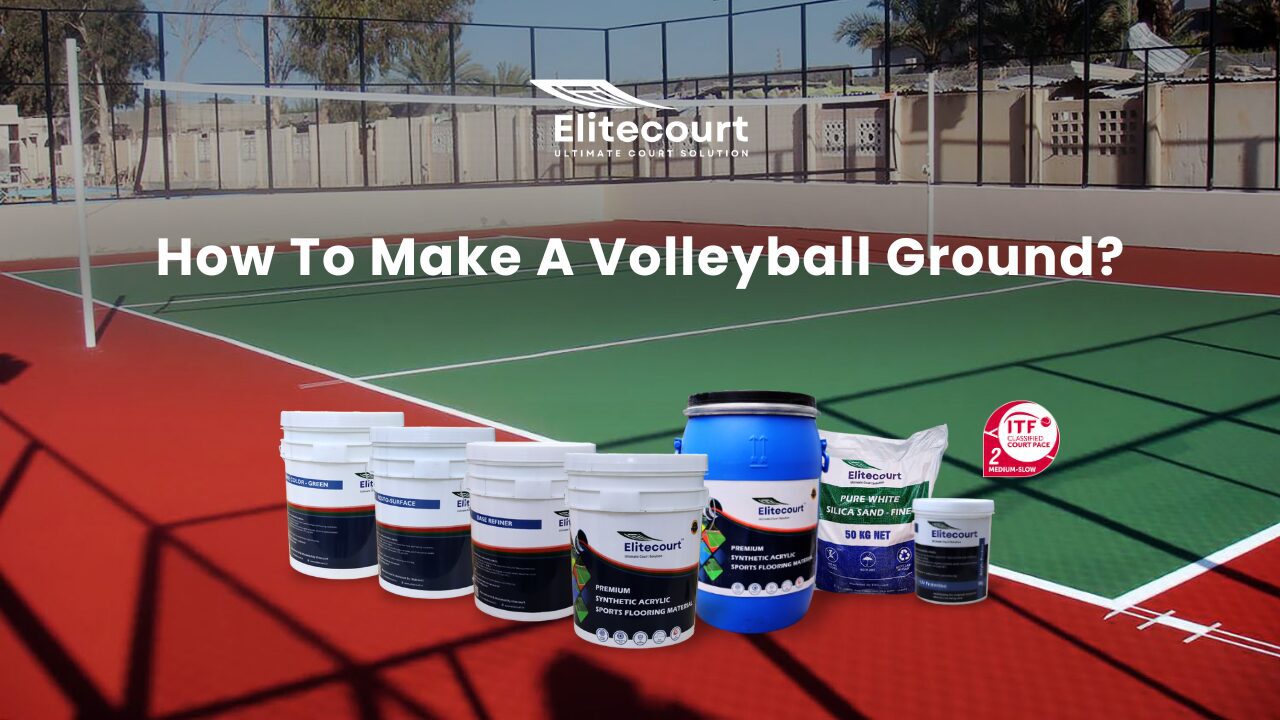
Introduction: Creating the Perfect Volleyball Ground
If you are asking “how to make a volleyball ground?”, the direct answer lies in a structured process: selecting the right location, preparing a rigid asphalt or concrete sub-base, and applying a high-performance synthetic acrylic coating system to ensure safety, durability, and playability. While digging a pit in the sand might work for a beach vacation, a professional or community volleyball ground requires precise engineering and the right materials to stand the test of time and intense gameplay.
Building a sports facility is an investment in health, community, and athletic development. Whether you are a school administrator, a sports club manager, or a private developer, understanding the anatomy of a top-tier volleyball ground is essential. It is not just about drawing lines on a flat surface; it is about creating an ecosystem where players can dive without fear of injury and where the ball bounces consistently every single time.
At Elitecourt, we understand that the surface defines the game. As a premier manufacturer of synthetic acrylic sports flooring materials, we have seen how the right surface transforms a simple patch of land into a world-class arena. In this comprehensive guide, we will walk you through every aspect of creating a volleyball ground, from understanding the critical dimensions to choosing the materials that will ensure your court lasts for years. We will explore why synthetic acrylic flooring has become the gold standard for outdoor and indoor courts globally and how you can leverage these materials to build a facility that rivals the best in the business.
Anatomy of a Volleyball Ground
Before we dive into construction materials and layering systems, it is vital to understand what physically constitutes a regulation volleyball ground. A court that doesn’t meet standard dimensions isn’t just unprofessional; it can actually hinder player development by accustoming them to incorrect spacing and timing.
Standard Dimensions and Zones
According to the International Volleyball Federation (FIVB), a standard volleyball ground is a rectangle measuring 18 meters by 9 meters (59 feet by 29.5 feet). However, the “ground” extends far beyond the playing court itself.
The Playing Court
The court is divided into two equal squares of 9m x 9m by a center line. Above this line stands the net.
- Attack Line: This is perhaps the most critical marking on the court. It is drawn 3 meters back from the center line on both sides. This line dictates where back-row players can attack the ball.
- Service Zone: This is a 9-meter wide area behind each end line. It extends indefinitely, but typically, a minimum depth is required for players to execute jump serves safely.
The Free Zone
Surrounding the playing court is the “Free Zone.” This area is crucial for safety. Players often run off the court to save errant passes. If this area is obstructed or constructed with different, unsafe materials, it poses a severe injury risk.
- Minimum Width: For general play, a minimum of 3 meters on all sides is recommended.
- FIVB Competitions: For high-level competitions, the free zone expands to 5 meters on the sides and 6.5 meters at the ends.
The Importance of Surface Uniformity
One key requirement for a volleyball ground is that the surface must be flat, horizontal, and uniform. It must not present any danger of injury to the players. It is prohibited to play on rough or slippery surfaces. This is where the choice of flooring material becomes the deciding factor in the quality of the ground. While grass and sand have their places, a hard-court volleyball ground intended for fast-paced, high-performance play requires a synthetic acrylic surface that offers grip, consistency, and a slight cushioning effect.
Expert Tip: When planning your volleyball ground, always account for the “Free Zone” in your total square footage calculations. A common mistake is preparing a base only for the 18m x 9m court, leaving players to transition onto dangerous uneven ground during play.

Why Material Choice Defines the Volleyball Ground
When discussing how to make a volleyball ground, the conversation often shifts quickly to the surface. Historically, courts were made of concrete or asphalt. While durable, these surfaces are unforgiving. A player diving for a dig on bare concrete risks scrapes, bruises, and long-term joint impact.
This is why synthetic acrylic flooring has revolutionized the industry.
The Shift to Synthetic Acrylic
Elitecourt specializes in manufacturing high-grade synthetic acrylic flooring materials because they offer the perfect balance between the durability of hard courts and the performance needs of athletes.
- Shock Absorption: Unlike bare concrete, a volleyball ground surfaced with a multi-layered acrylic system (especially those with cushion layers) absorbs some of the impact energy. This reduces fatigue in players’ legs and lowers the risk of stress fractures.
- Slip Resistance: Volleyball involves explosive lateral movements and quick stops. A surface that is too slick is dangerous; one that is too gritty causes skin abrasions. Our acrylic materials are engineered to provide an optimal friction coefficient—allowing players to pivot and stop securely without getting stuck.
- All-Weather Performance: A volleyball ground situated outdoors must withstand rain, scorching sun, and temperature fluctuations. Synthetic acrylics are UV-stable, meaning they won’t fade or crack easily under the sun’s glare. They are also semi-permeable, allowing moisture to evaporate without causing the surface to bubble.
Comparison: Acrylic vs. The Rest
- vs. Concrete: Concrete is hard on joints and becomes slippery when dusty or wet. Acrylic provides texture and cushion.
- vs. Polypropylene Tiles: Tiles can sometimes buckle under thermal expansion or shift during play. A liquid-applied acrylic system bonds directly to the sub-base, creating a seamless, monolithic surface that never shifts.
- vs. Wood: Wood is the standard for indoor arenas but is prohibitively expensive and impossible to maintain outdoors. Acrylic offers a similar reliable bounce and feel but is suitable for outdoor environments and is much more cost-effective to maintain.
The Sub-Base – The Foundation of Your Ground
You cannot apply high-quality paint or coating to a crumbling wall and expect it to look good. The same logic applies to a volleyball ground. As a manufacturer of the top-coat materials, we emphasize that our product performs best when the foundation is solid.
Asphalt vs. Concrete Sub-Base
To make a volleyball ground that lasts, you generally start with one of two bases:
- Asphalt (Bituminous Concrete): This is often preferred for outdoor sports courts. Asphalt is flexible, meaning it expands and contracts with temperature changes without cracking as easily as concrete. It cures faster (usually 14-28 days) and provides an excellent surface for acrylic adhesion.
- Reinforced Concrete (VDF): Concrete is extremely durable and rigid. However, it requires a longer curing time (minimum 28 days) to ensure all moisture has escaped. It also requires a vapor barrier underneath to prevent ground moisture from rising up and delaminating the coating.
Slope and Drainage
A flat court is essential for play, but a completely level outdoor court will pool water. A professional volleyball ground must have a subtle slope—typically 0.5% to 1%—usually from side to side or from the center outwards. This ensures that after a rainstorm, the water drains away efficiently, allowing play to resume quickly.
Critical Warning: Never apply synthetic acrylic materials to a damp or uncured base. Moisture trapped beneath the surface is the number one enemy of court longevity.
Transform Your Sports Facility Today!
Contact us for high-quality synthetic sports flooring material and elevate your space!
How to Make a Volleyball Ground – The Application Process
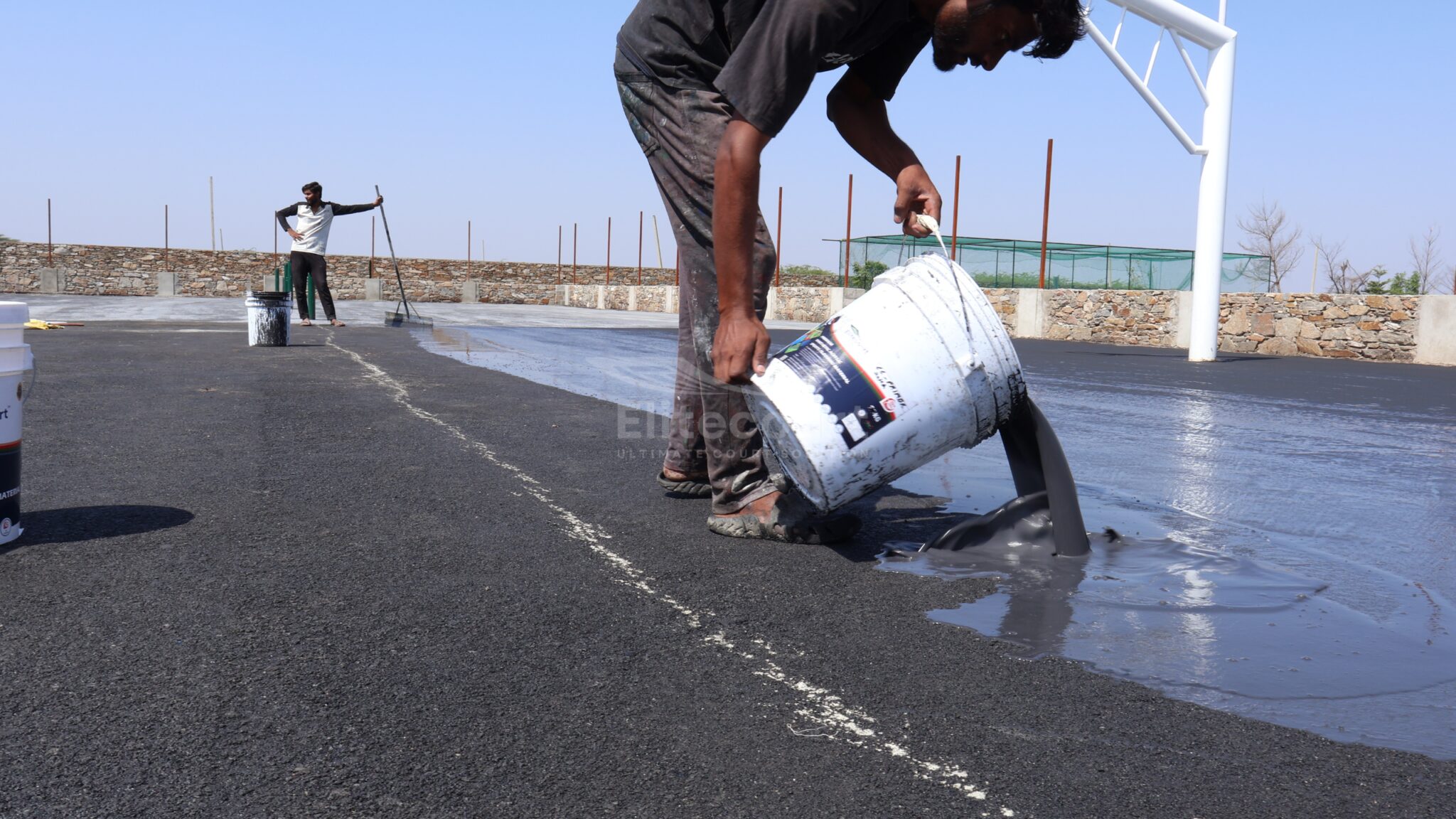
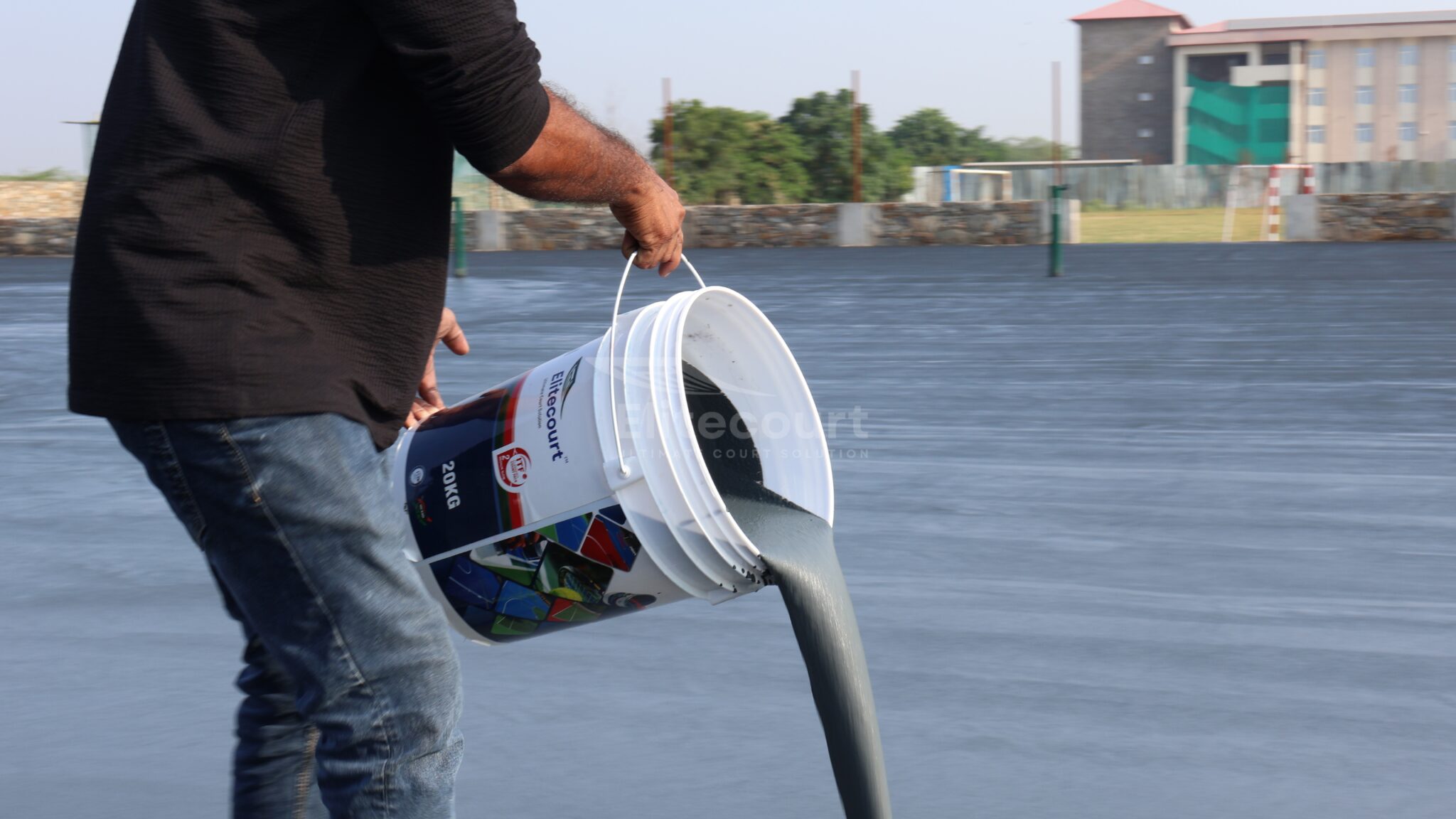
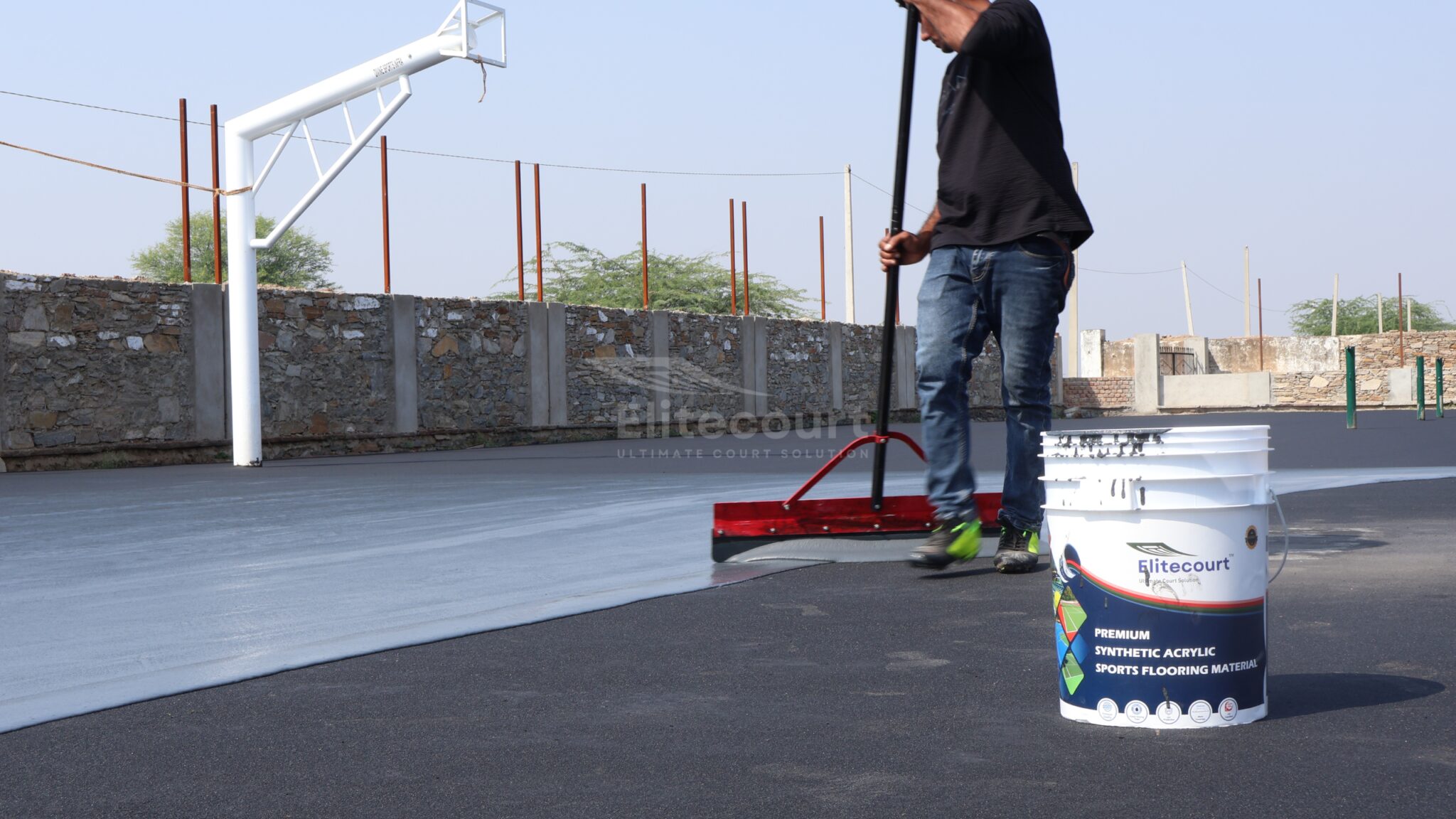
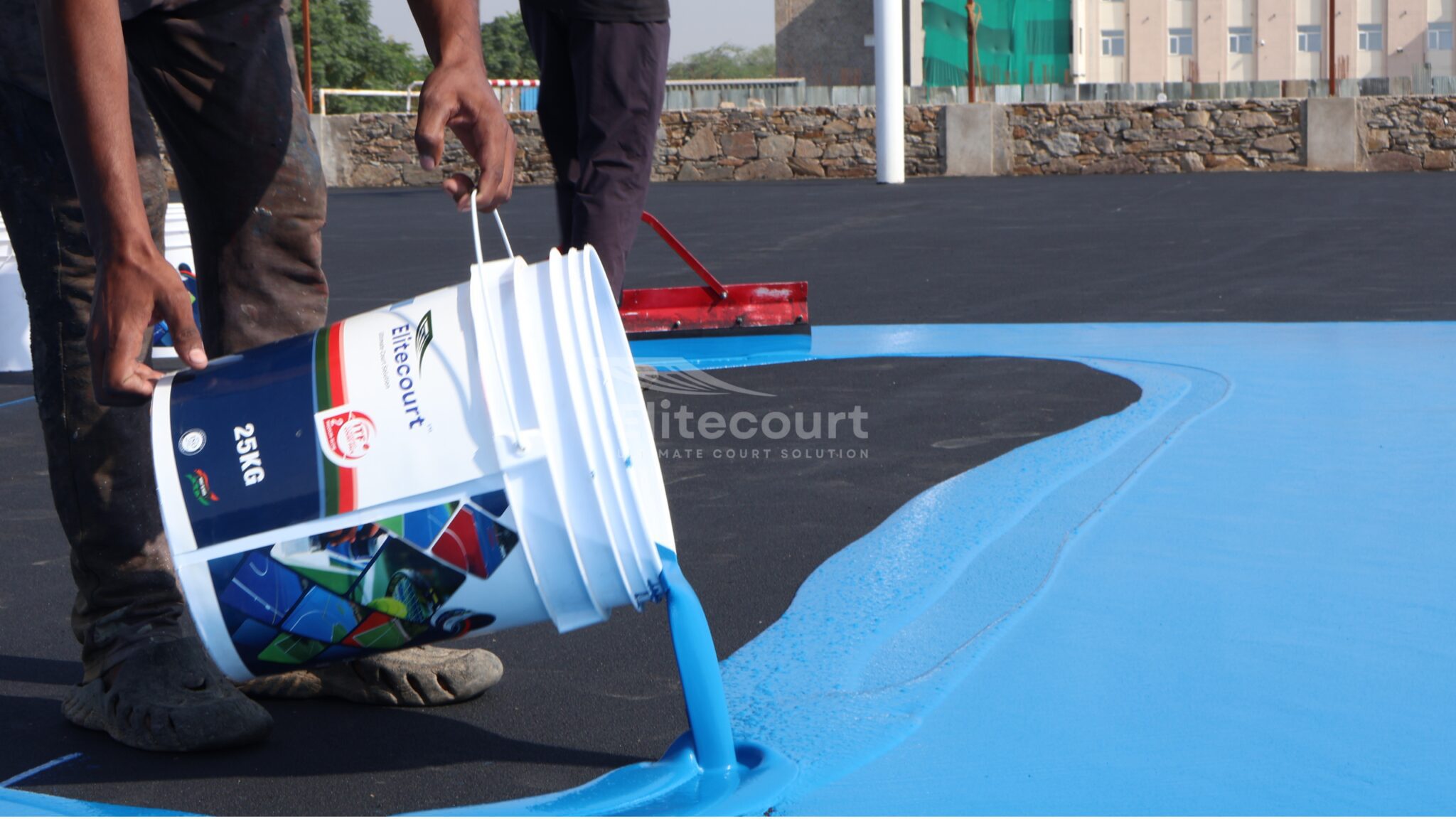
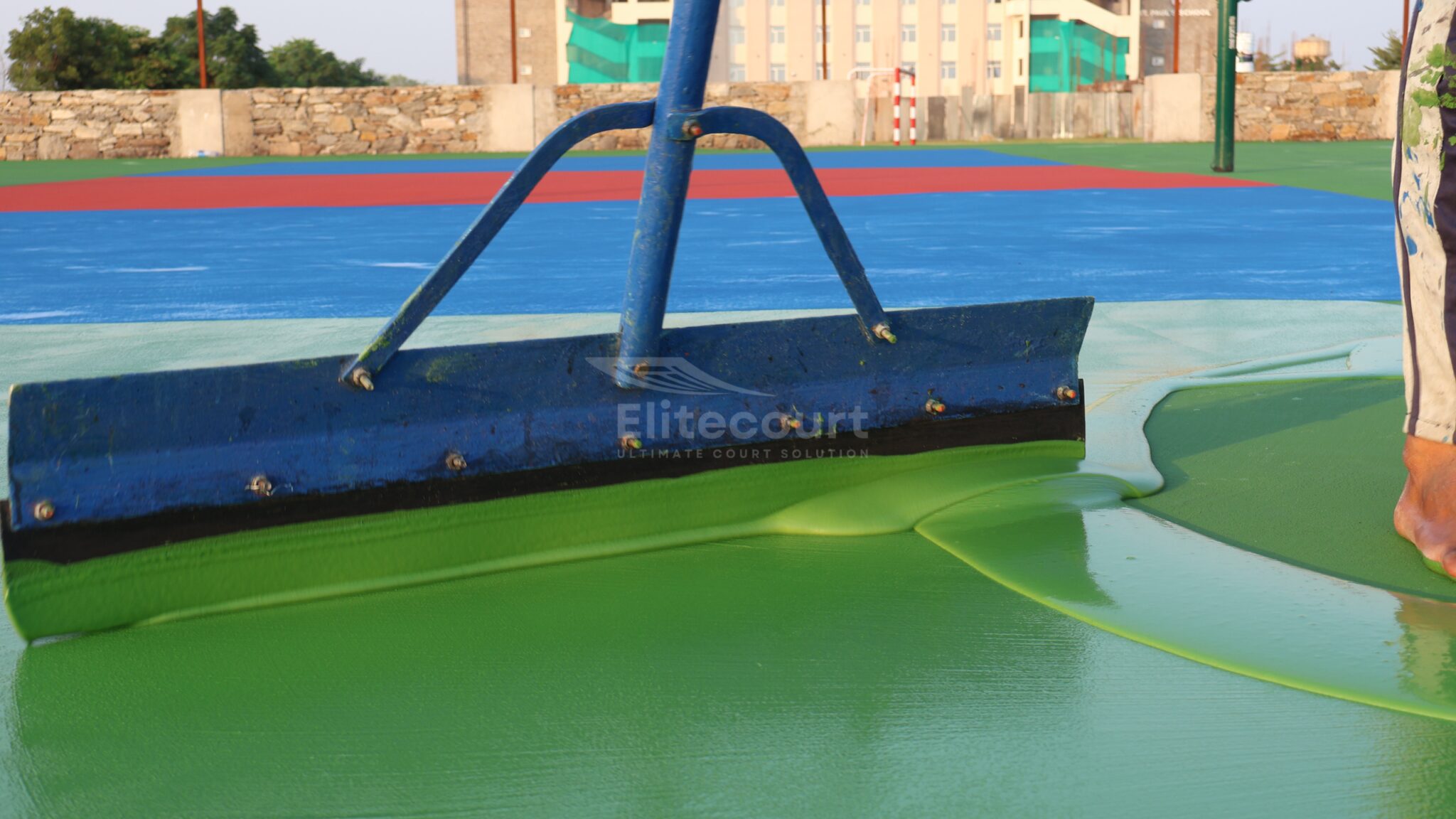
Once your civil work (the asphalt or concrete base) is ready, cured, and clean, you can begin transforming the surface into a true volleyball ground. This is where Elitecourt’s expertise in material manufacturing shines. While we supply the materials, you should understand how to apply them so you can effectively supervise the creation of your facility.
The creation of the surface is a multi-layered process. It is not just “painting the ground.” It is building a system.
Step-1: Surface Preparation
Clean the base meticulously. Remove any oil spots, dust, or debris that could prevent adhesion. If you work with a concrete base, acid-etch or mechanically grind it to open up the pores and ensure the primer bonds properly.
Step-2: Patching and Leveling
Even a new asphalt base might have “birdbaths”—low spots where water holds. You must fill these areas using a patching compound (often a mix of acrylic binder and cement/sand). You cannot compromise on having a perfectly level playing field for a professional volleyball ground.
Step-3: The Primer (For Concrete Bases)
If working on concrete, an acrylic primer is essential. This low-viscosity liquid penetrates the concrete, creating a bridge between the rigid base and the flexible sports coating. Asphalt bases typically do not require this specific primer step as the acrylic binds naturally to the asphalt bitumen, provided it is clean.
Step-4: The Resurfacer Layer
This is the first heavy coat. The Acrylic Resurfacer is mixed with silica sand and applied over the entire court. Its job is to fill the small voids and textures of the asphalt or concrete, creating a uniform, smooth canvas for the subsequent layers. It regulates the absorption of the final color coats.
Step-5: The Cushion Layers
For a premium volleyball ground, we recommend a cushion system. This involves applying multiple layers of acrylic binder mixed with rubber granules.
- Coarse Rubber Layers: Provide the deep resilience and shock absorption.
- Fine Rubber Layers: Refine the surface, bridging the gap between the spongy coarse layer and the firm top finish.
- This system significantly reduces player fatigue, making the court safer for diving and jumping.
Step-6: The Color Finish Coats
This is where the court comes to life. Apply Elitecourt’s high-pigment acrylic coatings in multiple layers (usually 2-3). Mix these coatings with specially graded silica sand to control the “speed” of the court and the grip. Keep the texture consistent—not too rough to graze skin, but not too smooth to slip.
Step-7: Line Marking
The final step requires precision. Tape off and paint the 18m x 9m boundaries, the center line, and the attack lines using a textured heavy-body acrylic line paint. Unlike road paint, this line paint matches the texture of the rest of the court, ensuring the ball doesn’t skid if it lands on the line.
Common Questions on Court Construction
Is a synthetic volleyball ground suitable for all climates?
Elitecourt’s synthetic acrylic materials handle high UV exposure without fading or chalking because we specifically formulate them for all climates. The flexibility of our acrylic resins lets the surface expand and contract with temperature shifts, which prevents the cracking often seen in rigid materials.
Can I upgrade an existing concrete court?
Yes! You do not always need to pour a new slab. If your existing concrete volleyball ground has no major cracks or sinking and remains structurally sound, you can thoroughly clean, repair, and resurface it with our acrylic system. This approach revives a facility and instantly improves safety standards.
Why is sand mixed into the paint?
The sand does more than fill space; it provides the friction players need to stop and change direction. Without sand aggregate, acrylic dries into a smooth, plastic-like sheet that creates a dangerously slippery surface when wet or sweaty. During our manufacturing process, we carefully select the size and shape of the sand particles to ensure the perfect texture.
Durability and Maintenance of Your Volleyball Ground
One of the primary reasons facility managers choose synthetic acrylic for their volleyball ground is the ease of maintenance. However, “low maintenance” does not mean “no maintenance.” To ensure the longevity of the materials we manufacture, a simple care routine is required.
Routine Cleaning
The most important maintenance task is keeping the court clean. Dirt, leaves, pine needles, and other debris can grind into the surface like sandpaper, wearing down the acrylic coating prematurely.
- Sweeping: Use a soft-bristled broom or a specialized court blower to remove debris weekly.
- Washing: A monthly wash with a mild pressure washer (low PSI) helps remove deep-seated dust and bird droppings.
Managing Moisture
While the materials resist water, standing water harms the court over long periods. Mineral deposits (hard water stains) can form and make the court slippery and unsightly. Keep your drainage system clear at all times. Patch any puddles (“birdbaths”) that form as the court settles over the years with acrylic patching compounds.
What to Avoid
- No Heavy Vehicles: A volleyball ground is designed for foot traffic. Driving maintenance trucks or placing heavy staging equipment on the court can crush the asphalt base or tear the acrylic surface.
- Proper Footwear: Ensure players wear non-marking court shoes. Running shoes with black soles or cleats can damage the finish and leave marks that are difficult to remove.
- Chemicals: Avoid spilling fertilizers, weed killers, or harsh solvents on the court, as these can chemically attack the acrylic binder.
Long-Term Resurfacing
Even the best volleyball ground will eventually show signs of wear, especially in high-traffic areas like the service line or center court. The beauty of synthetic acrylic systems lies in their easy renewability. After every 5 to 7 years, depending on usage, you can lightly sand the court and apply a fresh top coat of color. This simple process restores grip and aesthetics without requiring you to rebuild the base.
The Physics of the Bounce
For a casual observer, a bounce is a bounce. For a competitive volleyball player, the way the ball reacts to the floor is critical.
When a volleyball strikes a surface, it transfers energy. On a soft surface like grass or sand, the surface absorbs energy and deadens the bounce. On a rigid surface like tile or concrete, the bounce becomes fast and high.
Elitecourt’s synthetic acrylic materials are engineered to provide a “true bounce.” This means the ball responds consistently to spin and speed.
- Uniform Friction: When a top-spin serve hits the ground, it should kick forward. Our textured surface ensures the ball “bites” the floor just enough to translate that spin into movement, rather than skidding.
- Consistent Hardness: Because our materials are applied in liquid form and self-level, they create a seamless monolithic surface. There are no seams or joints (like in tiles) that can cause a “dead bounce” or a “wild deflection” if the ball hits an edge.
This consistency is vital for training. Players develop muscle memory based on how the ball reacts. Training on a high-quality volleyball ground ensures that their skills translate effectively to competition venues.
Transform Your Sports Facility Today!
Contact us for high-quality synthetic sports flooring material and elevate your space!
Aesthetic Customization and Branding
A volleyball ground is often the centerpiece of a sports complex or school campus. The visual appeal matters. Synthetic acrylic coatings offer a vast palette of possibilities that go beyond standard green and red.
Color Psychology
- Blue: Often used for the inner court, blue contrasts well with a yellow or white volleyball, improving visibility for players and spectators.
- Green: A traditional choice for the outer playing area, blending well with outdoor landscaping.
- Two-Tone Schemes: Using contrasting colors for the playing court (inside the lines) and the free zone (outside the lines) clearly delineates the play area. This helps players peripherally know exactly where they are on the court without looking down.
Branding
Because the surface is applied as a liquid coating, it serves as an excellent canvas.
- Logos: Paint school mascots, club logos, or sponsor branding directly onto the court using stencils and specific acrylic paints.
- Custom Designs: We have seen innovative designs where the free zones feature geometric patterns or school colors, turning the volleyball ground into a landmark.
Safety First – Preventing Injuries
The priority in constructing any sports facility must be athlete safety. Volleyball is a sport characterized by vertical jumps and frequent diving. The volleyball ground plays a massive role in injury prevention.
Impact Protection
Shin splints, knee tendinitis, and stress fractures are common in volleyball. A hard, unforgiving surface exacerbates these issues. Elitecourt’s cushion systems (utilizing rubber layers) provide shock attenuation. This means the floor compresses slightly under the athlete’s weight, absorbing impact energy that would otherwise travel up the leg bones.
Skin Abrasion
Diving for a ball (a “dig”) is fundamental to volleyball. On rough concrete, this results in “road rash.” On indoor wood, it results in friction burns. Synthetic acrylic surfaces are designed with a very specific texture profile. They are smooth enough to allow a player to slide slightly, reducing the friction heat, yet rough enough to prevent slipping. This balance is a result of precise manufacturing control over the sand aggregate size in our coatings.
Glare Reduction
Outdoor courts can suffer from sun glare, blinding players looking up for a high ball. Our matte-finish formulations absorb and diffuse light rather than reflecting it. This reduces eye strain and helps players track the ball more accurately against the sky.
The Environmental Advantage
Is Acrylic Flooring Eco-Friendly?
In the world of construction, sustainability is becoming a key metric. Elitecourt is committed to environmentally responsible manufacturing.
- Water-Based Formulations: Our synthetic acrylics are water-based, not solvent-based. This means they have low Volatile Organic Compounds (VOCs). They are safe for the applicators and do not release harmful fumes into the environment during the curing process.
- Longevity Reduces Waste: A well-built volleyball ground using durable materials lasts for decades with resurfacing. This contrasts with cheaper alternatives that might peel or degrade quickly, requiring complete removal and disposal in landfills.
- Recycled Components: Many cushion systems incorporate recycled rubber granules, repurposing materials that might otherwise be waste into high-performance athletic surfaces.
Conclusion: Build It Right with Elitecourt
Building a volleyball ground is a precision task. It bridges the gap between civil engineering and sports science. From the moment you lay the sub-base to the final stroke of line paint, every decision impacts the quality of the game.
The answer to “how to make a volleyball ground?” goes beyond digging a hole or pouring concrete—you choose a surfacing system that respects the athlete by offering grip without abrasion, cushion without softness, and durability without harshness.
At Elitecourt, our years of expertise in manufacturing synthetic acrylic sports flooring materials position us as your ideal partner in this journey. We provide the chemistry and the technology that contractors use to build world-class facilities across world. Whether you are building a community court or a professional arena, the quality of the materials you choose today will define the game for years to come.
Ensure your volleyball ground is more than just a place to play—make it a place to perform.
Transform Your Sports Facility Today!
Contact us for high-quality synthetic sports flooring material and elevate your space!
Frequently Asked Questions (FAQs)
Synthetic acrylic flooring is ideal for outdoor courts due to its durability against UV rays and rain, excellent traction, consistent ball bounce, low maintenance, and customizable design.
A standard court is 18m long and 9m wide, with a surrounding “Free Zone.” Recreational courts need at least 3m of free space on all sides (total 24m x 15m), while official FIVB courts require 5m on the sides and 6.5m on the ends.
Yes, Elitecourt’s synthetic acrylic is suitable for indoor courts. It offers a durable, non-slip surface that is low maintenance and performs well, making it a great alternative to hardwood floors.
The timeline depends on the sub-base. A new concrete or asphalt base needs 14 to 28 days to cure, after which applying the acrylic coating system takes 5 to 7 days, depending on weather conditions.
Elitecourt manufactures synthetic acrylic sports flooring materials but does not handle installations. Certified contractors use our materials, and we can recommend professionals for your project.
For detailed official rules and court diagrams, you can visit the International Volleyball Federation (FIVB) Court Standards