
The question of “how long is a basketball court” seems straightforward, but the answer is more layered than you might think. A standard, regulation-size basketball court used for professional play, such as in the NBA or FIBA, is 94 feet (28.65 meters) long. This dimension is crucial for ensuring fair play and consistency across the highest levels of the sport.
However, basketball is played everywhere, from school gymnasiums to community parks. Not all courts adhere to these professional standards. The length can vary significantly depending on the level of play, available space, and specific league rules. In this detailed guide, we will explore the precise dimensions of various basketball courts, explain why these measurements matter, highlight the history and evolution of court standards, and delve into the critical role that high-quality flooring plays in the game.
Understanding the Standard Basketball Court Length
When people ask, “How long is a basketball court?”, they are usually referring to the dimensions used in professional leagues. These measurements provide the official benchmark against which all other courts are compared.
Professional Court Dimensions (NBA & FIBA)
The two primary governing bodies for professional basketball are the NBA (National Basketball Association) in North America and FIBA (International Basketball Federation) for international competitions. While their rules have historically differed, they have moved toward greater uniformity.
- NBA Court Length: A regulation NBA court is 94 feet long.
- FIBA Court Length: A regulation FIBA court is slightly shorter, measuring 28 meters (approximately 91.86 feet) long.
This small difference of just over two feet can impact player spacing and strategy, but for most practical purposes, the dimensions are very similar. The width for both NBA and FIBA courts is also standardized, with an NBA court being 50 feet wide and a FIBA court being 15 meters (49.21 feet) wide.
Why are these dimensions so specific?
Standardization is key in professional sports. A consistent court length ensures that:
- Games are fair regardless of location.
- Player statistics are comparable across different arenas.
- Athletes can train and compete on surfaces with familiar boundaries.
- Game strategies, such as full-court presses and fast breaks, are executed within a predictable space.
The length of the court directly influences the pace and flow of the game. A 94-foot court provides ample space for the incredible speed and athleticism of professional players, allowing for dramatic, end-to-end action.
The Role of Court Markings Relative to Length
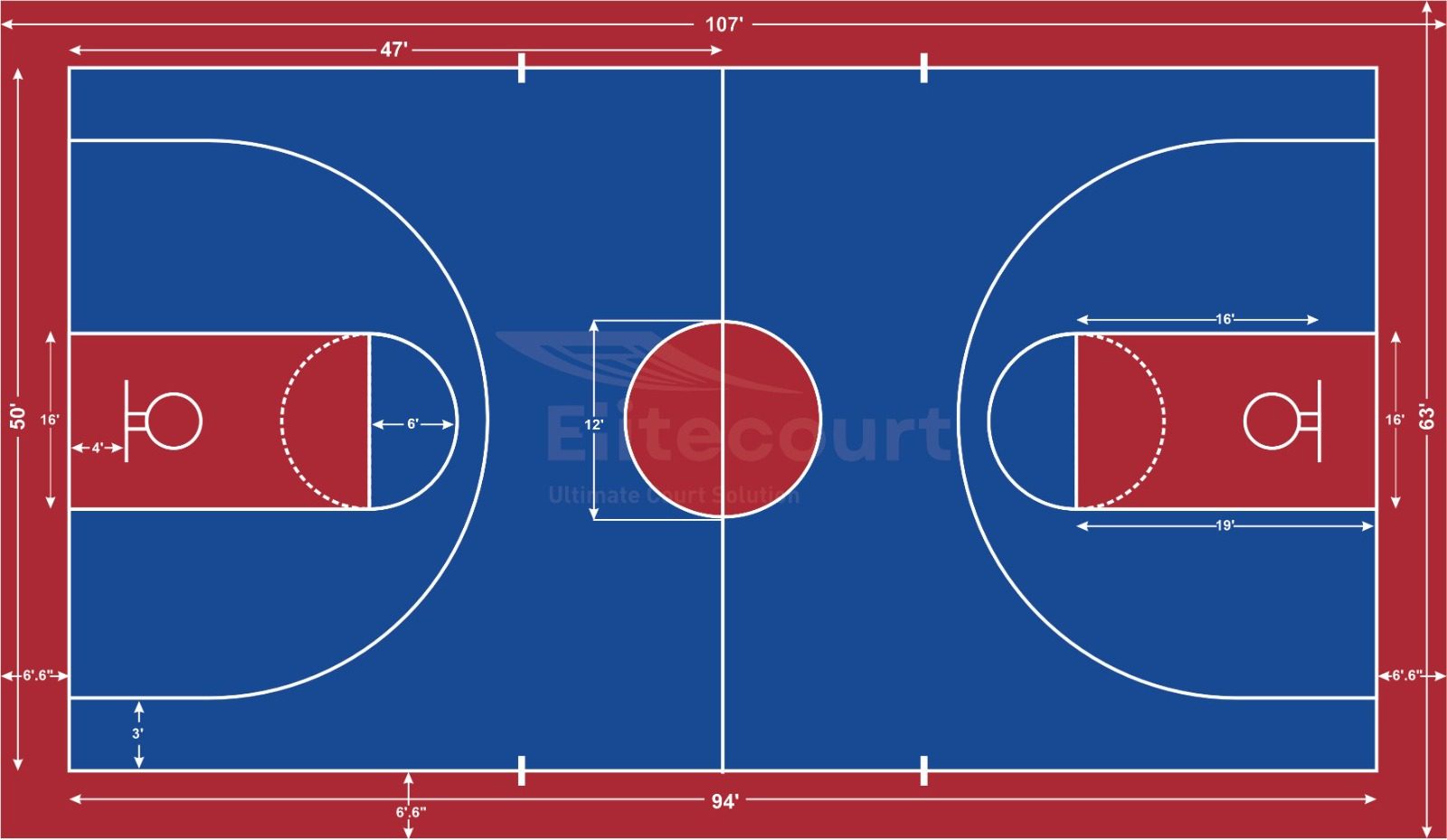
The overall length of the court is just the beginning. The internal lines and zones are precisely placed relative to the court’s length and define how the game is played.
- The Three-Point Line: This arc is a critical part of modern basketball. Its distance from the basket varies. On an NBA court, it is 23 feet, 9 inches from the center of the basket. The distance changes slightly in the corners.
- The Free-Throw Line: This line is 15 feet from the front of the backboard and 19 feet from the baseline. Its position is one of the most consistent measurements across all levels of basketball.
- The Key (or The Lane): The area from the free-throw line to the baseline. In the NBA, it is 16 feet wide. This area is crucial for offensive and defensive positioning.
- The Half-Court Line: As the name suggests, this line divides the court into two equal halves. On a 94-foot court, it is located 47 feet from each baseline.
Each of these markings is integral to the rules of basketball. Their placement is directly proportional to the total length of the court, ensuring the geometric integrity of the game is maintained.
Transform Your Sports Facility Today!
Contact us for high-quality synthetic sports flooring material and elevate your space!
The History of Basketball Court Dimensions
From YMCA Gyms to Global Arenas
The origins of basketball trace back to 1891, when Dr. James Naismith created the sport at the YMCA International Training School in Springfield, Massachusetts. The first games were played in small indoor gymnasiums, and there were no standard court sizes at all—courts often measured around 50 feet by 35 feet.
Evolution Over Time
As basketball rapidly gained popularity in schools and athletic clubs, the need for a standard playing area became clear:
- By the 1930s, most U.S. high schools and colleges aimed for courts about 70–75 feet long.
- The National Basketball Association (NBA), established in 1946, eventually set the professional standard at 94 feet by 50 feet, a size chosen to allow effective offensive and defensive spacing and to optimize athletic performance on a large, unbroken surface.
- FIBA, the international governing body, followed by setting its official length at 28 meters (about 91.86 feet) to best fit arena sizes available worldwide.
Why Does This History Matter?
The gradual movement toward standardization supports uniform rule enforcement and creates a consistent global expectation for the game, regardless of where it’s played.
The Evolution of Court Standards
Unifying Global Play
In the early days, courts could be any length that fit a gym. As basketball transitioned into a global sport, international bodies like FIBA and the NBA recognized the need for consistency:
- Early Disparities: Traditionally, schools and community courts were built to whatever size the building allowed, creating an array of lengths and widths.
- Move to Standardization: The introduction of organized leagues demanded fixed regulations, and the 94-foot length gained traction for adult and professional play.
- International Agreements: FIBA and other organizations have worked to unify standards so athletes can seamlessly compete globally, with recent updates aligning FIBA’s widths and marking conventions closely with NBA specifications.
Evolution of Court Lengths Over Time
| Era | Typical Court Length(s) | Notable Changes |
|---|---|---|
| 1890s | 50–60 feet | First games in YMCA gyms |
| 1920s–1930s | 70–75 feet | Expansion in schools; need for more space |
| 1940s–1950s | 84 feet (high schools emerge) | High school regulation emerges in the USA |
| 1950s–today | 94 feet (NBA, NCAA) | NBA/college standardization; FIBA 28 meters |
How Long Is a Basketball Court for Other Levels of Play?
While professional courts have strict specifications, the dimensions for collegiate, high school, and junior-level basketball are different. This variation accommodates different age groups, skill levels, and the physical space available in most educational institutions.
College Basketball Court Length (NCAA)
Collegiate basketball, governed by the NCAA, uses the same court dimensions as the NBA.
- NCAA Court Length: A regulation NCAA court is 94 feet long and 50 feet wide.
This standardization helps players transition smoothly from college-level competition to the professional leagues. By training and competing on a court of the same length, athletes develop the stamina and court awareness required for the next level. The offensive and defensive schemes used in college basketball are often designed with these professional dimensions in mind.
High School and Junior High Basketball Court Length
This is where the dimensions begin to vary more significantly. High school and junior high courts are typically smaller to suit the physical development of younger players and to fit within the spatial constraints of most school gymnasiums.
- High School Court Length: A standard high school basketball court is 84 feet long and 50 feet wide. This 10-foot reduction in length makes a noticeable difference. It shortens the distance for full-court sprints, allows for quicker transitions from offense to defense, and can lead to a faster-paced game.
- Junior High Court Length: Courts for junior high or middle school players are often even smaller. A common size is 74 feet long and 42 feet wide. This smaller playing area ensures the game is manageable and enjoyable for players aged 11–14, who are still developing their strength, stamina, and skills.
Why the difference in length?
- Player Development: A shorter court is less physically demanding, allowing younger players to focus on skill development—like dribbling, passing, and shooting—without being exhausted by running end-to-end.
- Space Constraints: Many schools build gymnasiums that must accommodate multiple sports and activities. An 84-foot or 74-foot court is more practical and space-efficient than a 94-foot court.
- Safety: A smaller court for younger players can reduce the risk of fatigue-related injuries.
Understanding how long a basketball court is at these levels is crucial for facility managers, coaches, and athletic directors when planning new constructions or renovations.
Comparison Table: Basketball Court Lengths by Level
| Level | Court Length (Feet) | Width (Feet) |
|---|---|---|
| NBA/NCAA | 94 | 50 |
| FIBA | 91.86 (28 meters) | 49.21 |
| High School | 84 | 50 |
| Junior High | 74 | 42 |
| Recreational | Varies | Varies |
Does a Shorter Court Change the Game?
Question: How does playing on an 84-foot court versus a 94-foot court affect gameplay?
Answer: Yes, it significantly changes the dynamics of the game. A 10-foot difference in length might not sound like much, but it has a cascading effect on strategy and player experience.
On a shorter, 84-foot high school court:
- Faster Transitions: The time it takes to get from one end of the court to the other is reduced. This can lead to more fast-break opportunities and a quicker offensive tempo.
- More Compact Defenses: With less ground to cover, defensive schemes like the full-court press become more effective and can be sustained for longer periods. The half-court defense also feels more congested.
- Stamina Management: While the game can be faster, the overall aerobic demand per possession might be slightly lower due to the shorter sprints required.
- Different Spacing: Offensive players have less room to operate. This can make it harder for teams to spread the floor and create open driving lanes.
In contrast, the 94-foot court used in college and the pros emphasizes athleticism and endurance. The extra space rewards teams that can effectively spread the floor, and it makes full-court defensive pressure a more taxing strategy.
Transform Your Sports Facility Today!
Contact us for high-quality synthetic sports flooring material and elevate your space!
Technical Details of Basketball Court Flooring
The length and size of a basketball court are foundational, but the surface quality strongly impacts gameplay, safety, and maintenance. Flooring technology has advanced rapidly in recent decades, offering new options with significant advantages.
Surface Options and Their Effects on Play
- Hardwood (Traditionally Indoors): The classic option, providing excellent ball response and comfortable underfoot feel, but requires intensive maintenance and climate control.
- Concrete/Asphalt (Outdoors): Resistant to weather and ideal for casual outdoor courts but provides minimal shock absorption and can cause player fatigue over long sessions.
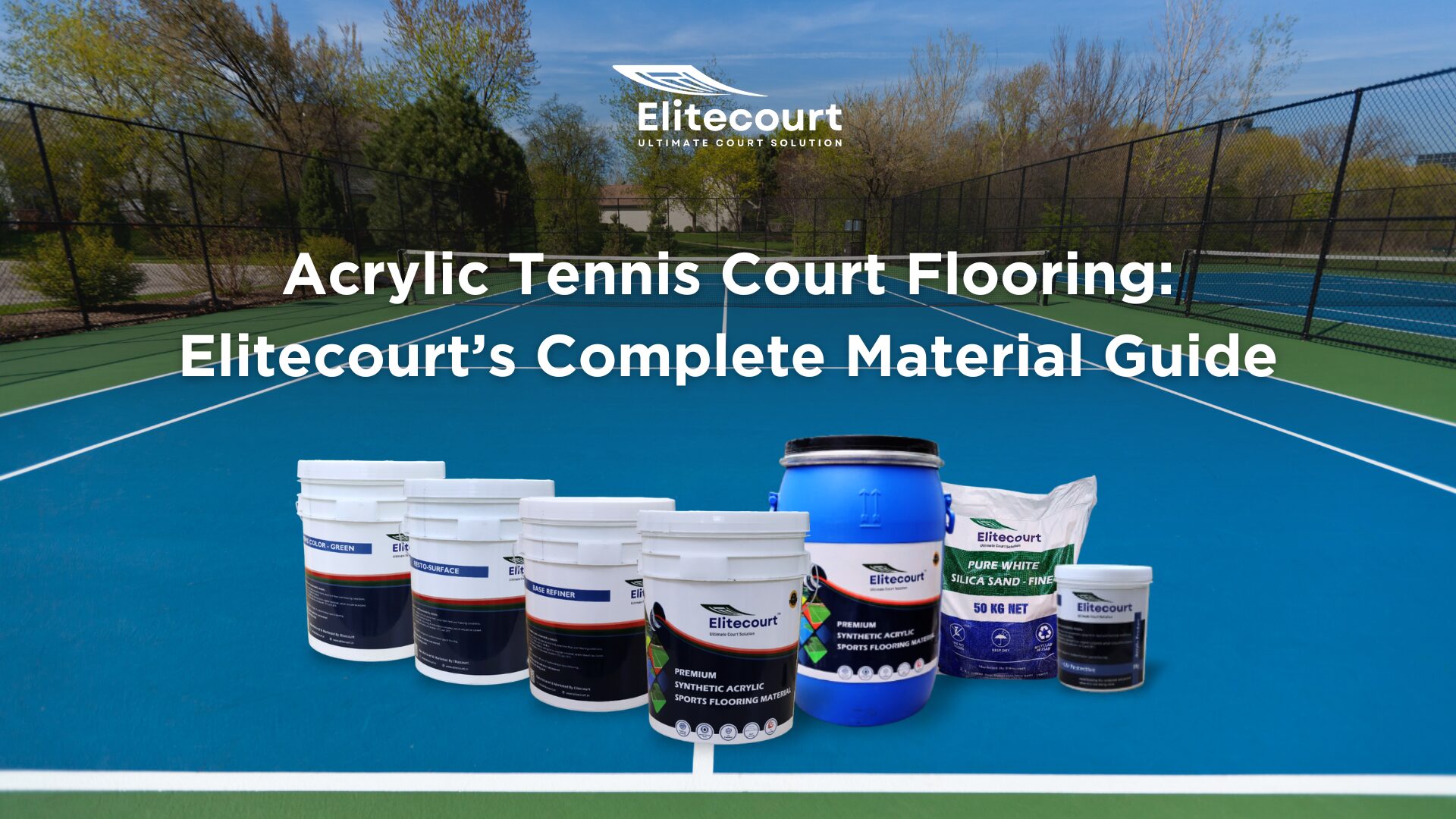
- Synthetic Acrylic (Elitecourt Specialty): A versatile, performance-focused choice that provides excellent slip resistance, customizable cushioning, and bright, lasting color for clear court lines and designs.
Flooring Materials Comparison
| Flooring Type | Shock Absorption | Ball Bounce | Maintenance | Suitability |
|---|---|---|---|---|
| Hardwood | High | Excellent | High | Indoor professional/amateur |
| Asphalt | Low | Medium | Medium | Outdoor community/recreation |
| Concrete | Low | Medium | Low | Outdoor, budget-oriented |
| Synthetic Acrylic | Customizable | Excellent | Low | Indoor/Outdoor, all levels |
Elitecourt’s Synthetic Acrylic: The Science Behind Performance
Elitecourt’s proprietary acrylic surfaces are engineered for both endurance and performance, with special features tailored to the Indian climate and athlete needs:
- Multi-layer construction balances hardness for responsive bounce with soft underlayers that absorb shock.
- UV-resistant pigmentation keeps colors vivid and lines highly visible, even under intense sunlight.
- Non-porous surfaces repel water and dust, making courts playable soon after rain and easy to clean.
- Customizable slip coefficient matches the requirements for different levels—training, recreational, or competition.
- Long-term durability ensures that courts retain their professional performance for years, reducing the need for resurfacing.
Environmental and Health Benefits
Modern synthetic acrylic surfaces offer significant sustainability and health advantages:
- Eco-Friendly Formulation: Many acrylic systems use low-VOC (volatile organic compounds) adhesives and coatings that are safer for the environment and athletes.
- Minimizing Heat Buildup: Special formulations can reduce surface temperatures, making outdoor courts more comfortable even during peak summer.
- Allergen & Mold Resistance: Properly installed acrylic courts do not retain moisture, discouraging mold and harmful bacterial growth.
- Recyclability: Some components in advanced acrylic systems can be recycled or repurposed, reducing the environmental impact of court construction.

Planning and Building Your Basketball Court
Now that we have a thorough understanding of how long a basketball court is and the importance of its surface, let’s consider the practical aspects of planning for one.
Essential Space Requirements
The court dimensions are just one part of the equation. You also need to account for the run-off area—the empty space around the court’s perimeter. This area is a critical safety feature, providing players with room to slow down after running out of bounds and preventing collisions with walls, fences, or spectators.
- Professional and Collegiate Courts: A minimum of 10 feet of clear space is recommended around the entire court.
- High School and Recreational Courts: A minimum of 6 feet is often acceptable, though 10 feet is always safer if space allows.
Therefore, when planning for a regulation 94×50 foot court, your total required space, including run-offs, would be at least 114×70 feet. For a high school court (84×50 feet), you would need a total area of at least 96×62 feet.
Indoor vs. Outdoor Courts
The decision to build an indoor or outdoor court also impacts planning and material selection.
- Indoor Courts: These are protected from the elements, allowing for year-round play. They require climate control (HVAC) and specialized lighting to ensure even illumination without glare. The sub-base is typically concrete, over which the flooring system is applied.
- Outdoor Courts: These are more exposed and must be built to withstand weather. The base is usually asphalt or concrete, which must be properly sloped (typically 1% grade) to allow for water drainage. The flooring material itself must be UV-resistant and durable enough to handle rain, heat, and cold. Elitecourt’s synthetic acrylic flooring is an ideal solution for outdoor courts due to its exceptional all-weather properties.
The Role of a High-Quality Manufacturer
While Elitecourt manufactures the flooring material and does not handle installation, choosing a superior product is the first and most important step in building a long-lasting, high-performance court. The quality of the acrylic, pigments, and cushioning compounds directly determines the final court’s playability and lifespan.
Working with an experienced manufacturer ensures you are getting a product that is:
- Tested and Certified: Adheres to the standards set by sports federations like FIBA.
- Consistent in Quality: Manufactured under strict quality control for uniform performance.
- Backed by Expertise: Developed by specialists who understand the science behind sports surfaces.
By choosing a premium flooring material, you lay the groundwork for a successful installation and a court that athletes will love to play on for years to come.
Transform Your Sports Facility Today!
Contact us for high-quality synthetic sports flooring material and elevate your space!
FAQs
The official length of an NBA basketball court is 94 feet (28.65 meters), with a width of 50 feet (15.24 meters).
High school (84-foot) and junior high (74-foot) courts are sized for age-appropriate gameplay, easier movement, safety, and to fit school gym construction constraints.
You can enjoy the game on any reasonably sized court, but competitive or official games at each level require the respective standardized length.
A flooring system’s shock absorption and resilience are especially important on longer courts. Quality synthetic acrylic, such as Elitecourt’s, reduces fatigue and injury risk—even during up-tempo, full-court games.
Many local and recreational courts, especially outdoors, may have unique sizes tailored to regional needs and available space. However, most competitive leagues now use the standards set by FIBA, NBA, or the NCAA.
For more details on official court standards, you can refer to governing bodies like the International Basketball Federation (FIBA).
Conclusion: More Than Just a Number
So, how long is a basketball court? The simple answer is 94 feet for professionals and 84 feet for high school. But the real answer is richer; the length and design of the court shape the very nature of the game. These standardized dimensions define the physical demands on athletes, influence coaching decisions, and ensure that the spirit of basketball—dynamic, challenging, and fair—thrives across the world.
At every level, from junior leagues to global championships, and regardless of whether indoors or outdoors, one factor remains constant: the surface underfoot. Elitecourt’s advanced synthetic acrylic flooring is designed to optimize safety, consistency, and durability, providing every player—novice or pro—the platform to excel.
By understanding both the history and evolution of court sizes, and the science behind modern court surfaces, you’re equipped to create a playing area that honors the sport’s legacy and enables future generations of athletes to soar.
Ready to build a world-class basketball court? Choose materials engineered for excellence—choose Elitecourt.
Transform Your Sports Facility Today!
Contact us for high-quality synthetic sports flooring material and elevate your space!