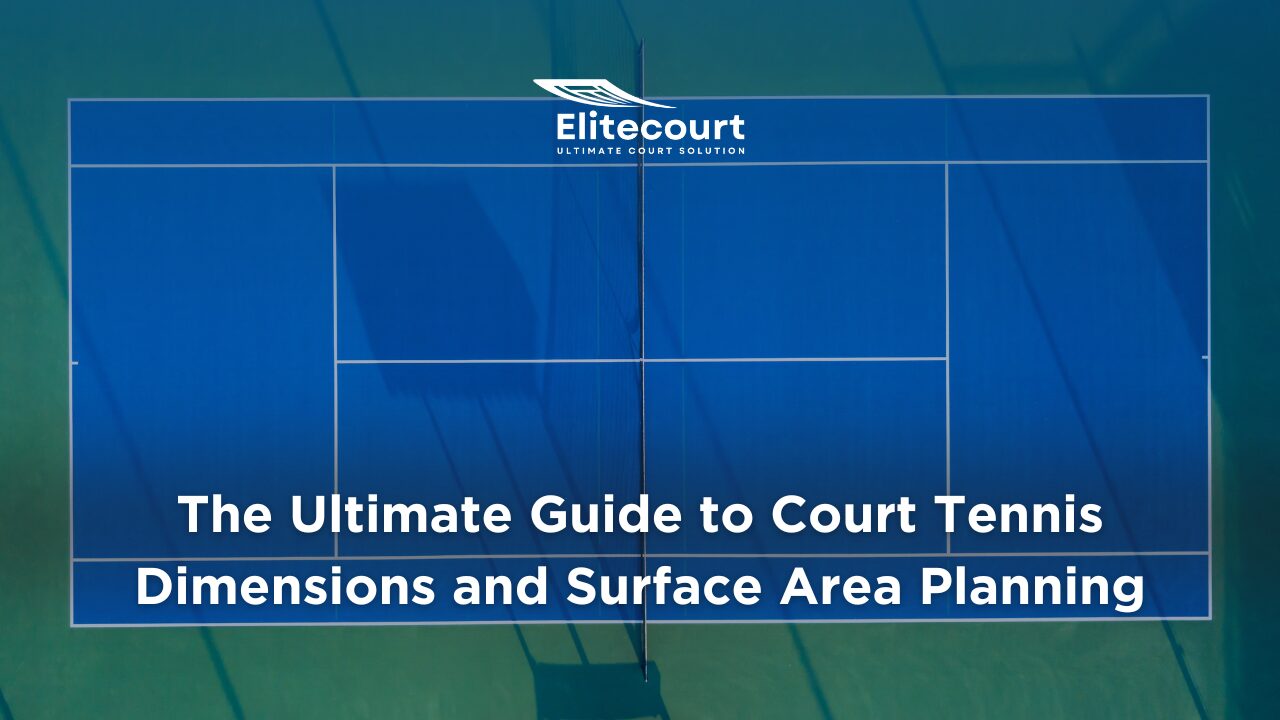
A standard tennis court is 78 feet (23.77 meters) long. For singles matches, the width is 27 feet (8.23 meters), while for doubles matches, the width extends to 36 feet (10.97 meters). However, the “playing area” requires significantly more space to account for runoffs, bringing the total recommended footprint for a standard domestic court to at least 120 feet by 60 feet (36.58m x 18.29m).
Understanding the precise court tennis dimension is the foundational step in any sports facility project. Whether you are an architect designing a municipal complex, a club manager planning a resurfacing project, or a homeowner considering a private court, precision is non-negotiable. At Elitecourt, we understand that the quality of the game relies not just on our premium synthetic acrylic materials, but on the accuracy of the canvas they are applied to.
This comprehensive guide will dissect every inch of the tennis court, from the baseline to the net post, ensuring your facility meets official standards and maximizes player safety.
The Anatomy of a Tennis Court: Standard Dimensions
When we discuss the “court,” we are technically referring to the area bounded by the outer lines (baselines and sidelines). However, for a manufacturer of acrylic surfacing like Elitecourt, the dimensions extend far beyond the white lines.
The Playing Rectangle (The Lines)
The International Tennis Federation (ITF) sets the global rules of tennis, including the strict geometry of the court.
- Length: The court is always 78 feet (23.77m) long, regardless of whether singles or doubles are being played.
- Singles Width: The game is played within the inner sidelines, measuring 27 feet (8.23m) wide.
- Doubles Width: The game utilizes the full width, including the alleys, measuring 36 feet (10.97m) wide.
- Service Line: This line is positioned 21 feet (6.40m) from the net on each side.
- The Alleys (Tramlines): The strips on the sides used for doubles are 4.5 feet (1.37m) wide.
Dimension Reference Table (Imperial vs. Metric)
| Measurement Component | Imperial Dimensions | Metric Dimensions |
| Total Length (Baseline to Baseline) | 78 feet | 23.77 meters |
| Total Width (Doubles) | 36 feet | 10.97 meters |
| Total Width (Singles) | 27 feet | 8.23 meters |
| Service Box Length | 21 feet | 6.40 meters |
| Service Box Width | 13.5 feet | 4.11 meters |
| Alley Width | 4.5 feet | 1.37 meters |
| Center Mark Length | 4 inches | 10 centimeters |

Total Playing Area: Why Runoff Space Matters
One of the most common errors in facility planning is confusing the court dimensions with the total playing area. The court tennis dimension must include the safety zones (runoffs) around the perimeter. Players frequently run outside the lines to retrieve balls; without adequate space, the court is unplayable and dangerous.
Minimum vs. Recommended Runoff
The space required depends on the level of play. A recreational court requires less runoff than a stadium hosting an ATP tour event.
Residential and Club Minimums
For general recreational use, the minimum total dimensions (fence-to-fence) are:
- Length: 114 feet (34.75m)
- Width: 56 feet (17.07m)
However, the recommended standard for comfortable play is:
- Length: 120 feet (36.57m)
- Width: 60 feet (18.29m)
International Tournament Standards (ITF)
For high-level competition, the ITF stipulates larger runoff areas to accommodate faster play and line judges.
- Length: 130 feet (39.62m) minimum.
- Width: 66 feet (20.11m) minimum.
This distinction is vital for material estimation. When ordering Elitecourt acrylic surfacing, you are surfacing the entire footprint, not just the game lines. A difference of 10 feet in length significantly alters the quantity of resurfacer and color coating required.
The Geometry of Safety – Why Runoff Defines Playability
When we think of a “premium” tennis court, we often think of the surface speed or the clarity of the colors. However, true luxury in tennis infrastructure is defined by space. The area outside the lines—the runoff—is where matches are won and lost.
In professional tennis, players like Rafael Nadal or Daniil Medvedev often stand 10 to 15 feet behind the baseline to return serves. If a facility builder adheres strictly to the minimum court tennis dimension without accounting for deep returns, they effectively neutralize a defensive baseline playing style.
Furthermore, lateral runoff is critical for safety. A player chasing a wide angled volley needs to decelerate safely without hitting a fence or retaining wall.
Key Takeaway for Planners:
Never compromise on runoff to squeeze a court into a tight space. If you have limited acreage, it is better to adjust the landscaping around the court than to shrink the playing surface. For acrylic application, remember that the runoff areas endure high foot traffic and require the same durable Elitecourt finish as the center of the court.
Net and Post Dimensions
The net assembly is the centerpiece of the court, and its placement dictates the geometry of the lines.
The Net Posts
The placement of the net posts varies depending on whether the court is being used for singles or doubles.
- Doubles Matches: The centers of the posts are placed 3 feet (0.914m) outside the doubles sideline.
- Singles Matches: If a singles net is used, the centers of the posts are 3 feet (0.914m) outside the singles sideline.
Note: Most permanent courts are set up for doubles. When playing singles on a doubles net, “singles sticks” are used to prop the net up to the correct height, placed 3 feet outside the singles line.
The Net Height
- Center: 36 inches (0.914m) high.
- At the Posts: 42 inches (1.07m) high.
The tension of the net must be sufficient to ensure these heights are maintained. From a manufacturing perspective, the surfacing around the post sleeves must be perfectly flush to prevent water accumulation, which can degrade the acrylic coating over time.
Line Width Regulations
When applying Elitecourt acrylic textures and line paints, precision in line width is mandated by the rules of tennis. Inconsistent line widths can cause disputes during play, as the ball is considered “in” if it touches any part of the line.
- Center Service Line: Must be 2 inches (5cm) wide.
- Baselines: Can be up to 4 inches (10cm) wide, though standard is often between 2 and 3 inches. The extra width allows players to see the boundary clearly from the opposite end.
- All Other Lines: Must be between 1 inch (2.5cm) and 2 inches (5cm) wide.
The lines must be painted in a single color that contrasts clearly with the court surface. Textured line paint is recommended to ensure the ball bounce on the line is consistent with the rest of the acrylic surface.
Calculating Material Needs for Acrylic Resurfacing
When preparing to order Elitecourt materials for a project, simply knowing the “standard court tennis dimension” is not enough. You must calculate the Total Square Footage (TSF) or Total Square Meters (TSM) of the playable surface.
Here is the formula manufacturers use:
Total Length (Fence to Fence) × Total Width (Fence to Fence) = TSF
- Example: A standard 120’ x 60’ court = 7,200 sq. ft.
However, acrylic coatings are applied in layers. A typical premium system might include:
- Acrylic Resurfacer (1-2 coats): To smooth porosity and minor imperfections.
- Color Coats (2-3 coats): The visible surface providing texture and aesthetics.
- Line Paint: A specific quantity based on linear footage.
The “Porosity Factor”:
New asphalt absorbs more material than an existing acrylic surface. When calculating your project needs based on dimensions, always factor in the condition of the substrate. An older, open pavement might require 10-15% more material than the standard coverage rate suggests. Precision in measurement leads to precision in ordering, preventing shortages mid-job.
Youth Tennis Dimensions (ITF Play & Stay)
To encourage younger players, the ITF developed the “Play & Stay” campaign (also known as “10 and Under Tennis” in the US). These formats use smaller courts, slower balls, and smaller rackets. These dimensions are often painted as “blended lines” (ghost lines) on a standard court.
Red Court (Stage 3)
- Target Age: 5–8 years old.
- Court Size: 36 feet (10.97m) long x 18 feet (5.48m) wide.
- Net Height: 31.5 inches (0.8m).
- Layout: Often set up across the width of a standard court.
Orange Court (Stage 2)
- Target Age: 8–10 years old.
- Court Size: 60 feet (18.29m) long x 21 feet (6.4m) wide (Singles).
- Net Height: 31.5 – 36 inches.
- Layout: Fits within a standard court, using the standard net but shorter baselines.
Green Court (Stage 1)
- Target Age: 9–10 years old.
- Court Size: Full standard size (78’ x 27’).
- Net Height: Standard (36 inches).
Orientation and Environmental Factors
While the court tennis dimension is a fixed variable, the orientation of those dimensions is a critical design choice.
North-South Orientation
Tennis courts should almost always be oriented North-South. This is to prevent players from having to look directly into the sun during dawn or dusk. If a court is oriented East-West, the sun will be directly in a player’s eyes during morning and afternoon play, rendering the court unusable for competitive matches.
Slope and Drainage
Acrylic surfaces are impermeable; they do not absorb water. Therefore, the court dimension planning must include a specific slope to shed water.
- Standard Slope: 0.83% to 1% (1 inch of drop for every 10 feet).
- Direction: Ideally, the court should tilt along a single plane (e.g., side-to-side or end-to-end) rather than crowning in the middle.
Proper slope ensures that the Elitecourt acrylic system performs optimally and does not suffer from premature degradation due to standing water (birdbaths).
The Rise of Multi-Sport Configurations
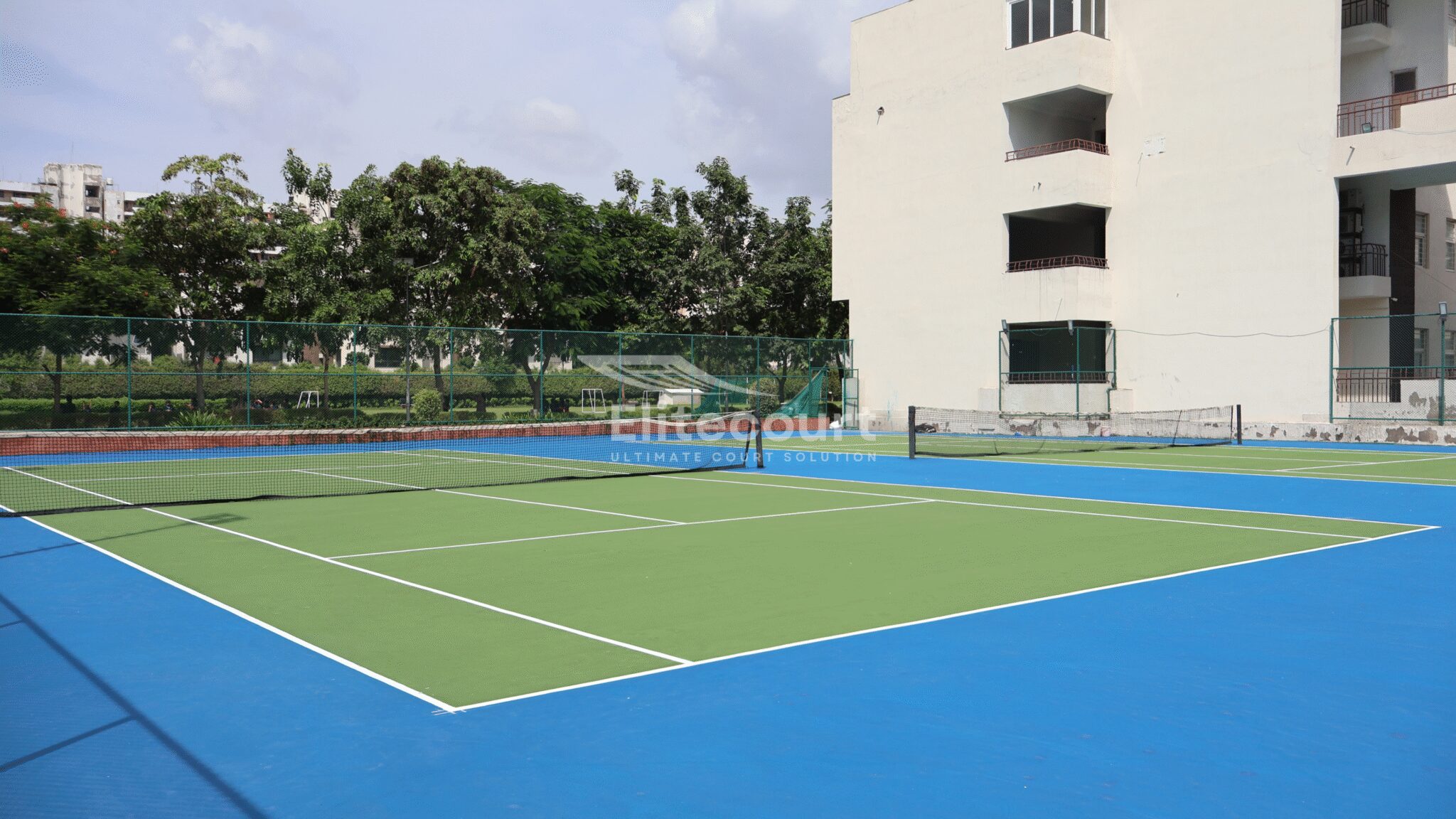
The demand for Pickleball has surged, leading many facility owners to explore multi-sport configurations. Because a Pickleball court is significantly smaller than a tennis court, the standard tennis dimensions offer ample room for conversion or dual-use.
The Pickleball Dimension:
- Dimensions: 44 feet long x 20 feet wide.
- Kitchen: 7 feet from the net on both sides.
Fitting it In:
You can fit up to four Pickleball courts on a single standard tennis footprint (120’ x 60’), though two is more comfortable for permanent setups.
The Blended Line Solution:
Using Elitecourt line paints, you can add Pickleball lines in a tonal color (e.g., light blue on a dark blue court) to a standard tennis court. This allows the court to retain its official tennis dimensions while offering versatility. The key is ensuring the Pickleball lines do not intersect the tennis lines in a way that causes visual confusion during high-speed tennis rallies.
Vertical Dimensions: Indoor and Lighting
For indoor facilities or covered courts, the vertical dimension is just as important as the length and width.
Ceiling Height
The clear span over the net is crucial for lobs.
- Recreational Minimum: 18 feet (5.5m) at the sidelines, rising to 35 feet (10.67m) over the net.
- Professional Standard: A uniform minimum height of 40 feet (12.19m) across the entire playing area.
Lighting Poles
For outdoor courts, light fixtures are typically mounted outside the fence line or on the fence line.
- Pole Height: Typically 20 to 22 feet.
- Placement: Generally positioned to align with the net line and the baselines to minimize shadows.
Surface Flatness Standards
While we are discussing dimensions, we must address the “Z-axis”—the flatness of the pavement. For an Elitecourt synthetic acrylic system to be applied successfully, the asphalt or concrete base must meet strict planarity requirements.
The industry standard for planarity is that the surface should not vary more than 1/8th of an inch in any 10-foot radius.
Any depressions deeper than this will result in “birdbaths”—puddles that take more than an hour to evaporate in sunlight. These deviations in the dimension of the substrate must be corrected using acrylic patch binder before the color system is installed.
Why Color Contrast Matters in Court Dimensions
While the dimensions of a tennis court are defined by white lines, the perception of those dimensions is defined by color. The “Two-Tone” court—where the playing rectangle is one color and the runoff area is another—is not just an aesthetic choice; it is a functional one.
Enhanced Depth Perception:
By using a darker color inside the lines (e.g., Elitecourt US Open Blue) and a lighter color for the runoff (e.g., Elitecourt Light Green), players can track the ball better against the surface. This contrast helps the player’s peripheral vision instinctively know where the boundary is without looking down.
Tournament Standard:
Almost all professional events use a two-tone scheme. This visual separation helps spectators (and cameras) distinguish the field of play. When planning your facility’s layout, consider how color choices can visually reinforce the court dimensions you have so carefully measured.
Comparison: Tennis vs. Other Racquet Sports
To better understand the scale of a standard tennis court, it is helpful to compare it to other popular court sports. This context helps in planning multi-use complexes.
| Sport | Length | Width | Total Area (Lines Only) |
| Tennis (Doubles) | 78 feet | 36 feet | 2,808 sq. ft. |
| Pickleball | 44 feet | 20 feet | 880 sq. ft. |
| Paddle Tennis | 50 feet | 20 feet | 1,000 sq. ft. |
| Badminton (Doubles) | 44 feet | 20 feet | 880 sq. ft. |
| Squash | 32 feet | 21 feet | 672 sq. ft. |
As shown, a tennis court is roughly three times the size of a Pickleball or Badminton court. This massive surface area highlights why the durability of the acrylic coating is paramount—maintenance on 7,200 square feet of surface is a significant undertaking, and choosing a premium product like Elitecourt minimizes the frequency of resurfacing.
Frequently Asked Questions (FAQ)
Here are the most common questions regarding court tennis dimensions and layout planning.
While the strict game lines are 78′ x 36′, you physically cannot play without runoff. The absolute minimum fence-to-fence dimension for a residential court is usually cited as 114′ x 56′, but 120′ x 60′ is highly recommended for safety and playability.
The length is the same (78 feet), but the width differs. A singles court uses the inner side lines (27 feet wide), while doubles uses the full width including alleys (36 feet wide). Most courts are painted for doubles to accommodate both.
Lines must be between 1 and 2 inches wide, except for the baseline, which can be up to 4 inches wide. The center service line must be exactly 2 inches wide.
You need a flat area of roughly 7,200 square feet (120′ x 60′). You also need to account for drainage and orientation (North-South).
If you have multiple courts side-by-side (a battery), there should be a minimum of 12 feet between the sidelines of adjacent courts. This prevents players from running into each other.
Each of the four service boxes measures 21 feet long by 13.5 feet wide.
Conclusion: Precision is the Foundation of Performance
The dimensions of a tennis court are more than just numbers in a rulebook; they are the geometric framework that makes the sport possible. From the precise 78-foot length to the critical 1% slope for drainage, every measurement impacts the game.
For facility owners and architects, respecting these dimensions ensures that the court is safe, compliant, and enjoyable for players of all levels. But accurate dimensions are also the starting point for a high-performance surface.
At Elitecourt, we manufacture the world’s finest synthetic acrylic sports flooring materials, designed to bring these dimensions to life. Whether you are surfacing a tournament-ready stadium or a private backyard sanctuary, the integrity of the installation begins with the accuracy of the footprint.
Ready to surface your court?
If you have your dimensions ready and are looking for premium acrylic surfacing materials that offer vibrant color, consistent speed, and unmatched durability, we are here to help.
Contact Elitecourt today to discuss your material requirements and find the perfect surfacing system for your facility.
Transform Your Sports Facility Today!
Contact us for high-quality synthetic sports flooring material and elevate your space!