Introduction
If you are looking for the exact badminton court size, here is the short answer: A standard badminton court is 13.40 meters (44 feet) long and 6.10 meters (20 feet) wide for doubles matches. For singles matches, the length remains the same, but the width is reduced to 5.18 meters (17 feet).
Understanding the precise dimensions of a court is critical, whether you are an facility manager planning a new sports complex, a school administrator upgrading a gymnasium, or a professional installer laying down high-performance acrylic surfaces. At Elitecourt, we understand that every millimeter counts. The quality of the game depends not just on the players’ skills but on the accuracy of the playing surface beneath their feet.
In this extensive guide, we will dive deep into every aspect of badminton court size, from the detailed breakdown of lines and zones to the importance of run-off areas and ceiling height. We will explore how these dimensions impact gameplay and why choosing the right surface—like our premium synthetic acrylic flooring—matters just as much as getting the measurements right.
Why Precision in Badminton Court Size Matters
Badminton is often called the fastest racquet sport in the world. With shuttlecocks traveling at speeds exceeding 400 km/h in professional play, the court is a high-velocity zone where agility, precision, and spatial awareness are paramount.
The badminton court size is not merely a set of arbitrary numbers; it is a carefully calibrated framework designed to test a player’s endurance, speed, and tactical acumen. If a court is even a few centimeters off in its dimensions, it fundamentally alters the game. A court that is too narrow restricts the angles a player can use for cross-court smashes. A court that is too short makes the back boundary too easy to defend.
The Role of Standardization
The Badminton World Federation (BWF) sets strict standards for court dimensions to ensure fairness and consistency globally. Whether a match is played in a local community center in Europe or a massive stadium in Asia, the playing field must be identical. This standardization allows players to develop muscle memory regarding the court’s boundaries. They know instinctively where the back line is without looking, purely based on their position relative to the net.
For facility owners and contractors, adhering to these standards is non-negotiable. Installing a court with incorrect dimensions can lead to disqualification from hosting official tournaments and can negatively impact the training of athletes who use the facility.
Safety and Performance
Beyond the rules, correct sizing impacts safety. The badminton court size includes not just the playing area but also the safety run-off zones around it. insufficient space around the court can lead to collisions with walls, spectators, or other equipment. Furthermore, the surface texture and shock absorption—qualities central to Elitecourt’s acrylic flooring technology—must be consistent across the entire measured area to prevent slips and joint injuries.
Detailed Breakdown of Standard Badminton Court Dimensions
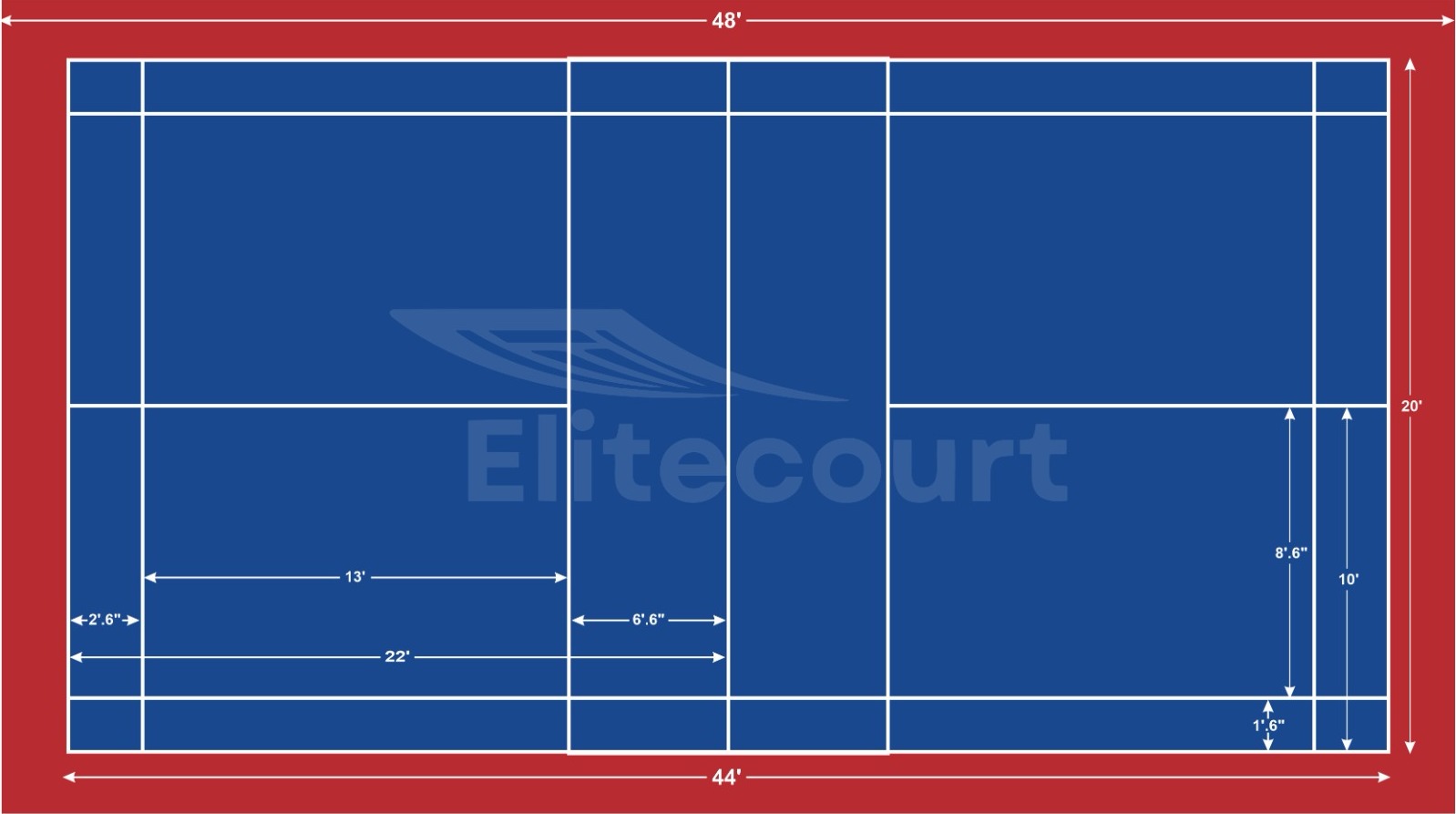
To fully grasp the layout, we need to dissect the court into its constituent parts. The badminton court size is defined by outer boundary lines and inner service lines.
Overall Dimensions
- Total Length: 13.40 meters (44 feet)
- Total Width (Doubles): 6.10 meters (20 feet)
- Total Width (Singles): 5.18 meters (17 feet)
- Diagonal Length (Full Court): 14.723 meters (48 feet 3.6 inches)
The diagonal measurement is the secret weapon for installers. When laying out a court, checking the diagonal length is the most reliable way to ensure the court is perfectly rectangular and not a rhombus (diamond shape). If the diagonals match at exactly 14.723 meters, your corners are perfectly 90 degrees.
The Lines
All lines on a badminton court must be 40mm (1.5 inches) wide. They should be painted or marked in a color that contrasts sharply with the floor surface—typically white or yellow. It is important to note that the width of the lines is considered part of the area they define. For example, the service line is part of the service court. If a shuttlecock hits any part of the line, it is considered “in.”
Zones and Areas
The court is divided into specific zones, each with its own dimensions and purpose.
The Net Line
This invisible line divides the court into two equal halves. Each half measures 6.7 meters (22 feet) in length.
Short Service Line
Located 1.98 meters (6 feet 6 inches) from the net on either side. In every form of badminton (singles and doubles), a serve must cross this line to be valid.
Long Service Line (Doubles)
This line is unique to doubles play. It is located 0.76 meters (2 feet 6 inches) closer to the net than the back boundary line. In doubles, a serve must land before this line. In singles, the long service line is the same as the back boundary line.
Center Line
This line divides the court width-wise, separating the left service court from the right service court. It extends from the short service line to the back boundary line.
Side Lines (Singles vs. Doubles)
- Doubles Side Lines: These are the outermost vertical lines, defining the full 6.10-meter width.
- Singles Side Lines: These are the inner vertical lines, positioned 0.46 meters (1 foot 6 inches) inward from the doubles sidelines.
The “Tramlines”
The area between the singles sideline and the doubles sideline is often referred to as the “tramlines” or “alleys.” This strip is 0.46 meters wide. It is out of bounds during singles play but in bounds for doubles play. Similarly, the area between the doubles long service line and the back boundary line is the rear tramline, used only during play (not serving) in doubles and fully in singles.
Singles vs. Doubles: Understanding the Differences
While the physical footprint of the court doesn’t change, the active badminton court size shifts depending on whether two or four players are on the court.
The Singles Court
In singles, the game is a test of stamina and coverage. One player must defend the entire area.
- Active Width: 5.18 meters.
- Active Length: 13.40 meters.
- Service Area: Long and narrow. You serve from the short service line all the way to the back boundary line, but only within the 5.18m width.
The challenge in singles is moving forward and backward. The court feels incredibly long when you are alone. The exclusion of the side tramlines makes the court narrower, forcing play to be more vertical (net to baseline).
The Doubles Court
In doubles, the game is faster, with more attacking shots and flat exchanges.
- Active Width: 6.10 meters.
- Active Length: 13.40 meters.
- Service Area: Short and wide. You serve from the short service line to the doubles long service line (not the back boundary), utilizing the full 6.10m width.
The complex part of doubles is the service. Because the service area is shorter (stopping 0.76m before the back line), players often stand closer to the net to intercept flicks. However, once the rally begins after the serve, the entire court—all the way to the back boundary line—is active.
Q&A: Common Misconceptions About Court Size
Q: Is the net height the same for singles and doubles?
A: Yes. The net height is standard regardless of the game type. It must be 1.55 meters (5 feet 1 inch) high at the edges (over the doubles sidelines) and 1.524 meters (5 feet) high in the exact center of the court. The slight dip in the middle is natural and required by regulations.
Q: Do I need a different court for singles and doubles?
A: No. A standard badminton court is a “combination court” marked for both. It contains all the necessary lines for both disciplines. It is extremely rare to find a court marked only for singles or only for doubles, as it limits the utility of the facility.
Q: Does the line width count as inside or outside?
A: In badminton, the lines are part of the court. If a shuttle lands on the outer edge of the boundary line, it is “in.” This is why precision in marking the 40mm line width is vital during the manufacturing and installation of the court surface.
Transform Your Sports Facility Today!
Contact us for high-quality synthetic sports flooring material and elevate your space!
Clearance and Safety Run-Off Areas
The badminton court size refers to the playing area, but the total space required to install a court is significantly larger. You cannot simply paint lines on a floor that is exactly 13.4m x 6.1m; players would crash into walls immediately.
Minimum Clearances
For recreational and club-level play, a minimum clearance of 1.5 meters (5 feet) around the entire perimeter of the court is recommended.
For international or high-level competition play (BWF Grade 1 and 2), the requirements are stricter:
- Side Clearance: At least 2 meters between courts (if side-by-side).
- Rear Clearance: At least 2 meters from the baseline to the wall or background barriers.
Height Clearance
Badminton is unique because it is a 3D sport where the shuttle is frequently hit high into the air.
- Recreational Courts: Minimum ceiling height of 7 to 9 meters.
- International Stadiums: Minimum ceiling height of 12 meters clear space (no beams or lights obstructing this zone).
If the ceiling is too low, defensive clears and high lifts become impossible, fundamentally changing the nature of the game. When Elitecourt consults on flooring projects, we always advise clients to consider the vertical volume of the space just as seriously as the floor area.
Court Surface Materials: The Foundation of the Game
While the badminton court size dictates the boundaries, the floor surface dictates the performance. A court with perfect dimensions is useless if the floor is slippery, too hard, or uneven.
At Elitecourt, we specialize in synthetic acrylic sports flooring. This material is increasingly becoming the standard for modern multi-sport and dedicated badminton facilities for several reasons.
Why Acrylic?
- Consistent Bounce and Pace: Unlike natural grass or inconsistent concrete, synthetic acrylic provides a uniform surface. The shuttle doesn’t bounce, but the players do. The surface needs to provide the right energy return.
- Grip vs. Slip: Badminton requires a very specific friction coefficient. Players need to stop instantly to change direction (grip), but they also need to slide slightly into a lunge to reach a drop shot (slip). If the floor is too grippy, players risk ankle rolls and knee injuries. If it’s too slippery, they lose traction and speed. Elitecourt’s acrylic formulations are engineered to hit this “Goldilocks” zone of friction.
- Durability: Badminton courts see heavy foot traffic in concentrated areas (service boxes and the center of the court). Acrylic coatings are incredibly durable and resistant to wear, ensuring that the court retains its color and texture for years.
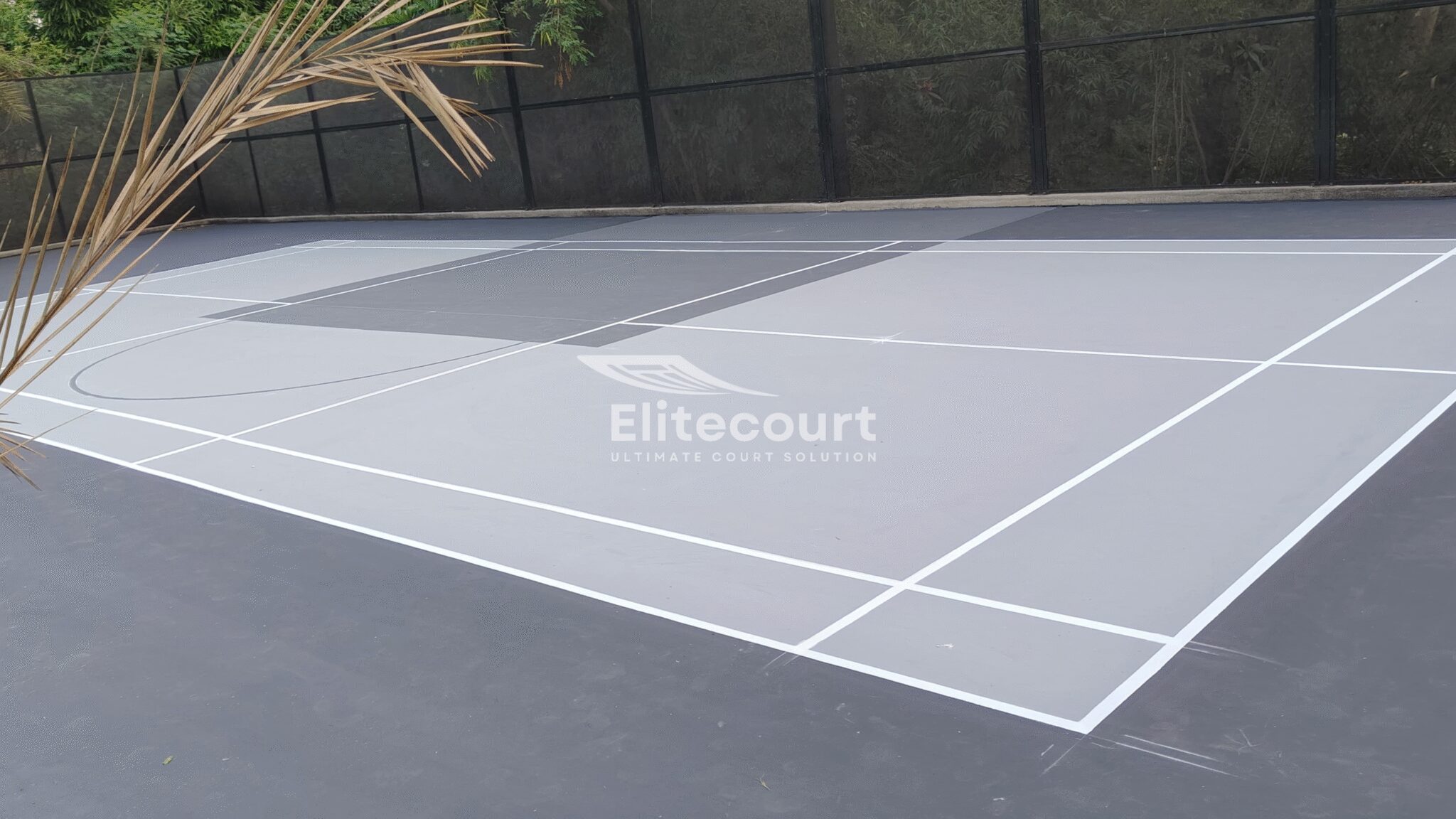
- Visibility: Acrylic courts allow for vibrant, matte-finish colors. This reduces glare from overhead lighting and provides high contrast against the white shuttlecock, making it easier for players to track the bird.
Comparison with Other Surfaces
- Wooden Floors: Traditionally the gold standard, wood offers great shock absorption. However, it is expensive to maintain, sensitive to humidity, and can become slippery with sweat.
- PVC Mats: These rollout mats are popular for portable courts. They offer good grip but can sometimes be too soft, absorbing too much of the player’s energy and making movement more tiring.
- Concrete/Asphalt: Never recommended for badminton due to the lack of shock absorption, which leads to shin splints and joint pain. However, an acrylic system over a cushioned sub-base can transform a hard surface into a safe, playable court.
Transform Your Sports Facility Today!
Contact us for high-quality synthetic sports flooring material and elevate your space!
How to Measure and Mark a Badminton Court
For contractors and facility managers installing an Elitecourt surface, marking the badminton court size correctly is the final, crucial step.
Step-by-Step Layout
- Establish the Center: Find the exact center of the playing area. This will be the point directly under the net, in the middle of the court.
- Lay the Net Line: Mark the transverse line where the net will go. This defines the width.
- Mark the Center Line: From the center point, measure 6.7 meters towards both ends to establish the total length.
- Create the Box: Mark the four corners of the doubles court (13.4m x 6.1m).
- Check Diagonals: Measure from corner to opposite corner. The distance must be 14.723 meters. Adjust until this is exact.
- Fill in the Details: Once the outer rectangle is squared, measure inwards to mark the singles sidelines (0.46m in), the short service line (1.98m from the net), and the doubles long service line (0.76m from the back).
Painting Tips
- Use masking tape to ensure crisp edges.
- Apply the paint in thin layers to avoid ridges that could trip players.
- Ensure the paint is compatible with the acrylic surface to prevent peeling. Elitecourt provides specialized line marking paints designed to bond perfectly with our court systems.
The Importance of Lighting and Background
While not part of the physical badminton court size, the environment surrounding the dimensions is critical.
Lighting
Lighting should be positioned along the side of the court, not directly overhead. Lights directly above the court can blind players when they look up to hit a smash or clear. The goal is uniform illumination of about 500 lux for recreational play and over 1000 lux for professional competition.
Background Colors
The walls at the ends of the court should be a dark, solid color (dark green, blue, or black). This provides contrast for the white shuttlecock. A white wall behind the court effectively camouflages the shuttle, making the game unplayable.
Maintenance of Your Badminton Court
Maintaining the integrity of the badminton court size and surface is essential for longevity. Even the highest quality Elitecourt surface requires care.
Regular Cleaning
Dust and sweat are the enemies of badminton courts. Dust reduces grip, making the court slippery. Sweat leaves residue that can degrade the surface over time.
- Daily: Dry mop the court to remove dust and debris.
- Weekly: Wet mop with a neutral cleaner to remove sweat and body oils.
Surface Inspection
Regularly inspect the high-traffic areas. In badminton, the areas near the net (where players lunge) and the baseline (where they jump) wear out faster.
- Check for smoothness: If the texture becomes too smooth, grip is lost.
- Check line visibility: Faded lines can lead to disputes during play. Re-painting lines is a simple maintenance task that keeps the facility looking professional.
Shoe Policy
Strictly enforce a “non-marking indoor shoes only” policy. Outdoor running shoes can carry grit and small stones that scratch the acrylic surface. Black-soled shoes that leave marks should also be banned.
Adapting Badminton Court Sizes for Different Spaces
Not every facility has the luxury of a full-sized stadium. How do you adapt the badminton court size for smaller spaces like schools or community halls?
Multi-Use Courts
Many facilities use a single hall for basketball, volleyball, and badminton. In these cases, colored lines are used to differentiate sports.
- Hierarchy of Lines: Usually, the primary sport (e.g., basketball) gets white lines. Badminton lines might be yellow or light blue.
- Safety Zones: Ensure that the post holes for volleyball or badminton nets do not create trip hazards for basketball players.
Mini-Badminton
For junior players or small backyards, “Mini-Badminton” uses a modified badminton court size.
- Often, the court is just the standard doubles width (6.10m) but shorter length, or sometimes just the front half of a standard court.
- The net height is often lowered to 1.40 meters for children.
However, for any serious training, maintaining the standard dimensions is crucial so young players learn the correct distances.
Elitecourt: The Professional Choice for Badminton Flooring
When you are investing in a sports facility, the floor is your product. It is what players interact with every second of the game.
At Elitecourt, we don’t just sell paint; we sell performance. Our synthetic acrylic systems are engineered to meet the rigorous demands of sports like badminton.
- Customization: We can tailor the speed of the court by adjusting the texture of the acrylic finish.
- Aesthetics: Our wide range of vibrant, UV-stable colors allows you to create a visually stunning facility that invites players in.
- Longevity: Elitecourt surfaces are designed to withstand years of intense play without cracking or peeling.
Choosing Elitecourt means choosing a partner who understands the technical nuances of badminton court size, layout, and biomechanics. We ensure that your court isn’t just a painted rectangle, but a precision-engineered arena for athletes.
Transform Your Sports Facility Today!
Contact us for high-quality synthetic sports flooring material and elevate your space!
Detailed Technical Specifications Table
For architects and project managers, here is a quick-reference table for badminton court size data.
| Feature | Metric (Meters) | Imperial (Feet/Inches) |
|---|---|---|
| Court Length | 13.40 m | 44 ft |
| Court Width (Singles) | 5.18 m | 17 ft |
| Court Width (Doubles) | 6.10 m | 20 ft |
| Net Height (Posts) | 1.55 m | 5 ft 1 in |
| Net Height (Center) | 1.524 m | 5 ft |
| Short Service Line | 1.98 m from net | 6 ft 6 in from net |
| Long Service Line (Doubles) | 0.76 m from back | 2 ft 6 in from back |
| Line Width | 0.04 m (40mm) | 1.5 inches |
| Minimum Ceiling Height | 9.00 m | ~30 ft |
| Diagonal Length | 14.723 m | 48 ft 3.6 in |
Setting Up the Net and Posts
The net assembly is the final piece of the badminton court size puzzle.
Post Placement
The posts must be placed on the doubles side lines (6.10m apart), regardless of whether singles or doubles are being played.
- Common Mistake: Placing posts on the singles line for a singles match. This is incorrect. The net must always span the full 6.10m width.
- Verticality: Posts must remain vertical under the tension of the net. Elitecourt surfaces are compatible with various sleeve and anchor systems to ensure rigid post installation.
The Net
The net itself should be 760mm in depth and at least 6.1m wide. The top of the net should be edged with a 75mm white tape doubled over a cord or cable running through the tape. This white tape provides a clear visual reference for the height of the net against the background.
FAQs
Here are some of the most frequently asked questions we receive at Elitecourt regarding court dimensions and setup.
To build a safe and comfortable court, you need more than just the playing dimensions. We recommend a total floor area of roughly 17m x 10m (55 ft x 32 ft). This accommodates the 13.4m x 6.1m court plus adequate safety run-off on all sides.
While physically possible, it is highly discouraged due to the high risk of injury. The lack of shock absorption creates stress on knees and ankles. If you have a concrete base, we recommend applying a multi-layer Elitecourt synthetic acrylic system with cushion layers to provide the necessary impact attenuation and grip.
The shorter service area in doubles reduces the advantage of the serving side. In doubles, the receiver can stand further back, making a high serve to the back of the court very risky. The shorter line forces a flatter, more tactical serving game, which is characteristic of doubles play.
No, the official badminton court size dimensions are identical for both indoor and outdoor play (like the new AirBadminton format). However, outdoor courts often use slightly different shuttlecocks and require more durable, weather-resistant flooring solutions like Elitecourt’s outdoor-rated acrylics.
Strictly 40mm. If lines are too thick or too thin, they can cause confusion during close calls. When applying lines on Elitecourt surfaces, using high-quality line marking tape ensures consistent 40mm width and crisp edges.
Advanced Considerations: AirBadminton and Outdoor Courts
In recent years, the BWF has promoted “AirBadminton,” a version of the game designed for outdoor play on hard surfaces, sand, or grass. While the game uses a specialized wind-resistant shuttlecock, the badminton court size generally remains the standard 13.4m x 6.1m, though some recreational variations include a “dead zone” at the front of the court (2 meters from the net) where the shuttle cannot land.
For facility owners looking to activate outdoor spaces (parks, rooftops, parking lots), installing permanent outdoor badminton courts is a growing trend. Elitecourt’s acrylic systems are UV-stabilized and weatherproof, making them the perfect choice for these durable, high-performance outdoor courts. Unlike tiles that can warp or concrete that cracks, our continuous acrylic surface provides a professional feel in an open-air environment.
Transform Your Sports Facility Today!
Contact us for high-quality synthetic sports flooring material and elevate your space!
Conclusion
The badminton court size is a rigid standard that creates the stage for a fluid, dynamic, and explosive sport. From the 13.40-meter length to the millimeter-perfect 1.55-meter net height, every dimension serves a purpose in testing human athleticism.
Whether you are building a backyard court or a national training center, respect for these dimensions is the first step toward excellence. But remember, the dimensions are just the outline; the surface is the soul of the court. A well-installed court with precise markings and a high-quality surface elevates the game, protects the players, and ensures the facility remains a hub of activity for years.
At Elitecourt, we are dedicated to providing the highest quality sports flooring solutions that honor the standards of the game. Our expertise ensures that when you lay down an Elitecourt surface, you are laying down a foundation for champions.
For more information on sports standards and regulations, you can visit the Badminton World Federation (BWF), the global governing body for the sport.
Ready to upgrade your facility with professional-grade flooring? Trust the experts who understand every inch of the court. Trust Elitecourt.
Transform Your Sports Facility Today!
Contact us for high-quality synthetic sports flooring material and elevate your space!