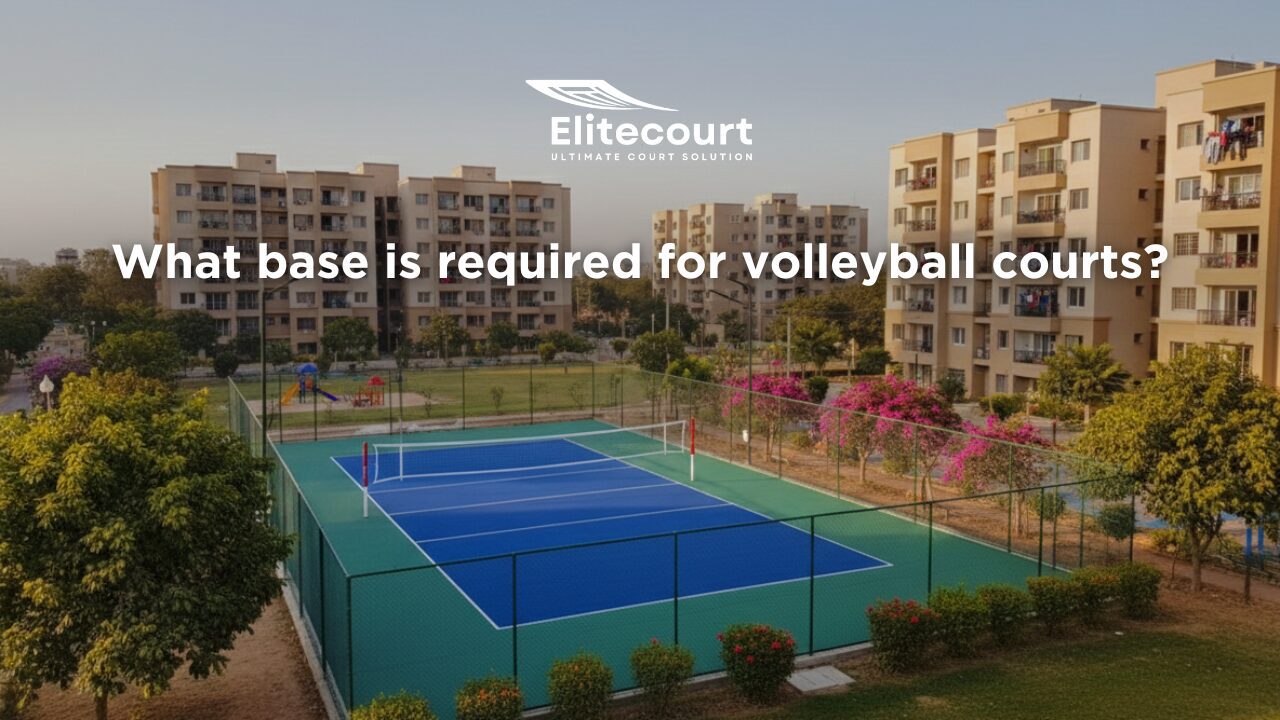
Constructing high-performance volleyball courts requires more than just pouring a surface layer and painting lines. The secret to a durable, safe, and professional-grade playing area lies entirely beneath the surface. As a manufacturer of premium synthetic acrylic sports flooring materials, Elitecourt understands that our top-tier acrylic systems can only perform as well as the foundation they rest upon.
If you are planning to build or specify materials for volleyball courts, understanding the base requirements is non-negotiable. A flawed base leads to cracking, pooling water, and premature deterioration of the acrylic playing surface. A well-engineered base ensures decades of reliable gameplay, optimal shock absorption, and consistent ball bounce.
This comprehensive guide explores the structural requirements, material choices, technical specifications, long-term maintenance best practices, and innovative solutions necessary for constructing the perfect base for synthetic acrylic volleyball courts.
The Critical Role of the Sub-Base for Volleyball Courts
Before applying premium synthetic acrylic coatings, the underlying structure must meet strict engineering standards. Volleyball courts endure intense localized impact. Players constantly jump, dive, and pivot, transferring significant kinetic energy through the playing surface into the base.
Stability and Durability
The base provides unwavering stability and resilience against environmental factors. Expansive soils, freeze-thaw cycles, and heavy rainfall can shift the earth beneath the court. A properly engineered base absorbs these environmental stresses, preventing the surface from shifting. When the base remains rigid and stable, the synthetic acrylic surface applied over it maintains its structural integrity, preventing micro-cracks from forming in the playing area.
Tip: For high-performance longevity, ensure the sub-grade compaction meets or exceeds 95% Standard Proctor Density.
Planarity and Water Shedding
Volleyball courts must be perfectly flat, yet engineered to shed water. In outdoor applications, standing water degrades the playing experience and can slowly compromise the adhesion of acrylic materials. Industry standards dictate a specific slope—usually 1% (1 inch in 10 feet)—to ensure proper drainage without affecting gameplay. Achieving this precise slope relies entirely on the accuracy of the asphalt or concrete base.
Soil Considerations and Initial Site Evaluation
Geotechnical Analysis
A thorough geotechnical analysis is a cornerstone for every volleyball court construction project.
Why it matters:
- Identifies subsurface conditions
- Determines soil bearing capacity
- Recommends necessary compaction and stabilization methods
Soil Types:
- Clayey soils: Require chemical stabilization or deeper excavation
- Sandy soils: Easy to compact, but may need geotextile separation and proper grading
- Rocky/Gravelly soils: Ideal for foundational support but may require grading for levelness
Best practice: Always remove organics and unstable soil before base installation.
Concrete vs. Asphalt Bases for Volleyball Courts
When constructing permanent volleyball courts, facilities generally choose between two primary base materials: asphalt and concrete. Both materials perform exceptionally well with Elitecourt’s synthetic acrylic systems when designers cure them correctly.
Concrete Bases: The Rigid Pavement Solution
Post-tensioned concrete and reinforced concrete are the gold standards for high-end volleyball courts. Concrete provides a rigid, unyielding foundation that resists movement and settling.
Technical Specifications for Concrete Bases:
- Thickness: Minimum of 4 to 5 inches, depending on soil conditions.
- Vapor Barrier: Install a heavy-duty polyethylene vapor retarder (minimum 10-mil, preferably 15-mil) directly beneath the concrete to prevent moisture from migrating upward.
- Curing: Concrete must cure for a minimum of 28 days before applying synthetic acrylic materials.
- Finish: A medium broom finish is required. A slick, steel-troweled finish will not provide adequate mechanical adhesion for the acrylic coatings.
Advantages:
- Long lifespan (20-40+ years)
- Minimal maintenance
- Excellent for both indoor and outdoor courts
Limitations:
- Higher upfront cost
- Requires strict vapor barrier protocols
Asphalt Bases: The Flexible Pavement Solution
Asphalt is a popular choice for outdoor volleyball courts due to its lower initial cost and natural flexibility. Because it lacks the rigid tension of concrete, it is slightly more forgiving of minor soil settling.
Technical Specifications for Asphalt Bases:
- Structure: Typically consists of a compacted crushed aggregate sub-base (4–6 inches) followed by a base course of asphalt (1.5–2 inches) and a surface course of asphalt (1–1.5 inches).
- Compaction: Total compaction to 95% standard Proctor density is crucial.
- Curing: New asphalt must cure for at least 14 to 30 days to allow light oils and volatiles to oxidize and dissipate before applying acrylics.
- Texture: The surface course must be a dense-graded mix to provide a smooth, tight texture.
Advantages:
- Lower upfront cost
- Slightly easier repairs
- Faster installation time
Limitations:
- More maintenance over lifespan
- Lifespan of 10–20 years
- Not suitable for high water table areas unless drainage is meticulously planned
Transform Your Sports Facility Today!
Contact us for high-quality synthetic sports flooring material and elevate your space!
Base Material Comparison
| Feature | Post-Tensioned Concrete | Reinforced Concrete | Hot-Mix Asphalt |
| Initial Cost | High | Medium-High | Low-Medium |
| Lifespan | 20–40+ years | 20–30 years | 10–20 years |
| Flexibility | Rigid | Rigid | Flexible |
| Curing Time Required | 28 days | 28 days | 14–30 days |
| Vapor Barrier Need | Mandatory | Mandatory | Not typically required |
| Maintenance | Very Low | Low | Moderate |
Calculate Your Court Material Requirements
Calculate your synthetic sports flooring material and elevate your space!
Sub-Base Layers: Selection and Installation
The sub-base is the layer directly beneath the primary concrete or asphalt base. Its quality heavily influences the performance of the volleyball court.
Ideal Sub-Base Materials:
- Crushed stone or gravel (graded aggregate): Preferred for drainage and load distribution
- Stabilized sand: Common in areas with good drainage
- No organic content: Avoid clay lumps, organics, or topsoil
Typical Installation Steps:
- Excavate to the required depth based on the engineering plan.
- Compact native soil and verify density.
- Place geotextile fabric if soil separation is required.
- Add graded aggregate in lifts, compacting each lift.
- Laser-grade each layer for perfect slope and planarity.
Note: The minimum aggregate depth will vary based on climate and soil analysis, but 4–6 inches is standard for most volleyball courts.
Drainage Systems and Water Management
Water accumulation is the number one enemy of sports court surfaces. Effective drainage preserves both the base and surface performance.
Drainage Features
Key Systems:
- French Drains: Perimeter trenches filled with gravel, housing a perforated pipe, direct water away from the base
- Sub-surface drains: Piped below the base if high water table or persistent groundwater is an issue
- Catch basins: Collect standing water at court edges and connect to drain pipes
Best Practices:
- Always slope the sub-base away from the court or toward drains
- Integrate surface slope (typically 1%) for outdoor applications
- Use filter fabric in conjunction with gravel to prevent sediment clogging
Planarity, Slope, and Surface Grading
As volleyball is a fast-paced sport, even minor anomalies in the surface can cause trip hazards, ball irregularities, or drainage problems.
- Industry standards: Maximum deviation of 3mm under a 3m straightedge
- Recommended slope: 1% (or 1 inch in 10 feet) for outdoor courts to ensure water runoff
Grading Tolerance Table
| Surface | Max. Deviation | Slope Recommendation |
| Indoor | 1–2 mm/m | Flat (0%) |
| Outdoor | 3mm/3m | 1% (0.5–1.0 degree) |
Key Detail: Inspect courts post-paving for “birdbaths” by flooding the surface and marking areas where water deeper than 1/16” remains.
Moisture Barriers and Vapor Control
One of the most frequent causes of acrylic coating failure on concrete volleyball courts is hydrostatic pressure and vapor transmission.
When concrete is poured directly over soil without a barrier, it acts like a hard sponge and draws moisture up from the earth. As the sun heats the surface of the court, this moisture turns into vapor and attempts to escape upward. If the vapor pressure exceeds the adhesive strength of the acrylic coating, the surface will blister, bubble, and eventually peel away.
Key Requirements for Moisture Prevention:
- Vapor Retarder: A continuous, puncture-resistant vapor retarder must be placed over the compacted sub-base before pouring concrete. All seams must be overlapped and taped.
- Drainage: The perimeter drainage system must keep the water table low beneath the slab.
- Vapor Testing: Test the concrete for vapor emission rates using calcium chloride tests or relative humidity probes before applying Elitecourt synthetic acrylics.
- Expansion Joints: Proper jointing ensures any expansion or contraction in the slab occurs along controlled, protected lines.
Asphalt bases naturally breathe better than concrete and generally do not require a vapor barrier, though proper aggregate drainage below the asphalt remains critical.
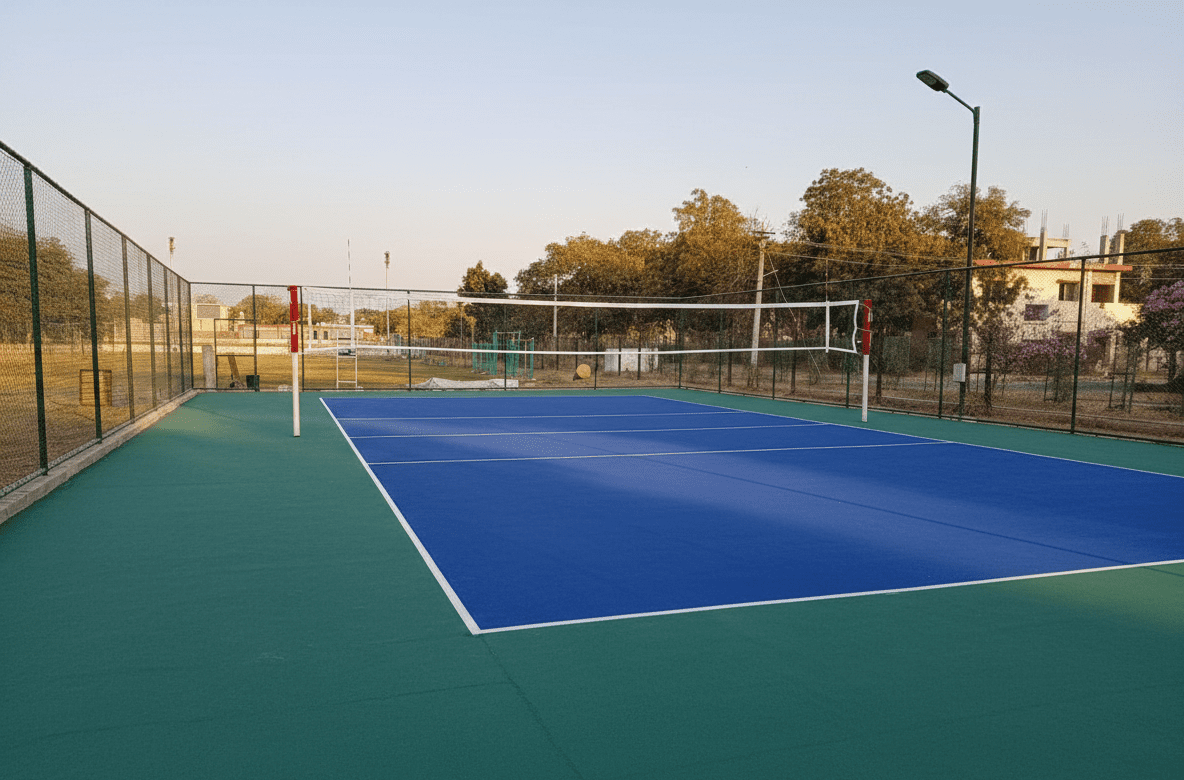
Surface Preparation for Synthetic Acrylic Coatings
Once the base is constructed and properly cured, it must be prepared to receive the synthetic acrylic materials. Elitecourt manufactures materials that rely on a clean, sound base for mechanical and chemical adhesion.
Surface Preparation Checklist:
- Cleaning: The base must be entirely free of dust, dirt, grease, curing compounds, and laitance. Power washing and mechanical scrubbing are usually necessary.
- Acid Etching (Concrete Only): Concrete bases often require mild acid etching to open the pores, followed by thorough neutralizing and rinsing. This ensures the acrylic primer can penetrate the surface.
- Patching and Leveling: Flood the base with water. Mark and fill any areas holding water deeper than 1/16 inch (birdbaths) with an acrylic-compatible patching compound.
- Priming: Apply a specialized primer to ensure maximum bond strength between the raw base and the subsequent acrylic layers.
Long-Term Maintenance of Court Bases
A world-class sub-base will provide decades of service, but longevity depends on proper maintenance practices.
Maintenance Essentials
- Inspect for Cracks: Annually inspect joints and any areas prone to cracking for preventative patching.
- Surface Cleaning: Keep surfaces free of debris and organic matter to avoid premature wear.
- Check Drainage: Regularly verify that surface and subsurface drainage are unblocked and functional.
- Sealcoat Reapplication: Periodically reapply acrylic resurfacing and color coats as recommended by Elitecourt for best performance.
Typical Maintenance Schedule Table
| Task | Frequency |
| Inspect surface/base | 1–2x per year |
| Clear drains | Quarterly |
| Recoat/patch | Every 4–8 yrs |
| Clean surface | Monthly |
Environmental Impact and Sustainability
Elitecourt is committed to supporting sustainable athletic facilities. Selection of base materials and engineering choices can have a meaningful environmental impact.
- Recycled Aggregate: Use of recycled crushed concrete or asphalt in sub-base layers can reduce resource consumption.
- Water Management: Efficient drainage design helps prevent soil erosion and local waterway contamination.
- Low-VOC Materials: Elitecourt’s synthetic acrylics meet or exceed industry standards for low volatile organic compounds, supporting greener sports facilities.
How Weather Impacts Your Court Base Material
When designing volleyball courts, local climate conditions play a massive role in base selection and engineering. Temperature fluctuations, average rainfall, and freeze-thaw cycles dictate how the base will perform over time.
In regions with severe winters, moisture trapped in the soil can freeze and expand. This process, known as frost heave, exerts tremendous upward pressure on the court base. To counter this, engineers must excavate below the local frost line and backfill with non-frost-susceptible materials like clean crushed stone. Concrete bases in these climates also require specific air-entrainment to allow for internal moisture expansion without cracking the slab.
Conversely, in hot and humid climates, prolonged heat exposure can affect asphalt bases. Asphalt is a flexible pavement; under extreme heat, it becomes softer. While the premium acrylic surfaces manufactured by Elitecourt protect the base from direct UV degradation, the base itself must be formulated with the correct asphaltic binder grade to withstand regional temperature maximums.
Understanding your local weather patterns ensures that the base structure remains stable year-round, providing the perfect canvas for Elitecourt’s synthetic acrylic materials.
The Science of Synthetic Acrylic Court Materials
What makes synthetic acrylic the preferred choice for volleyball courts? It comes down to a perfect blend of chemistry, durability, and performance engineering. Elitecourt designs acrylic systems to solve specific challenges faced by athletes and facility owners.
Synthetic acrylics are highly engineered polymers. When applied over a properly prepared base, these polymers cross-link to form a tough, resilient, and UV-resistant membrane. Unlike bare asphalt or concrete, which are extremely abrasive and unforgiving, an acrylic system can be formulated with specialized cushion layers. These layers contain suspended elastomeric granules that compress under foot traffic, absorbing the shock of a player’s jump and reducing joint fatigue.
Furthermore, acrylics are microporous. This means they allow trace amounts of vapor to escape while completely blocking liquid water from penetrating the surface. This breathability is crucial for maintaining a strong bond with the concrete or asphalt base over decades of use. Formulated with highly concentrated, fade-resistant pigments, Elitecourt materials ensure that volleyball courts remain vibrantly colored, slip-resistant, and visually striking for years, regardless of extreme sun exposure or heavy play.
Why Planarity Matters in Professional Volleyball
In professional sports infrastructure, the term “planarity” refers to the flatness and evenness of the playing surface. For volleyball courts, perfect planarity is not just an aesthetic preference; it is a strict functional requirement that heavily impacts gameplay and safety.
When a court lacks planarity, it develops “birdbaths”—shallow depressions that hold standing water after it rains. For synthetic acrylic surfaces, prolonged exposure to standing water can cause the coating to soften or discolor over time. Furthermore, birdbaths delay court usability, as facility managers must wait for these areas to dry before allowing athletes to play.
Beyond water shedding, planarity affects player movement. Volleyball requires explosive lateral movements and immediate stops. If a player steps on an uneven section of the court, the risk of ankle rolls or knee injuries increases exponentially. Elitecourt’s acrylic surfacing materials conform exactly to the profile of the base. Therefore, contractors must ensure the asphalt or concrete base is perfectly laser-leveled and flooded to check for depressions prior to applying any acrylic layers. A perfectly planar base guarantees a safe, consistent, and fast-paced volleyball match.
Indoor vs. Outdoor Volleyball Court Requirements
While Elitecourt’s synthetic acrylic materials perform brilliantly in both environments, the base requirements for indoor and outdoor volleyball courts differ significantly.
Outdoor Courts
The primary challenges for outdoor courts are water management and temperature extremes. Outdoor bases must be engineered with a precise 1% slope to facilitate rapid water runoff. Furthermore, outdoor bases require frost-depth excavation in colder climates to prevent winter heaving. The acrylic surface applied outdoors will feature specialized UV inhibitors and a slightly higher texture profile to ensure slip resistance when players are dealing with ambient moisture or humidity.
Indoor Courts
Indoor courts are protected from rain and extreme temperature swings, eliminating the need for a 1% slope; indoor bases are poured perfectly flat (0% slope). However, indoor concrete bases face a different threat: trapped sub-slab moisture. Because the building prevents natural evaporation, moisture vapor transmission rates can be severe. A flawless, heavy-duty vapor barrier is absolutely critical for indoor installations. Additionally, indoor courts often utilize thicker layers of Elitecourt’s elastomeric cushion systems, as indoor acoustics and the rigid nature of flat concrete demand superior shock absorption to protect players’ joints.
Innovations in Sports Court Base Engineering
In recent years, the sports flooring industry has witnessed innovations that enhance volleyball court performance and sustainability.
- Geotextile Technology: Use of advanced geotextile layers improves separation between subgrade and aggregate, mitigating soil migration and enhancing drainage.
- Recycled Materials: Courts are now constructed with bases that incorporate recycled concrete or glass aggregate, reducing ecological impact.
- Permeable Pavements: New permeable base options promote natural water infiltration and decrease surface runoff.
As a material manufacturer, Elitecourt continually invests in R&D to ensure compatibility of its acrylic systems with innovative base technologies preferred by forward-thinking facility designers.
Transform Your Sports Facility Today!
Contact us for high-quality synthetic sports flooring material and elevate your space!
Frequently Asked Questions (FAQs)
A concrete base should cure for at least 28 days so all moisture escapes and the surface becomes stable. For asphalt, a curing period of 14 to 30 days is usually sufficient. Applying acrylics too soon can cause blistering or peeling.
Yes, but the existing concrete must be solid, clean, and free of major cracks. A high-quality vapor barrier is important to prevent moisture issues. The base should also be properly prepared by cleaning and patching any surface flaws before adding new acrylic materials.
A 1 percent slope, or a one-inch drop every 10 feet, is ideal. This gentle slope is necessary for good water drainage and helps prevent puddles on the court. At the same time, it is not steep enough to affect the game or ball movement.
A medium broom finish makes the concrete surface slightly rough. This light texture allows synthetic acrylic coatings to stick properly, providing better durability and preventing the coatings from coming loose during use.
No, cushion layers are not applied straight to the concrete or asphalt. First, a primer and resurfacer are added to create a smooth, even surface. Only then are the cushion layers and final acrylic color coats applied, ensuring a safe, comfortable, and long-lasting playing area.
Conclusion
The secret to a world-class volleyball court is a meticulously engineered foundation. Whether you opt for the rigid longevity of post-tensioned concrete or the cost-effective flexibility of hot-mix asphalt, strict adherence to base construction standards is the only way to ensure success. Proper site excavation, compaction, moisture management, and precise slope grading create the perfect canvas for high-performance athletic surfaces.
As a manufacturer of premium synthetic acrylic flooring, Elitecourt knows that our advanced polymer systems perform beautifully when paired with a flawlessly executed sub-base. By understanding these base requirements and paying careful attention to materials, site-specific challenges, and innovative solutions, facility owners and architects can ensure their volleyball courts deliver exceptional safety, vibrant aesthetics, and decades of reliable play.
Ready to elevate your sports facility with premium surface materials? Contact Elitecourt today to learn more about our advanced synthetic acrylic systems and find the perfect material specification for your next volleyball court project.