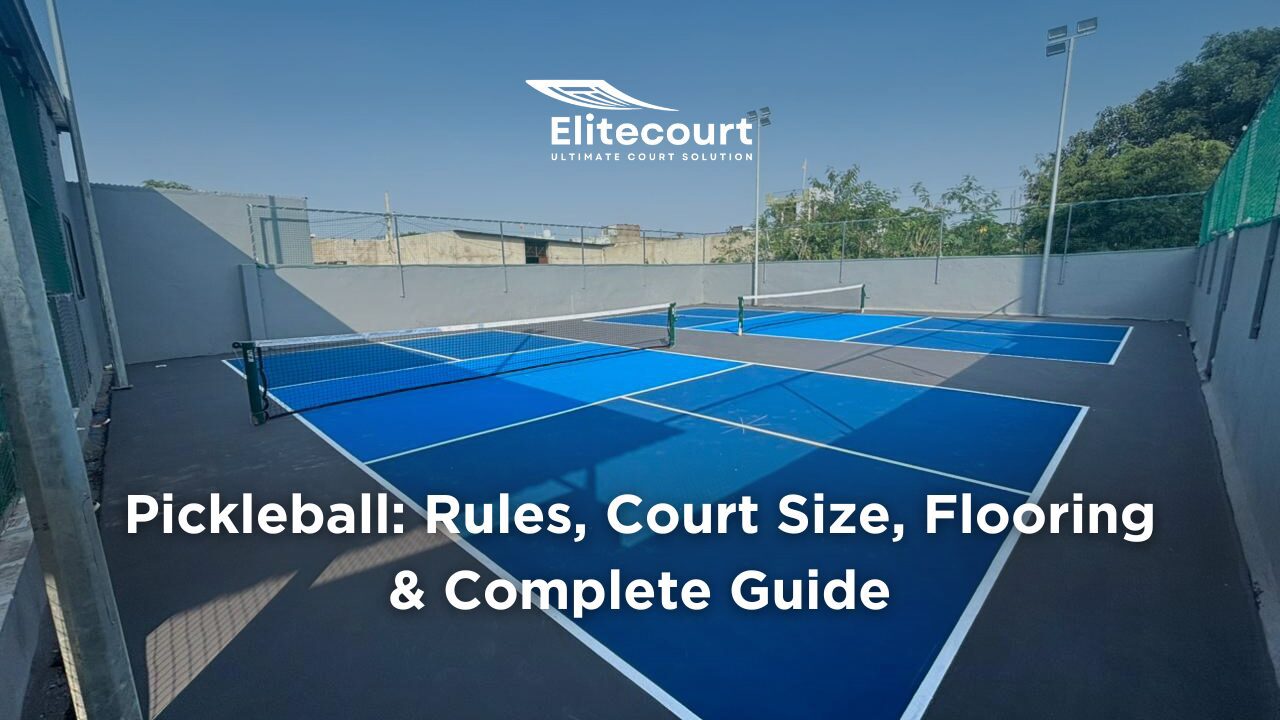
Pickleball combines elements of tennis, badminton, and ping-pong into a highly engaging, fast-paced sport. If you are planning a facility or simply want to understand the game, the most critical factors for success are understanding the rules, knowing the exact court dimensions, and selecting the right surface material. The quality of your synthetic acrylic flooring directly impacts ball bounce, player comfort, and the overall longevity of the court.
In this comprehensive guide, we explore the mechanics of the game, precise court specifications, equipment requirements, and the technical aspects of high-performance acrylic surfacing.
What is Pickleball?
Pickleball is a paddle sport played on a court roughly the size of a doubles badminton court. Players use solid paddles to hit a perforated polymer ball over a net. The game offers accessibility to beginners while providing dynamic, high-speed strategic play for advanced competitors.
The sport bridges the gap between generations, allowing younger athletes and older adults to share the same court. Because the paddle is shorter than a tennis racket and the ball moves slower than a tennis ball, the game relies more on strategy, placement, and quick reflexes than sheer brute force. Players can compete in singles or doubles matches, with doubles being the most common format due to the strategic exchanges near the net.
Expert Tip: The secret to mastering pickleball lies in court positioning. Controlling the net and understanding angles will elevate your game faster than simply hitting the ball hard.
Transform Your Sports Facility Today!
Contact us for high-quality synthetic sports flooring material and elevate your space!
History and Growth of Pickleball
The Origins of the Game
The game was invented in 1965 on Bainbridge Island, Washington. Three fathers—Joel Pritchard, Bill Bell, and Barney McCallum—wanted to create a backyard game that their entire families could play together. Using an old badminton court, ping-pong paddles, and a perforated plastic ball, they established the foundational rules of what would eventually become a global phenomenon.
Evolution into a Modern Sport
Initially a regional pastime, the sport slowly spread across community centers, YMCAs, and retirement communities throughout the United States. It provided an excellent cardiovascular workout without the heavy impact on joints associated with tennis or basketball.
Over the decades, the sport formalized its rules and equipment. Wooden paddles evolved into lightweight composite and carbon fiber models. The balls were standardized for consistent flight and bounce. Today, governing bodies like USA Pickleball regulate the sport, ensuring consistent standards for professional tournaments, equipment specifications, and court construction.
A Global Phenomenon
We are now witnessing unprecedented growth in the sport’s popularity. Municipalities are converting underutilized tennis courts into dedicated pickleball facilities to meet surging demand. Professional leagues have emerged, attracting significant sponsorships and national television coverage. This rapid expansion highlights the need for dedicated, high-quality playing facilities built with premium materials.
Pickleball Court Dimensions & Layout
Understanding the exact specifications of a court is essential for proper gameplay and facility planning. The dimensions are strict and must be adhered to for both recreational and competitive play.
Court Size
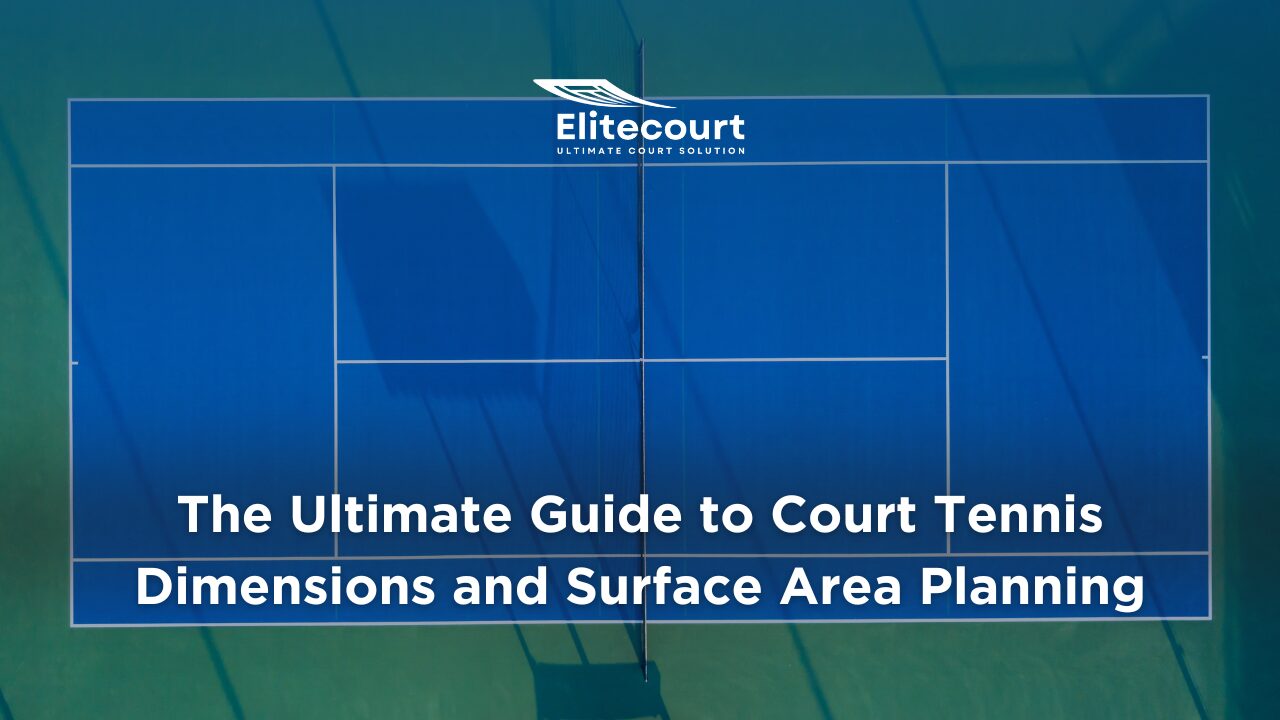
A standard pickleball court measures 20 feet wide by 44 feet long for both singles and doubles play. However, you must also account for the out-of-bounds safety area. The recommended total playing area, including overruns, is 30 feet by 60 feet. Stadium courts or tournament facilities often use a larger footprint of 34 feet by 64 feet to accommodate umpires and fast-paced professional play.
Net Height
The net divides the court exactly in half. It is suspended at a height of 36 inches at the sidelines and dips slightly to 34 inches at the center. This subtle dip in the center requires players to use strategic cross-court shots to minimize the risk of hitting the net.
Markings and Zones
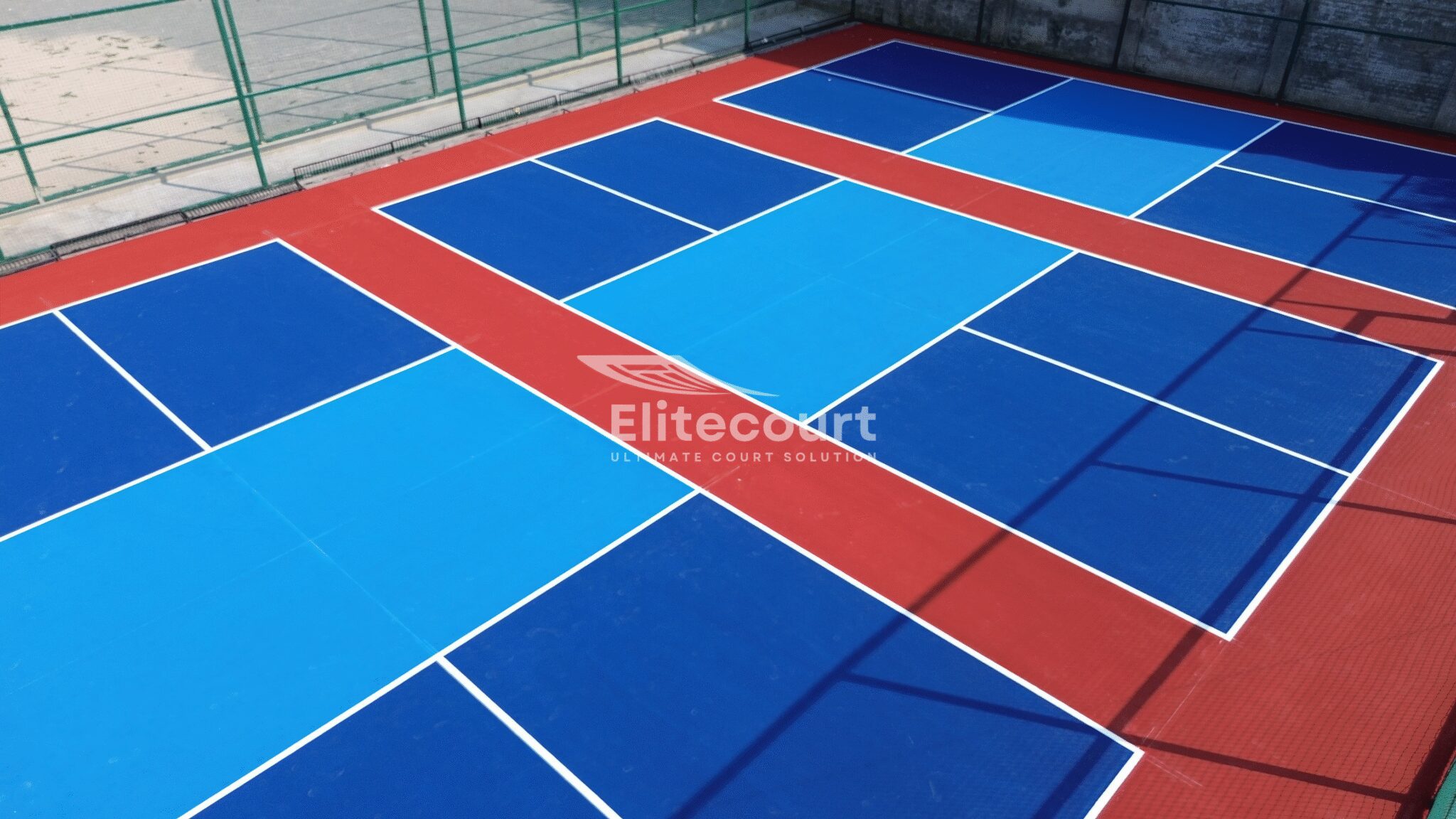
Court lines should be exactly 2 inches wide and painted in a color that strongly contrasts with the playing surface. The court is divided into specific zones:
- Baselines: The lines parallel to the net at the back of the court.
- Sidelines: The lines running perpendicular to the net on the sides.
- Non-Volley Zone (The Kitchen): The area extending 7 feet from the net on both sides. Players cannot hit the ball out of the air (volley) while standing inside this zone.
- Centerline: The line dividing the service courts, extending from the Non-Volley Zone line to the baseline.
- Service Courts: The areas on either side of the centerline, bounded by the baseline and the Non-Volley Zone line.
Court Specifications Table
| Measurement Type | Dimension | Description |
|---|---|---|
| Overall Court Size | 20′ x 44′ | The precise playing lines for singles and doubles. |
| Recommended Total Area | 30′ x 60′ | Includes necessary safety overrun space. |
| Net Height | 36″ (edges) / 34″ (center) | Regulated height for consistent gameplay. |
| Non-Volley Zone (Kitchen) | 7′ from net | The restricted area to prevent aggressive net spiking. |
| Line Width | 2 inches | Must be clearly painted and contrasting. |

Pickleball Court Flooring (Our Core Advantage)
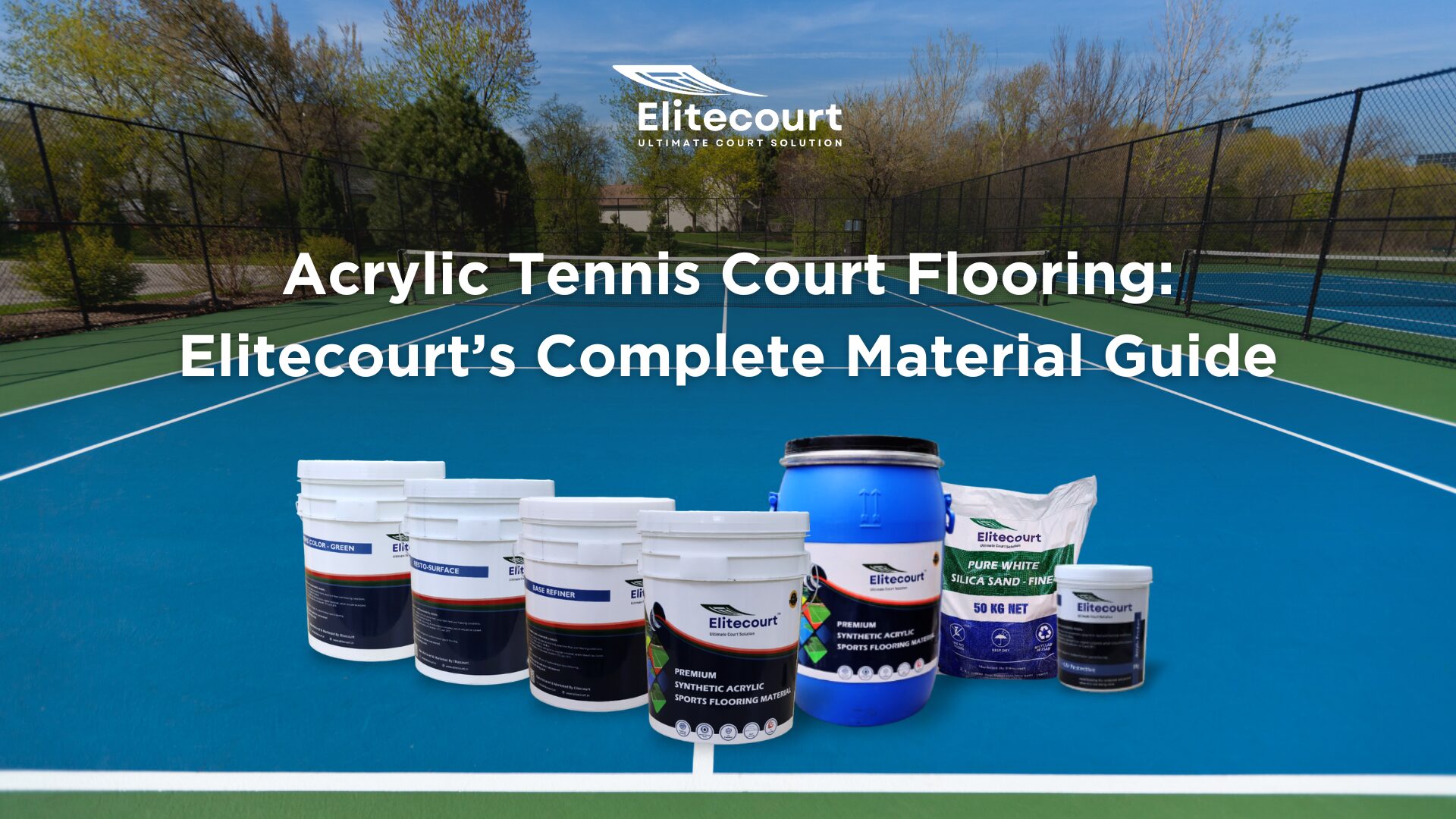
The playing surface is arguably the most critical component of any sports facility. At Elitecourt, we manufacture the industry’s most advanced synthetic acrylic flooring materials, formulated specifically to meet the rigorous demands of racket and paddle sports.
Why the Surface Matters
A premium synthetic acrylic surface provides consistent ball bounce, optimal traction, and glare reduction. When players step onto a court, they expect predictability. A ball hitting an unpainted or poorly surfaced concrete slab will skid aggressively and bounce erratically. Our synthetic acrylic materials provide a micro-textured finish that grips the ball slightly upon impact, ensuring a true, vertical bounce. Furthermore, the cushioning properties of advanced acrylic systems protect players’ joints during intense, lateral movements.
The Concrete or Asphalt Base
Our acrylic materials must be applied over a properly constructed base. The base is typically a reinforced concrete slab or a specialized asphalt mix.
- Concrete Bases: Highly durable and long-lasting, concrete is the preferred choice for permanent facilities. Builders pour the slab with a slight slope (typically 1%) to ensure proper water drainage. They install a vapor barrier beneath the slab to prevent moisture from migrating upward and compromising the acrylic adhesion.
- Asphalt Bases: Asphalt is flexible and cures relatively quickly. However, it requires a longer oxidation period before the acrylic coatings can be applied.
The Layers of an Elitecourt Acrylic System
Our manufacturing expertise allows us to create multi-layered systems that transform a rigid base into a high-performance sports floor. A professional application typically involves:
- Primer/Resurfacer Layer: Once the concrete or asphalt base is properly cured and cleaned, an acrylic resurfacer is applied. This heavily pigmented, sand-filled base coat fills minor voids in the substrate, providing a smooth, uniform texture for subsequent layers.
- Cushion Layers: For premium facilities, we manufacture specialized liquid acrylics infused with microscopic rubber granules. When applied in multiple thin layers, this cushion system absorbs shock, significantly reducing player fatigue and the risk of lower-body injuries.
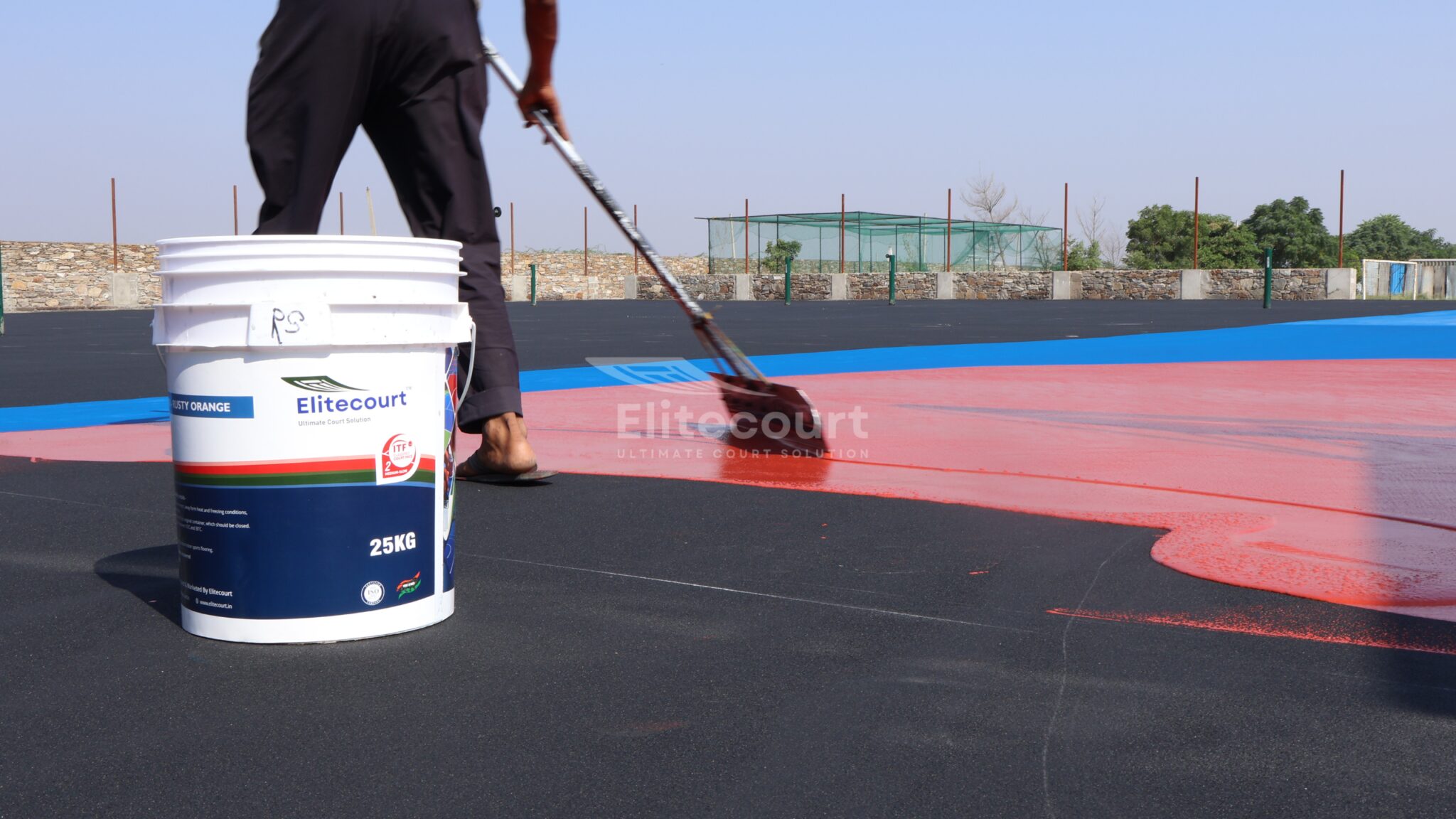
- Color Coatings: The playing surface receives multiple coats of highly pigmented acrylic colorant. We blend these coatings with specific silica sands to achieve the exact speed and texture desired for pickleball.
- Line Paint: Contractors apply heavy-duty, 100% acrylic line paint. This line paint delivers sharp edges, brilliant opacity, and exceptional resistance to fading.
Expert Tip: When planning a facility, always specify 100% acrylic materials for outdoor use. Acrylics breathe, allowing subterranean moisture vapor to escape without causing the surface to blister or peel.
Indoor vs Outdoor Pickleball Courts
Builders construct facilities both indoors and outdoors, and the environment determines the materials and design considerations.
Outdoor Courts
Outdoor courts face constant exposure to ultraviolet rays, rain, temperature fluctuations, and environmental debris.
- Material Differences: Outdoor facilities absolutely require weather-resistant synthetic acrylics. Our specialized outdoor formulations contain UV stabilizers to prevent the vibrant colors from fading under direct sunlight. The texture must also be slightly more aggressive to provide slip resistance even when damp.
- Performance Impact: Wind and sun glare play a massive role in outdoor games. Outdoor balls are heavier and have smaller holes to cut through the wind. The court surface must not reflect sunlight into the players’ eyes, which is why our acrylic finishes dry to a matte, glare-reducing sheen.
Indoor Courts
Indoor facilities offer climate control and year-round playability, regardless of weather conditions.
- Material Differences: While indoor spaces often use hardwood or rolled vinyl flooring, applying synthetic acrylic over an indoor concrete slab is becoming increasingly popular. It accurately replicates the true outdoor bounce that professional players prefer. Contractors use indoor acrylic formulations with a slightly smoother texture since rain-induced slip hazards are not a concern.
- Performance Impact: Without wind interference, indoor games rely heavily on precision and spin control. The surface must provide consistent friction to allow players to execute sharp cuts and sudden stops safely.
Pickleball Rules Explained Simply
To appreciate the sport, you must understand its unique rules. These mechanics were specifically designed to prevent dominant, overpowering plays and encourage extended rallies.
Serving Mechanics
Players must hit the serve underhand, ensuring paddle contact with the ball occurs below the server’s waist. The server starts with at least one foot behind the baseline and strikes the ball diagonally into the opponent’s cross-court service zone, clearing the Non-Volley Zone completely.
Unlike tennis, you only get one fault per serve attempt. The serving side continues to serve, alternating sides, until they commit a fault.
The Double-Bounce Rule
This rule is fundamental to the flow of the game. After the ball is served, the receiving team must let it bounce once before returning it. Then, the serving team must also let it bounce once before hitting it back. After these two bounces have occurred, players can choose to volley the ball (hit it out of the air) or play it off a bounce. This rule eliminates the server’s advantage of rushing the net immediately after a serve.
The Non-Volley Zone (The Kitchen)
The Kitchen is the 7-foot area on both sides of the net. Players cannot volley the ball while standing inside this zone, or even touching the line. If a player volleys a ball and their momentum carries them into the Kitchen, it is a fault. Players can only enter the Kitchen to hit a ball that has already bounced. This restriction prevents players from standing at the net and executing aggressive downward smashes.
Scoring
Only the serving team can score points. Players traditionally play matches to 11 points, but the winning team must achieve at least a 2-point lead. In professional tournament formats, players sometimes compete to 15 or 21 points.
Transform Your Sports Facility Today!
Contact us for high-quality synthetic sports flooring material and elevate your space!
Equipment Needed
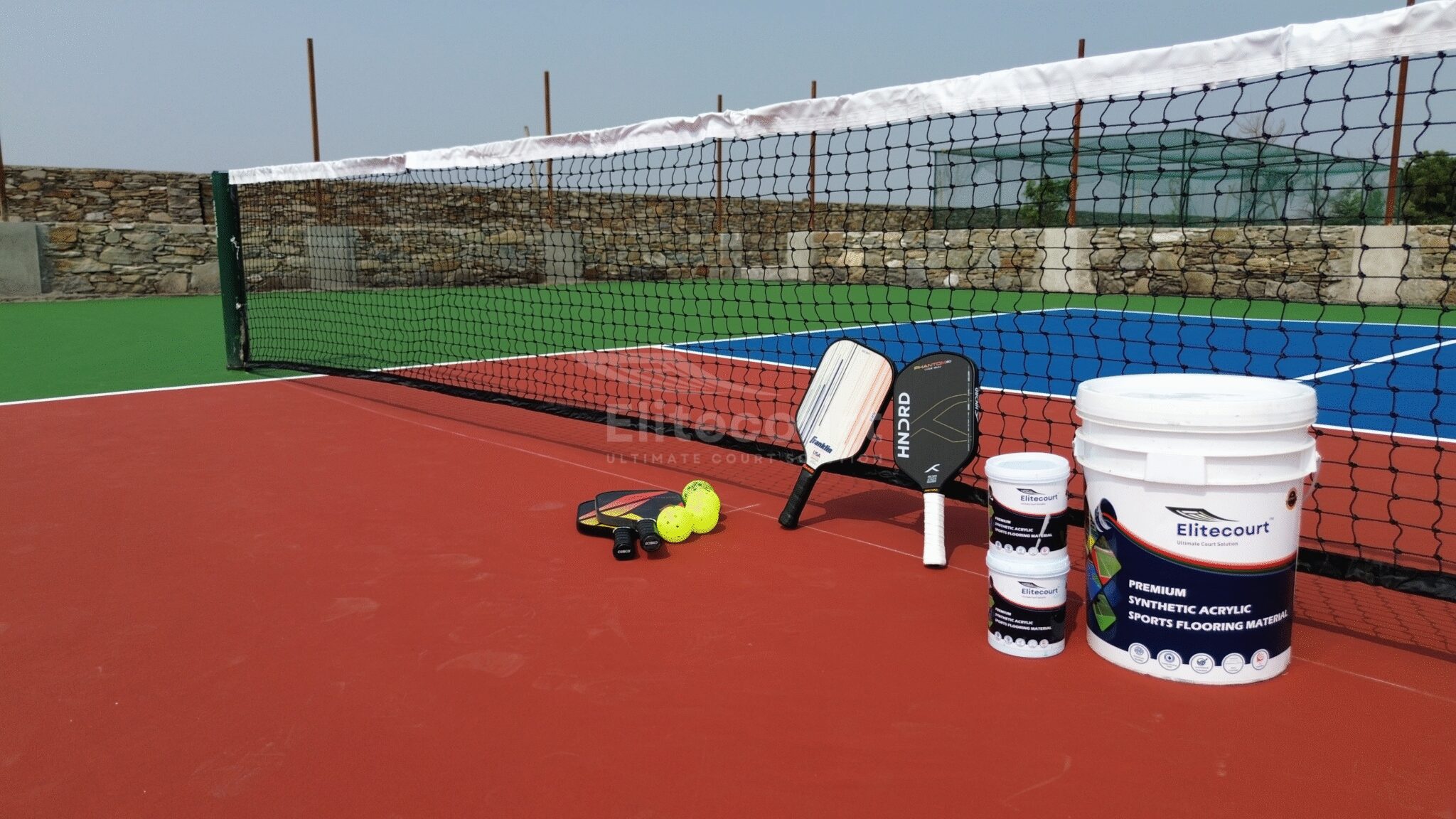
The accessibility of the sport is largely due to its minimal equipment requirements. You only need three primary items to start playing.
The Paddle
Originally cut from solid wood, modern paddles are sophisticated pieces of sporting equipment. They feature a solid face and a core designed to optimize power and control.
- Core Materials: Most high-end paddles use a polymer honeycomb core. This structure is incredibly lightweight but offers exceptional durability and a large “sweet spot.”
- Face Materials: The surface of the paddle is typically made of fiberglass, graphite, or carbon fiber. Fiberglass provides more power, while carbon fiber offers enhanced touch and control.
The Ball
The ball is made of smooth molded plastic with circular holes drilled into it.
- Indoor Balls: Lighter, with larger holes, designed to skip smoothly across indoor surfaces. They are softer and easier to control.
- Outdoor Balls: Heavier, harder plastic with smaller holes. They are engineered to resist wind interference and withstand the abrasive nature of outdoor acrylic surfaces.
The Net
While permanent facilities use heavy-duty steel posts securely anchored into the concrete foundation, portable nets are also widely used. Portable nets have a lightweight metal frame that holds the net at the regulation 34-inch center height, making it easy to set up a court on any hard, flat surface.
Why Pickleball is Growing Rapidly
Unmatched Accessibility
The sport has an incredibly low barrier to entry. The rules are intuitive, and beginners can achieve baseline proficiency within a single afternoon. The physical demands are easily adaptable; players can engage in a relaxed, social game or push themselves in highly competitive, cardiovascularly demanding matches.
Community and Social Trends
The compact nature of the court means players are physically closer to one another than in tennis, fostering a highly social environment. Conversations easily flow across the net. Furthermore, community centers have embraced the sport because up to four pickleball courts can fit within the footprint of a single standard tennis court, maximizing facility usage.
Economic Viability for Facilities
For sports clubs and municipal parks, investing in dedicated courts provides an exceptional return on community engagement. By applying our premium acrylic flooring materials, facilities create durable, low-maintenance spaces that attract large numbers of daily users.
Construction and Maintenance
Construction Process
Building a high-quality facility requires precision from the ground up. As manufacturers of the final surface coating, we know that our acrylics only perform as well as the base beneath them.
- Site Preparation: The process begins by excavating, leveling, and compacting the ground. Proper drainage systems redirect groundwater away from the playing area, ensuring long-term durability.
- Base Installation: A thick layer of crushed stone forms the base, followed by pouring reinforced concrete or paving asphalt. The surface requires precise leveling with a slight 1% slope to allow water runoff effectively.
- Curing Time: Concrete must cure for roughly 28 days, while new asphalt should oxidize for at least 14 to 30 days before surfacing begins.
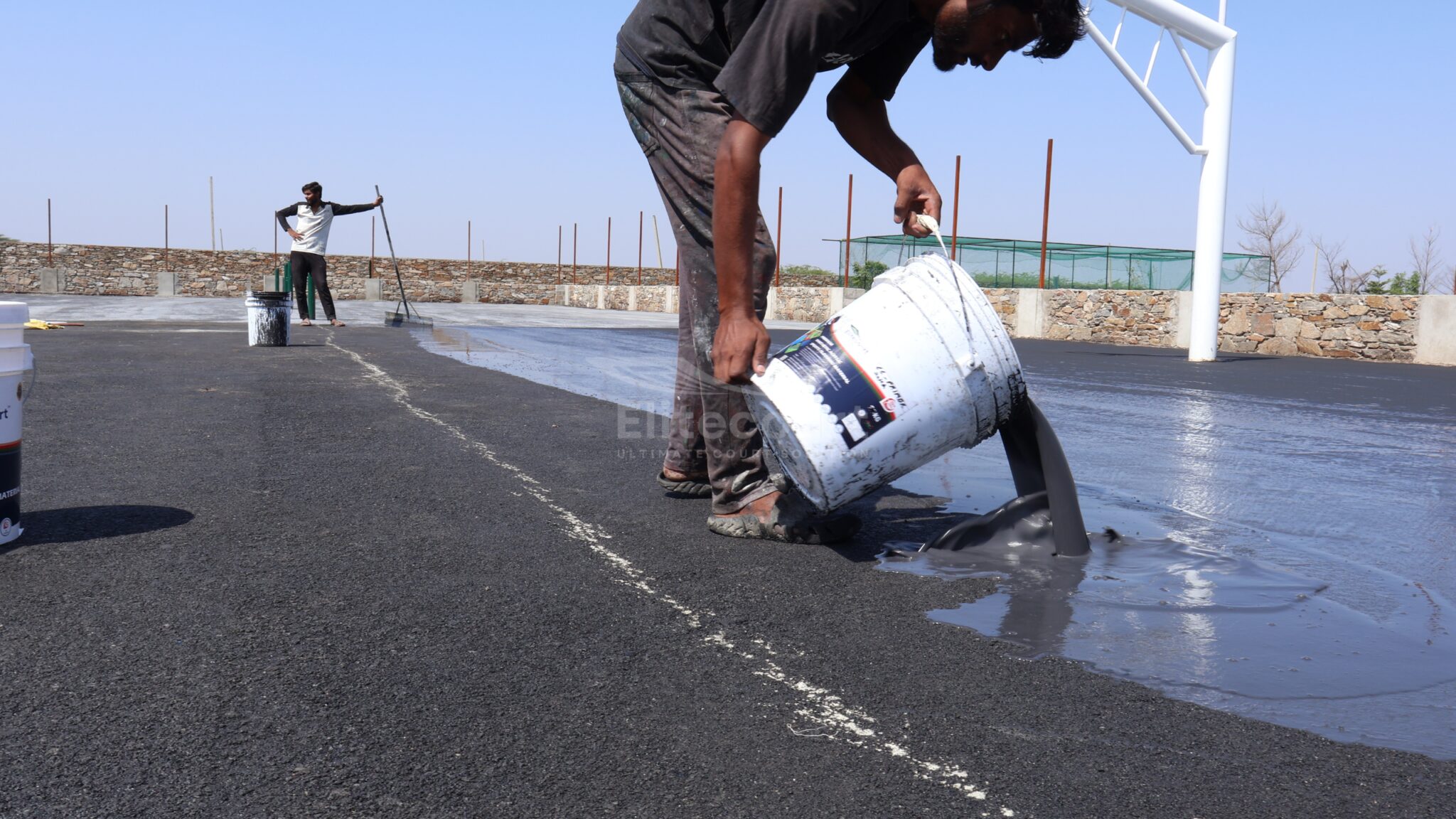
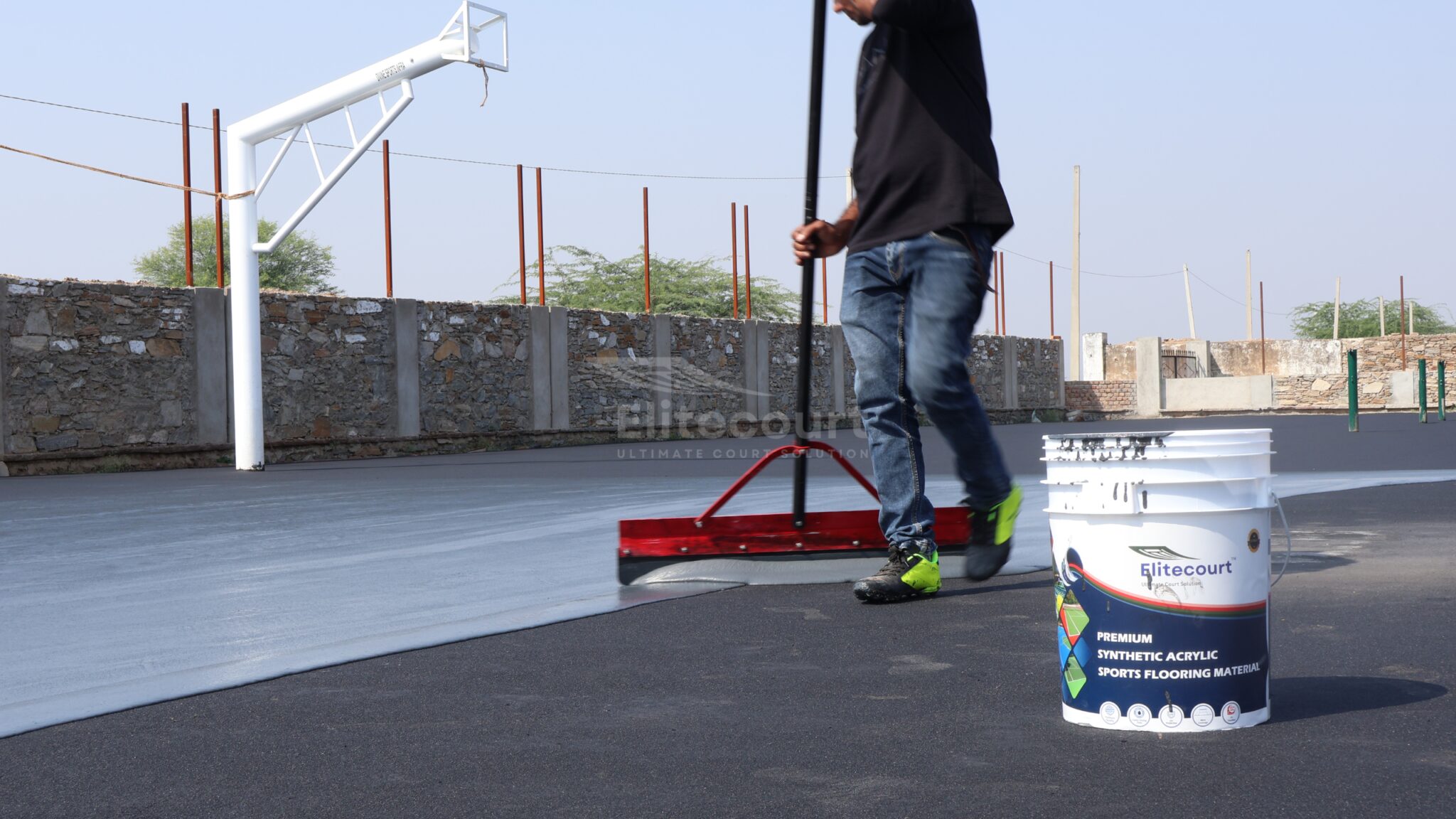
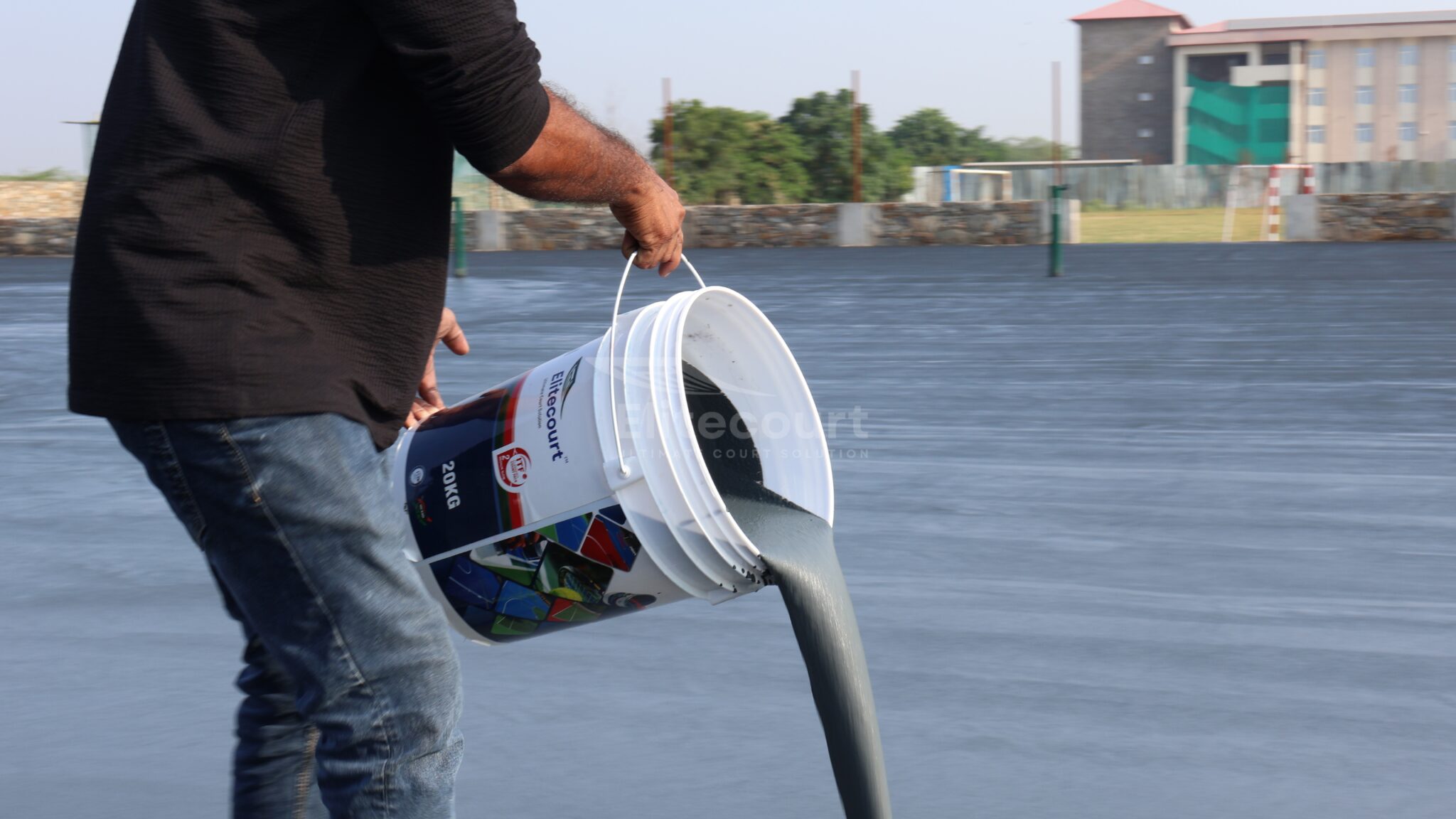
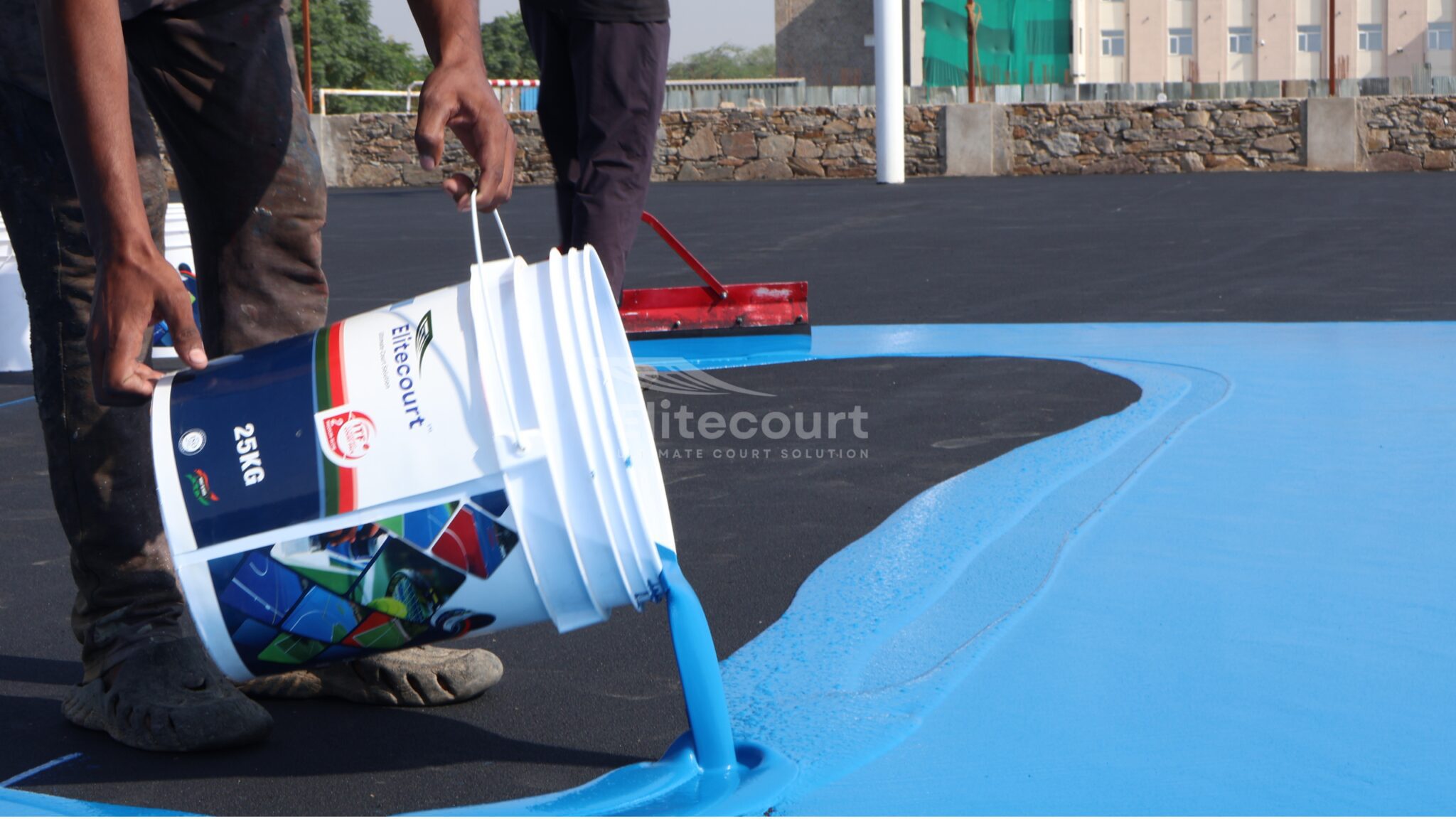
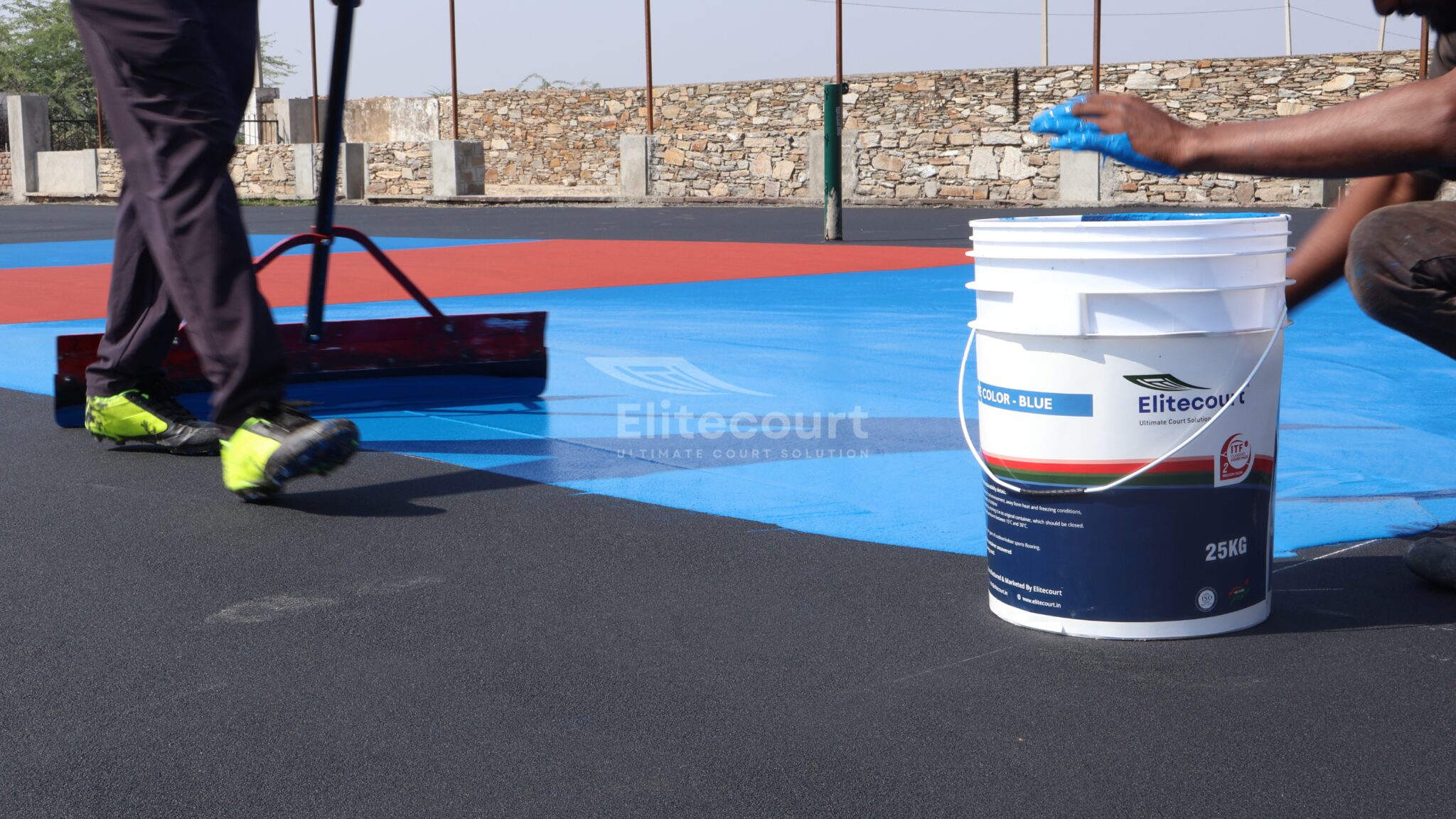
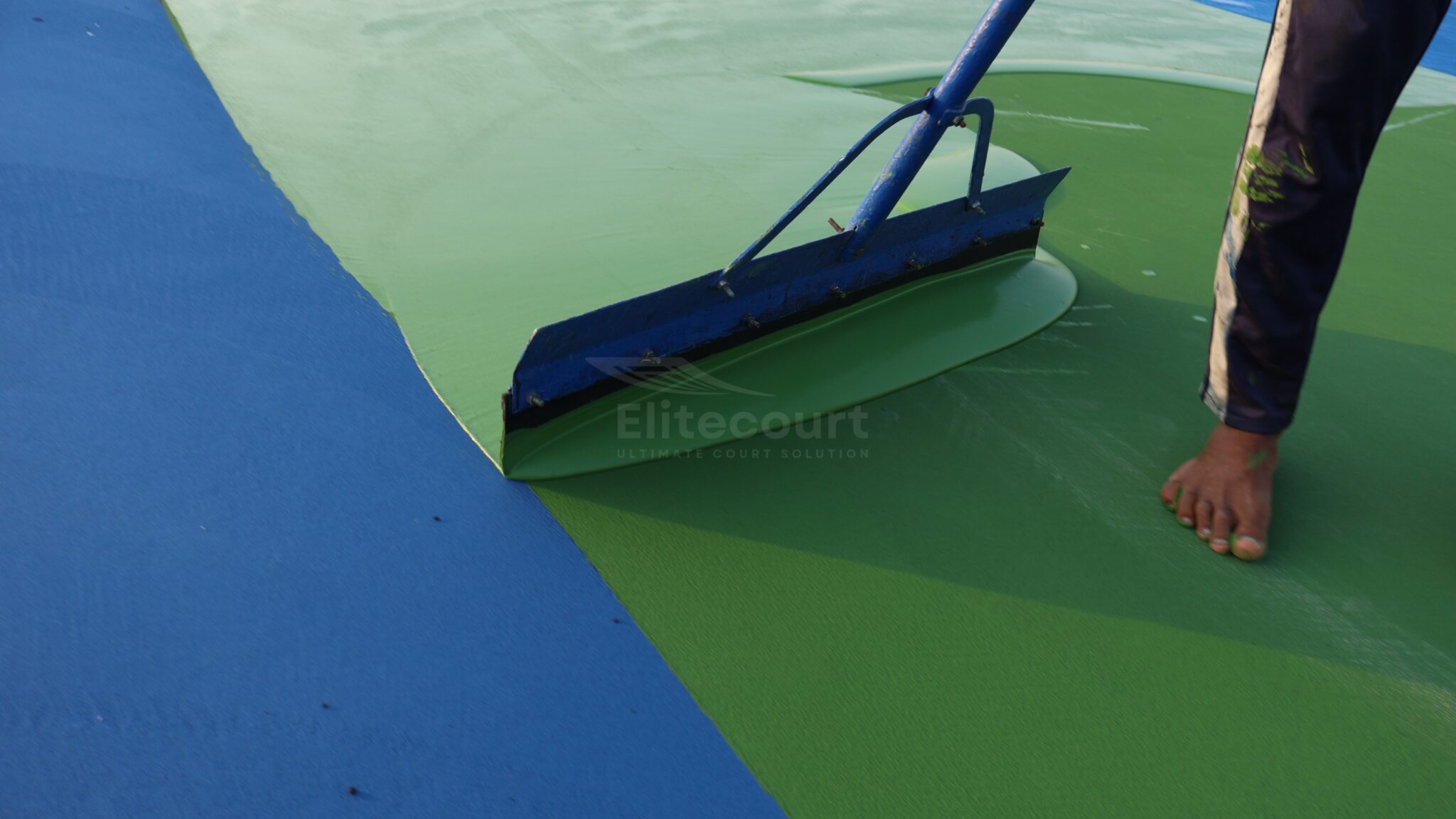
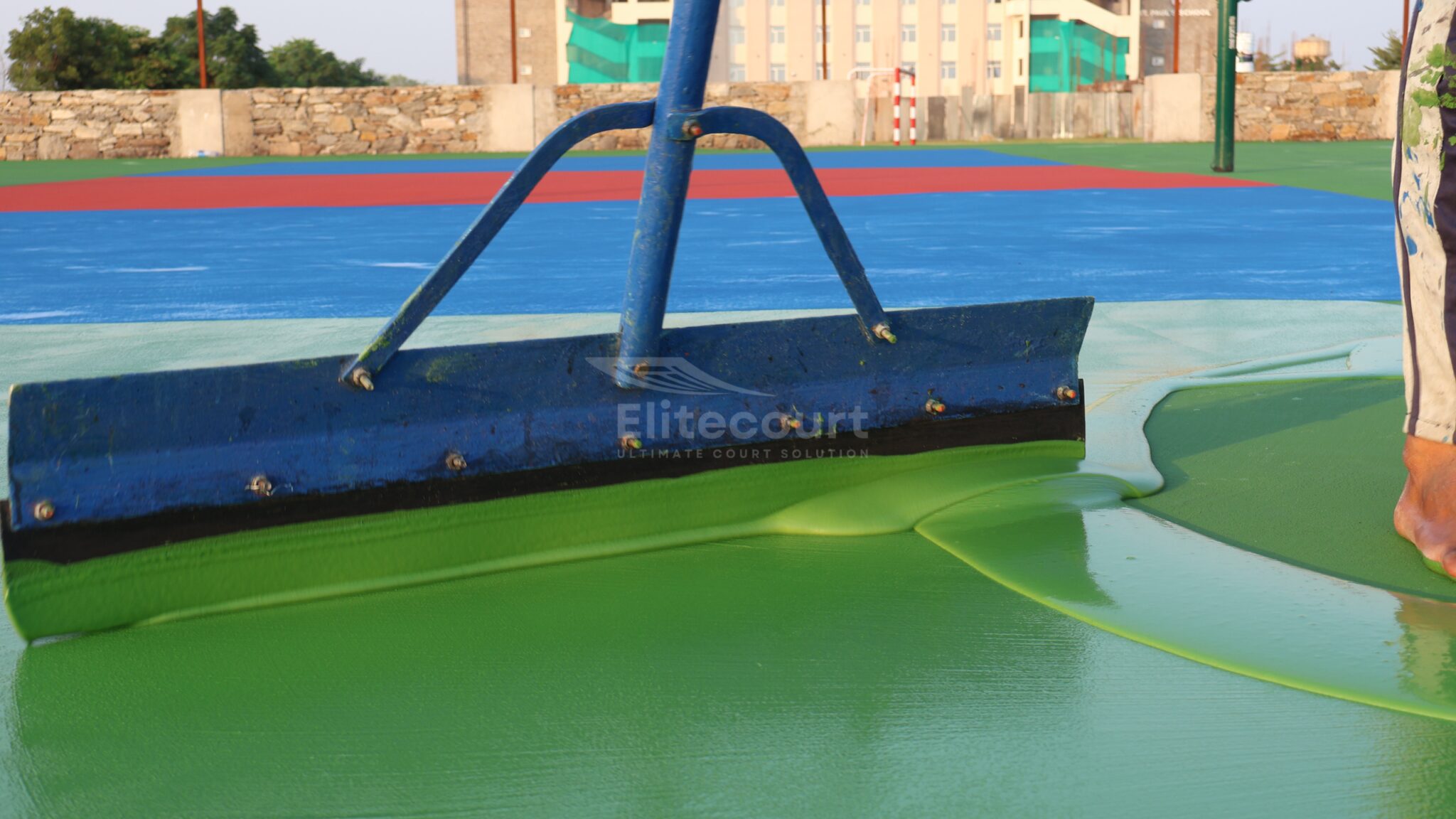
- Acrylic Application: Using heavy rubber squeegees, specialized contractors apply our Elitecourt resurfacers, optional cushion layers, and vibrant color coatings in precise, methodical layers.
Maintenance of Pickleball Courts
Maintaining a court featuring high-quality synthetic acrylic flooring is straightforward and ensures longevity.
- Routine Cleaning: Sweep or use a mechanical blower weekly to remove leaves, pine needles, and dirt. Organic matter left on the surface can break down and stain the vibrant acrylic color.
- Washing: Clean the surface gently once a month with water and a mild detergent to remove sweat, spilled sports drinks, and accumulated dust.
- Water Removal: Ensure there are no low spots (“birdbaths”) where water pools after rain. Sitting water degrades the surface over time.
- Recoating: Recoat the color layers professionally every 5 to 8 years, depending on usage volume and environmental exposure, to restore texture and brilliant aesthetics.
Common Construction Mistakes
- Ignoring Proper Drainage: If water cannot drain off the court, it will pool, causing premature deterioration of the acrylic coatings and creating a slippery hazard.
- Skipping the Vapor Barrier: If a vapor barrier is not placed under a concrete slab, ground moisture will travel up through the porous concrete. When the sun heats the court, this moisture turns to vapor, pushing against the impermeable acrylic layers and causing massive blistering and peeling.
- Using Improper Paint: Applying standard house paint or untextured epoxy to a court is a critical error. Only 100% synthetic acrylic sports coatings, like those manufactured by Elitecourt, contain the proper silica sand suspension to provide safe traction and correct ball mechanics.
Transform Your Sports Facility Today!
Contact us for high-quality synthetic sports flooring material and elevate your space!
FAQs
A pickleball court is 20 feet wide by 44 feet long for both singles and doubles, with extra space around for safety.
No, pickleball is played on a smaller court with different paddles, balls, and unique rules that set it apart from tennis.
Synthetic acrylic flooring over a concrete or asphalt base is ideal for consistent bounce and player safety.
It’s unsafe to play on a wet court due to the risk of slipping. Always wait until the surface is dry.
The “Kitchen” is the 7-foot non-volley zone by the net, where volleying is not allowed to encourage strategic play.